Write to the booksellers
-
Type
Book (1194)
Magazine (26)
Maps (3)
Photographs (2)
-
Latest
Last month (122)
Last week (5)
-
Language
English (2)
French (1223)
-
Century
16th (1)
17th (1)
18th (25)
19th (136)
20th (292)
21st (103)
-
Countries
Belgium (142)
Canada (3)
Denmark (106)
France (889)
Switzerland (85)
-
Syndicate
ALAC (2)
ILAB (236)
NVVA (61)
SLACES (61)
SLAM (66)
"POINCARE, H. (HENRI). - THE DISCOVERY OF AUTOMORPHIC FORMS.
Reference : 49173
(1882)
Sur les fonctions fuchsiennes. (+) Sur les fonctions.... Note. (+) Sur les fonctions.... Note.
(Paris: Gauthier-Villars), 1882. 4to. No wrappers. In: ""Comptes Rendus Hebdomadaires des Seances de l'Academie des Sciences"", Vol 94, No 4 + 15 + 17. Pp. (149-) 184, pp. (997--) 1068 a. pp. (1139-) 1214. (3 entire issues offered). Poincare's papers: pp. 163-168, 1038-1042 a. 1166-67.
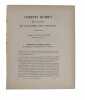
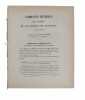
First appearance in print of the discovery of the automorphic forms, which Poincaré named Fuchsian functions.""One of Poincaré's first discoveries in mathematics, dating to the 1880s, was automorphic forms. He named them Fuchsian functions, after the mathematician Lazarus Fuchs, because Fuchs was known for being a good teacher and had researched on differential equations and the theory of functions. Poincaré actually developed the concept of these functions as part of his doctoral thesis. Under Poincaré's definition, an automorphic function is one which is analytic in its domain and is invariant under a discrete infinite group of linear fractional transformations. Automorphic functions then generalize both trigonometric and elliptic functions."" (Wikipedia).
Theorie des Groupes fuchsiens (+) Mémoire sur les Fonctions fuchsiennes (+) Sur les Fonctions de deux Variables (+) Mémoire sur les groupes kleinéens (+) Sur les groupes des équations linéaires (+) Mémoire sur les fonctions zétafuchsiennes. - [THE DISCOVERY OF AUTOMORPHIC FUNCTIONS]
Berlin, Stockholm, Paris, F. & G. Beijer, 1882-84. Large4to (272 x 230 mm). Three volumes uniformly bound in contemporary half calf with gilt lettering to spine. In ""Acta Mathematica"", volume 1-5. Light wear to extremities, boards and spines with scratches. Stamp to verso of front board in all volumes. First three leaves in first volume detached, otherwise internally fine and clean. Vol. I, pp. 1-62" Pp. 193-294 Vol. II, pp. 97-113 Vol. III. pp. 49-92 Vol. IV pp. 201-312" Vol. V pp. 209-278.
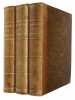
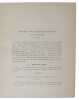
First publication of these groundbreaking papers which together constitute the discovery of Automorphic Functions. ""Before he was thirty years of age, Poincaré became world famous with his epoch-making discovery of the ""automorphic functions"" of one complex variable (or, as he called them, the ""fuchsian"" and ""kleinean"" functions)."" (DSB).These manuscripts, written between 28 June and 20 December 1880, show in detail how Poincaré exploited a series of insights to arrive at his first major contribution to mathematics: the discovery of the automorphic functions. In particular, the manuscripts corroborate Poincaré's introspective account of this discovery (1908), in which the real key to his discovery is given to be the recognition that the transformations he had used to define Fuchsian functions are identical with those of non-Euclidean geometry. (See Walter, Poincaré, Jules Henri French mathematician and scientist).The idea was to come in an indirect way from the work of his doctoral thesis on differential equations. His results applied only to restricted classes of functions and Poincaré wanted to generalize these results but, as a route towards this, he looked for a class functions where solutions did not exist. This led him to functions he named Fuchsian functions after Lazarus Fuchs but were later named automorphic functions. First editions and first publications of these epochmaking papers representing the discovery of ""automorphic functions"", or as Poincaré himself called them, the ""Fuchsian"" and ""Kleinian"" functions.""By 1884 Poincaré published five major papers on automorphic functions in the first five volumes of the new Acta Mathematica. When the first of these was published in the first volume of the new Acta Mathematica, Kronecker warned the editor, Mittag-Leffler, that this immature and obscure article would kill the journal. Guided by the theory of elliptic functions, Poincarë invented a new class of automorphic functions. This class was obtained by considering the inverse function of the ratio of two linear independent solutions of an equation. Thus this entire class of linear diffrential equations is solved by the use of these new transcendental functions of Poincaré."" (Morris Kline).Poincaré explains how he discovered the Automorphic Functions: ""For fifteen days I strove to prove that there could not be any functions like those I have since called Fuchsian functions, I was then very ignorant" every day I seated myself at my work table, stayed an hour or two, tried a great number of combinations and reached no results. One evening, contrary to my custom, I drank black coffee and could not sleep. Ideas rose in crowds I felt them collide until pairs interlocked, so to speak, making a stable combination. By the next morning I had established the existence of a Class of Fuchsian functions, those which come from hypergeometric series" i had only to write out the results, which took but a few hours...the transformations that I had used to define the Fuchsian functions were identical with those of Non-Euclidean geometry...""
Voyage en Espagne
MAME Alfred et FILS. 1882. In-4In-4 Carré. Cartonnage d'éditeurs. Bon état.Quelques rousseurs. 397 pages. Frontispice en noir et blanc hors-texte. Nombreuses illustrations en noir et blanc dans le texte et en planches hors-texte. Tranches dorées. Relié pleine toile rouge, décorés de motifs noirs et dorés. Illustrations de V. Foulquie
Ray W2*
Le devisement du monde, le livre des merveilles (2 volumes). Collection : La Découverte/Poche/Littérature et voyages.
Paris, La Découverte, 1998. 12 x 19, 2 volumes, 447 pp (pagination continue), broché, très bon état.
"Texte intégral établi par A.-C. Moule et Paul Pelliot; version française de Louis Hambis; introduction et notes de Stéphane Yerasimos."
Le livre des merveilles (traduction, notes et commentaire de Louis Hambis). Collection : Grands textes et civilisations, l'Occident médiéval.
Paris, Club du Livre, Philippe Lebaud, 1977. 29 x 23, 297 pp., gravures sur bois des XIIIe et XIVe siècles, reliure d'édition plein cuir brun à 4 nerfs, plats et dos décorés (noir et or), sous étui carton (ouverture bordée de cuir), tête dorée, parfait état.
"Edition originale, N° 921 sur 2500 exemplaires numérotés sur vélin de Lana; lithographies en couleurs de Stanislas Lepri."
Le Paris Mystérieux. Tome III : La Dame au Gant Noir
sd Editions Arthème Fayard, Collection "Le Livre Populaire" - Sans date (circa 1910) - In-12, broché, couverture illustrée - 382 p.
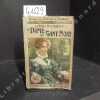
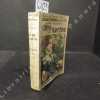
Bon état - Couverture défraîchie (Plis au dos, frottements, légère mouillure sans atteinte au texte, rousseurs)
Après Freud.
Paris, René Julliard, 1965 ; in-8, broché ; 366 pp. , (1) f.
Exemplaire en très bon état.

La logique de la découverte scientifique.
Payot 2012 Payot, 2012, 480 p., broché, environ 225x140mm. Haut du dos un peu frotté. Bon état néanmoins et intérieur bien propre.
Merci de nous contacter à l'avance si vous souhaitez consulter une référence au sein de notre librairie.
Ile de Sein une paroisse des histoires
Mouez enez sun in8. Sans date. Agrafé. Enez Sun est un carnet de voyage illustré qui présente l'île de Sein à travers le regard du géographe Louis Brigand avec des illustrations de Didier-Marie Le Bihan. L'ouvrage aborde l'histoire l'actualité et la géographie de cette île bretonne en offrant un portrait à la fois sentimental et documenté de ce territoire insulaire
Bon état circa 2001
All under heaven: the chinese world. With text by Jonathan Porter.
New York, Pantheon Books, 1983, in-4to, 190 p., rich. ill. with color plates, orig. cloth, with DJ.

(SLACES, NVVA)
Phone number : 41 (0)26 3223808
Toscane et Rome correspondance d’Italie
in 8 plein cuir glacé vert,fers à la rocaille,en long, filet en encadrement,et titre dorés,au dos.Plaque à froid avec filet doré en encadrement,sur les plats.Filet doré sur coupe.(Ecole Ste Barbe doré sur le premier plat)Faux-titre, frontispice gravé sous serpente,titre,2 pages de table,423 pages, tranches marbrées.Paris Dezobry,E Magdeleine & Cie 1840, bine complet du frontispice qui manque souvent, rousseurs éparses,principalement en début et fin de volume. Un petit frottement sur le premier plat,sans gravité
LE POUVOIR DU MONDE.
, Paris, Editions la Decouverte, 2003., Broche, couverure d' editeur, 13,5x22cm, 259pp.
Quand un journal veut changer la France.
Polyzoa (Bryozoa) - Ascophora - from Norh New Zealand (Discovery Reports Vol. XXXIV)
1 vol. in-4 br., Discovery Reports Vol. XXXIV, Cambridge University Press, 1967, pp. 199-394 avec 17 planches hors texte
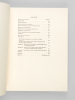
Inscribed by the auhor ("Compliment of the author"). Etat très satisfaisant (accroc restauré en coiffes, bon état par ailleurs).
White settlers in the tropics. With additional notes by R. G. Stone. "American geographical society", 23.
New York, American geographical society, 1939,. gr. in-8vo, XII + 311 p. + 88 ill. (photogr. plates), orig. publisher’s illustrated red cloth. Spines sunned, else a fine set.
(SLACES, NVVA)
Phone number : 41 (0)26 3223808
Athènes, cité des dieux. Collection : Cités d'Art.
Paris, Albin Michel, 1965. 20 x 28, 246 pp., 27 planches en couleurs, 118 illustrations en N/B, cartonnage d'édition pleine toile + jaquette en couleurs, très bon état.
"Photos : Edwin Smith; traduction de l'anglais : Jane Fillion."
PROUST, (JOSEPH LOUIS) - THE DISCOVERY AND ISOLATION OF GRAPE-SUGAR.
Reference : 45517
(1806)
Memoire sur le Sucre de raisin" (+) Suite du Mémoire....sur le sucre de raisin. (2 Parts).
Paris, Chez Bernard, 1806. No wrappers. Ectracts from ""Annales de Chimie ou Recueil de Mémoires.."" Vol. 57. Pp. 131-174 a. pp. 225-272. With the titlepage to volume 57.
First appearance of a classic paper in which Proust describes his discovery of Grape.Sugar and the identificationof this with glucose. He investigated the varieties of sugar that occur in sweet vegetable juices, distinguishing three kinds, and he showed that the sugar in grapes, of which he announced the existence to his classes at Madrid, is identical with that obtained from honey by the Russian chemist J. T. Lowitz.Proust is famous for his work on the steadiness of composition of chemical compounds.""In chemistry, the law of definite proportions, sometimes called Proust's Law, states that a chemical compound always contains exactly the same proportion of elements by mass. An equivalent statement is the law of constant composition, which states that all samples of a given chemical compound have the same elemental composition. For example, oxygen makes up 8/9 of the mass of any sample of pure water, while hydrogen makes up the remaining 1/9 of the mass. Along with the law of multiple proportions, the law of definite proportions forms the basis of stoichiometry.""(Wikipedia).
[Fulvio ROITER] - PRÉHISTOIRE par Emmanuel ANATI, Claude ROY et Fulvio ROITER.
Reference : AUB-3939
(1966)
Naquane. Découverte d'un pays et d'une civilisation. Richt illustré et documenté. Edition originale.
Lausanne 1966. Bel ex. relié, rel. Ornée d'éd., gd in-8 (24 cm x 21), 152 p. avec cartes, table chronologique, ill. et tables.
En quête de la gnose (2 tomes)
1978 - broché - Editions Gallimard nrf - Collection Bibliothèque des sciences humaines - 1978 et 1982 - 2 volumes in-8 (22,5 x 14 cm) broché - 300 + 319 pages - ISBN du tome II : 2-07-029770-5 - Tome I : "La gnose et le temps et autres essais" - Tome II : "Sur l'évangile selon Thomas. Esquisse d'une interprétation systématique"
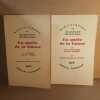
Bon état - Couverture du premier tome très légèrement jaunie
Périgord Découverte. Guide 2017. Infos tourisme Dordogne
Département de la Dordogne. 2017. In-4. Broché. Bon état, Couv. convenable, Dos satisfaisant, Intérieur frais. 144 pages. Nombreuses illustrations en couleur dans et hors texte.. . . . Classification Dewey : 53-Guide
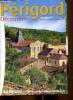
Classification Dewey : 53-Guide
Traversées de la France
Bartillat 2004 525 pages 14x3 6x21 8cm. 2004. Broché. 525 pages.

Très bon état
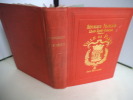
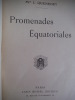
Promenades équatoriales
In 12 carré pleine toile rouge éditeur(ville de Paris sur le premier plat)titre doré au dos.373 pages illustrations photographiques hors-texte.Bornéo,Malaisie,Ceylan,Afrique Orientale.Albin Michel éditeur sans date
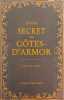
Guide secret des Côtes-d'Armor
OUEST FRANCE 2012 144 pages 13 2x1 6x19cm. 2012. Relié. première édition. 144 pages. Christian Querré explore les richesses insoupçonnées des Côtes-d'Armor à travers 30 thèmes incluant rites païens vestiges obscurs et légendes étonnantes. L'ouvrage invite à redécouvrir la région par ses lieux insolites mystérieux ou étonnants avec une iconographie à l'ancienne et une couverture imitation cuir
Très bon état
Jésus, l'homme et le fils de Dieu
Flammarion In-8, broché, couverture souple ill ( jésus en toutes lettres) 231 pages, bel ensemble.
Bon Etat Mise à jour du Samedi 27 Juin 2026. Paiement PayPal immédiat, Mondial Relay pour : France, Allemagne, Autriche, Belgique, Espagne, Italie, Portugal, Luxembourg, Pays-Bas, Pologne (Communiquer votre point ou locker si connu). Une participation supplémentaire peut être demandée pour les colis lourds hors France où les envois compris entre 5 et 25 kg sont dégressifs : 2 à 4 kilogrammes - 7.99 / 5 à 10 kg - 15.99 / 15 -25 kg - 25.99. Certaines de nos collections ( Vian, Céline, Camus (...) peuvent être expédiées en Franco de port. Pour linternational hors Europe (Suisse, Canada, Japon, Etats-Unis, les frais dexpéditions peuvent varier selon le poids (mise à jour : 1 juin 2026).
A travers la Russie boréale
in 12 demi-chagrin vert à nerfs ; titre, fer dorés. Filet à froid sur les plats, charnière intérieure toile verte. Faux-titre, frontispice, titre illustré, 320 pages, 61 gravures dans le texte et hors texte, dont 2 cartes, tranches mouchetées. Paris Librairie Hachette & Cie 1894. Très bon état.de Pétersbourg à Kazan, Kazan, au pays des Tchérénisses, le paganisme en Europe, les Tchouaves, les permiaks, traversée de l’Oural septentrional, traversée de l’Oural, la Sygva et la Slava, les grandes routes de Sibérie,