 Write to the booksellers
-
Type
Book (1194)
Magazine (26)
Maps (3)
Photographs (2)
-
Latest
Last month (109)
Last week (5)
-
Language
English (2)
French (1223)
-
Century
16th (1)
17th (1)
18th (25)
19th (136)
20th (292)
21st (103)
-
Countries
Belgium (142)
Canada (3)
Denmark (106)
France (889)
Switzerland (85)
-
Syndicate
ALAC (2)
ILAB (236)
NVVA (61)
SLACES (61)
SLAM (66)
Muracciole Jean Bendjebbar André Grégoire Isabelle
Reference : 500231857
(1994)
ISBN : 9782011158161
Multilivre CE2: Cycle des approfondissements niveau 1 histoire géographie sciences
Hachette 1994 19 4x1 4x27 4cm. 1994. Broché.
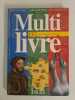
Bon état
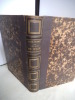
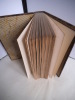
Historical account of discoveries and travels in Africa, from the earliest ages to the present time. Including the substance of the late Dr. Leyden’s work on that subject. Second edition. in 2 vol.
Edinburgh, Archibald constable and company, 1818, in-8vo, XXIII + 557 p. + 2 maps (1 folded) / VIII + 550 p. + 3 maps (2 folded), some foxing, small legacy stamp on first free flyleaf ‘Guggisberg’, half leather, spine lost, text blocks firm but in first volume seperated from frontcover (sticking with sellotape). Marbled covers. (bindings to be restorated).

(SLACES, NVVA)
Phone number : 41 (0)26 3223808
Voyage pittoresque en Italie
Partie Septentrionale. Grand in 8 demi-chagrin à nerfs et à caissons dorés.Faux- titre,frontispice gravé(vue de Florence)titre illustré,VIII,536 pages et 32 illustrations Hors-Texte gravées sur acier(avec le frontispice)de ROUARGUE Frères. Dont 6 en couleurs Morizot 1864,rousseurs éparses habituelles 280€
Bell d'hier à demain. La grande histoire d'une entreprise canadienne
BCE Inc In-4 à l'italienne Couverture souple Montréal 2005
Très bon 124 pages + cd rom. Histoire de cette entreprise, des découvertes scientifiques des débuts, jusqu'aux développements commerciaux d'aujourd'hui. Illustrations noir et blanc, et couleurs. Complet du cd-rom.
"A la rencontre de Sindbad, la route maritime de la soie; Musée de la Marine-Paris, 18 mars-15 juin 1994."
Paris, Musée de la Marine, 1994. 21 x 27, 239 pp., très nombreuses illustrations et figures en couleurs et en N/B, broché, très bon état (sauf 1 cachet d'ex-propriétaire).
Découverte des mondes ensevelis. Richement documenté ( héliogravures, cartes).
Editions Delachaux & Niestlé 1954. Bel exemplaire broché, couverture ornée d'éd., in-8, 154 pages + planches.
"MÜLLER, JOHANNES & THEODOR SCHWANN. - THE DISCOVERY OF PEPSIN, THE FIRST KNOWN ANIMAL ENZYME & THE ""FIBRES OF REMAK""
Reference : 45406
(1836)
Versuche über die künstliche Verdauung des geronnenen Eiweisses (Müller & Schwann) (+) Ueber das Wesen des Verdauungsprocesses (Schwann). 2 paers.
Berlin, G. Eichler, 1836. In ""Archiv für Anatomie, Physiologie und Wissenschaftliches Medicin Herausgegeben von Johannes Müller"". Jahrgang 1836. Pp. 66-89 a. pp. 90-139. The entire volume offered in its 6 parts (in 5), all 5 issues uncut with orig. printed warppers. (2),CCXXIV,390 pp. and 15 engraved plates. The 2 first issues with a faint dampstain to lower part of leaves and plates.
First appearance of an importent paper in the history of biology, in which Schwann describes his discovery and isolation of pepsin, the substance in the stomach that aids digestion of eggwhite. It is the FIRST KNOWN ANIMAL ENZYME. The paper appeared at the same time in ""Annalen der Physik und Chemie. Hrsg. von J.C. Poggendorff"".Theodor Schwann (1810-1882) was a great German physiologist, pathologist, and experimenter. One of the founders of the cell doctrine and of the idea of the living nature of yeast. Born at Neuss, near Düsseldorff. A catholic, educated in the Jesuit Gymnasium in Cologne. Intended for the church but took to medicine. He was a pupil of Johannes Müller and a collegueand lifelong friend of J. Henle, the anatomist. In Berlin Schwann was Johannes Müller's assistent for five years, and it was then that he discovered pepsin in 1836 (the paper offered).Parkinson ""Breakthroughs"" 1836 B. - Garrison & Morton no. 991.The first paper offered, written together with Johannes Müller records the preliminary investigaions leading to the discovery of Pepsin. - Garrison & Morton no. 990.The volume also contains another famous paper by ROBERT REMAK ""Vorläufige Mittheilung microscopischer Beobachtungen über den innern Bau der Cerebrospinalnerven und über die Entwicklung ihrer Formenelemente. (Hierzu Tafel IV). Pp. 145-161. This paper contains the first announcement of his DISCOVERY OF ""FIBRES OF REMAK"", the non-medullated nerve-fibres. (Garrison & Morton no. 1260.
Le conte des conteurs
1984 ED La découverte, 1984 - Coll Voix - In-8 carré broché couverture repliée illustrée par l'éditeur - Nombreux dessins et textes en langue arabe in texte - 153 pages
Bon état - Couverture un peu défraichie - quelques traces sur la tranche inférieure
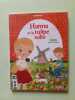
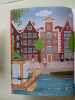
Minimiki - Hannah et la tulipe noire - Tome 29
Play Bac 2020 32 pages 15 2x19 8x0 7cm. 2020. Broché. 32 pages.
Bon état
Naef, A.:/ Vouga, Paul / Spahni, J / Drack, W ean-Christian: / Egloff, M.
Reference : 57648aaf
(SLACES, NVVA)
Phone number : 41 (0)26 3223808
Vers le Pôle.
Paris, Ernest Flammarion, 1936. 12 x 18, 468 pp., broché, état moyen (couverture défraîchie).
"100 illustrations d'après les photographies et les dessins de l'explorateur; traduction de Charles Rabot."
L'Arche de Noé retrouvée
1991 - broché - Pierre Téqui, éditeur - 1991 - In-8 (21 x 15 cm) broché - 192 pages + annexes in fine - Cahier central comprenant des photographies en noir et blanc - ISBN : 2-7403-0032-8 / 9782740300329
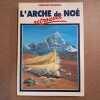
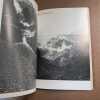
Bon état - Infimes frottements au dos
Le progrès par l'Eglise : inventions et découvertes.
Aubeville, C. Paillart, Imprimeur-Editeur, s.d. (ca 1900). "16 x 25, 240 pp., reliure dos toilé, bon état (couverture défraîchie; 2 cachets ex-bibliothèque)."
QUIBERON souvenirs du Morbihan.
In 12 pleine toile rouge, titre, caissons à froid. Faux-titre, frontispice sous serpente, titre 333 pages. Pris Librairie LECOFFRE ancienne Maison PERISSE Frères LECOFFRE & Cie successeur 1869.
"NILSON, L.- F. (LARS FREDRIK). - THE DISCOVERY OF A NEW ELEMENT SCANDIUM.
Reference : 47273
(1879)
Sur l'ytterbine, terre nouvelle de M. Marignac. (+) Sur le scandium, élément nouveau.
(Paris, Gauthier-Villars), 1879. 4to. No wrappers. In: ""Comptes Rendus Hebdomadaires des Séances de L'Academie des Sciences"", Tome 88, No 12. Pp. (625-) 676. (Entire issue offered). Nilson's papers: pp. 642-645 a. 645-648. First leaf with a tear to right margin, no loss of paper.
First apperance of the papers in which Nilson describes his discovery of a new element and its properties, and naming it Scandium. It was the second new element found after Mendeleev's prediction of its existence as ""Eka-Boron"".""Mendeléeff had predicted that another element, which he called eka-boron and which he said would have an atomic weight between 40 (calcium) and 48 (titanium), would some day be revealed. It was discovered in 1879 by Lars Fredrik Nilson.... Nilson extracted 63 grams of the rare earth erbia from gadolinite and euxenite, and converted it into the nitrate. Upon decomposing this salt by heat, as Marignac had done, he obtained some very pure ytterbia and, to his great surprise, an earth that was unknown to him.Upon thoroughly investigating this new earth, he found that it contained an element whose properties concided almost exactly with those Mendeléef had predicted for ekaboron. Nilson called it scandium in honour of his fatherland.""(Weeks ""Discovery of the Elements"" pp. 219-20).Parkinson ""Breakthroughs"" 1879 C.
La Thèbes des pharaons. Collection : Cités d'Art.
Paris, Albin Michel, 1965. 20 x 28, 208 pp., 49 planches en couleurs, 51 illustrations en N/B, cartonnage d'édition pleine toile + jaquette en couleurs, très bon état.
"Photos : Edwin Smith; traduction de l'anglais : Jane Fillion."
Dictionnaire des origines
inventions et découvertes dans les Arts,les Sciences, la Géographie,l’Agriculture,le Commerce etc.Seconde édition, revue, corrigée,et augmentée de plus de 800 articles par les auteurs et par M.PUISSANT fils.4 tomes en 4 volumes in 8 demi-cuir vert,titre,tomaison,filets,roulette,palmette dorés.Tome 1:faux-titre,titre,VII,Tome 2 faux-titre,856 pages pagination continue pour ces deux volumes.Tome 3 faux-titre,titre,Tome 4 faux-titre,titre 1014 pages pagination continue.1 page d’errata tete sur 2 colonnes A.Cotelle libraire éditeur PAris 1840 au tome une petite mouillure en pied à la page 4 sinon très bon état
Voyage de La Vega autour de l'Asie et de l'Europe.
Accompagné d'un résumé des voyages précédemment effectués le Long des Côtes Septentrionales de l'Ancien Continent. Ouvrage traduit du Suédois avec l'autorisation de l'auteur par MM. Charles Rabot (Membre de la Société de Géographie de Paris) et Charles Lallemand (Ingénieur au Corps des Mines). Contenant 293 gravures sur bois, 3 gravures sur acier et 18 cartes. Paris, Librairie Hachettes et Cie, 1883-1885. 2 volumes in-4 (28,5x3,5x20cm) reliés demi chagrin brun à coins, dos petits nerfs ornés de caissons dorés, double filets sur les plats, têtes dorées (reliure d'époques). [2]ff. n. ch., IV,481pp. + [2]ff. n.ch., 278pp.
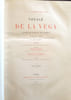
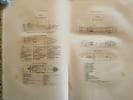
Complet en 2 volumes, portrait de l'auteur en frontispice, la dédicace à sa Majesté Le Roi Oscar, 18 cartes, dont 12 cartes dépliantes regroupées en fin des volumes et 54 planches hors-texte. 1 ère édition française du récit de cette expédition scientifique Suédoise de 1878-1879 qui explore le passage polaire du Nord-Est...... Petite déchirure dans marge verticale à la page 71 du tome 1er. Bon état.
Le Masque de Poix
1941 Editions Tallandier, collection "Le Lynx" N° 19 - 1941 - In-8, broché couverture illustrée - 62 pages
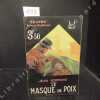
Bon état - Couverture très légèrement frottée
Perla, fille d'Israël
1956 Éditions de l'Arabesque, collection "Charme et exotisme" N° 3 - 1956 - In-12, broché, couverture illustrée signée Aslan - 223 pages
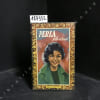
Bon état - Menus frottements sur la couverture Bon
Nouveau dictionnaire des origines (2 volumes), inventions et découvertes dans les arts, les sciences, la géographie, le commerce, l'agriculture.
Bruxelles, Librairie de Frechet, Editeur, 1828. 14 x 22, 2 volumes, 515 + 666 + 100 pages, reliure plein cuir, bon état.
"2 tomes plus un supplément; corrigé, et augmenté en Belgique, d'un supplément et de notes intéressantes, par une société de savants et de gens le lettres."
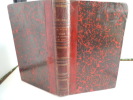
scènes américaines dix huit mois dans le nouveau monde
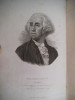
In 12 demi-cuir rouge à nerfs,titre,fers,roulette,filets dorés.XVI-320 pages.Portrait de Washington en frontispice.figures dans le texte.Culs de lampe.Amyot 1853 édition originale , rousseurs éparses
La conquête de la Terre. Histoire des découvertes et des explorations des origines à nos jours. (6 volumes)
1933 Editions Payot, Paris, Collection "Bibliothèque historique" - 1933 à 1937 - Six volumes in-8, broché, couverture illustrée en N&B - Illustrations (gravures) en N&B in et hors-texte
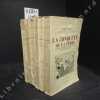
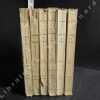
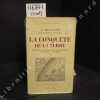
Assez bon état - Dos frottés, avec déchirures et manque de papier pour les tomes I, II et III - Couverture frottée et coins émoussés - Intérieur frais
Les Vautours de Kergroaz.
sd Editions J. Dupuis, collection "Les Beaux Romans Populaires pour la Famille", Série B, N° 75 - Sans date - 1 brochure in-4, broché couverture illustrée - 42 pages, imprimées sur 2 colonnes - Illustrations dans le texte
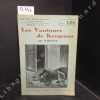
Rousseurs sur la couverture sinon bon état.
La Truffe
Avignon Aubanel 1979 GRAND In-8 185 pp, réédition de celle de 1973, préface de Sylvain Floirat
Bon Broché à Rabats

