 Write to the booksellers
-
Type
Book (7257)
Disk (44)
Drawings (1)
Engraving (9)
Magazine (89)
Maps (4)
Music sheets (135)
New book (2)
Old papers (1)
Photographs (19)
Posters (1)
-
Latest
Last 24h (1)
Last 3 days (5)
Last month (969)
Last week (2)
-
Language
Czech (1)
Dutch (9)
English (156)
French (7383)
German (4)
Italian (2)
Latin (3)
Russian (4)
-
Century
16th (17)
17th (43)
18th (199)
19th (881)
20th (2484)
21st (1566)
-
Countries
Belgium (1156)
Canada (34)
China (56)
Côte d'Ivoire (7)
Denmark (1063)
France (4896)
Germany (1)
Netherlands (181)
Switzerland (155)
United Kingdom (9)
United States of America (4)
-
Syndicate
ALAC (27)
CLAM (25)
CLAQ (2)
ILAB (2246)
NVVA (15)
SLACES (15)
SLAM (1036)
SNCAO (4)
American Cinematographer - The International Journal of Film and Video Production Techniques
Reference : 107688
(1990)
American Cinematographer Vol. 71 N° 2 : Blaze, scandal on the Bayou - Triumph of the Spirit, on location at Auschwitz - Focus on computer graphics - The Emperor Jones, Robeson and the Rest Recalled - ...
1990 Vol.71 N° 2 - Février 1990 - Revue mensuelle illustrée - Texte en anglais - In-4 - Broché - 88 pages
Bon état - Trace de pli sur le haut de la couverture
American Cinematographer - The International Journal of Film and Video Production Techniques
Reference : 107689
(1990)
American Cinematographer Vol. 71 N° 3 : Wide screen formats, their future - What awaits these giants in show biz? Showscan, IMAX, Omnimax, ...
1990 Vol.71 N° 3 - Mars 1990 - Revue mensuelle illustrée - Texte en anglais - In-4 - Broché - 88 pages
Bon état - trace de pli sur la couv.
American Cinematographer - The International Journal of Film and Video Production Techniques
Reference : 107690
(1990)
American Cinematographer Vol. 71 N° 4 : I Love You To Death, pizza a la black comedy - Perry Mason Encore, this time in Paris - Revenge, Mexico lends color to fiery drama - ...
1990 Vol.71 N° 4 - Avril 1990 - Revue mensuelle illustrée - Texte en anglais - In-4 - Broché - 116 pages
Bon état
American Cinematographer - The International Journal of Film and Video Production Techniques
Reference : 107691
(1990)
American Cinematographer Vol. 71 N° 5 : Supernatural Thriller, The Guardian - 1990 awards nominees and winners - The best laid plans Of Mice and Men (1940) - Crazy People, cast in Zany good humor - ...
1990 Vol.71 N° 5 - Mai 1990 - Revue mensuelle illustrée - Texte en anglais - In-4 - Broché - 100 pages
Bon état
American Cinematographer - The International Journal of Film and Video Production Techniques
Reference : 107692
(1990)
American Cinematographer Vol. 71 N° 6 : Ultimate crime fighter returns in Robocop 2 - Bird on a Wire, new twist on 'The Chase' - Vicious side of the law potent theme of Impulse - Gremlins 2 the New Batch up to nasty tricks again - ...
1990 Vol.71 N° 6 - Juin 1990 - Revue mensuelle illustrée - Texte en anglais - In-4 - Broché - 100 pages
Bon état
American Cinematographer - The International Journal of Motion Picture Production Techniques
Reference : 107693
(1990)
American Cinematographer Vol. 71 N° 7 : Splendid recollection of The Alamo (1960) - Total Recall, of memories lost on Mars - Airborne derring-do for Flight of the Intruder - ...
1990 Vol.71 N° 7 - Juillet 1990 - Revue mensuelle illustrée - Texte en anglais - In-4 - Broché - 96 pages
Bon état
American Cinematographer - The International Journal of Motion Picture Production Techniques
Reference : 107694
(1990)
American Cinematographer Vol. 71 N° 8 : Documentaries, a special kind of filming - Symphony in Riff, features Benny Carter's unique life & style - Capt. Noel, 1922 cinematographer of Mt. Everest - Die Hard II crashes summer biggie list - ...
1990 Vol.71 N° 8 - Août 1990 - Revue mensuelle illustrée - Texte en anglais - In-4 - Broché - 84 pages
Bon état
American Cinematographer - The International Journal of Motion Picture Production Techniques
Reference : 107695
(1990)
American Cinematographer Vol. 71 N° 9 : Post-production, the latest news - Vitaphone records sound for early films - All the colors of jazz for Mo' Better Blues - Electronic Post, its problems and promises - ...
1990 Vol.71 N° 9 - Septembre 1990 - Revue mensuelle illustrée - Texte en anglais - In-4 - Broché - 88 pages
Bon état
American Cinematographer - The International Journal of Motion Picture Production Techniques
Reference : 107699
(1991)
American Cinematographer Vol. 72 N° 2 : Astronomers, computer graphics detail the Universe - Restored Fantasia revives old memories - Laser animation opens new graphic wonders - ...
1991 Vol.72 N° 2 - Février 1990 - Revue mensuelle illustrée - Texte en anglais - In-4 - Broché - 84 pages
Bon état
Booklet to advertise and furnish correct information concerning Japan Tea, from its mythical origin up to the present day.-
Printed in Japan. S. d. Peut-être 1930. In-12 (103 x 150mm) attaché par un cordonnet de soie vieux rose, entièrement illustré couleurs de dessins japonais, texte intégré dans les illustrations, 20 pages, couverture comprise. Menus défauts, séduisant petit ouvrage.
DISQUE VINYLE 33T YOU CAN DO MAGIC / YOU GIRL / JODY / NEVER BE LONELY / EVEN THE SCORE...
PATHE MARCONI. 1982. In-12. Broché. Bon état, Couv. convenable, Dos satisfaisant, Intérieur frais. Photos du groupe sur la couverture et au dos de la pochette par G. WEBSTER.. . . . Classification : 410-33 Tours
Classification : 410-33 Tours


"AMICI, JEAN-BAPTISTE. - INVENTION OF THE ACROMATIC MICROSCOPE.
Reference : 48349
(1821)
Sur les Microscopes catadioptriques. (Traduit de l'italien).
Paris, Crochard, 1821. No wrappers. In: ""Annales de Chimie et de Physique, Par MM. Gay-Lussac et Arago."", tome 17, Cahier 4. With titlepage to tome 17. Pp. 337-414 a. 1 engraved folded plate. (Entire issue offered). Amici's paper: pp. 412-434 a. 1 folded engraved plate. Clean and fine, printed on good paper.
First French edition of Amici's famous paper ""Dei microscopii catadiottrici"" first published in Italian in 1818, in which he describes his invention of a new type of catadioptric microscope, the first with successfull achromatic lenses. The invention had a great impact on biology - Amici himself was able to see the streeming movements of protoplasm in the Alga Chara and in examining the hairs on the stigma of Purslane he saw a tube given off by the pollen grain, and the granular content os prerform streaming movementys like those in Chara, an importent feature in plant fertilization.
Medieval Holy Women in the Christian Tradition c.1100-c.1500 9782503531809
, Brepols Publishers, 2010 hardcover XI 748 p., 3 b/w ill., 7 b/w line art, 156 x 234 mm Languages: English, Latin, French . ISBN 9782503531809.
The first comprehensive survey of the major - but much neglected - contribution made by holy women to the religious culture of the later Middle Ages. Medieval Holy Women in the Christian Tradition offers the first wide-ranging study of the remarkable women who contributed to the efflorescence of female piety and visionary experience in Europe between 1100 and 1500. This volume offers essays by prominent scholars in the field which extend the boundaries of our previous knowledge and understanding of medieval holy women. While some essays provide new perspectives on the familiar names of the unofficial canon of mulieres sanctae, many others bring into the spotlight women less familiar now, but influential in their own time and richly deserving of scholarly attention. The five general essays establish a context for understanding the issues affecting female religious witness in the later Middle Ages. The geographical arrangement of the volume allows the reader to develop an awareness of the particular cultural and religious forces in seven different regions and to recognize how these influenced the writing and reception of the holy women of that area. Seventeen major figures have essays devoted exclusively to each of them; in addition, the survey chapters on each region introduce the reader to many more. The extensive bibliographies which follow each chapter encourage further reading and study. Alastair Minnis was Director of the Centre for Medieval Studies and Head of the Department of English at the University of York, and is currently Douglas Tracy Smith Professor of English at Yale University. A Fellow of the Medieval Academy of America and of the English Association, he is the author of six monographs and the editor or co-editor of fifteen further volumes. Rosalynn Voaden (D.Phil., University of York, UK) is the author of God?s Words, Women?s Voices: The Discernment of Spirits in the Writing of Late-Medieval Women Visionaries, and is the editor or co-editor of several volumes in the field. She was a Research Fellow at St Anne?s College, Oxford, and is currently Associate Professor of English at Arizona State University.
Le livre-jeu des dinos
Fleurus 2019 16 pages 21 5x30 9x1 1cm. 2019. Relié. 16 pages.

Très bon état
Amir Magali Santoni Dominique Tatin David
Reference : 500093034
(2021)
ISBN : 9782366722208
Du Luberon a la montagne de Lure - 4 saisons de nature: Du Luberon à la montagne de Lure
PLUME CAROTTE 2021 272 pages 26 7x27x2 4cm. 2021. Relié. 272 pages.
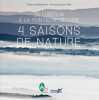
Bon état
"AMONTONS, (GUILLAUME). - ESTABLISHING THE LAW OF PROPORTIONALITY AND THE BASIC CONCEPT OF FRICTION.
Reference : 44387
(1702)
De la Resistance cause'e dans les Machines, tant par les frottemens des parties qui les composent, que par la roideur des Cordes qu'on y employe, & la maniere de calculer l'un & l'autre.
(Paris, Jean Boudot, 1702). 4to. Without wrappers. Extracted from ""Mémoires de l'Academie des Sciences. Année 1699"". Pp. 206-227 a. 5 large engraved plates (tables). Textillustrations. Last leaf with a small paperloss in inner margin
First appearance of a milestone paper on the friction loss of energy in machines, hereby establishing the basic concepts of friction.""In the same year (1699) Amontons produced the first known study on the question of losses caused by friction in machines. He then established the las of proportionality between friction an the mutual pressure of the bodies in contact."" (DSB I, p. 138).
De la Hauteur du Mercure dans les Barometres. (+) Suite des Remarques sur la hauteur du mercure....(+) Suite des remarques...(+) Suite des Remarques...(4 Parts).
(Paris, Jean Boudot, 1706). 4to. Without wrappers. Extracted from ""Mémoires de l'Academie des Sciences. Année 1705"". Pp. 229-232, 232-234, 234-236 a. 267-272.
First apperance of one of Amontons last papers on the barometer. He develops, after having noted that barometers are affected by heat as well as by the weight of the atmosphere, his mercury barometer.
"AMONTONS, (GUILLAUME). - THE INVENTION OF THE AIR PRESSURE THERMOMETER.
Reference : 44385
(1704)
Discours sur quelques proprietez de l'air, & le moyen d'en connoître la temperature dans tous les climats de la terre.
(Paris, Jean Boudot, 1704). 4to. Without wrappers. Extracted from ""Mémoires de l'Academie des Sciences. Année 1702"". Pp. 155-174 a. textillustrations.
First appearance of this paper in which Amontons describes his invention, construction and function of his air thermomer. He thus improves on Gallileo's design by using air pressure instead of volume. The paper is the earliest study in this field, and Amontions concludes ""that unequal masses of air under equal weights invcrease equally the force of their spring for equal degrees of heat"" Fifteen years later Gay-lussac performed the same experiments with better technique and results - the Gay-Lussac laws.The paper ""contains Amontons' account of the first thermometer with which temperature was measured by the pressure of air.""(Magie ""A Source book in Physics"", pp. 128 ff.).""His first scientific production was a Hygrometer in 1687....The other was an air thermometer independent of the atmospheric pressure. Air occupied the top of one of the branches of a U-shaped tube, and by its dilation it pushed down one of the mercury columns so that the other end ofthe branch formed a barometric chamber.""(DSB I, p. 138 a).Parkinson ""Breakthroughs"", 1702 M).
"AMONTONS, (GUILLAUME). - THE INVENTION OF THE THERMIC MOTOR.
Reference : 44388
(1702)
Moyen de substituer Commodement L'Action du Feu, a la Force des Hommes et des Chevaux pour mouvoir les Machines.
(Paris, Jean Boudot, 1702). 4to. Without wrappers. Extracted from ""Mémoires de l'Academie des Sciences. Année 1699"". Pp. 112-126 and 1 engraved plate. (showing the ""Moulin a Feu"" Textillustrations.
First apperance of this classic paper in which Amontons decribes his invention of a thermic motor.""As early as 1699 Amontons proposed a thermic motor: a machine using hot air and external combustion with direct rotation. The experiments carried on in connection with this machine led him to note that ordinary air going from the temperature of ice to that of boiling water increases in volume by about one third.""(DSB I, p. 139).Together with L'HOPITAL ""Methode Facil pour trouver un Solide Rond qui étant mû dans un Fluide en repos paralellement..."" 1699/1702. Pp. 107-112
Mémoire sur la Détermination de la surface courbe des ondes lumineuses dans un milieu dont l'élasticité est différrente suivant les trois directions principales, c'est-à-dire celles où la force produite par l'élasticité a lieu dans la direction mém...
(Paris, Crochard, 1828). No wrappers. In: ""Annales de Chimie et de Physique, Par MM. Gay-Lussac et Arago."", tome 39 (Sec. Cahier), With halftitle to vol. 39. pp. 113-224. (Entire issue offered). Ampere's paper: pp. 113-145 a. 1 folded engrave plate. The plate with a few, mostly marginal brownspots.
First appearance of Ampere's mathematical treatment of Fresnel's ondulatory theory of light, agreeing with Fresnel and opposed to Biot and Laplace who advocated a corpuscular theory.
"AMPÈRE, ANDRÉ-MARIE. - DEMONSTRATING THE BOYLE-MARIOTTE LAW OR AMPÈRES GAS LAW.
Reference : 45113
(1815)
Démonstration de la relation découverte par Mariotte, entre les volumes des gaz et les pressions qu'ils supportent à une même température. Lu a l'Institut, le 24 janvier 1814.
Paris, Crochard, 1815. Contemp. hcalf. Spine gilt. Slightly rubbed. A few scratches to binding. Wear to top of spine. Small stamps on verso of titlepage.In: ""Annales de Chimie, ou Recueil de Mémoires concernant la Chemie"" Tome 94. 336 pp. a. 1 plate (the plate in facs., not belonging to Ampere's paper). Ampere's paper: pp. Some scattered brownspots.
First appearance of Amperes second paper on molecular physics.""The noumenal aspect of chemistry fascinated Ampère. Although his derivation of Avogadro’s law came three years after Avogadro had enunciated it, the law is known today in France as the Avogadro-Ampère law. This was Ampère’s first excursion into molecular physics, and was followed almost immediately by a second. In 1815 he published a paper demonstrating the relation between Mariotte’s (Boyle’s) law and volumes and pressures of gases at the same temperature. The paper is of some interest as a pioneer effort, along with Laplac’s great papers on capillarity, in the application of Mathematical analysis to the molecular realm.""(DSB).The volume contains 3 importent papers by Jean-Baptiste Biot on polarisation of light and Berzelius ""Experiences pour déterminer les proportions définies, dans lequelles les élémens de la nature organique sont combinés"" + ""Suite..."" 1-2, pp. 5-33, pp. 170-190 a. pp. 296-232
"AMPÈRE, ANDRÉ-MARIE. - INCORPORATED IN THE ""PRINCIPIA"" OF ELECTRODYNAMICS.
Reference : 44786
(1824)
Extrait d'un Mémoire sur les Phénomènes électro-dynamiques. (Communique à l'Academie royale des Sciences le 22 dévcembre 1823). + Suite de l'Extrait, fait par M. Ampère, de son Mémoire sur les Phénomènes électro-dynamiques.
Paris, Crochard, 1824. 8vo. Without wrappers. In 'Annales de Chimie et de Physique', Series 2 - Volume 26, issue 2 and 3. With titlepage to vol. 26. Pp. 113-224 a. pp. 225-336, 1 folded engraved plate (entire issues offered). Ampere's papers: pp. 134-162 a. pp. 246-258.
First appearance of one of Ampere's importent contributions to electrodynamic. This memoir was later incorporated in his great memoir of 1827 ""Mémoire sur la théorie mathématique des phénomenes electro-dynamiques...."", published 1827, the ""Principia"" of electrodynamics.
"AMPÈRE, ANDRÉ-MARIE. - INCORPORATED IN THE ""PRINCIPIA"" OF ELECTRODYNAMICS AND THE INVENTION OF THE SOLENOID.
Reference : 48831
(1824)
Extrait d'un Mémoire sur les Phénomènes électro-dynamiques. (Communique à l'Academie royale des Sciences le 22 dévcembre 1823). + Suite de l'Extrait, fait par M. Ampère, de son Mémoire sur les Phénomènes électro-dynamiques. + Description d'un Appa...
Paris, Crochard, 1824. 8vo. Contemp. hcloth with gilt lettering to spine. In 'Annales de Chimie et de Physique', Series 2 - Volume 26. 448 pp. a. 5 large folded engraved plates. (Entire volume offered). Ampere's papers: pp. 134-162, 246-258 a. 390-411. A bit of browning to halftitle and verso of last plate. A few scattered brownspots.
The first paper is the first appearance of one of Ampere's importent contributions to electrodynamic. This memoir was later incorporated in his great memoir of 1827 ""Mémoire sur la théorie mathématique des phénomenes electro-dynamiques...."", published 1827, the ""Principia"" of electrodynamics.The second paper is the first appearence of the paper in which Ampere describes his invention of the SOLENOID, the electro-magnetic device he used in his early electrodynamical experiments.""A solenoid is a coil wound into a tightly packed helix. In physics, the term solenoid refers to a long, thin loop of wire, often wrapped around a metallic core, which produces a magnetic field when an electric current is passed through it. Solenoids are important because they can create controlled magnetic fields and can be used as electromagnets. The term solenoid refers specifically to a magnet designed to produce a uniform magnetic field in a volume of space (where some experiment might be carried out).""The volume contains further importent papers by Poisson ""Sur la Chaleur rayonnante"", pp. 225-246 + Note.. pp. 442-44, Gay-Lussac, Savart, Pelletier et Caventou, Becquerel etc.
"AMPÈRE, ANDRÉ-MARIE. - ""ONE OF THE MOST CELEBRATED MEMOIRS IN THE HISTORY OF NATURAL PHILOSOPHY""
Reference : 48082
(1825)
Mémoire sur une nouvelle Expérience électrodynamique, sur son application à la formule qui représente l'action mutuelle de deux élemend de conducteurs voltaïques, et sur de nouvelles conséquences déduites de cette formule. (Lu à l'Academie royale de...
Paris, Crochard, 1825. 8vo. Bound in 2 uniform later hcloth. Gilt lettering to spines. In: ""Annales de Chimie et de Physique, Par MM. Gay-Lussac et Arago."", tome 29 a. 30. - 448 pp. and 3 folded engraved plates + 448 pp. and 2 folded engraved plates. (The entire volumes offered). Ampère's papers: pp. 381-404 (tome 29) + Suite pp. 29-41 (tome 30) + ""Lettre à Gerhardi"": pp. 373-381 (tome 29). Some scattered brownspots.
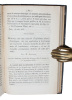
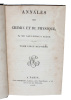
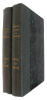
First appearance of this famous memoir, in which Ampère presented his collected results on electrodynamics to the French Academy, creating the foundation of 19th century developments in electricity and magnetism. In the words of James Clark Maxwell, ""We can scarcely believe that Ampère really discovered the law of action by means of the experiments which he describes. We are led to suspect, what, indeed, he tells us himself, that he discovered the law by some process which he has not shown us, and that when he had afterwards built up a pefect demonstration he removed all traces of the scaffolding by which he raised it.""The offered memoir was published BEFORE the famous ""Theorie mathématique des phénomènes électro-dynamiques uniquement déduite de L'expérience"", which did not appear until 1827. That 1827-Memoire incorporates, together with a new presentation of Ampère's results from 1820, 1822, 1823, the offered memoir (1825). (Horblit: 100 - Dibner: 62).""From 1814 until 1820 Ampére did not perform the kind of research that would have made it into the annals of the histrory of science, but on September 11, 1820 when he heard Francois Arago speak about Oersted's work, he got fresh inspiration and started the work that made him famous. Arago related how Oersted had found that a steady electric current influences the orientation of a compass needle. After a weak Ampère had determined experimentally that that two straight, parallel, and current-carrying, wires execute a force on each other. The magnitude of the force is inversely proportional to the distance between the wires and proportional to the strenghts of the current..... During the following years he continued his researches, both experimentally and theoretically. he built an instrument for measuring electricity that later was developed into the galvanometer. Finally in 1825 he presented his collected results to the Academy IN ONE OF THE MOST CELEBRATED MEMOIRS IN THE HISTORY OF NATURAL PHILOSOPHY (The paper offered)."" (Citizen's Compendium, p. 2). - Norman No 47.The volumes contain many other notable papers by: Wöhler, Fresnel, Marcet, Berzelius, Felix Savart, De la Rive, Braconnet, Boussingault, Magnus, Poncelet, Vaugelin, Poisson, Gay-Lussac, Faraday, Laplace etc.
"AMPÈRE, ANDRÉ-MARIE. - THE CARDINAL FORMULAS OF ELECTRO-DYNAMICS.
Reference : 47420
(1825)
Mémoire sur une nouvelle Expérience électrodynamique, sur son application à la formule qui représente l'action mutuelle de deux élemend de conducteurs voltaïques, et sur de nouvelles conséquences déduites de cette formule. (Lu à l'Academie royale de...
(Paris, Crochard, 1825). Extracted from ""Annales de Chimie et de Physique, Par MM. Gay-Lussac et Arago."", tome 29 a. 30. Ampère's papers: pp. 381-404 a. 1 folded engraved plate (tome 29) + Suite pp. 29-41 (tome 30) + ""Lettre à Gerhardi"": pp. 373-381 (tome 29). With both halftitlepages to vol. 29 a. 30. Scattered brownspots.
First appearance of this famous memoir, in which Ampère presented his collected results on electrodynamics to the French Academy, creating the foundation of 19th century developments in electricity and magnetism. In the words of James Clark Maxwell, ""We can scarcely believe that Ampère really discovered the law of action by means of the experiments which he describes. We are led to suspect, what, indeed, he tells us himself, that he discovered the law by some process which he has not shown us, and that when he had afterwards built up a pefect demonstration he removed all traces of the scaffolding by which he raised it.""The offered memoir was published BEFORE the famous ""Theorie mathématique des phénomènes électro-dynamiques uniquement déduite de L'expérience"", which did not appear until 1827. That 1827-Memoire incorporates, together with a new presentation of Ampère's results from 1820, 1822, 1823, the offered memoir (1825). (Horblit: 100 - Dibner: 62).""From 1814 until 1820 Ampére did not perform the kind of research that would have made it into the annals of the histrory of science, but on September 11, 1820 when he heard Francois Arago speak about Oersted's work, he got fresh inspiration and started the work that made him famous. Arago related how Oersted had found that a steady electric current influences the orientation of a compass needle. After a weak Ampère had determined experimentally that that two straight, parallel, and current-carrying, wires execute a force on each other. The magnitude of the force is inversely proportional to the distance between the wires and proportional to the strenghts of the current..... During the following years he continued his researches, both experimentally and theoretically. he built an instrument for measuring electricity that later was developed into the galvanometer. Finally in 1825 he presented his collected results to the Academy IN ONE OF THE MOST CELEBRATED MEMOIRS IN THE HISTORY OF NATURAL PHILOSOPHY (The paper offered)."" (Citizen's Compendium, p. 2). - Norman No 47.

