 Write to the booksellers
-
Type
Book (7247)
Disk (44)
Drawings (1)
Engraving (9)
Magazine (89)
Maps (4)
Music sheets (135)
New book (2)
Old papers (1)
Photographs (19)
Posters (1)
-
Latest
Last 24h (3)
Last 3 days (2)
Last month (971)
Last week (2)
-
Language
Czech (1)
Dutch (9)
English (156)
French (7373)
German (4)
Italian (2)
Latin (3)
Russian (4)
-
Century
16th (17)
17th (43)
18th (199)
19th (881)
20th (2478)
21st (1565)
-
Countries
Belgium (1156)
Canada (32)
China (56)
Côte d'Ivoire (7)
Denmark (1063)
France (4888)
Germany (1)
Netherlands (181)
Switzerland (155)
United Kingdom (9)
United States of America (4)
-
Syndicate
ALAC (25)
CLAM (25)
CLAQ (2)
ILAB (2234)
NVVA (15)
SLACES (15)
SLAM (1026)
SNCAO (4)
La seconde guerre mondiale : Un conflit à repenser ?: un conflit à redécouvrir
Bréal 2017 128 pages 11 8x17 8x1 6cm. 2017. Broché. 128 pages.
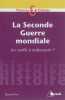
Très bon état - livre issu de destockage - pouvant présenter d'infimes traces de stockage - Expédié soigneusement dans emballage adapté
The Troubles of Janice. / Story & Art by Von Götha. Part 1, part 2 & part 3.
(San Francisco), Priaprism Press, (Last Gasp), (International Presse Magazine), (1998-1999). 3 volumes grands in-8 (29,8 cm) 57,(1) pages; 62 pages; 64 pages, illustrés de bandes dessinées érotiques en couleurs. Couvertures souples illustrées en couleurs. Bel état général.

Jan Fabre. Die Jahre der blauen Stunde. The Years of the Hour Blue. Katalog zur Ausstellung im Kunsthistorischen Museum Wien, 2011. Deutsch-Englisch
Wien, Kunsthistorisches Museum Wien, 2011 Bound, dustjacket, 173pp., 24x28cm., illustr. troughout in col., new. ISBN 9783850335959.
Ob mit Performance oder Skulptur, als Regisseur oder Choreograph, seit den 1970er Jahren mischt das flamische Multitalent Jan Fabre die zeitgenossische Kunst auf. Mit seinen Tanz-, Theater- und Opernproduktionen bespielt er grosse Weltbuhnen. Der Performance-Kunstler, in dessen Arbeiten Elemente aus allen Kunstsparten zu einem Gesamtkunstwerk verschmolzen werden, begann seine Karriere als Maler. Mit seinem Skulpturen, Gemalde, Fotografien, Zeichnungen und Installationen umfassenden? OEuvre erobert er auch Museen von Weltrang? wie z.B. den Louvre. Nun beehrt der Kunstler 2011 das Kunsthistorische Museum mit seiner nachsten Ausstellung in Wien.? Ab den 1980er Jahren widmete sich Fabre? der Erforschung des menschlichen Korpers und seiner Transformation, sehr bald kam die Faszination fur Insekten hinzu, wobei der thematische Bogen von Leben, Tod und Auferstehung konstant blieb. Sein immer wiederkehrendes "Markenzeichen", der Kafer, galt in der Mythologie des Alten Agypten als Symbol der Verwandlung und als Brucke zwischen Leben und Tod. Ein Lebensthema des Kunstlers, der zwei Mal im Koma lag. Der vorliegende Bildband nimmt Arbeiten in den Fokus, in denen sich der Kunstler auf die Schriften seines Urgrossvaters, des Insektenforschers Jean-Henri Fabre, bezieht.
HET HOOGLIED VAN SALOMO,
Amsterdam, Grafische School, 1948 Gebonden, creme-kleurig linnen met rode titelopdruk, 225 x 335mm., 23pp., veelkleurendruk.
Dit calligrafisch werk werd in 1948 op de Europede tentoonstelling voor calligrafie te Parijs bekroond. Het facsimile wordt aangeboden bij het 50-jarig bestaan van de Amsterdamse Grafische School. In goede staat.
Principat 17.1 + 17.2 RELIGION: Heidentum Römische Götterkulte Orientalische Kulte in der Rômischen welt- Aufstieg und Niedergang der römischen Welt
de Gruyter 1981 629 pages in8. 1981. Cartonné jaquette. 2 volume(s). 629 pages.
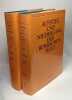
très bon état de conservation avec emboîtage cartonné et jaquette intérieurs propres bonne tenue texte en anglais français allemand
PRINCIPAT - Bd.23/1 + 23/2 - RELIGION : Vorkonstantinisches Christentum: Verhaltnis Zu Romischem Staat Und heidnischer religion - Aufstieg und Niedergang der römischen Welt
de Gruyter 1979 877 pages in8. 1979. Cartonné jaquette. 877 pages.
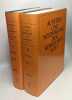
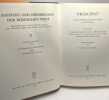
très bon état de conservation avec emboîtage cartonné intérieurs propres bonne tenue textes en allemand anglais
Sprache und Literatur: Mehrsprachig - Bd.31/1 + 31/2 + 31/3 + 31/4 / Aufstieg und Niedergang der römischen Welt (ANRW) / Rise and Decline of the Roman World. Principat Band 2)
de Gruyter 1980 715 pages 18 2x4 8x24 6cm. 1980. Cartonné jaquette. 4 volume(s). 715 pages.
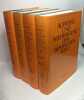
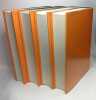
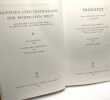
Très bon état de l'ensemble avec jaquette intérieurs propres bonne tenue textes en anglais allemand italien français petites tâches sur la tranche du volume 31/2 volume 31/1 avec son emboîtage caronné
Principat Zwölfter Band - Künst (1+2 Teilband) - Aufstieg und Niedergang der römischen Welt
de Gruyter 1981 629 pages in8. 1981. Cartonné jaquette. 2 volume(s). 629 pages.
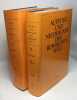
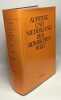
volume 12.1 à l'état de neuf avec son emboitage cartonné volume 12.2 en très bon état cependant tranche ternie textes en anglais français allemand
Early Germanic Kingship: In England and on the Continent (Ford Lectures)
Oxford university press 1971 172 pages 13 8x1 6x21 4cm. 1971. Broché. 172 pages.
livre en bon état cependant page 157 à la dernière page abîmées
Ljoda-Bók.
Reykjavik, Thorsteinn Gislason, 1916. Orig. hldrbd. med rig rygforgyldning. Helt guldsnit. Portræt. 486,(1) pp. Fint frisk eksemplar.
English Logic and Semantics, from the End of the Twelfth Century to the Time of Ockham and Burleigh. Acts of the 4th European Symposium on Mediaeval Logic and Semantics, Leiden-Nijmegen, 23-27 April 1979,
Turnhout, Brepols, 1979 Paperback, VII+417 p., 165 x 240 mm. ISBN 9789070419028.
Languages: Latin, English.
Aristotle's Peri hermeneias in the Latin Middle Ages. Essays on the Commentary Tradition,
Turnhout, Brepols, 2003 Paperback, XLI+509 p., 165 x 240 mm. ISBN 9789070419424.
Languages: Latin, English.
Marsilius of Inghen. Acts of the International Marsilius of Inghen Symposium organized by the Nijmengen centre for Medieval Studies (CMS), Nijmegen, 18-20 December 1986,
Turnhout, Brepols, 1986 Paperback, VII+214 p., 165 x 240 mm. ISBN 9789070419295.
Languages: Latin, English.
Hagiographica, Jos Carlos Mart n-Iglesias (ed), Patrick Henriet (ed), lvaro Cancela Cilleruelo (ed), Ainoa Castro Correa (ed), Carmen Esteban Mart nez (ed)
Reference : 64893
Hagiographica hispana regnorum Aragonum et Castellae Legionisque saeculorum IX-XIII. Vitae sanctorum, Inuentiones et translationes, Libri miraculorum, Hymni
, brepols, 2022 Hardback, ccclx + 304 pages, Size:155 x 245 mm, Illustrations:7 tables b/w., Language: Latin.*new ISBN 9782503597744.
Summary Ce volume r unit un grand nombre d'?uvres hagiographiques, en prose et en vers, d'origine essentiellement monastique, r dig es dans l'Espagne des IXe-XIIIe si cle. Elles comportent plusieurs vies (notamment d'ermites), une passion (saint Zo le de Cordoue), des r cits de translation de reliques (comme celle de saint Indal ce, l'un des sept vang lisateurs mythiques de l'Espagne) et des recueils de miracles soit in uita soit post mortem ; la notice de la vie ou du transfert du corps du saint est souvent suivie des miracles survenus sur sa tombe ou proximit . Ces textes ont t compos s dans les monast res de San Juan de la Pe a (Huesca: Aragon), San Mill n de la Cogolla (La Rioja/Castille) et San Zoilo de Carri n (Palencia: Castille). La Vita s. Vrbici confessoris (BHL 8408m) a sans doute t crite dans un monast re aragonais non identifi au IXe s., tandis que le Liber de uita et miraculis s. Isidori agricolae (BHL 4494-4495) est l'?uvre d'un diacre de l' glise Santa Mar a de la Almudena de Madrid (XIIIe s.), avec des continuations d'abord, quelques ann es plus tard, par un franciscain, puis ensuite par d'autres auteurs jusqu'au XVe s. TABLE OF CONTENTS Vita sancti Vrbici (BHL 8408m) Hymnus de sancta Eulalia Translatio s. Indalecii ep. Vrcensis (BHL 4270) auctore Ebretmo Cluniacensi monacho Lectiones in translatione s. Indalecii ab Ebretmo Cluniacensi monacho duobus miraculis auctae Hymni de sancto Indalecio Vita s. Voti et Felicis fratrum Caesaraugustanorum (BHL 8733) Vita s. Voti et Felicis fratrum Caesaraugustanorum (BHL 8734: Recensio I seu originalis) Vita s. Voti et Felicis fratrum Caesaraugustanorum (BHL 8734/8734B: Recensio IIA) Vita s. Voti et Felicis fratrum Caesaraugustanorum (BHL 8732) Hymnus de sancto Voto et Felice fratribus Caesaraugustanis (D az 1499) Hymnus de domo sancta Pinnatensi Translatio et miracula sancti Felicis presbyteri (BHL 2861-2862), auctore Grimaldo Aemilianensi monacho Translatio et liber miraculorum sancti Aemiliani Cucullati (BHL 102-104), auctore Fredinando Iohannis Aemilianensi monacho Translatio sancti Aemiliani Cucullati (BHL 102) Liber miraculorum sancti Aemiliani Cucullati: Recensio breuior (BHL 103) Liber miraculorum sancti Aemiliani Cucullati: Recensio longior (BHL 103-104) Miracula III sancti Zoili Cordubensis, in codice Matritensi Bibliotheca Nationalis 11556 adseruata Passio, translatio et miracula sancti Zoili Cordubensis, auctore Rodulfo monacho Casae Dei, Carrionensi dicto Hymni in festiuitate beati Zoili martyris Miraculum sancti Zoili Cordubensis in fine mutilum ut in codice Matritensi Bibliothecae Nationalis 11556 adseruatum Liber de uita et miraculi sancti Isidori Agricolae (BHL 4494-2295)
Über ein neues, die Emanation des Thoriums gebendes radioaktives Element.
Leipzig, S. Hirzel, 1905. No wrappers. Issued in ""Jahrbuch der Radioaktivität und Elekronik"", 2. Bd., Heft 3. Hahn's paper: pp. 233-264. Enntire issue: pp. 233-262 (= entire ""Heft 3""). Fine and clean.
First printing of this paper, which is Hahn's Habilitation paper, announcung his discovery of a new element in residues from a Ceylon mineral called Thorianite. He later showed that it is an intermediate disintegration product.""Because the sample (thorianite) was small, Ramsay proposed that Hahn confirm Marie Curie's determination of the atomic weight of radium by preparing it in some organic compounds (thereby greatly increasing the total amount being examined) and calculating the atomic weight from the measured molecular weights. Chance sometimes favors the unprepared mind, and Hahn, who familiarized himself with only the basic of radioactivity, followed the prescribed separationss technique and found himself the discovere of a new radioelement: radiothorium. The explanation was that the material given him came from an ore which contained a large percentage of thorium in addition to the radium. Thus, upon completion of the chemical procedure, not all the activity was confined in the radium-containg fraction"" indeed the nes subsyance in the remainder was several hundred thousand times more active than thorium and ultimately yielded the characteristic one.minute halflife of thorium emanation.""(DSB VI, p. 15). - Weeks, Discovery of the Elements,p. 308 ff.).
Richtig Clever !: Richtig Clever! Allemand 1ere annee Livre
Didier 2016 120 pages 19 2x0 8x28cm. 2016. Broché. 120 pages.
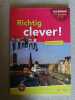
Bon état
Versuch schweizerischer Gedichte. Durchgesehen und besorg ton Johann Rudolf Wyss.
12. Aufl. Bern, Typograph. Gesellschaft, 1828. 8°. LXXX, 288, (1) S. Mit 1 gest. Portrait nach Dunker, 1 Tafel nach einer Handschrift sowie 17 gest. Textvignette. Privater Pappbd. d. 20. Jahrhunderts (leicht berieben u. bestossen).
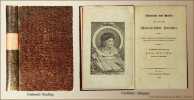
Lonchamp 1380. - Diese Ausgabe neu mit einer Lebensbeschreibung Hallers. Mit einem Frontispiz auf fest. Vorsatz. - Das Frontispiz mit ursprünglichen Fehlstellen an Kopf u. Fuss (ohne Bildverlust) anlässlich Neubindung aufgezogen. Leicht gebräunt.
Ljodmæli (og) I Obundna Mali. Tómas Gudmundsson gaf ut a Hundrad Ara Danarafmæli Skaldsins. 2 Bd.
Reykjavik, Helgafell, 1945-46. 4to. 2 orig. helldrbd. med blindtryk på permer. XLVIII,390VIII,346 pp. Med opklæbede farveplancher i første bind.
Ueber den Einfluss des Lichtes auf electrostatisch geladene Körper.
Leipzig, Johann Ambrosius Barth, 1888. Without wrappers as issued in ""Annalen der Physik und Chemie. Hrsg. von G. Wiedemann."", Neue Folge Bd. 33, 2. Heft (= No 2). Titlepage to vol. 33. Smal stamps to verso of title and titlepage. Pp. 241-416 a. 1 plate (entire issue offered ""Heft"" 2). Hallwach's paper: pp. 301-312. Clean and fine.
First appearance of this pioneer paper in the history of the PHOTOELECTRIC EFFECT, as Hallwachs here for the first time showed that metals lose their negative charges under the action of ultraviolet radiation and becomes positive charged. The earliest speculations of the nature of the effect predates the discovery of the electron in 1897 by J.J. Thomson.""This process, which is called the photoelectric effect or Hallwachs effect, forms the basis for the physics of the photoelectric cell and was theoretically interpreted by Einstein in 1905 in Einstein's work on light quanta.""(DSB VI, p.74).""On the basis of his heuristic principle, Einstein proposed the following 'simplest picture' for the photoeffect. A light-quantum gives all its energy to a single electron, and the energy transfer by one light-quantum is independent of the presence of other light-quanta....and he gave several other applications of his heuristic principle...""(Pais in ""Subtle is the Lord"" pp. 380-81).Magie ""A Source Book in Physics"", pp. 578 ff.
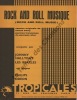
Hallyday Johnny,The Beatles,Mitchell Eddy,Berry Chuck - Berry Chuck - Berry Chuck
Reference : 95189
(1956)
Partition de la chanson : Au rythme et au blues (Roll over Beethoven)
Tropicales 1956
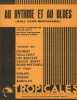
Bon état Format Coquille Piano
Histoires du peuple juif
ARTHAUD 2010 224 pages 25x31 6x2 6cm. 2010. Reliure Editeur avec jaquette. 224 pages. Marek Halter retrace l'histoire du peuple juif à travers quatre mille ans d'aventure de l'Amérique à l'Asie en adoptant une approche de conteur sans chercher l'adhésion des orthodoxes ni des historiens. L'ouvrage illustré explore l'identité juive la Loi et l'unité du peuple à travers les âges
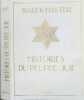
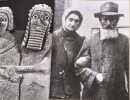
Très bon état jaquette avec légères traces d'usage intérieur trés propre
Oldenburgische Chronicon Das ist Beschreibung Der Löblichen Uhralten Grafen zu Oldenburg und Delmenhorst/ ec. Von welchen die jetzige Könige zu Dennemarck und Hertzogen zu Holstein entsprossen, Sampt Ihres Stammens ersten Ankunnft, Thaten, Regierung, ...
(Oldenburg, Warner Berendts Erben), 1599. Folio. Contemp. full calf. Richly gilt spine. Titlelabel gone. Engraved ornamental title-page. (86),494,(18) incl. (2) blank. Profusely textillustrated with engravings and woodcuts among them the full-page portrait of the author, a full-page view of Oldenburg, 3 folded genealogical tables and the double-page engraved elevated plan of Oldenburg. Internally clean and fine.
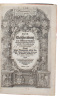
First edition. Hamelmann's Chronicon is the first book to be printed in Oldenburg (Brunet) and it is the historical source work for the ""House of Oldenburg"" whose descendents became kings of Denmark and emperors of Russia. -Adams H 30.
5 volumes en un : Volume I (n°1980) : Commission chargée de l'enquête sur l'exploitation du monopole des tabacs et des poudres. Volume II (n°3455) : Rapport fait au nom de la commission d'enquête sur l'exploitation du monopole des tabacs et des poudres...
Cerf et Fils. 1874. In-4. Relié. Etat d'usage, Coins frottés, Dos satisfaisant, Papier jauni. Volume I : 167 pages. Volume II : 53 pages. Volume III : 22 pages. Volume IV : 478 pages. Volume V : 20 pages. Rousseurs. Nombreuses annotations au crayon sur la page titre. Une étiquette de librairie collée sur le 1er contreplat. Titre doré sur le dos.. . . . Classification Dewey : 633.7-Plantes alcaloïdes (tabac, thé, cacao, café, pavot)
Volume I (n°1980) : Commission chargée de l'enquête sur l'exploitation du monopole des tabacs et des poudres. Volume II (n°3455) : Rapport fait au nom de la commission d'enquête sur l'exploitation du monopole des tabacs et des poudres, par M. Lebourgeois. Volume III (n°3664) : Rapport fait au nom de la commission d'enquête sur l'exploitation du monopole des tabacs et des poudres, par M. de Lamberterie. Volume IV : Réponses aux questions posées par la commission législatives chargée de l'enquête sur l'exploitation du monopole des tabacs et des poudres. Volume V : Réponses aux questions posées par la commission législatives chargée de l'enquête sur l'exploitation du monopole des tabacs et des poudres, questionnaire spécial aux zones et aux tabacs de cantine (observations supplémentaires). Classification Dewey : 633.7-Plantes alcaloïdes (tabac, thé, cacao, café, pavot)


