 Write to the booksellers
39 books for « scaliger j j »Edit
-
Language
French (36)
Latin (3)
-
Century
16th (4)
17th (10)
18th (2)
19th (1)
20th (1)
-
Countries
Belgium (6)
France (20)
Germany (2)
Netherlands (6)
Switzerland (5)
-
Syndicate
ILAB (13)
SLAM (12)
Topics
- Aristotle (1)
- Autographs (1)
- Binding w/arms (1)
- Books from the xviith (1)
- Dedication (1)
- Early printed books (4)
- Earth (1)
- Elzevier (1)
- Encyclopaedia (1)
- Erasmus (1)
- Ex-libris (1)
- Fables (1)
- First edition (2)
- Greek (1)
- History (4)
- Humanism (1)
- Isaac (1)
- Italian literature (1)
- Julius caesar (2)
- Latin (4)
- Literature (1)
- Maxims (1)
- Medicine (1)
- Metaphysics (1)
- Muret maurice (1)
- Part dieu (1)
- Philology (1)
- Philosophy (2)
- Planet (1)
- Portraits (1)
- Printing (2)
- Protestantism (1)
- Rome (1)
- Sky (1)
- Star (1)
- Tales (1)
- Theocritus (1)
Satirae duae, Hercules tuam fidem sive Munsterus Hypobolimaeus, et Virgula divina. Cum brevioribus annotatiunculis, quibus nonnulla in rudiorum gratiam illustrantur. Accessit his accurata Burdonum Fabulae confutatio, quibus alia nonnula hac editione accedunt.
Leiden (Lugduni Batavorum), Apud Ludovicum Elzevirium, 1617. (Colophon at the end: 'Lugduni Batavorum, Typis Isaaci Elsevirii, anno 1617')
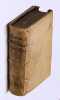
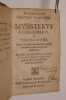
12mo. (XXIV),619 (recte 529),(20),(3 blank) p. Overlapping vellum 13 cm (Ref: STCN ppn 832983446; USTC 1028202; Willems 123; Rahir 99; Berghman 1329 Graesse 6/1, 273/274; Not in Smitskamp's 'The Scaliger Collection', but it does figure in its list of Scaliger editions, p. 120) (Details: 5 thongs laced through the joints. Manuscript title on the back. The first Elzevier edition in small format) (Condition: Vellum age-toned and soiled. Front hinge cracking. Front flyleaf worn and inscribed. Title dustsoiled, and with 2 small ownership entries. Some old marginal notes, occasional ink underlinings) (Note: The French protestant classical scholar J.J. Scaliger, 1540-1609, was a genius, but was also vain and sharp tongued. Consequently he had many enemies. His greatest enemies were among members of the catholic Jesuit order. Scaliger had turned his back on France, and had come in 1592 to Leiden at the request of the authorities of that city and the local University, who desired nothing more than his inspiring presence. There he gathered around him a group of brilliant young man, among whom H. Grotius. In 1599 young Daniel Heinsius, 1580-1655, entered the group, and became 'because of his reputedly attractive personality and remarkable gifts' Scaliger's favorite student. (P.R. Sellin, Daniel Heinsius and Stuart England', Leiden etc., 1968, p. 14) Heinsius rapidly made a name as classical scholar and neolatin poet. In 1609 Scaliger died in his arms. One of Scaliger's foulest adversaries was a former friend, Gaspar Schoppe, or in Latin Scioppius, 1576-1649, who converted to catholicism. He distinguished himself by the virulence of his writings against the Protestants, and he even wanted to incite a war against these heretics. In 1607 this man published a vicious attack upon Scaliger with his 'Scaliger hypololymaeus', in English 'Suppositious Scaliger', or rather 'Basterd Scaliger'. 'Dem tobensten Schimpfen wird hier freier Lauf gelassen; Gifte jeder Art von Verunglimpfung und Verdächtigung werden zusammen gebraut'. (J. Bernays, 'Joseph Justus Scaliger', Berlin, 1855, p. 85) Scioppius wanted to throw discredit on Scaliger, and weaken his authority, so he attacked him at his weakest spot, his supposed noble birth. Scaliger had been raised in the belief that he was a descendent of the royal family Della Scala of Verona, and he let no opportunity pass to mention the splendour of his ancestry. The validity of his pretentions were however dubious. The challenge of Scioppius was accepted by the favourite pupil of Scaliger, Daniel Heinsius, who published one year later, in 1608, anonymously in defence of his master the 'Satirae duae, Hercules tuam fidem, sive Munsterus Hypobolimaeus, et Virgula divina', two mordant Menippean satires that covered Scioppius, who occasionally signed his letters off as 'G.S. a Munster' (hence Munsterus), with much abuse. As Scioppius himself had done with Scaliger, Heinsius smears with the mud of satire his scholarship, his name, the respectability of his parents, and his conversion to catholicism. In the following mockery 'Virgula Divina, sive Lucretii Vespillonis apotheosis', inspired by Seneca's Apocolocyntosis, Heinsius focusses on the humble origins of Scioppius, himself, he tells, a supposititious child. His 'father', called by Heinsius Vespillo, or corpse-bearer/gravedigger (See Martial I,47,1), is sentenced to become assistant of Charon. Scaliger has often admitted in his letters that Heinsius was the author of the satires, and the editor of the book, which opens with a preface dedicated to Scaliger, and a section of Scioppius praise of Scaliger from the time when he was still a friend and a protestant, then a support letter of the French scholar and friend of Scaliger, Isaac Casaubon. Next follow both satires of Heinsius, followed by an attack on Scioppius and his ancestry in a mock-biography: 'Vita et parentes Gasp. Schoppii, a Germano quodam contubernali eius conscripta', composed by Scaliger himself or by Ianus Rutgerus, a friend of Heinsius, and a student of Scaliger. The great man himself contributed, using the initials of his student Rutgerus (auctore I.R. Batavo, Iuris studioso) also to this own defence, a 'accurata Burdonum Fabulae confutatio', 'a precise refutation of the Burdonese story', with the help of charters and documents which should prove his noble origin. Nevertheless, the defence of Heinsius and Scaliger made 'einen sehr kühlen Eindruck auch auf die nähreren Freunde Scaligers'. (Bernays, p. 85). Few wanted to side with him on this matter; the answer of Scaliger was deemed not satisfactory. Scioppius' reputation was damaged too. Heinsius had portrayed him as a parasite and as 'Monster of Münster', labels which he never got rid of. A revised second edition of the 'Satirae duae' was published in the same year in Leiden by Johannes Patius, who had also published the first edition. 1609 he already produced his 4th edition. An eludicating survey of the hard to fathom content of both satires can be found in chapter 5 of 'Menippean Satire and the Republic of Letters, 1581-1655', of A. R. de Smet, Geneva, 1996. 'Hercules tuam fidem' is the title of Varro's 39th Menippean satire) (Provenance: On the title: 'Bern. à Mallinckroth', and also 'Sum J. Niefert'. On the front pastedown a Swedish name 'Henrik Kröijer', and probably one 'R. Berghes') (Collation: *12, A-Z12 (leaf Z11 verso and Z12 blank. Page numbers 513-529 misnumbered 603-619)) (Photographs on request)
Iulii Caesaris Scaligeri viri clarissimi Poemata in duas partes divisa. Pleraque omnia in publicum iam primum prodeunt; reliqua vero quam ante emendatius edita sunt. Sophoclis Aiax Lorarius, stylo Tragico a Josepho Scaligero Iulii F. translatus. Eiusdem epigrammata quaedam, tum Graeca tum Latina, cum quibusdam e Graeco versis.
N.pl. (Geneva), Apud Petrum Santandreanum (Pierre de Saint-André), 1591.
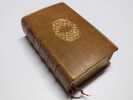
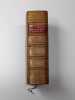
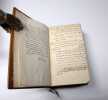
8vo. 3 parts in 1: (VIII),663,(1 blank); 336; 70,(1 errata),(1 blank) p. Calf, end 19th century. 17 cm (Ref: GLN-2264; USTC no. 450529; Smitskamp's 'The Scaliger collection' no. 147; cf. Brunet 5,179; cf. Graesse 6/289 & & 6,444; cf. Hoffmann 3,425; Ebert 20452) (Details: Printed in italics. Some signs of censorship in the text. Nice binding. Gilt panelled back with 5 raised bands. Boards with triple fillet gilt borders and an oval gilt ornament. Edges of the boards and the turn-ins gilt. All edges gilt. Marbled endpapers. 'Veritas' woodcut printer's device on the title, depicting a woman, the naked truth, seated on a cubus, holding a radiant sun in her right hand. In her left hand she holds an opened book and a palm leaf. Her feet rest on the globe; the garland of fruit which surrounds her shows a motto in Greek: 'Alêtheia Pandamatôr', i.e. 'Allmighty Truth'. 2 red/yellow/blue book ribbons. Each of the 3 parts has a title-page of its own. Part 1 contains: Apiculae, p. 1; Nemesis, p. 59; Teretismata, Satyra, p. 76; Nova Epigrammata, p. 113; Farrago, p. 150; Thaumantia, p. 224; Arae Fracastoreae, p. 256; Nymphae indigenae, p. 272; Adamantij Catulli tumulus, p. 391; Heroes, p. 307; Archilochus, p. 339; Hipponax, p. 385; Sidera, p. 458; Lacrymae, p. 526; Aenigmata, p. 546; Urbes, p. 582; Logogriphi, p. 614; Manes Catulliani, p. 634. Part 2 contains: Ata, p. 3; Hymni, p. 79; Epidorpidum libri octo, p. 98; De Regnorum eversionibus, p. 324; Part 3 contains a Latin translation of the Ajax of Sophocles by the son of Julius Caesar, Josephus Justus Scaliger, and concludes with 20 pages epigrammata composed by junior) (Condition: Some slight wear to the binding. Oval stamp cut out of the first 2 title-pages, but skillfully repaired. In old ink 'Expurgata' written on the title page. Paper yellowing, sometimes browning. Occasionally a word, or a line, or sometimes a complete poem has been made illegible with ink stripes by a censuring cleric. Scaliger's Poemata figured in the Catholic 'Index librorum prohibitorum'. This 'Index' of forbidden books contained publications that were banned by the Catholic Church, because they were deemed heretical, anti-clerical or immoral. The censoring sometimes came down to the erasing or cutting out of names, or passages, or the removal of leaves, even complete chapters by catholic librarians. Such a librarian must have written, after having completed the job, at the foot of the title-page, 'Expurgata') (Note: The classical scholar Julius Caesar Scaliger (Giulio Bordone della Scala), 1484-1558, was of Italian origin. In 1524 he moved to France where he became physician to bishop Antonio della Rovere of Agen, and where his brilliant son Joseph Juste was born in 1540, the same year in which his 'De causis linguae latinae libri tredecim' was published. This book is among his most important philological works. Another work of fundamental importance is his 'Poetices libri septem' (1561), a manual for the apprentice poet, that became Europe's standard in matters of Neo-Latin poetry for two centuries. Scaliger published collections of his Neo-Latin poetry in 1533 and 1546. He considered the mastery of Latin composition not as a pastime, but as the scholar's most valuable skill. In 1574 his son Joseph Juste (Josephus Justus) produced a new edition of his father's collected poems during his stay at Geneva, where he took refuge because of the French wars of religion and St. Bartholomew's Day Massacre. Here Scaliger jr. delivered public lectures and tutored students, and met fellow humanists, Beza, Henricus Stephanus et alii, all interested in or writing Neo-Latin poetry. This edition of 1591 is a line by line reissue of the edition of 1574. To the edition of his father's poetry the son added a work of himself, the translation of Sophocles' Ajax. This translation was first published in 1573 in Paris with a Greek text and the translation on the facing page. The appropriate medium for the translation of the Ajax was in Scaliger's eyes archaic Latin. 'He used as many arcane or distinctively pre-classical words as possible (...). He dressed ordinary words in primitive spellings (...). And, like the archaic poets, he freely coined new compound words'. (Grafton,A., Joseph Scaliger, a study in the history of scholarship', volume 1, Oxford 1983, p. 114/115) After the Ajax Scaliger jr. added 20 pages with epigrammata, Greek and Latin, also of his own) (Provenance: Before the title have been bound 2 leaves, the first from 1890, the 2nd much older, after 1633. The text of the first manuscript leaf: 'Ce volume, que j'ai acheté aux libraires Mayer et Muller, de Berlin, était alors relié avec un exemplaire du Poemata de J. César Scaliger, de l'édition rarisssime de 1546. L'un et l'autre, ainsi réunis avaient appartenu à une Bibliothèque de Vérone (on le voit à la maculature laissée par le timbre, en tête de la 2e partie). L'un et l'autre portait les suppressions imposées par l'Index. - Voir, à ce sujet, la note italienne écrite ci après, probablement par un religieux du couvent dont la Bibliothèque possédait ces volumes. Dans l'éd. de 1546, beaucoup des pièces biffées ici n'avaient pas été supprimées. R. Dezeimeris, 1890.' The French historian and politician Reinold Dezeimeris, was 'Conservateur' of the 'Bibliothèque municipale' of Bordeaux, and a passionate bibliophile, but most of all he is remembered for his scholarly activities. He devoted many studies to Renaissance authors from his dear city. He participated in an important edition of the 'Essais' of Montaigne, Bordeaux 1870-1873. This title on offer of father and son Scaliger will have caught his attention, because of their connection with Bordeaux. On the authority of Dezeimeris, who must have had sharp eyes, we assume that the removed stamp from the first 2 title-pages belonged to a library at Verona. In the leaf immediately after the second title the dent of the stamp that was cut out of the title is indeed still visible, though hardly legible. (See for much more on Dezeimeris: rfhl.org/pages/historique/bibliophiles-bordelais/reinhold-dezeimeris-1835-1913.html and especially a biography at: saint-blaise-cadillac.eklablog.com/reinhold-dezeimeris-a46642037. Scaliger pretended to be a descendant of the house of La Scala, for hundred and fifty years lords of Verona. Dezeiremis apparantly split up the binding with works of Scaliger that he bought from the famous price-cutting Berlin 'Antiquariat Mayer & Müller'. This fine binding with Scaliger's Poemata of 1591 was probably commissioned by him. The librarian who wrote 'Expurgata' on the title, probably also wrote the text on the leaf bound before the first flyleaf. It is in Italian, and refers to the decree of the Church for the prohibition of Scaliger's works, dated March 19, 1633) (Collation: *4, a-z8, A-S8, T4 (leaf T4 verso blank); Aa-Xx8; AA-DD8, EE4 (leaf EE4 verso blank))
Illustriss. viri Iosephi Scaligeri, Iulii Caes. à Burden F. Epistolae omnes quae reperiri potuerunt, nunc primum collectae ac editae. Caeteris praefixa est ea quae est De gente Scaligera; in qua de autoris vita; & sub finem Danielis Heinsii De morte eius altera.
Leiden (Lugduni Batavorum), Ex officina Bonaventurae & Abrahami Elzevir, 1627.
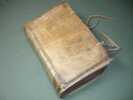
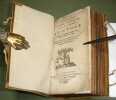
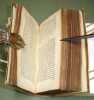
8vo. (XXIV),887,(1 blank) p. Limp restored vellum 18 cm (Ref: STCN ppn 840010095; Willems 288; Berghman 1393; Rahir 253; Smitskamp Scaliger Collection 166; Graesse 6/2,289; Ebert 20438) (Details: Elsevier's printer's mark on the title, depicting an old man who stands in the shade of a vine- elmtree, symbolising the symbiotic relationship between scholar and publisher; the motto: 'Non solus', probably indicates the interdependency of publisher and scholar) (Condition: Binding recently restored antique style. Vellum soiled. Endpapers renewed. Old and small ownership entry on the title. Edges of the title and last leaf, and the tip of the upper corner of first & last 2 leaves skillfully restored. Last 2 leaves slightly soiled. Some faint pencil) (Note: The place of Josephus Justus Scaliger, 1549-1609, in the history of classical scholarship is royal. His preeminence is summarized masterly in the blurb text of the dustjacket of the intellectual biography of Anthony Grafton 'Joseph Scaliger, A study in the history of classical scholarship', Oxford, 1983/93. 'In an age of great classical scholars, Joseph Scaliger was the greatest. His early work as an editor of Latin texts won the attention of the learned throughout Europe and contained technical innovations that remain of interest. His later work as the founder of the discipline of historical chronology involved him in the superhuman task of trying to reconstruct every sophisticated calender and to date every significant event in human history. Along the way he emended hundreds of corrupt passages in classical texts, collated scores of manuscripts, quarrelled with dozens of his rivals, failed humiliatingly (...) to prove that he was descended from the della Scala of Verona - and dashed off in his spare time works that would remain standard for centuries, like Gruter's Corpus of inscriptions, the publication of which Scaliger oversaw. His work was perhaps most important in that it showed that the Bible and the events it recorded could not be understood except in the light of the writings of the pagans and the methods of classical scholarship'. In 1593 he filled the vacant place left by Justus Lipsius at the young the University of Leiden. 'His disinclination to lecture was duly respected; all that the authorities at Leyden desired was his living and inspiring presence in that seat of Protestant learning' (Sandys p. 202). On this honorary post he produced works that made him immortal, and lend lustre to Leyden and its Universtiy. Scaliger spent the last 16 years of his life in Leiden as the jewel of the University. There he enjoyed also the friendship of a great numbers of pupils and admirers. To his circle belonged H. Grotius, D. Heinsius, the Dousae, and in France Du Thou and Casaubon. Scaliger died in the arms of his favourite pupil and closest friend Daniel Heinsius, who wrote a funerary oration for him. The correspondence reflects his relations with contemporary scholars and scientists, and the scholarly circles in which he moved. He corresponded with Salmasius, Heinsius, Casaubon, Lindenbrogius, Gruter, Lipsius, Labbaeus and many others. Scaliger had inherited from his father Julius Caesar Scaliger a profound belief in his descent from the noble Veronese family Della Scala. The correspondence opens with a 58 page letter addressed to Dousa, and is on this matter, 'De vetustate gentis Scaligerae in qua & de vita utriusque Scaligeri'. Here Scaliger tries to prove his princely descent) (Provenance: Old ownership entry on the title of one 'J. Bridges', who also contributed some small marginalia in a clear and legible hand) (Collation: *8, 2*4; A-3I8, 3K4) (Photographs on request)
Iulii Caesaris Scaligeri viri clarissimi Poemata in duas partes divisa. Pleraque omnia in publicum iam primum prodeunt; reliqua vero quam ante emendatius edita sunt. Sophoclis Aiax Lorarius, stylo Tragico a Josepho Scaligero Iulii F. translatus. Eiusdem epigrammata quaedam, tum Graeca tum Latina, cum quibusdam e Graeco versis. (Volume I)
N.pl. (Geneva), (Jacob Stoer for Gaspard de Hus), 1574.
8vo. (IV),663,(1 blank) p. Vellum. 18 cm (Ref: GLN-2523; USTC 450676; cf. Smitskamp's 'The Scaliger collection' no. 146; Brunet 5,179; Graesse 6/289; Ebert 20452) (Details: Back with 4 raised bands. Woodcut printer's mark on the title, depicting two men who are planting and watering young trees; above them, in a cloud, the divine Tetragrammaton, a 4-letter Hebrew word, the name of the biblical God of Israel, Yahweh. Printed in italics. Volume 1 only, containing the poetry of Julius Caesar Scaliger: 'Apiculae, p. 1; Nemesis, p. 59; Teretismata, ubi Satyrae, p. 76; Nova Epigrammata, p. 113; Farrago, p. 150; Thaumantia, p. 224; Arae Fracastoreae, p. 256; Nymphae indigenae, p. 272; Adamantij Catulli tumulus, p. 391; Heroes, p. 307; Archilochus, p. 329; Hipponax, p. 385; Sidera, p. 458; Lacrymae, p. 526; Aenigmata, p. 546; Urbes, p. 582; Logogriphi, p. 614; Manes Catulliani, p. 634. Lacking the second volume with poetry of his son Josephus Justus Scaliger) (Condition: Vellum soiled and age-toned. Owner's inscription on the front flyleaf. Old stamp on the title, depicting the Holy Cross, on which rests the Crown of thornes; the monogram C.S. is written across its standard. A name erased on the title. Paper yellowing. On page 578 has been erased with black ink a 6 lines poem called 'Fratres monachi, iterum', 3 elegiac couplets directed against monks, who are compared to pigs. Volume 1 only, containing the poetry of Julius Caesar Scaliger only, and lacking the second volume with poetry of his son Josephus Justus Scaliger) (Note: The greatest contribution of the classical scholar of Italian origin Julius Caesar Scaliger (Giulio Bordone della Scala), 1484-1558, to the history of classical scholarship is his brilliant son Josephus Justus Scaliger. In 1524 Julius Caesar Scaliger moved to France where he became physician to bishop Antonio della Rovere of Agen, and where his son Joseph Justus was born in 1540, the same year in which his 'De causis linguae latinae libri tredecim' was published. This book is among his most important philological works. Scaliger published collections of his Neo-Latin poetry in 1533 and 1546. He considered the mastery of Latin composition not as a pastime, but as the scholar's most valuable skill. In 1574 his son Josephus Justus produced a new edition of his father's collected poetry during his stay at Geneva, where he took refuge because of the French wars of religion and St. Bartholomew's Day Massacre (1572). Here he delivered public lectures and tutored students, and met fellow humanists, Beza, Henricus Stephanus et alii, all interested in or writing Neo-Latin poetry.) (Provenance: On the front flyleaf: 'Ad usum D. Romanus Merighij Camald.sis'. This is Don Romanus Merighius (Romano Merighi), born near Imola in 1658, head (procurator generalis) of the Camaldolese Order, the 'Ordo Camaldulensium', a monastic community that traces its lineage to a monastic movement begun by Saint Romuald. Their name is derived from the Holy Hermitage, Sacro Eremo, Camaldoli, near Arezzo. Because of the colour of their habit they are called 'White Benedictines'. Romanus was a theologian, but he also earned fame as a prominent vernacular poet. He is known for the Idyll in Toscan 'Nesso e Logilde'. He died in 1737. His portrait can be found via Google, search for "Porträtsammlung" and "ÖNB", then Schnellsuche: "Merighi". A useful article on Merighi in 'Centifolium Camaldulense, Sive Notatia Scriptorum Camaldulensium', by M. Ziegelbaur, Venice 1750, p. 69/71) (Collation: *4, a-z8, A-S8, T4 (leaf T4 verso blank)
Prima Scaligerana, nusquam antehac edita, cum praefatione T. Fabri.
Utrecht (Ultrajecti), Apud Petrum Elzevirium, 1670.
8vo. (X),101,(1 blank) p. Modern half vellum 16 cm (Ref: Willems 1605: one of the few Elzevier-editions from Utrecht; Rahir 1782; Berghman 1339; Not in the 'Scaliger Collection', Smitskamp, Leiden 1993, only mentioned in the register, p. 128. Not in Brunet, Graesse or Ebert) (Details: Boards with marbled paper. Woodcut printer's mark on title, depicting a celestial sphere) (Condition: Small stamp on the title) (Note: The place of Josephus Justus Scaliger, 1549-1609, in the history of classical scholarship is royal. His preeminence is best understood from the entry which the French classicist Isaac Casaubon made in his diary after the death of this great man: 'Exstincta est illa seculi nostri lampas, lumen litterarum, decus Galliae, ornamentum unicum Europae'. His erudition was considered by his contemporaries to be a wonder of mankind. 'He not only exhibits a remarable aptitude for the soundest type of textual emendation; but he is also the founder of historical criticism. His main strength lay in a clear conception of antiquity as a whole, and in the concentration of vast and varied learning on distinctly important works' (Sandys, History of Classical Scholarship, p. 199-204). He was one of the first to point the way to a sounder method of emendation founded on the genuine tradition of MSS. In 1590 he filled the vacant place left by Justus Lipsius at the young the University of Leiden. 'His disinclination to lecture was duly respected; all that the authorities at Leyden desired was his living and inspiring presence in that seat of Protestant learning' (Sandys p. 202). On this honorary post he produced works that made him immortal. His immortality was further ensured by the publication after his death of the Prima Scaligerana, a collection of table conversations in which observations of great scientific value can be found, and which is an exeptional and much-quoted source in the historiography of the late humanistic republic of letters. The complicated history of this Prima Scaligerana and Secunda Scaligerana is explained best online at The Warburg Institute (research/projects/scaliger/scaligerana). The table conversations were originally penned down by a friend of Scaliger, the medicin François de Saint-Vertunien (Franciscus Vertunianus). 'Soweit sie also mündliche Aeusserungen Scaligers enthält, umfasst die Sammlung die Periode 1574 bis 1593.' (...) Nach Vertunians Tode (1607) blieben diese Aufzeichnungen unter seinen Papieren in Poitiers liegen, bis sie um das Jahr 1669 ein dortiger Advokat, de Sigogne, an sich brachte und dem Tanaquil Faber nach Saumur zur Herausgabe schickte'. (Bernays,J., Joseph Justus Scaliger, Berlin, 1855, p. 232) They left the press in Saumur in that same year under a fake imprint, i.e. 'Groningae, apud Petrum Smithaeum, 1669', this to escape the attention of the authorities of the church and the state. This work was edited by the French classical scholar Tanneguy Lefebvre, or in Latin Tanaquillus Faber, 1615-1672. In the short preface to this work M. Lefebvre explains also why this edition was called: Prima Scaligerana. That was because the edition of another collection of Scaligerana which was published a few years earlier (1666 & 1668) contained material of a later date than his edition. The Dutch printer Pieter Elzevier, one of the last Elzeviers of this celebrated family of booksellers, publishers and printers of the 17th century, published in 1670 this reissue of the Groningen edition of 1669. There exists an editio altera, priore emendatior, with the imprint Ultrajecti, Apud Petrum Elsevirium, 1671, which is however a counterfeit, executed in France, and considered a false Elsevier) (Collation: A-G8) (Photographs on request)
Florilegium epigrammatum Martialis. Josephus Scaliger,... vertit graece ad Isaacium Casaubonium
1607 Lutetiæ, Ex Typographia Roberti Stephani, 1607; in-12 de (12) ff. (dont le titre, une étude en latin sur Scaliger et Casaubon, la table, l'extrait du privilège) - 70 ff. ch. Plein veau granité brun, fine roulettte à froid encadrant les plats, dos à nerfs orné de filets pointillés et petits fers dorés, coupes guillochées, tranches rouges ( reliure postérieure). Petit arrachage de cuir à l'angle supérieur du1er plat, sinon très bon exemplaire.
Epigrammes de Martial imprimées en latin et grec chez Robert III Estienne dans une édition donnée par Joseph Scaliger ( 1540- 1609), et Isaac Casaubon (Genève 1559 - Londres 1614). Scaliger et Casaubon étaient deux humanistes protestants, traducteurs et commentateurs des textes antiques. Casaubon était marié à la fille de l'imprimeur Henri Estienne. Intéressante édition, où se trouve au colophon la mention: "Excudebat Ionnes Ianonus in Typographia Rob. Stephani, Anno M. DC. VII". Jean Jannon (Genève 1580 - Sedan 1658) fit son apprentissage chez Robert III Estienne. Il est connu "pour avoir gravé par la suite un petit caractère d'une grande finesse: "la petite sedanaise" dont le nom évolua au cours des siècles en "romain de l'université" puis fut attribué à tort à Claude Garamond". Les études du XXe siècle en typographie ont rétabli la paternité de ce caractère à Jannon.( Reu-Bur)


Iulii Caesaris Scaligeri viri clarissimi Poetices libri septem: I. Historicus, II. Hyle, III. Idea, IIII. Parasceue, V. Criticus, VI. Hypercriticus. VII. Epinomis. Ad Sylvium filium. Editio secunda.
N.pl. (Geneva), Apud Petrum Santandreanum (Pierre de Saint-André), 1581.
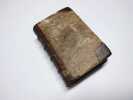
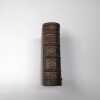
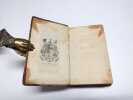
8vo. (XXIV),945 (recte 949; p. 1-432, 431-462 459-945),(67 index) p. Half calf. 18 cm (Ref: GLN-2893; Graesse 6/1,289; Ebert 20450) (Details: Back gilt and with 4 raised bands. Santandrea's 'Veritas' printer's device on the title: a woman, the naked truth, seated on a cubus, holding a radiant sun in her right hand; in her left hand she holds an opened book and a palm leaf; her feet rest on the globe; the garland of fruit which surrounds her shows a ribbon with the text in Greek: 'Alêtheia Pandamatôr', i.e. 'Allmighty Truth) (Condition: Small hole at the junction of the spine and the joint near the foot of the spine. Wear to the head and tail of the spine. Edges a bit worn. Marbled paper on the boards wearing away. Right upper corner of the upper board bending. Bookplate on the front pastedown. Endpapers slightly stained. Three small wormholes in the first leaves. Some small wormholes in the blank lower margin in a few places. Paper yellowing) (Note: The greatest contribution of the classical scholar of Italian origin Julius Caesar Scaliger (Giulio Bordone della Scala), 1484-1558, to the history of classical scholarship is of course his brilliant son Joseph Justus Scaliger. In 1524 he moved to France where he became physician to bishop Antonio della Rovere of Agen, and where his son Joseph Justus was born in 1540, the same year in which his 'De causis linguae latinae libri tredecim' was published. This work is among his most important philological works. A far more comprehensive work is Scaliger's 'Poetices libri septem', posthumously published at Lyon in 1561, which offers his generically organized classifications of kinds of ancient and modern Latin poems, and comparative criticism of ancient and modern poets, recognizing the rivalry and imitation in Greek, Roman and modern writings. It is 'one of the earliest modern attempts to treat the art of poetry in a systematic manner. Here he deals with the different kinds of poems, and the various metres, together with figures of speech and turns of phrase, criticises all the Latin poets ancient and modern, and institutes a detailed comparison between Homer and Virgil to the distinct advantage of Virgil, while the epics of Homer are regarded as inferior to the 'Hero and Leander' of Musaeus. He also declares Seneca inferior to none of the Greeks in majesty. He makes all literary creation depend ultimately on judicious imitation'. (Sandys 2, p. 178) This Genevan edition of 1581 is a reissue of the edition of 1561. This fundamental work remained the standard in matters of Latin poetry well into the 18th century) (Provenance: Engraved armorial bookplate of 'Robert Chambre Vaughan Esq. Burlton Hall, Co. Salop'. Vaughan, Robert-Chambre, esq. of Burlton Hall in the County of Salop, born in 1796, was a graduate of Brasenose College, Oxford. (See for him and his ancestors J. Burke, 'A Genealogical and Heraldic History of the Commoners of Great Britain and Ireland', London 1835, Volume 2, p. 238/242). In 1818 the degree of Bachelor of Arts was conferred to him. He died in 1876)(Collation: *8, 2*4, a-z8, A-Z8, Aa-Rr8, Ss4)
SCALIGERANA Editio altera ad vervm exemplar restitua, & innumeris jusque foedissimis mendis, quibus prior illa passim ...
Coloniae Agrippinae( Rouen ? ) Apud Gerbrandum Scagen ( A. Daillé ) 1667 1 vol. in-18 ( 16 x 9 cm ) T. , (5) ff. n. ch. , 268 ( i. e. 254 ) pp. . Texte en petits caractères . Avec Lectori S. et Errata . Au titre , marque typographique à la sphère armillaire . Veau brun granité de l' époque . Dos à cinq caissons ornés et titre dorés . Toutes tranches jaspées rouges . Reliure solide . Manquent la coiffe sup. et une partie du caisson sup. ; coiffe inf. légèrement arasée . Manque au plat inf. ( éraflure peu visible ) . P. 97 ch. 79 ; p. 195 ch. 209 , p. 196 ch. 210 et ainsi de suite jusqu' à la fin ( p. 254 ch. 268 ) . ( Collat. complet )
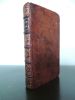
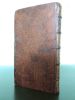
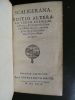
" Recueil des propos tenus par Joseph Juste Scaliger au cours de conversations avec Nicolas et Jean Vassan, transcrits par le second qui confia ses notes à Pierre Dupuy ; quelques familiers de celui-ci en firent des copies ; celle réalisée par Claude Sarrau fut à son tour copiée et mise en ordre alphabétique par Adrien Daillé ; c'est cette copie que Isaac Vossius fit imprimer en 1666 à l'insu de Daillé, qui, jugeant l'édition pleine de fautes, aurait réalisé cette édition en 1667. - Imprimé à Rouen sous une fausse adresse d'après P. des Maizeaux ; cependant, d'après le matériel typographique, si l'impression est effectivement française, elle ne présente aucune des caractéristiques des impressions rouennaises. " ( BnF , Catalogue général , Notice bibliographique , https://catalogue.bnf.fr/ark:/12148/cb30383762r ) . " La première édition du Scaligerana Secunda , parue en 1666 sous le nom de Scaligeriana , est en principe à éviter : elle a été faite d' après une copie hâtive et les fautes sont nombreuses . L' édition de Rouen ( sous le nom de Cologne ) de 1667 ( Scaligerana, editio altera , ad verum exemplar restituta ...) doit être considérée comme la véritable première édition " ( F. Wild , " Le prima Scaligerana . Registre d' une amitié savante " , in : " Albineana , Cahiers d'Aubigné " , 7 , 1996 , p. 130 ) . " Les Scaligerana , ou bons mots de l' illustre humaniste protestant Joseph-Juste Scaliger ( 1540 - 1609 ) , ont toujours eu mauvaise réputation . Dès 1666, à leur première parution , Guy Patin confiait à son collègue médecin André Falconet , que " c' est un livre fort curieux , mais un peu dangereux ". Jusqu' à la fin du XVIIe siècle , son parfum de scandale lui valut d' innombrables rééditions, et autant de contrefaçons . Toutes parurent en terre hérétique , à La Haye , à Saumur , ou chez les imprimeurs rouennais . Dans le même temps , ce livre eut une postérité également extraordinaire qui lui valut d' être considéré comme le père d' un genre nouveau , les ana ." ( J. Delatour , " Pour une édition critique des Scaligerana " , in : " Bibliothèque de l' Ecole des chartes ", 1998 , T. 156 , livraison 2 , p. 407 ) . J. Delatour ajoute en note : " Les lieux des premières éditions ont été systématiquement supposés " et renvoie à Pierre Des Maizeaux ( " Scaligerana, Thuana, Perroniana, Pithoeana, et Colomesiana , ou Remarques historiques, critiques, morales, & litteraires de Jos. Scaliger, J. Aug. de Thou, le cardinal du Perron, Fr. Pithou, & P. Colomiés " , Chez Cóvens & Mortier, 1740 , T. 2 , p. XXVI ) qui intitule la préface de notre ouvrage " Préface de Mr. Daillé sur la seconde édition du Second Scaligerana , imprimée à Rouen , sous le nom de Cologne , en 1667. "
ΑΡΙΣΤΟΤΕΛΟΥΣ ΠΕΡΙ ΖΩΩΝ ΙΣΤΟΡΙΑΣ. Aristotelis historia de animalibus. Iulio Caesare Scaligero interprete, cum eiusdem commentariis; Philippus Jacobus Maussacus, in senatu Tolosano consiliarius regius, ex bibliotheca paterna opus a multis abhinc annis expetitum primus vulgauit & restituit, additis prolegominis & animaduersionibus ; Accedit fragmentum quod decimus historiarum inscribitur, multo quam antea antea emendatius & auctius ; Additi praeterea indices, unus auctorum qui in opere citantur & emendantur, alter rerum & verborum notabilium.
Tolosae, Apud Dominicum & Petrum Bosc., 1619. In-folio de [32]-1248-[24] pages, plein veau fauve de l'époque, dos à 6 nerfs orné de fleurons, filets, roulettes et titre dorés, double filet doré encadrant les plats. Tampon de bibliothèque au titre.
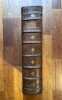
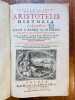
Illustré d'un belle vignette de titre. Bandeaux et lettrines. Première édition de cette version de Scaliger, un des plus célèbres polémistes de la renaissance, publiée à titre posthume sous la direction de l'excellent helléniste P. J Maussac qui a fourni une traduction latine et quelques notes pour accompagner les extraits d' Aristote en grec et les longs commentaires de Scaliger. "Né enItalied'une famille qu'il prétendait illustre et qui fut très vraisemblablement obscure, condottiere de l'épée avant de devenir «gladiateur des lettres» (Nisard), tour à tour étudiant et moine, Jules César Scaliger (1484-1558) s'initie à la médecine, qu'il vient exercer en France: il se fixe à Agen, qu'il ne quittera pratiquement plus. Doué d'une force de travail et d'une mémoire exceptionnelles, il acquiert une érudition immense qui fait l'étonnement de ses contemporains mêmes. Traducteur (en latin) et commentateur savant mais aussi critique d'écrits scientifiques grecs — du livre d'Hippocrate sur l'insomnie (1538), duTraité des planteset de l'Histoire des animauxattribués àAristote(1556), [...] il se signale par de fracassantes querelles avec des hommes de lettres, des savants, des philosophes, en particulier Cardan, et surtout Erasme [...]" [J.-Y. Pouilloux, Encycl. Uni.].
C. Iulii Caesaris quae extant [Les oeuvres de Caius Julius César]
Ex officina Elzeviriana | Lugduni Batavorum [Leyde] 1635 | 7.7 x 12.9 cm | Relié
Édition elzévirienne du texte de Jules César, d'après la recension établie par le philologue et historien humaniste Joseph Juste Scaliger (1540-1609), rattaché à l'université de Leyde ; cette édition posthume parut vingt-six ans après la mort de Scaliger. Précieux exemplaire comportant toutes les caractéristiques du premier tirage : La tête de buffle ornant la vignette d'en-tête de la dédicace et de la page 1 La page 149 est numérotée 153 La page 335 est numérotée 345 La page 475 est numérotée 375 L'index imprimé en caractères italiques Page de titre gravée en taille douce, deux vignettes d'en-tête ornées, un portrait de Jules César et 5 planches en pleine page gravés sur bois, 3 cartes gravées dépliantes, nombreuses petites lettrines ornées, un cul-de-lampe orné d'une tête grotesque. Reliure en plein maroquin rouge, plats ornés d'encadrements dorés avec des fleurons dorées dans chaque coin, dos lisse orné de bandeaux et de motifs de vases dorés, titre, année et éditeur dorés au dos, roulette dorée sur les coupes, contreplats et gardes de papier marbré, tranches dorées, reliure de la période Empire. Discrètes vaguelettes sur le cuir, coins, coupes inférieures et coiffes légèrement frottés, dos très légèrement insolé, rares annotations à l'encre sur certains feuillets. Précieuse édition imprimée en minuscules caractères neufs, recherchée pour la qualité de son papier et l'élégance de ses gravures, ici minutieusement reliée en fin maroquin rouge du style Empire. - Photographies et détails sur www.Edition-Originale.com -
Scaligeriana. ou Bons mots, rencontres agréables, et remarques judicieuses & sçavantes de J. Scaliger. Avec des notes de M. [Tanneguy II] Le Fèvre, & de Mr. de Colomies. Le tout disposé par ordre alphabétique en cette nouvelle édition
Cologne [= Utrecht ?], chez *** [Halma ?], 1695 in-12, titre, 418 pp., un f. vierge, [4] ff. n. ch. (poésie latine, catalogue de livres), avec un frontispice gravé, veau blond, dos à nerfs cloisonné et fleuronné, pièce de titre cerise, encadrement de triple filet doré sur les plats, tranches dorées, gardes peigne jaspées (reliure de l'époque). Coiffe supérieure rognée, rousseurs.
Nouveau recueil, très rare, des pensées de Joseph-Just Scaliger, à ne pas confondre avec celui donné par les frères Dupuy en 1666 sous le titre Scaligeriana, sive Excerpta ex ore Josephi Scaligeri, et abondamment réédité ensuite. Les titres du catalogue final suggèrent - sans certitude - Utrecht comme lieu d'impression.Curieusement aucun exemplaire de cette édition au CCF.Ex-libris manuscrit du bibliographe Simon Chardon de La Rochette (1753-1814).Bel exemplaire. - - VENTE PAR CORRESPONDANCE UNIQUEMENT - LIEN DE PAIEMENT, NOUS CONSULTER.
M. Manili astronomicon libri quinque
Roberti Stephani apud Mamertum Patissonium [ Mamert Patisson] | Lutetiae (Paris) 1579 | 10 x 16 cm | 2 parties reliées en un volume
Edition originale, rare. La première partie à pagination séparée est constituée par le texte de Manilius (caractères italiques), la seconde, qui possède sa propre page de titre et sa pagination, par les commentaires de Scaliger, lesquels sont deux fois plus long que le texte. Cette seconde partie est accompagnée de quelques diagrammes, notamment hors-texte. Marques de l'imprimeur sur les deux pages de titre. Plein Parchemin d'époque. Dos lisse avec titre à la plume noire. Coin droit manquant sur quelques mm sur le plat supérieur. Bordure ouverte sur 3 mm au plat inférieur. Les astronomiques de Manilius, poète let astrologue latin du début du premier siècle, est un poème didactique sur l'astronomie et l'astrologie. Le livre premier constitue une description du ciel, le second est consacré au zodiaque, le troisième apprend comment établir un horoscope d'après l'observation des cieux, le livre quatre est une analyse des peuples de la terre selon l'influence astrale, et le dernier livre une explication de l'influence des planète selon leurs positions. On notera que pour la première fois dans l'histoire de l'astrologie appraît dans ce texte le concept de "Maison", toujours utilisé. Les commentaires et réflexions de Saliger sont les premiers existants sur cet ouvrage. Scaliger, on le sait, fut un des plus importants érudit du XVIe siècle et succèda à Juste Lipse à L'université de Leyde. Son intérêt pour la chronologie, l'astrologie et l'astronomie l'a accompagné sa vie durant. Ses détracteurs lui reprochèrent cependant en ce domaine une approximation dans ses sources et une certaine erreur dans ses jugements sur l'astromie ancienne. - Photographies et détails sur www.Edition-Originale.com -
Hippolyti Episcopi Canon Paschalis: cum Josephi Scaligeri Commentario. Excerpta ex Computo Græco Isacii Argyri de Correctione Paschatis. Josephi Scaligeri Elenchus et castigatio Anni Gregoriani. [relié avec] Ioannis Meursi De luxu romanorum liber singularis siue Commentarius Vberior in locum Senecae epist. CXIV item Mantisa.
Lugduni Batavorum, ex Officina Plantiniana, apud F. Raphelengium, [et] Hagae-Comitis : ex officinâ Hillebrandi Iacobi, 1595 [et] 1605. 2 volumes reliés en un de [12]-78 et [8]-88-[8] pages ( *6; A-I4; K3 et *4; A-M4) reliés en plein vélin (reliure XXème).
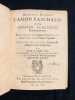
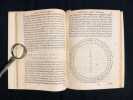
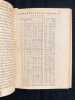
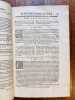
Commentaire de Joseph-Juste Scaliger sur le comput de Pâques établi par Hippolyte de Rome au troisième siècle. Après l'adoption par l'église catholique du calendrier grégorien en 1583, Scaliger publie "Opus novum de emendatione temporum" ou il établi un comput du temps à partir du lundi 1 janvier - 4712. De là il continue sans cesse, entre autres matières - à s'occuper de calendriers. Johannes von Meurs est un érudit hollandais qui fut philologue classique, lexicographe et historien d'expression latine.Nom de possesseur ancien au premier feuillet blanc du premier ouvrage. Ex-libris Édouard Chapuisat, avec sa devise "Juste et courtois". Mouillure, papier un peu bruni.
[Henri Scheurleer] - PITHOU, Pierre ; LIPSE, Juste ; SAUMAISE, Claude ; VINET, Elie ; SCALIGER, Joseph Juste
Reference : 66301
(1712)
Pervigilium Veneris ex editione Petri Pithoei, Cum ejus & Justi Lipsii Notis ; Itemque ex alio Codice Antiquo, Cum Notis Cl. Salmasii et Pet. Scriverii Accessit ad haec Andr. Rivini Commentarius. Ausonii Cupido Cruci Adfixus, Cum Notis Mariang. Accursii, El Vineti, Pet. Scriverii et Anonymi. Accessere ad Calcem Jos. Scaliger et Casp Barthii animadversione
1 vol. in-8 reliure de l'époque pleine basne marbrée, dos à 5 nerfs orné, coupes et chasses ornées, Apud Henricum Scheurleer, Hagae Comitum [ Den Haag ; La Haye ], 1712, XVI-208 pp. et 8 ff. n. ch. Rappel du titre complet : Pervigilium Veneris ex editione Petri Pithoei, Cum ejus & Justi Lipsii Notis ; Itemque ex alio Codice Antiquo, Cum Notis Cl. Salmasii et Pet. Scriverii Accessit ad haec Andr. Rivini Commentarius. Ausonii Cupido Cruci Adfixus, Cum Notis Mariang. Accursii, El Vineti, Pet. Scriverii et Anonymi. Accessere ad Calcem Jos. Scaliger et Casp Barthii animadversione
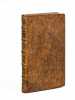
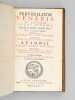
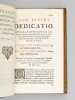
Le manuscrit de la "Veillée de Vénus" ("Pervigilium Veneris") fut découvert en 1507 à Venise, par Erasme, dans la bibliothèque d'Alde Manuce, mais il ne fut publié par Pierre Pithou qu'en 1587. Le poème décrit le réveil printanier de la flore et de la faune. Bon état (ex-libris en garde). Good condition (ex-libris).
POMPEIUS (Sextus Pompeius Festus) - VERRIUS FLACCUS Marcus - SCALIGER Joseph
Reference : 14650
(1574)
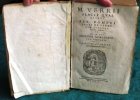
M. Verrii Flacci quae extant Sex. Pompei Festi De Verborum Significatione libri XX.
M. Verrii Flacci quae extant Sex. Pompei Festi De Verborum Significatione libri XX. Et in Eos Josephi Scaligeri Iul. Caesaris Filii Castigationes nunc primum publicatae.Marcus Verrius Flaccus (né vers 55 avant J.-C., mort en 20 après J.-C.), est un savant érudit, historien, philologue, poète, grammairien et maître d'école (grammaticus) romain, exerçant sous les règnes d'Auguste et de Tibère.Festus Grammaticus, Sextus Pompeius Festus est un grammairien latin de la fin du IIe siècle ap. J.-C, ayant peut-être vécu à Narbo (Narbonne).Il avait composé, sous le titre de Significatione Verborum, une sorte de dictionnaire précieux pour la connaissance des antiquités romaines, de la langue latine et de la mythologie.Joseph Juste Scaliger, fils de Jules César Scaliger, né en 1540 à Agen et mort en 1609 à Leyde est l'un des plus grands érudits français du XVIe siècle. Il surpassa de loin son père comme philologue, et se fit en outre un nom comme chronologiste et historien.Sans lieu (Genève), Apud Petrum Santandreanum 1574-1575. Préface, 200 pages, index, et Annotationes (1574), 76 pages.Reliure plein vélin de l'époque. Dos à nerfs avec titre manuscrit (restauré). Quelques mouillures. 2 coins frottés. Pas de rousseur. Bon état. Format in-12°(17x12).
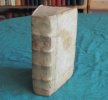
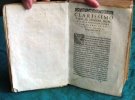
Scaliger Epistolae aliquot nuc primum vulgate. [suivi de : Familiarium exercitationum libris].
1620 1 Toulouse, Dominicum Bosc & Petrum Bosc, 1620, in-4° en deux parties de 79 et 52 pp., reliure vélin XIXe, gardes renouvelées.
Scaliger, grand érudit, donne ici ses commentaires sur Aristote et son "Histoire des animaux" ; à la suite, figurent les reliquats savants d'un rat de bibliothèque assidu à la fréquentation des livres.
Catulli, Tibulli, Properti, nova editio. Iosephus Scaliger Iul. Caesaris F. recensuit. Eiusdem in eosdem Castigationum Liber. Ad Cl. Puteanum…
1582 basane XVIIe, dos à n. (reliure très usée, un plat détaché). in-8, (6ff.), 274pp., (1f. bl), 240 (4ff.), 192pp., (3ff.), Anvers apud Aegidium Radaeum 1582
M. Manil Asto, omicon libri quinque. Josephus Scaliger Iul. Caes. F. recensuit ac pistino ordini suo restituit. Ejusdem Ios. Scaligeri Commentarius in eosdem libros et castigationum explicationes.
Lutetiae, apud Marnerum Patissorum typographum Regius, in officina Roberti Stéphani, 1579 ; deux parties avec titre propre reliées en un volume in-8, veau marbré, dos à nerfs décoré et doré avec le chiffre de Mathieu Molé, armes de Mathieu Molé au centre des plats ; (12)-136 pp. , (6) p. , (1) f. blanc ; 292, (12) pp.volume in-8, veau marbré, dos à nerfs décoré et doré avec le chiffre de Mathieu Molé, armes de Mathieu Molé au centre des plats ; (12)-136 pp. , (6) p. , (1) f. blanc ; 292, (12) pp.
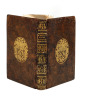
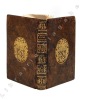
Première édition donnée par Scaliger, qui a suivi un manuscrit très ancien de l'Abbaye de Gembloux et y a joint de très longs commentaires qui forment la seconde partie ; cette édition est d'ailleurs l'une des plus appréciées et des plus érudites. Exemplaire aux armes de Mathieu Molé, seigneur de Champlâtreux (1584-1656), conseiller au Parlement de Paris en 1606 à 22 ans, puis président d'une chambre des enquêtes, procureur général en 1614, enfin premier Président en 1641. Il joua un grand rôle de conciliateur entre le Parlement et Anne d'Autriche pendant la Fronde, souvent au péril de sa vie ; fervent bibliophile, ses livres passèrent à son troisième fils abbé de Sainte-Croix. (OHR 258, fer 1 pour le plat et 3 pour le dos). Ex-libris gravé du XVIIe : Ex-bibliotheca de Meaux : Etienne de Meaux, seigneur de Châtillon, Marbé, la Douze, premier président au baillage et présidial de Mâcon (ORH 276). Le poème de Manilius est autant astrologique qu'astronomique. On y trouve : liber I, notions de la sphère de la figure de la terre, de la division du ciel et des constellations ; liber II, les sexes et autres qualités des signes du zodiaque ; liber III, les correspondances astrologiques entre les signes et les années, les mois, les jours ; liber IV, des considérations sur la grandeur et l'intelligence ; liber V, l'astrognosie extra-zodiacale, les levers et couchers des constellations, la distinction des étoiles en six grandeurs (la plus ancienne mention de ce genre). Contemporain d'Auguste, affranchi originaire de Syrie, Manilius a rédigé ce traité sous forme de vers, fort beaux, du reste ; la première édition date de 1472, il y avait eu, en raison de son immense succès, une dizaine d'éditions incunables et autant au XVIe siècle. Petites usures aux coiffes et coins mais bel exemplaire dans l'ensemble, l'intérieur est frais et la provenance prestigieuse. (Renouard-I-181-4 ; Houzeau-Lancaster-1037).
Magnae deum matris Idaeae & Attidis initia, ex vetustis monumentis nuper Tornaci erutis. Edente iterum & explicante accuratius ad veterum auctorum mentem Laurentio Pignorio. [relié avec] Jul. Caes. Scaligeri Adversus Desid. Erasmum orationes duae, eloquentiae romanae vindices, una cum ejusdem epistolis et opusculis aliquot nondum vulgatis, quibus de novo etiam accedunt Problemata gelliana, ut reperiri potuerunt.
Venetiis, Sumptibus Petri Pauli Tozzii, 1624. In-4 de 23-[2[ et une planche hors-texte; et [24]-51-[1] pages, cartonnage du temps.
Une large marque d'imprimeur gravée, deux planches à pleine page, et 4 gravures in-texte pour le premier ouvrage; et une marque d'imprimeur pour le second. Sacerdos Matris Deum Magnae Idaeae était le titre de la prêtresse de la déesse Cybèle dans la Rome antique. Cette fonction fut créée lorsque le culte de Cybèle fut officiellement introduit à Rome en 204 av. J.-C. La prêtresse de Cybèle officiait aux côtés d'un prêtre de Cybèle en tant que deux chefs du culte ; ensemble, ils supervisaient les galli, les assistants, qui accomplissaient d'autres tâches liées à la liturgie, telles que fournir la musique sacrée. Officiellement, la prêtresse et le prêtre devaient être originaires de Phrygie, le pays natal de la déesse ; dans la pratique, ils n'étaient pas toujours originaires de Phrygie, mais ils étaient toujours étrangers. Contrairement au prêtre, qui se castrait, la prêtresse ne subissait aucune modification physique.Le second opuscule est un recueil partiel de deux discours de Jules César Scaliger contre Erasme qui vient de publier, en 1528, son Ciceronianus , dans lequel il caricature les cicéroniens. Publié à Toulouse, chez Raymond Colomiez en 1621. Il contient la préface, qui est dédiée à Guillaume Du Vair et l'épître dédicatoire adressée par Erasme à Johannes Von Vlatten; et se trouve relié ensuite la dernière partie de l'ouvrage, celle relative aux "Problemata gelliana". Cartonnage frotté.
[Gerhardum Nicolaum V.] - SCHOPPE, Caspar ; [ SCIOPPIUS ] ; SCALIGER, Joseph ; LINDENBROG, Friedrich
Reference : 66885
(1664)
Priapeia, sive diversorum Poetarum in Priapum Lusus ; Illustrati Commentariiss Gasperis Schoppii, Franci, L. Apuleii Madaurensis Anechomenos, Heraclii Imperatoris, Sophoclis Sophistae, C. Antonii, Q. Sorani, & Cleopatrae reginae, Epistolae, De propudiosa Cleopatrae Reginae libidine, Huic editioni accedunt Joseph Scaligeri in Priapeai commentarii ac Frederici Linden-Bruch in eadem notae.
1 vol. petit in-8 cartonnage de l'époque, Apud Gerhardum Nicolaum V., Patavii [ Amsterdam ], 1664, 8 ff., 175 pp. Rappel du titre complet : Priapeia, sive diversorum Poetarum in Priapum Lusus ; Illustrati Commentariiss Gasperis Schoppii, Franci, L. Apuleii Madaurensis Anechomenos, Heraclii Imperatoris, Sophoclis Sophistae, C. Antonii, Q. Sorani, & Cleopatrae reginae, Epistolae, De propudiosa Cleopatrae Reginae libidine, Huic editioni accedunt Joseph Scaligeri in Priapeai commentarii ac Frederici Linden-Bruch in eadem notae.
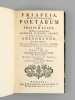
Cette édition savante enrichie notamment des commentaires de Scioppius et de Scaliger est l'une des premières éditions complètes des "Priapées". "Voici, selon une conjecture du très docte Scioppius, l'origine des "Lusus in Priapum" : une niche, en forme de petit temple, abritait dans les jardins de Mécène, la statue du dieu des jardins ; un des convives du maître de la maison passa un jour devant la grotesque image ; il improvisa quelques vers, et il les inscrivit sur le mur de la niche ; d'autres vinrent, lurent et tinrent à ne pas rester en arrière. Ainsi se forma une sorte d'album qui est venu jusqu'à nous" (Gay, III, 848-850). Bon état (cartonnage un peu frotté, très bon état par ailleurs, ex-libris en garde).
Catalectes, ou Pièces choisies des anciens, recueillies en deux livres par Ioseph Scaliger. Traduction en vers par Michel de Marolles, abbé de Villeloin.
"5. Paris, s.e., 1667, in-8°, xvi + 256 pp, contemporary full calf, rather worn, extremeties damaged, headcaps missing, joints cracked but holding, interior fine apart from a tiny worm gallery in the inner margin of the last work. 16 Pages containing the notes, are bound before the title page. Followed by other translations by Villeloin; Le livre des spectacles et le premier livre des Epigrammes de Martial, 100 pp; Les estreines et les apophorettes ou les présens de Martial, qui composent les deux derniers livres des Epigrammes de ce Poëte, ib., 110 pp; Lettre de M. l'abbé de Villeloin à Monsieur l'abbé de la Victoire, Touchant quelques Traductions de l'Eneïde de Virgile, 1667., 24 pp; L'histoire auguste des six autheurs anciens..., Paris, 1667, 32 nn pp; notes, 48 pp, with a 17th-c. score for two songs from Antiquity. Joseph-Juste Scaliger, 1540-1609, philologist and historian. Michel de Marolles, 1600-1681, neither a good translator nor a good priest, but whose collection of engravings is the nucleus of the Cabinet des Estampes."
[Librairie Droz] - SCALIGER, Jules-César ; (CHOMARAT, Jacques)
Reference : 63240
(1994)
La Poétique. Livre V : Le Critique [ Livre dédicacé par le traducteur ]
Présentation, traduction et notes de Jacques Chomarat, 1 vol. grand in-8 reliure pleine toile rouge éditeur, Travaux d'Humanisme et Renaissance, Librairie Droz, Genève, 1994, 412 pp.
![La Poétique. Livre V : Le Critique [ Livre dédicacé par le traducteur ]. SCALIGER, Jules-César ; (CHOMARAT, Jacques)](https://static.livre-rare-book.com/pictures/CDL/63240_thumb.jpg)
![La Poétique. Livre V : Le Critique [ Livre dédicacé par le traducteur ]. SCALIGER, Jules-César ; (CHOMARAT, Jacques)](https://static.livre-rare-book.com/pictures/CDL/63240_2_thumb.jpg)
![La Poétique. Livre V : Le Critique [ Livre dédicacé par le traducteur ]. SCALIGER, Jules-César ; (CHOMARAT, Jacques)](https://static.livre-rare-book.com/pictures/CDL/63240_3_thumb.jpg)
Bel exemplaire enrichi d'un envoi du traducteur. Le cinquième livre de la Poétique de Scaliger est consacré à une comparaison des poètes latins et des poètes grecs.
Prima Scaligerana priore emendatior.
Ultrajecti [Utrecht], apud Petrum Elzevirium [Elzevier / Elsevier], 1671. Un vol. au format in-16 (137 x 87 mm) de 6 ff. n.fol. et 140 pp. Reliure de l'époque de plein veau moucheté havane, armes dorées de Le Fèvre de Caumartin de Saint-Ange portées au centre de chacun des plats, dos à nerfs orné de filets gras à froid, doubles caissons d'encadrement dorés, fleurons dorés, titre doré, roulette dorée sur les coupes, tranches jaunes et mouchetées.
![Prima Scaligerana priore emendatior.. [SCALIGER (Joseph Juste)].](https://static.livre-rare-book.com/pictures/BLS/25912_1_thumb.jpg)
![Prima Scaligerana priore emendatior.. [SCALIGER (Joseph Juste)].](https://static.livre-rare-book.com/pictures/BLS/25912_2_thumb.jpg)
Exemplaire - sorti des presses des Elzevier - sous reliure aux armes de Le Fèvre de Caumartin, Marquis de Saint-Ange ; dont la bibliothèque s'avérait « remarquable tant par le choix des ouvrages que par la beauté des reliures » (in OHR). Les ''Scaligerana'' marquent la naissance d'un genre littéraire nouveau : les Ana ''Scaliger est l'un des plus grands érudits français du XVIème siècle. Il surpassa son père (Julés César) comme philologue, et se fit en outre un nom comme chronologiste et historien. Il est considéré comme le créateur de la science chronologique et notamment de la période julienne (en hommage à son père), utilisée en astronomie, qui permet une datation indépendante du calendrier en vigueur.'' Willems, Les Elzevier, 2150 - OHR, Guide de l'amateur de reliures armoriées, 651. - Dubuisson I, Armorial des principales maisons du royaume, p. 147. Angles élimés. Plats légèrement desquamés. Coiffe supérieure arasée. Petit manque en queue du dos. Petit manque angulaire ou marginal affectant deux feuillets. Quelques claires rousseurs dans le corps d'ouvrage. Du reste, bonne condition.
SÉNÈQUE (Lucius Annaeus SENECA), PUBLILIUS SYRUS MIMUS, S. HAVERCAMP, A. PREYGER, J. GRUTER, SCALIGER
Reference : 20016
(1708)
L. Annaei senecae & P. Syri Mimi, forsan etiam aliorum, singulares sententiae, centum aliquot versibus ex Codd. Pall. & Frising. auctae & correctae, studio & opera Janu Gruteri. Cum notis ejusdem recognitis & castigatis. Accedunt ejusdem notae postumae ut & nova versio graeca Josephi Scaligeri
1708 Lugduni Batavorum, Apud Johannem du Vivie, 1708, frontispice allégorique dessiné par F. Goeree gravé par P. Sluyter et jolie vignette gravée d'après le même sur la page de titre qui est imprimée en rouge et noir, in-8 de (26)-569-(5) pp., reliure de l'époque, dos lisse de velin ivoire orné de fleurs de lis et filets dorés, pièce de tire de maroquin vert, plats de veau brun moucheté avec encadrement de filet dorés, tranches dorées, bel exemplaire
Texte en latin et en grec. Réunion des aphorismes de Sénèque et de Publilius Syrus, corrigée par Sigebert Havercamp et Abraham Preyger, qui reprennent ici la version que l'humaniste Jean Gruter donna au début du XVIIe siècle. Des annotations abondantes et érudites de Gruter parcourent l'ouvrage. Le texte grec des apophtegmes de Syrus établi par Scaliger (d'après Gruter), se trouve à la fin de l'ouvrage.
LETTRES GRECQUES DE J.-C. SCALIGER A IMBERT
Imprimerie G. Gounouilhou, Bordeaux. 1877. In-8. Broché. Etat d'usage, Couv. défraîchie, Dos abîmé, Déchirures. Plaquette de 37 pages. Gravure en noir et blanc en page de titre. Bandeaux et culs-de-lampe ornés en noir et blanc. Envoi manuscrit du traducteur sur le 1er plat. Manques sur le dos. 2e plat abîmé. Galeries d'insectes en bas de pages n'altérant pas la lecture.. . . . Classification Dewey : 97.2-Dédicace, envoi
Publiées, trad. et annotées par Reinhold DEZEIMERIS. Classification Dewey : 97.2-Dédicace, envoi

