 Write to the booksellers
SCALIGER,J.C. & "GIESSENER POETIK."
Iulii Caesaris Scaligeri Viri Clarissimi, De causis linguae latinae libri tredecim. (Bound with:) Poetica Latina Nova, methodo perspicua tradita, commentariis luculentis declarata, exemplis tum veterum, tum recentiorum Poëtarum illustrata (...). Per Scholae Giessenae nonnullos Professores Philosophos.
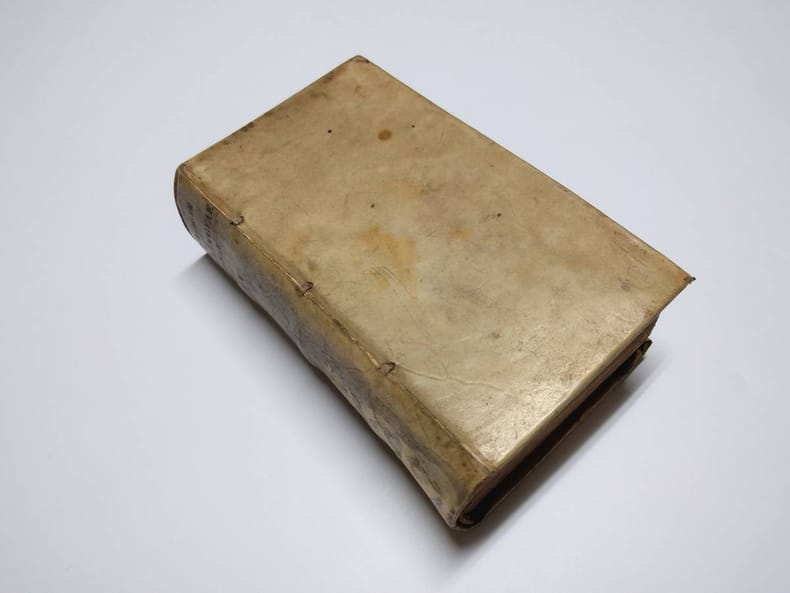
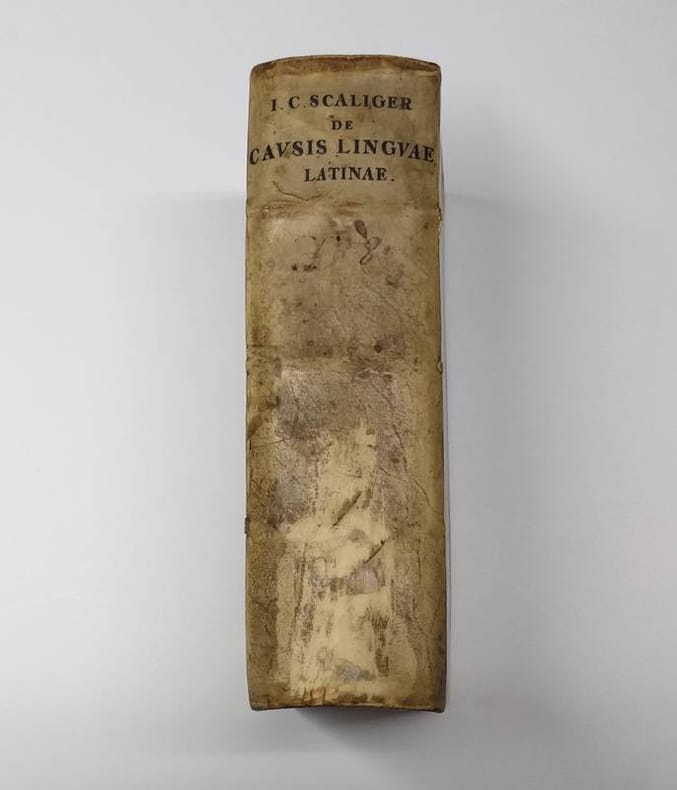
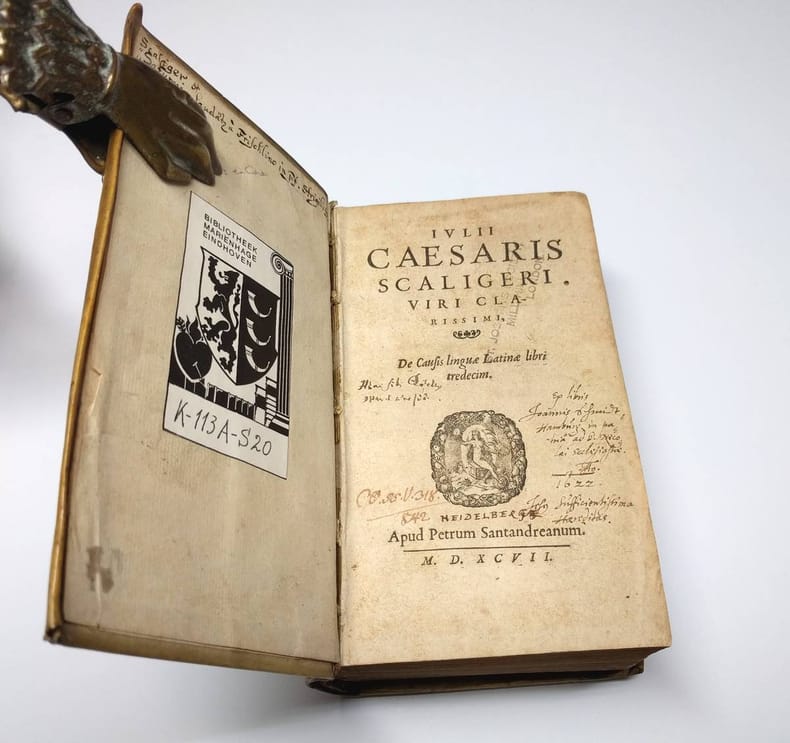
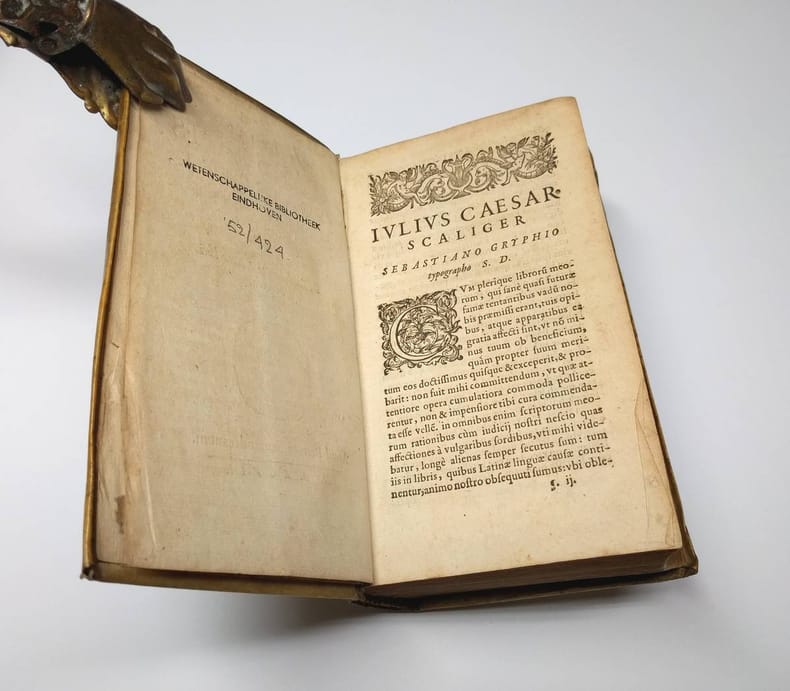
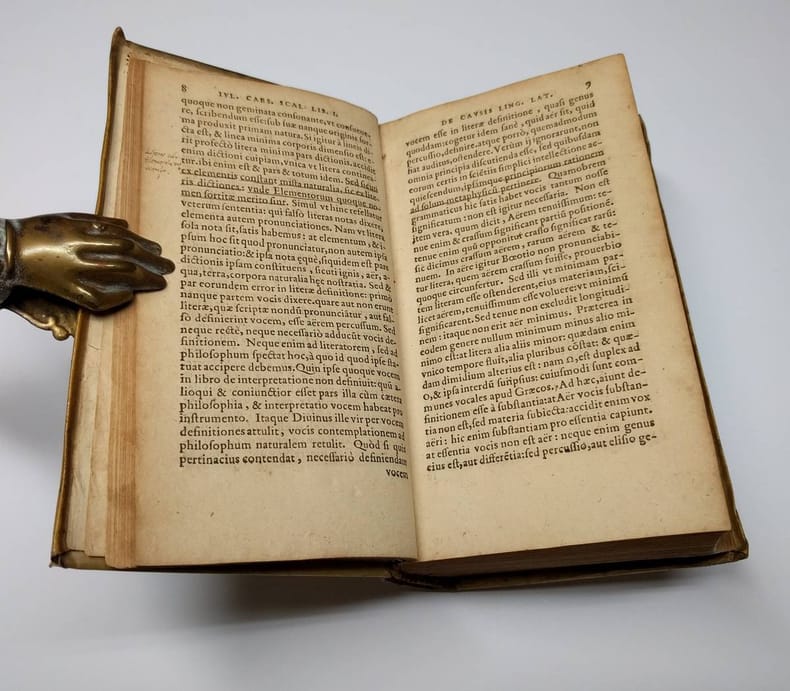
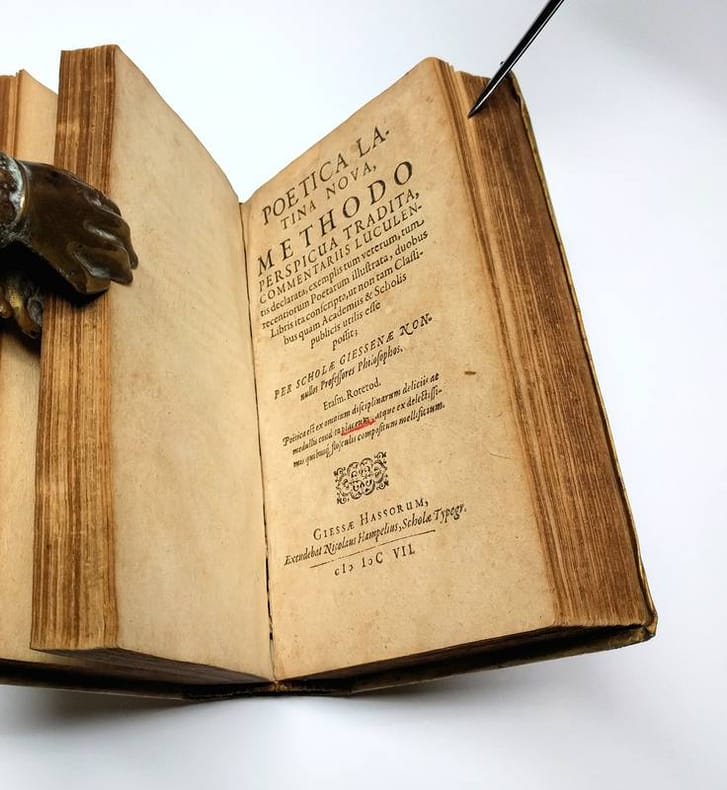
Ad 1: (Geneva), Apud Petrum Santandreanum, 1597. Ad 2: Giessen (Giessae Hassorum), Excedubat Nicolaus Hampelius, 1607.
Reference : 159072
8vo. 2 volumes in 1. Ad 1: (XXIV),451 (recte 455),(1 blank) p. Ad 2: (XV),393,(7) p. Overlapping vellum. 18 cm. - First edition of the Giessener Poetik - (Ref: Ad 1: GLN-3933; USTC 429694. Ad 2: VD17 23:295251P) (Details: 4 thongs laced through the joints. Woodcut printer's device on the title, Veritas: a woman, the naked truth, seated on a cubus, holding a radiant sun in her right hand; in her left hand she holds an opened book and a palm leaf; her feet rest on the globe; the garland of fruit which surrounds her shows a ribbon with the text in Greek: 'Alêtheia Pandamatôr', i.e. 'Allmighty Truth') (Condition: Vellum soiled and spotted. Label pasted on front pastedown, bookplate on verso of the front flyleaf. Occasional old and small ink underlinings. Ad 1: Old ownership inscription and a faint stamp on the title. Paper yellowing. Small wormhole in the first 12 leaves, sometimes nibbling at a letter. Ad 2: Paper browning. Leaf K2 = p. 147/48 removed) (Note: Ad 1: The teaching of Latin was dominated during the Late Middle Ages by a 'fixed set of textbooks, namely the 'Ars Minor' by Donatus (4th cent.), the 'Doctrinale puerorum' by Alexander of Villadei (born ca. 1170) and a compilation of Donatus and Priscian (6th cent.) called 'Ianua cum rudibus primam cupientibus artem''. (M. Haspelmath et alii, 'Language Typology and Language Universals: An International Handbook, volume I', Berlin/New York 2001, p. 211) The first to challenge the rigid systematization of this kind of textbooks was the humanist Guarino Veronese (1374-1460) with his 'Regulae grammaticales' (before 1418). The Italian scholar Lorenzo Valla tried to break from this unscientific tradition with his 'Elegantiarum linguae Latinae libri sex'. (ca. 1444) 'In his mainly stylistically orientated compendium, he insisted on the usage of the language of the classical writers as the guideline for all grammar, thus taking grammar out of its self-contained existence'. (Idem, ibidem) One of the following major humanist linguistic innovations was published in 1540 by the Italian scholar Julius Caesar Scaliger (Giulio Bordone della Scala), 1484-1558. In 1524 he moved to France where he became physician to bishop Antonio della Rovere of Agen, and where his brilliant son Josephus Justus was born in 1540, the same year in which this 'De causis linguae latinae libri tredecim' was published. This work is among his most important philological works. Scaliger claimed 'that grammaticography was a science and not an art and (he) gave it a systematic framework with Aristotelian concepts.' (Idem, Ibidem). The work is 'an acute and judicious work on the leading principles of the language, in the course of which he claims to have corrected 643 mistakes made by Valla and his other predicessors'. (Sandys, 2/178) Scaliger's 'De causis' was reissued in Geneve in 1580 and 1584, and in Heidelberg in 1609 and 1623) Ad 2: The 'Poetica latina nova', better known in Germany as 'Giessener Poetik', was first published in Giessen in 1607. It was written, as is evident from the opening of the introductory poem, by 3 professors of the Giessen 'Gymnasium illustre', Christoph Helwig (Helvicus), Kaspar Finck (Finckius) and Konrad Bachmann (Bachmannus). (Leaf 7 verso) It saw eight reissues until 1671. This makes it, alongside Martin Opitz's 'Buch von der deutschen Poeterey' the most successful poetics of the 17th century. In the 'Giessener Poetik' the references to J.C. Scaliger's 'Poetices libri septem' (Lyon 1561) are numerous. Scaliger's poetics is used to such a degree that the 'Giessener Poetik' must for long stretches be regarded as an exegesis and paraphrasis. Dependence on Scaliger also blocks the professors' access to Aristotelian 'poetics', the existence of which is known to them, as occasional references show, but his 'poetics' left no trace. After a brief introduction follows the division of poetics into 2 parts: the first deals with the 'principia carminis', the other with the 'modus conficiendi'. The 'principia' are syllable quantity and verse foot, the discussion of which accounts for about three quarters of the total poetics. The 'modus conficiendi' encompasses the general principles, metrics and generic theory (Gattungslehre). (See: V. Wels, 'Begriff der Dichtung in der Frühen Neuzeit', Berlin/New York 2009, p. 97/100)) (Provenance: On the front pastedown a book ticket, and a catalogue clipping of the Dutch auctioneers Beijers. On the front flyleaf the name 'Münichmann, 1841'. On the verso of the front flyleaf a bookplate of 'Bibliotheek Mariënhage, Eindhoven'. This book was once the property of the Augustine monastery Eindhoven. A faint stamp on the first title page: 'St Joseph's Society, Mill Hill, London'. This was the Saint Joseph's Society for Foreign Missions, also called the Mill Hill Missionaries or Mill Hill Fathers, a society of apostolic life of Catholic missionaries, founded in 1866. On the title: 'Ex libris Joannis Schmidt Hamburg. in patria ad D. Nicolai (illegible word), 1622. (illegible word) sufficientissima Haeriditas'. We found one Joannes Schmidt who was Pastor of the Nicolai Church in Hamburg'. He died in 1629. A wild guess) (Collation: Ad 1: *8, 2*4, A-2E8, 2F4 (leaf 2F4 verso blank). Ad 2: 8, A-2B8. (Leaf K2 removed)) (Photographs on request)
Bookseller's contact details
Antiquariaat Fragmenta Selecta
+31 20 418 55 65
Payment mode

Sale conditions
Terms of Sale All items offered are subject to prior sale. Your order will be final after you have received our confirmation, with a specification of the availability of the items and the shipping costs. All books are complete and in good antiquarian condition, unless otherwise described. Prices are in EURO. Postage and insurance are not included. Postage will be calculated at cost (no extra charges). Returns Books may be returned within 14 days of receipt, if returned in the same condition as sent, and packed, shipped and insured as received (please always notify us). We will refund the shipping costs of a return shipment only if our descriptions were not correct. How to pay Pre-payment is necessary for new customers. Our order confirmation will provide detailed information and a specification of the shipping costs. Customers who are known to us and libraries will be invoiced as usual. We accept Visa and Mastercard. You can submit your card information through our SECURE PAYMENT FORM. PayPal: we will send you a personal link to the PayPal website. Banktransfers: payment can be made into our bank account in The Netherlands.

