 Write to the booksellers
SCALIGER,J.J.- HEINSIUS,D.
Satirae duae, Hercules tuam fidem sive Munsterus Hypobolimaeus, et Virgula divina. Cum brevioribus annotatiunculis, quibus nonnulla in rudiorum gratiam illustrantur. Accessit his accurata Burdonum Fabulae confutatio, quibus alia nonnula hac editione accedunt.
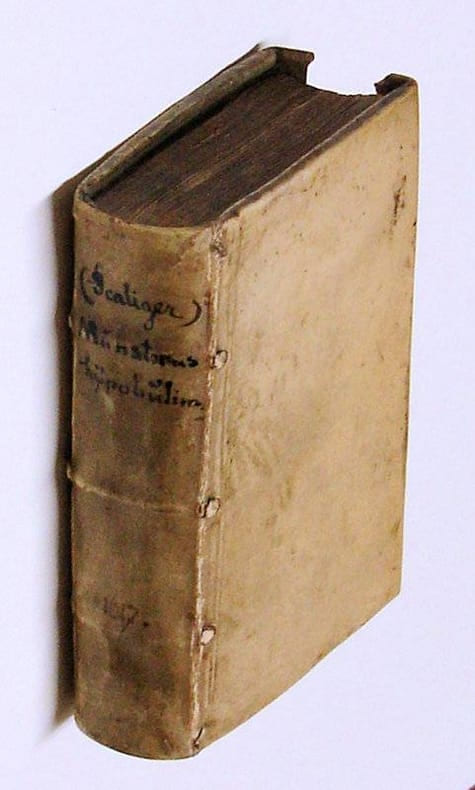
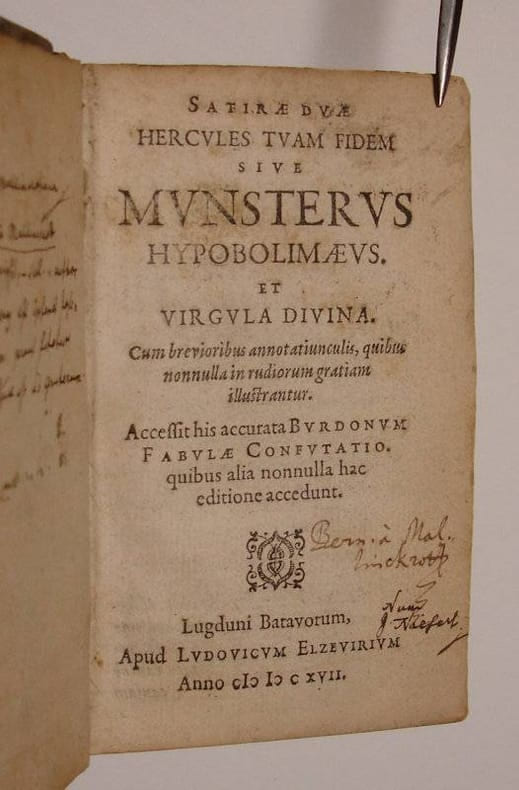
Leiden (Lugduni Batavorum), Apud Ludovicum Elzevirium, 1617. (Colophon at the end: 'Lugduni Batavorum, Typis Isaaci Elsevirii, anno 1617')
Reference : 120076
12mo. (XXIV),619 (recte 529),(20),(3 blank) p. Overlapping vellum 13 cm (Ref: STCN ppn 832983446; USTC 1028202; Willems 123; Rahir 99; Berghman 1329 Graesse 6/1, 273/274; Not in Smitskamp's 'The Scaliger Collection', but it does figure in its list of Scaliger editions, p. 120) (Details: 5 thongs laced through the joints. Manuscript title on the back. The first Elzevier edition in small format) (Condition: Vellum age-toned and soiled. Front hinge cracking. Front flyleaf worn and inscribed. Title dustsoiled, and with 2 small ownership entries. Some old marginal notes, occasional ink underlinings) (Note: The French protestant classical scholar J.J. Scaliger, 1540-1609, was a genius, but was also vain and sharp tongued. Consequently he had many enemies. His greatest enemies were among members of the catholic Jesuit order. Scaliger had turned his back on France, and had come in 1592 to Leiden at the request of the authorities of that city and the local University, who desired nothing more than his inspiring presence. There he gathered around him a group of brilliant young man, among whom H. Grotius. In 1599 young Daniel Heinsius, 1580-1655, entered the group, and became 'because of his reputedly attractive personality and remarkable gifts' Scaliger's favorite student. (P.R. Sellin, Daniel Heinsius and Stuart England', Leiden etc., 1968, p. 14) Heinsius rapidly made a name as classical scholar and neolatin poet. In 1609 Scaliger died in his arms. One of Scaliger's foulest adversaries was a former friend, Gaspar Schoppe, or in Latin Scioppius, 1576-1649, who converted to catholicism. He distinguished himself by the virulence of his writings against the Protestants, and he even wanted to incite a war against these heretics. In 1607 this man published a vicious attack upon Scaliger with his 'Scaliger hypololymaeus', in English 'Suppositious Scaliger', or rather 'Basterd Scaliger'. 'Dem tobensten Schimpfen wird hier freier Lauf gelassen; Gifte jeder Art von Verunglimpfung und Verdächtigung werden zusammen gebraut'. (J. Bernays, 'Joseph Justus Scaliger', Berlin, 1855, p. 85) Scioppius wanted to throw discredit on Scaliger, and weaken his authority, so he attacked him at his weakest spot, his supposed noble birth. Scaliger had been raised in the belief that he was a descendent of the royal family Della Scala of Verona, and he let no opportunity pass to mention the splendour of his ancestry. The validity of his pretentions were however dubious. The challenge of Scioppius was accepted by the favourite pupil of Scaliger, Daniel Heinsius, who published one year later, in 1608, anonymously in defence of his master the 'Satirae duae, Hercules tuam fidem, sive Munsterus Hypobolimaeus, et Virgula divina', two mordant Menippean satires that covered Scioppius, who occasionally signed his letters off as 'G.S. a Munster' (hence Munsterus), with much abuse. As Scioppius himself had done with Scaliger, Heinsius smears with the mud of satire his scholarship, his name, the respectability of his parents, and his conversion to catholicism. In the following mockery 'Virgula Divina, sive Lucretii Vespillonis apotheosis', inspired by Seneca's Apocolocyntosis, Heinsius focusses on the humble origins of Scioppius, himself, he tells, a supposititious child. His 'father', called by Heinsius Vespillo, or corpse-bearer/gravedigger (See Martial I,47,1), is sentenced to become assistant of Charon. Scaliger has often admitted in his letters that Heinsius was the author of the satires, and the editor of the book, which opens with a preface dedicated to Scaliger, and a section of Scioppius praise of Scaliger from the time when he was still a friend and a protestant, then a support letter of the French scholar and friend of Scaliger, Isaac Casaubon. Next follow both satires of Heinsius, followed by an attack on Scioppius and his ancestry in a mock-biography: 'Vita et parentes Gasp. Schoppii, a Germano quodam contubernali eius conscripta', composed by Scaliger himself or by Ianus Rutgerus, a friend of Heinsius, and a student of Scaliger. The great man himself contributed, using the initials of his student Rutgerus (auctore I.R. Batavo, Iuris studioso) also to this own defence, a 'accurata Burdonum Fabulae confutatio', 'a precise refutation of the Burdonese story', with the help of charters and documents which should prove his noble origin. Nevertheless, the defence of Heinsius and Scaliger made 'einen sehr kühlen Eindruck auch auf die nähreren Freunde Scaligers'. (Bernays, p. 85). Few wanted to side with him on this matter; the answer of Scaliger was deemed not satisfactory. Scioppius' reputation was damaged too. Heinsius had portrayed him as a parasite and as 'Monster of Münster', labels which he never got rid of. A revised second edition of the 'Satirae duae' was published in the same year in Leiden by Johannes Patius, who had also published the first edition. 1609 he already produced his 4th edition. An eludicating survey of the hard to fathom content of both satires can be found in chapter 5 of 'Menippean Satire and the Republic of Letters, 1581-1655', of A. R. de Smet, Geneva, 1996. 'Hercules tuam fidem' is the title of Varro's 39th Menippean satire) (Provenance: On the title: 'Bern. à Mallinckroth', and also 'Sum J. Niefert'. On the front pastedown a Swedish name 'Henrik Kröijer', and probably one 'R. Berghes') (Collation: *12, A-Z12 (leaf Z11 verso and Z12 blank. Page numbers 513-529 misnumbered 603-619)) (Photographs on request)
Bookseller's contact details
Antiquariaat Fragmenta Selecta
+31 20 418 55 65
Payment mode

Sale conditions
Terms of Sale All items offered are subject to prior sale. Your order will be final after you have received our confirmation, with a specification of the availability of the items and the shipping costs. All books are complete and in good antiquarian condition, unless otherwise described. Prices are in EURO. Postage and insurance are not included. Postage will be calculated at cost (no extra charges). Returns Books may be returned within 14 days of receipt, if returned in the same condition as sent, and packed, shipped and insured as received (please always notify us). We will refund the shipping costs of a return shipment only if our descriptions were not correct. How to pay Pre-payment is necessary for new customers. Our order confirmation will provide detailed information and a specification of the shipping costs. Customers who are known to us and libraries will be invoiced as usual. We accept Visa and Mastercard. You can submit your card information through our SECURE PAYMENT FORM. PayPal: we will send you a personal link to the PayPal website. Banktransfers: payment can be made into our bank account in The Netherlands.

