 Write to the booksellers
-
Type
Book (443)
Magazine (4)
-
Latest
Last 3 days (1)
Last month (14)
-
Language
English (3)
French (392)
German (1)
Polish (1)
Russian (50)
-
Century
18th (2)
19th (143)
20th (107)
21st (26)
-
Countries
Belgium (27)
Brazil (1)
Denmark (86)
France (248)
Germany (2)
Switzerland (30)
United States of America (53)
-
Syndicate
CLAM (2)
ILAB (217)
NVVA (5)
SLACES (5)
SLAM (112)
SNCAO (1)
Darwin: Texts Commentary (Norton Critical Editions)
Norton & Company 2000 720 pages 14 3x23 6x2 2cm. 2000. Broché. 720 pages.

Très bon état intérieur propre bonne tenue
"DARWIN, CHARLES (+) ASAJIRO OKA [translated and revised by).
Reference : 55802
(1905)
Shu no Kigen: Seizon Kyoso Tekisha Seizon no Genri (i.e. English: ""Origin of Species""]. - [THE MOST INFLUENTIAL JAPANESE TRANSLATION OF 'ORIGIN OF SPECIES']
Tokyo, Tokyo Kaiseikan, Meiji 38 [1905]. 8vo. In the original full bloth cloth with gilt letteing (in both Japanese and Latin characters). Light occassional brownspotting, otherwise a fine copy. 4, 894, 28, 12 pp. + frontispiece and folded plate with genealogical tree.
![Shu no Kigen: Seizon Kyoso Tekisha Seizon no Genri (i.e. English: ""Origin of Species""]. - [THE MOST INFLUENTIAL JAPANESE TRANSLATION OF 'ORIGIN OF ...](https://static.livre-rare-book.com/pictures/LLX/55802_1_thumb.jpg)
![Shu no Kigen: Seizon Kyoso Tekisha Seizon no Genri (i.e. English: ""Origin of Species""]. - [THE MOST INFLUENTIAL JAPANESE TRANSLATION OF 'ORIGIN OF ...](https://static.livre-rare-book.com/pictures/LLX/55802_2_thumb.jpg)
![Shu no Kigen: Seizon Kyoso Tekisha Seizon no Genri (i.e. English: ""Origin of Species""]. - [THE MOST INFLUENTIAL JAPANESE TRANSLATION OF 'ORIGIN OF ...](https://static.livre-rare-book.com/pictures/LLX/55802_3_thumb.jpg)
Rare second translation, and arguably the most important, of the Japanese translation of Darwin's ""Origin of Species"" (the first being from 1896 and only published once). This is the first translation to be made by a professional biologist. The previous translation (""Seibutsu Shigen"") was made by a law student which presumably was a contributing factor to the fact that the work primarily was embraced by social thinkers, philosophers and politicians to advocate the superiority of Japanese culture and society (and military) and not by biologist and zoologist. With the present translation Darwin's ideas and theories were finally properly introduced to the people they were intended for: biologist and zoologist. The popularity of Darwin's works and theories became immensly popular in Japan: ""Curiously, there are more versions of ""The Origin"" in Japanese than in any other language. The earliest were literary, with subsequent translations becoming more scientific as the Japanese developed a technical language for biology."" (Glick, The Comparatice Reception of Darwinism, P. XXII).""It was as if Darwin's famous oceanic journey and the meticulous research into the animal and plant kingdoms that he spent his life undertaking had all been staged as an elaborate excuse for composing a theory whose true object was Victorian society and the fate of the world's modern nations."" (Golley, Darwinism in Japan: The Birth of Ecology).Darwin's work had in Japan - as in the rest of the world - profound influence on the academic disciplines of zoology and biology, however, in Japan the most immediate influence was not on these subjects but on social thinkers: ""[...] it exerted great influence on Japanese social thinkers and social activists. After learning of Darwin's theory, Hiroyuki Kato, the first president of Tokyo Imperial University, published his New Theory of Human Rights and advocated social evolution theory (social Darwinism), emphasizing the inevitable struggle for existence in human society. He criticized the burgeoning Freedom and People's right movement. Conversely Siusui Kautoku, a socialist and Japanese translator of the Communist Manifesto, wrote articles on Darwinism, such as ""Darwin and Marx"" (1904). In this and other articles, he criticized kato's theory on Social Darwinism, insisting that Darwinism does not contradict socialism. The well known anarchist, Sakae Osugi published the third translation of On the Origin of Species in 1914, and later his translation of peter Kropotokin's Mutial Aid: A Factor of Evolution. Osugi spread the idea of mutual aid as the philosophical base of Anarcho-syndicalism."" (Tsuyoshi, The Japanese Lysenkoism and its Historical Backgrounds, p. 9) ""Charles Darwin's theory of evolution was introduced to Japan in 1877 (Morse 1936/1877) during Japan's push to gain military modernity through study of western sciences and technologies and the culture from which they had arisen. In the ensuing decades the theory of evolution was applied as a kind of social scientific tool, i.e. social Spencerism (or social Darwinism) (Sakura 1998:341"" Unoura 1999). Sakura (1998) suggests that the theory of evolution did not have much biological application in Japan. Instead, Japanese applied the idea of 'the survival of the fittest' (which was a misreading of Darwin's natural selection theory) to society and to individuals in the struggle for existence in Japan's new international circumstances (see also Gluck 1985: 13, 265).However, at least by the second decade of the 1900s, and by the time that Imanishi Kinji entered the Kyoto Imperial University, the curricula in the natural and earth sciences were largely based on German language sources and later on English language texts. These exposed students to something very different from a social Darwinist approach in these sciences. New sources that allow us to follow"" (ASQUITH, Sources for Imanishi Kinji's views of sociality and evolutionary outcomes, p. 1).""After 1895, the year of China's defeat in the Sino-Japanese War, Spencer's slogan ""the survival of the fittest"" entered Chinese and Japanese writings as ""the superior win, the inferior lose."" Concerned with evolutionary theory in terms of the survival of China, rather than the origin of species, Chinese intellectuals saw the issue as a complex problem involving the evolution of institutions, ideas, and attitudes. Indeed, they concluded that the secret source of Western power and the rise of Japan was their mutual belief in modern science and the theory of evolutionary progress. According to Japanese scholars, traditional Japanese culture was not congenial to Weastern science because the Japanese view of the relationship between the human world and the divine world was totally different from that of Western philosophers. Japanese philosophers envisioned a harmonious relationship between heaven and earth, rather than conflict. Traditionally, nature was something to be seen through the eyes of a poet, rather than as the passive object of scientific investigations. The traditional Japanese vision of harmony in nature might have been uncongenial to a theory based on natural selection, but Darwinism was eagerly adopted by Japanese thinkers, who saw it as a scientific retionalization for Japan's intense efforts to become a modernized military and industial power. Whereas European and American scientists and theologians became embroiled in disputes about the evolutionary relationship between humans and other animals, Japanese debates about the meaning of Darwinism primarily dealt with the national and international implications of natural selection and the struggle for survival. Late nineteenth-century Japanese commentators were likely to refer to Darwinism as an ""eternal and unchangeable natural law"" that justified militaristic nationalism directed by supposedly superior elites"". (Magner, A History of the Life Sciences, Revised and Expanded, p. 349)""Between 1877 and 1888, only four works on the subject of biological evolution were published in Japan. During these same eleven years, by contrast, at least twenty Japanese translations of Herbert Spencer's loosely ""Darwinian"" social theories made their appearance. The social sciences dominated the subject, and when Darwin's original The Origin of Species (Seibutsu shigen) finally appeared in translation in 1896, it was published by a press specializing in economics. It is not surprising then that by the early 20th century, when Darwin's work began to make an impact as a biological rather than a ""social"" theory, the terms ""evolution"" (shinka), ""the struggle for existence"" (seizon kyôsô), and ""survival of the fittest"" (tekisha seizon) had been indelibly marked as social and political principles. It was as if Darwin's famous oceanic journey and the meticulous research into the animal and plant kingdoms that he spent his life undertaking had all been staged as an elaborate excuse for composing a theory whose true object was Victorian society and the fate of the world's modern nations."" (Golley, Darwinism in Japan: The Birth of Ecology).Freeman 719

Darwin 1809 - 1882, l'autobiographie.
BELIN. Nov. 1987. In-12. Broché. Très bon état, Couv. fraîche, Dos satisfaisant, Intérieur frais. 175 pages. Quelques illustrations et photos en noir et blanc, dans le texte.. . . . Classification Dewey : 925-Savants, explorateurs
"Préface de Jean-Michel Goux. Collection ""Un savant, une époque"". Classification Dewey : 925-Savants, explorateurs"

THE ILLUSTRATED ORIGIN OF SPECIES
Hill and Wang. 1979. In-8. Relié. Bon état, Couv. convenable, Dos satisfaisant, Intérieur frais. 240 pages. Illustré de nombreux dessins et de nombreuses photos et cartes en noir et blanc et en couleur, dans et hors texte. Texte sur 2 colonnes.. Avec Jaquette. . . Classification Dewey : 420-Langue anglaise. Anglo-saxon
Abridged and Intro. by Richard E. Leakey. With W.F. Bynum and J.A. Barrett. Classification Dewey : 420-Langue anglaise. Anglo-saxon
La vie et la correspondance de Charles Darwin, avec un chapitre autobiographique, publiés par son fils M. Francis Darwin.
Paris C. Reinwald 1888 2 vol. relié 2 vol. in-8, cartonnages percaline verte de l'éditeur, titres dorés aux dos et ornements aux coiffes, IX + 701 + (3) et (4) + 794 pp., 1 figure gravée, 1 portrait hors-texte, index. Edition originale française. Traduit de l'anglais par Henry C. de Varigny. Manquent 2 portraits et le fac-similé. Plats du tome 1 frottés. Cartonnage du tome 2 différent, à l'adresse de "Schleicher Frères éditeurs". Des rousseurs, sinon en bonne condition. Peu courant.
![La vie et la correspondance de Charles Darwin, avec un chapitre autobiographique, publiés par son fils M. Francis Darwin.. DARWIN (Charles)]. DARWIN ...](https://static.livre-rare-book.com/pictures/VIG/124919_1_thumb.jpg)
![La vie et la correspondance de Charles Darwin, avec un chapitre autobiographique, publiés par son fils M. Francis Darwin.. DARWIN (Charles)]. DARWIN ...](https://static.livre-rare-book.com/pictures/VIG/124919_2_thumb.jpg)
![La vie et la correspondance de Charles Darwin, avec un chapitre autobiographique, publiés par son fils M. Francis Darwin.. DARWIN (Charles)]. DARWIN ...](https://static.livre-rare-book.com/pictures/VIG/124919_3_thumb.jpg)
El origin de las especies.
Barcelona, Bruguera, 1980. 8vo. In the original printed wrappers. Light wear and browning to extremities, otherwise a nice and clean copy. 670, (2) pp.
Freeman F2493Blanco & Llorca 63
"DARWIN, CHARLES. - FIRST DANISH EDITION OF ""THE ORIGIN OF SPECIES"".
Reference : 47264
(1872)
Om Arternes Oprindelse ved Kvalitetsvalg eller ved de heldigst stillede Formers Sejr i Kampen for Tilværelsen. Efter Originalens femte Udgave oversat af J.P. Jacobsen.
Kjøbenhavn, Gyldendalske Boghandel (F. Hegel), 1872. Contemp. hcalf. Spine gilt and with gilt lettering. Spine slightly rubbed. Corners a bit bumped. (10),XIII,605,(1) pp. and 1 folded plate. A few faint brownspots to the first leaves.
Scarce first Danish edition of ""On the Origin of Species"" (1859).Freeman: 643.
Die nächste Million Jahre. Ein Ausblick auf die künftige Entwicklung der Menschheit. Aus dem Englischen übertragen von Wilhelm H. Westphal.
Braunschweig, Friedr. Vieweg & Sohn 1953, 210x150mm, 163Seiten, Verlegereinband mit Umschlag. In gutem Zustand.

Pour un paiement via PayPal, veuillez nous en faire la demande et nous vous enverrons une facture PayPal
A ORIGEM DAS ESPECIES, Ilustrada
Melhoramentos - Universidade de Brasilia. 1982. In-8. Relié. Bon état, Couv. convenable, Dos satisfaisant, Intérieur frais. 239 pages. Illustré de nombreux dessins et de nombreuses photos en noir et blanc et en couleur, dans et hors texte. Texte sur 2 colonnes (en portugais).. Avec Jaquette. . . Classification Dewey : 460-Langues espagnole et portugaise
Condensado a com introdução de Richard E. Leakey. Classification Dewey : 460-Langues espagnole et portugaise
[C. Reinwald et Cie] - DARWIN, Charles ; MOULINIE, J.J. ; BARBIER, M. E.
Reference : 70394
(1873)
La Descendance de l'Homme et la Sélection Sexuelle (2 Tomes - Complet)
Traduit de l'anglais par J.-J. Mouliné, Deuxième édition revue sur la dernière édition anglaise par M. E. Barbier, préface par Carl Vogt, avec gravures sur bois, 2 vol. in-8 reliure éditeur pleine percaline verte, A. Lenègre relieur, C. Reinwald et Cie, Paris, 1873-1874, XV-466-20 pp. ; 2 ff., III-516 pp.
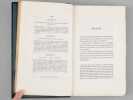
Bon état (cartonnage très lég. frotté, qq. rouss., très bel état par ailleurs)
Avtobiografiya. In Russian /Autobiography
Short description: In Russian. Darwin, Charles Robert. Autobiography of Dr. Philosophy M. Filipov. You are welcome to reach out to us for a detailed description of the copies currently available. Delivery of this book may take longer than usual including extended processing and pre-shipping time, no expedited shipping is available. Please advise us if you have a set date or a deadline to receive your order.SKU5238327
Darwin Charles: A Naturalist's Journey Around the World on the Beagle. In Russia
Short description: Darwin Charles: A Naturalist's Journey Around the World on the Beagle. In Russian /Darvin Charlz. Puteshestvie naturalista vokrug sveta na korable Bigl'.In Russian.Edition 3. Translation from English by S. L. Sobol. Edited by S. L. Sobol and K. E. Syroechkovsky. M. Thought 1976. 453 p. We have thousands of titles and often several copies of each title may be available. Please feel free to contact us for a detailed description of the copies available. SKUalb75574424b1f24e00

Darwin Charles: A Naturalists Journey Around the World Volume 1. In Russian (as
Darwin Charles: A Naturalists Journey Around the World Volume 1. In Russian (ask us if in doubt)/Darvin Charlz. Puteshestvie naturalista vokrug sveta. Tom 1.. E6

Darwin Charles. A naturalists journey around the world on the Beagle. In Russia
Darwin Charles. A naturalists journey around the world on the Beagle. In Russian /Darvin Charlz. Puteshestvie naturalista vokrug sveta na korable Bigl. 2nd edition. Translation, introductory article and notes by Prof. S. L. Sobol M. State edition of geographic literature 1954. 576 p.We have thousands of titles and often several copies of each title may be available. Please feel free to contact us for a detailed description of the copies available.SKUalb0268b34de4f73099.

Darwin Charles: A Naturalists Journey Around the World on the Beagle. In Russia
Darwin Charles: A Naturalists Journey Around the World on the Beagle. In Russian /Darvin Charlz. Puteshestvie naturalista vokrug sveta na korable «Bigl». Translation from English, introductory article and notes by S. L. Sobol. M. State Publishing House of Geographical Literature, 1955. 576 p. We have thousands of titles and often several copies of each title may be available. Please feel free to contact us for a detailed description of the copies available. SKUalb53d2a01e54e17c32.

Darwin Charles. A naturalists journey around the world on the Beagle. In Russia
Darwin Charles. A naturalists journey around the world on the Beagle. In Russian /Darvin Charlz. Puteshestvie naturalista vokrug sveta na korable Bigl. Translation by E. Beketova. Edited and with an introductory article by O. Kuznetsova. Ill.M Detizdat 1936. We have thousands of titles and often several copies of each title may be available. Please feel free to contact us for a detailed description of the copies available. The delivery of this book might be delayed beyond the usual timeframe due to extended processing and preparation before shipment, and faster shipping opSKUalb7232b07e5d8d1a14

Darwin Charles. A naturalists journey around the world on the Beagle. In Russia
Darwin Charles. A naturalists journey around the world on the Beagle. In Russian /Darvin Charlz. Puteshestvie naturalista vokrug sveta na korable Bigl.Translation, introductory article and notes by Prof. S.L.Sobolya. M. GIZ of Geographical Literature. 1953.We have thousands of titles and often several copies of each title may be available. Please feel free to contact us for a detailed description of the copies available. SKUalb6ad9fc4270377980.

Darwin Charles. A naturalists journey around the world on the Beagle. In Russia
Darwin Charles. A naturalists journey around the world on the Beagle. In Russian /Darvin Charlz. Puteshestvie naturalista vokrug sveta na korable Bigl. Translation, introductory article and notes by Prof. S. L. Sobol. M. State Publishing House of Geographical Literature 1954. We have thousands of titles and often several copies of each title may be available. Please feel free to contact us for a detailed description of the copies available. The delivery of this book might be delayed beyond the usual timeframe due to extended processing and preparation before shipment, and faster shipping options are not offered. Please inform us if you need the order by a certain date or have a deadline. SKUalbb59e60158b970aa4

Darwin Charles: Autobiography. In Russian /Darvin Charlz. Avtobiografiya.
Darwin Charles: Autobiography. In Russian /Darvin Charlz. Avtobiografiya. S.Pb.1896. We have thousands of titles and often several copies of each title may be available. Please feel free to contact us for a detailed description of the copies available. The delivery of this book might be delayed beyond the usual timeframe due to extended processing and preparation before shipment, and faster shipping options are not offered. Please inform us if you need the order by a certain date or have a deadline. SKUalbb21d736537dd9489

Darwin Charles. Darwin Charles The Origin Of Species. In English /Darwin Charle
Darwin Charles. Darwin Charles The Origin Of Species. In English /Darwin Charles. Darvin Charlz The Origin Of Species. Book in English 416 c. You are welcome to reach out to us for a detailed description of the copies currently available. Delivery of this book may take longer than usual including extended processing and pre-shipping time, no expedited shipping is available. Please advise us if you have a set date or a deadline to receive your order.SKUalb6a02f881b2503616
Darwin Charles. Human origins and gender selection. In two volumes. In Russian
Darwin Charles. Human origins and gender selection. In two volumes. In Russian /Darvin Charlz. Proiskhozhdenie cheloveka i podbor po otnosheniyu k polu. V dvukh tomakh. Translation from English edited by I.M. Sechenov. With drawings: St. Petersburg: Edition of the Cherkesov Bookshop 1871-1872 1) 2, XIII, 481 and 2) 2, VI, 452c. We have thousands of titles and often several copies of each title may be available. Please feel free to contact us for a detailed description of the copies available. SKUalbda0a499f81c12dff.

Darwin Charles. Human origins and gender selection. In two volumes. With drawin
"Darwin Charles. Human origins and gender selection. In two volumes. With drawings. In Russian /Darvin Charlz. Proiskhozhdenie cheloveka i podbor po otnosheniyu k polu. V dvukh tomakh. S risunkami. Soc. Charles Darwin; Translated from English, edited by I.M. Sechenov. St. Petersburg Cherkesov Bookshop, 1874. 322 and 374s. We have thousands of titles and often several copies of each title may be available. Please feel free to contact us for a detailed description of the copies available. SKUalb27e8c389274fc6dd."

Darwin Charles: Human Origins and Sex Selection. In Russian (ask us if in doubt)
Darwin Charles: Human Origins and Sex Selection. In Russian (ask us if in doubt)/Darvin Charlz. Proiskhozhdenie cheloveka i polovoy podbor.With 71 drawings. Complete translation from the last English edition of M. Filippov. Second newly reviewed edition. St. Petersburg Edition V.I. Tubinsky. 1903. 2 2 IV 566 2 p. We have thousands of titles and often several copies of each title may be available. Please feel free to contact us for a detailed description of the copies available. SKUalb4ad1a07a08c5ef3a

Darwin Charles. Human origins and sex selection. On the expression of feelings i
Darwin Charles. Human origins and sex selection. On the expression of feelings in humans and animals. In Russian (ask us if in doubt)/Darvin Charlz. Proiskhozhdenie cheloveka i polovoy podbor. O vyrazhenii oshchushcheniy u cheloveka i zhivotnykh.. E6
Darwin Charles: Journey around the world on the Beagle. In Russian /Darvin Char
Darwin Charles: Journey around the world on the Beagle. In Russian /Darvin Charlz. Puteshestvie vokrug sveta na korable «Bigl». The Complete Translation from English of M.M. Filippov. St. Petersburg, 1908. 338 p. We have thousands of titles and often several copies of each title may be available. Please feel free to contact us for a detailed description of the copies available. SKUalbdab3d1bca2464be8.


