 Write to the booksellers
-
Type
Book (439)
Magazine (4)
-
Latest
Last 24h (4)
Last month (9)
-
Language
English (3)
French (388)
German (1)
Polish (1)
Russian (50)
-
Century
18th (2)
19th (142)
20th (107)
21st (26)
-
Countries
Belgium (27)
Brazil (1)
Denmark (86)
France (244)
Germany (2)
Switzerland (30)
United States of America (53)
-
Syndicate
CLAM (2)
ILAB (217)
NVVA (5)
SLACES (5)
SLAM (112)
SNCAO (1)
Darwin Charles: The effect of cross-pollination and self-pollination in the pla
Darwin Charles: The effect of cross-pollination and self-pollination in the plant world. In Russian /Darvin Charlz. Deystvie perekrestnogo opyleniya i samoopyleniya v rastitelnom mire. A series of Classics of Natural Science. Translation from the 2nd English edition of Rybin V.A., Kokhanovskaya L.N., edited and with a foreword to the translation by Vavilov N.I. Introductory article by Komarov V.L. M., L.: Selkhozgiz. 1939. We have thousands of titles and often several copies of each title may be available. Please feel free to contact us for a detailed description of the copies available. The delivery of this book might be delayed beyond the usual timeframe due to extended processing and preparation before shipment, and faster shipping opSKUalbd7f10fc67ab8e36c
Darwin Charles. The origin of species by natural selection or the preservation
Darwin Charles. The origin of species by natural selection or the preservation of favorable races in the struggle for life. In Russian /Darvin Charlz. Proiskhozhdenie vidov putem estestvennogo otbora ili sokhranenie blagopriyatnykh ras v borbe za zhizn. Series: Classics of Science. M. Nauka. 1991. 568 p. We have thousands of titles and often several copies of each title may be available. Please feel free to contact us for a detailed description of the copies available. SKUalb81be24b0d79e1f6c.
Darwin Charles. Works. Volume I. A naturalists journey around the world. In Rus
Darwin Charles. Works. Volume I. A naturalists journey around the world. In Russian /Darvin Charlz. Sochineniya. Tom I. Puteshestvie naturalista vokrug sveta. Edited by S.L. Sobol. Design of the book by the artist-polygrapher A.V. Krejchik. Moscow: L.: Biomedgiz 1935. We have thousands of titles and often several copies of each title may be available. Please feel free to contact us for a detailed description of the copies available. The delivery of this book might be delayed beyond the usual timeframe due to extended processing and preparation before shipment, and faster shipping opSKUalbf3fe308d7eb7bba1

Engelhardt M.C. Darwin. His life and scientific activities. A biography with a
Engelhardt M.C. Darwin. His life and scientific activities. A biography with a portrait of Darwin engraved in Leipzig by Gedan. In Russian /Engelgardt M. Ch. Darvin. Ego zhizn i nauchnaya deyatelnost. Biograficheskiy ocherk s portretom Darvina, gravirovannym v Leyptsige Gedanom. The lives of remarkable people. F. Pavlenkovs Biographical Library. St. Petersburg. Public Benefit 1891. 96 You are welcome to reach out to us for a detailed description of the copies currently available. Delivery of this book may take longer than usual including extended processing and pre-shipping time, no expedited shipping is available. Please advise us if you have a set date or a deadline to receive your order.SKUalb36b38eadf6dd5ba2
Engelhardt M.C. Darwin on his life and scientific activities. A biography with a
Engelhardt M.C. Darwin on his life and scientific activities. A biography with a portrait of Darwin engraved in Leipzig by Gedan. In Russian (ask us if in doubt)/Engelgardt M. Ch. Darvin ego zhizn i nauchnaya deyatelnost. Biograficheskiy ocherk s portretom Darvina gravirovannym v Leyptsige Gedanom.The lives of remarkable people. F. Pavlenkovs biographical library. St. Petersburg type. T-va Public good 1891. 92 and 2 n.s. and 1 l. We have thousands of titles and often several copies of each title may be available. Please feel free to contact us for a detailed description of the copies available. SKUalb2444387627ce460d
O vyrazhenii oshchushcheniy u cheloveka i zhivotnykh. In Russian /On the expres
Short description: In Russian. Darwin, Charles Robert. On the expression of feelings in humans and animals. type. A. Porokhovshchikov. You are welcome to reach out to us for a detailed description of the copies currently available. Delivery of this book may take longer than usual including extended processing and pre-shipping time, no expedited shipping is available. Please advise us if you have a set date or a deadline to receive your order.SKU5199779
The Convolutee of Eight Books: Seven Books in the JZL series, The Lives of Grea
The Convolutee of Eight Books: Seven Books in the JZL series, The Lives of Great Men: F. Pavlenkos Biographical Library: Newton: C. Darwin: Em Kant: Auguste Comte: A. Schopenhauer: Adam Smith: D. S. Mill In Russian /Konvolyut vosmi knig: semi knig serii «ZhZL, Zhizn zamechatelnykh lyudey: Biograficheskaya biblioteka F. Pavlenkova»: Nyuton: Ch. Darvin: Em. Kant: Ogyust Kont: A. Shopengauer: Adam Smit: D.S. Mill With the appendix of the book: Lewis J. G. Emmanuel Immanuel Kant. His Life and Historical Meaning 1892-1897. The Convolutee of Eight Books: 1) Philip M. Newton. His Life and Scientific Activities: A Biographical Essay. With Newtons portrait engraved in Leipzig by Gedan. St. Petersburg: Typography and Chromolythography by A. Transchel, 1892. 80 p. We have thousands of titles and often several copies of each title may be available. Please feel free to contact us for a detailed description of the copies available. SKUalb98d3e2221b64a7a8.

O Vyranzenii oscuscenij u celoveka i zivotnych [i.e. Russian: ""The Expression of the Emotions of Man and Animals""]. - [FIRST RUSSIAN TRANSLATION OF ""THE EXPRESSION OF THE EMOTIONS OF MAN AND ANIMALS""]
St Petersburg, Suscinskiy, 1872. 8vo. In contemporary half calf. Spine with wear. title-page brownspotted and back end-paper with annotations and stamps, otherwise a fine copy. (2), (I)-III, (3), 335 pp. + with 18 plates of engravings (21 numbered) and 7 heliotype plates.
![O Vyranzenii oscuscenij u celoveka i zivotnych [i.e. Russian: ""The Expression of the Emotions of Man and Animals""]. - [FIRST RUSSIAN TRANSLATION OF ...](https://static.livre-rare-book.com/pictures/LLX/63400_1_thumb.jpg)
![O Vyranzenii oscuscenij u celoveka i zivotnych [i.e. Russian: ""The Expression of the Emotions of Man and Animals""]. - [FIRST RUSSIAN TRANSLATION OF ...](https://static.livre-rare-book.com/pictures/LLX/63400_2_thumb.jpg)
![O Vyranzenii oscuscenij u celoveka i zivotnych [i.e. Russian: ""The Expression of the Emotions of Man and Animals""]. - [FIRST RUSSIAN TRANSLATION OF ...](https://static.livre-rare-book.com/pictures/LLX/63400_3_thumb.jpg)
First Russian, and first overall, translation of Darwin’s ""The Expression of the Emotions of Man and Animals"", being published the same year as the English original (The original being published in November 1872, the Russian translation in December 1872). The Expression of the Emotions ""is an important member of the evolutionary set, and it was written, in part at least, as a confutation of the idea that the facial muscles of expression in man were a special endowment."" (Freeman p. 142). Darwin concluded that ""the chief expressiv actions exhibited by man and by the lower animals are now innate or inherited."" The work was 'translated from the proofs sent by the author' by Vladimir Kovalevsky (1842-83), Russian biologist and the founder of evolutionary palaeontology. His own scientific works were printed between 1873 and 1877, and according to Henry Osborn (Osborn, H. The rise of Mammalia in North America // Proc. Amer. Assoc. Sci. 1894. vol. 42, pp. 189-227) they ''dare away'' all traditional and dry European paleontology. That was mainly because Kovalevsky was a devoted Darwinist and adapted Darwin's ideas to palaeontology. Luis Dollo, the Belgian palaeontologist, a contemporary of Kovalevsky's, described him thus: ''No palaeontologist embodies so perfectly our epoch, as the brilliant and miserable Vladimir Kovalevsky, friend and guest of the immortal Charles Darwin''. Indeed, Kovalevsky was a friend of Darwin's and they corresponded extensively. When visiting Darwin in 1877, the Russian botanist, Timiryazev, asked Darwin about his views on Russian science and Darwin surprised him with an answer that Vladimir Kovalevsky (little known at the time) was the bright hope of palaeontology. Freeman 1206.
De L'Origine des Espèces ou des Lois du Progrès chez les Étres organisés par Ch. Darwin. Traduit en francais sur le troisieme Édition avec l'autorisation de l'Auteur par Mlle Clémence-Auguste Royer. Avec une Preface et des Notes du Traducteur. - [FIRST FRENCH EDITION OF THE ""ORIGIN""]
Paris, Guillaumin et Cie, Victor Masson et Fils, 1862. 8vo. Bound uncut and with the original printed front wrapper (expertly restored) in a very fine later half morocco binding with four raised bands and gilt title to spine. Very light minor brownspotting to a few pages. An exceptionally nice, clean, and attractive copy. LXIV (incl. half-title), I-XXIII + (24-) 712. pp. and 1 folded plate (between pp.160 a. 161). Fully complete.
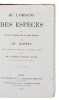
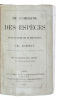
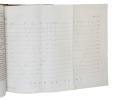
The scarce first French edition of Darwin's masterpiece, one of the most important books ever printed. The ""Origin"" started the greatest of all intellectual revolutions in the history of Mankind.There were some difficulties with the first French edition. Mlle Royer, who Darwin described as 'one of the cleverest and oddest women in Europe' and wished 'had known more of natural history', added her own footnotes. He was not really happy until the third translation by Éduard Barbier appeared in 1876. (Freeman). Freeman No 655 (Freeman does not mention the plate, which is present here).
De L'Origine des Espèces ou des Lois du Progrès chez les Étres organisés par Ch. Darwin. Traduit en francais sur le troisieme Édition avec l'autorisation de l'Auteur par Mlle Clémence-Auguste Royer. Avec une Preface et des Notes du Traducteur. - [FIRST FRENCH EDITION OF THE ""ORIGIN OF SPECIES""]
Paris, Guillaumin et Cie, Victor Masson et Fils, 1862. 8vo. In contemporary half calf with gilt title to spine. Very light minor brownspotting to a few pages. Previous owner's name to half title. A fine copy. LXIV (incl. half-title), I-XXIII + (24-) 712. pp. and 1 folded plate (between pp.160 a. 161). Fully complete.
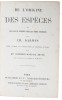
The scarce first French edition of Darwin's masterpiece, one of the most important books ever printed. The ""Origin"" started the greatest of all intellectual revolutions in the history of Mankind.There were some difficulties with the first French edition. Mlle Royer, who Darwin described as 'one of the cleverest and oddest women in Europe' and wished 'had known more of natural history', added her own footnotes. He was not really happy until the third translation by Éduard Barbier appeared in 1876. (Freeman). Freeman No 655 (Freeman does not mention the plate, which is present here).
De L'Origine des Espèces ou des Lois du Progrès chez les Étres organisés par Ch. Darwin. Traduit en francais sur le troisieme Édition avec l'autorisation de l'Auteur par Mlle Clémence-Auguste Royer. Avec une Preface et des Notes du Traducteur. - [FIRST FRENCH EDITION OF THE ""ORIGIN""]
Paris, Guillaumin et Cie, Victor Masson et Fils, 1862. 8vo. Bound partly uncut with the original wrappers in a very nice later full calf pastiche binding with four raised band and richly gilt spine. Gilt boarders to boards. Small repair to upper right corner of title-page, not affecting text. An exceptionally fine and clean copy. LXIV (incl. half-title), I-XXIII + (24-) 712. pp. and 1 folded plate (between pp.160 a. 161).
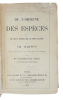

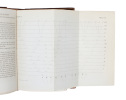
The scarce first edition of the controversial first French translation - bound partly uncut and with the original wrappers - of Darwin's masterpiece, one of the most important books ever printed. This famed translation - done by self-taught female scholar - ended up causing quite a stir and adding to the theory of evolution some for Darwin quite unforeseen interpretations. Because of this, the translator, Clémence Royer, gained notoriety as one of the leading eugenicists of the time. Darwin was very eager to have his work published in French. It is not known exactly how he happened on Royer as the translator, but as she was familiar with the works of Lamarck and Malthus, immediately realized the importance of Darwin's work and also had close connections to the French publisher Guillaumin, she must have seemed perfect for the job. She had a naturalist help her with the biologically technical parts and made an excellent job of the translation. There was one big problem, however - she went well beyond her role as a translator and added a 60-page preface and numerous explanatory footnotes that Darwin had not seen before publication. In the preface, she challenged the belief in religious revelation, she discussed the application of natural selection to the human race, and she presented a pure eugenic theory, explaining the negative consequences of protecting the weak and the infirm. She also promoted her concept of progressive evolution, which had more in common with the ideas of Lamarck than with those of Darwin. Right after having seen the translation, Darwin wrote in a letter to the American botanist, Asa Gray: ""I received 2 or 3 days ago a French translation of the Origin by a Madelle. Royer, who must be one of the cleverest & oddest women in Europe: is ardent deist & hates Christianity, & declares that natural selection & the struggle for life will explain all morality, nature of man, politicks &c &c!!!. She makes some very curious & good hits, & says she shall publish a book on these subjects, & a strange production it will be.""After some reflection, however, Darwin began having more serious doubts, and about a month later he wrote to the French zoologist Armand de Quatrefages: ""I wish the translator had known more of Natural History" she must be a clever, but singular lady" but I never heard of her, till she proposed to translate my book."" He had now also read the footnotes and wrote to Joseph Hooker: ""Almost everywhere in Origin, when I express great doubt, she appends a note explaining the difficulty or saying that there is none whatever!! It is really curious to know what conceited people there are in the world.""Freeman No 655 (Freeman does not mention the plate, which is present here).
Pour connaître la pensée de Charles Darwin.
Grenoble, Editions Françaises Nouvelles, 1944, in 8° broché, 96 pages ; couverture illustrée en couleurs ; manque en tête du dos.
PHOTOS sur DEMANDE. ...................... Photos sur demande ...................


Phone number : 04 77 32 63 69
A Concordance to Darwin's The Descent of Man, and Selection in Relation to Sex.
1987 x, 1137 p., cloth. New copy.
A new view of Darwinism.
London and New York, Macmillan and Co., 1871. Royal8vo. In publisher's original red embossed cloth. In ""Nature. A Weekly Illustrated Journal of Science"", Vol. 4, April-October 1871. Stamp to title-page and p. 1 and ex-libris pasted on to pasted down front end-paper. Binding with wear and light soiling, spine partly detached with a 7 cm long tear to rear hindge. Internally fine and clean. Darwin's paper: Pp.180-181. [Entire volume: XII, 520 pp].
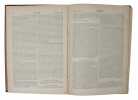
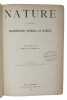
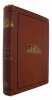
First appearance of Darwin’s short notice to Henry Hoyle Howorth (1842-1923), geologist and naturalist. F1754
Flowers of the primrose destroyed by birds.
London and New York, Macmillan and Co., 1874. Royal8vo. In a bit later full green cloth. In ""Nature. A Weekly Illustrated Journal of Science"", Vol. 10, May 1874 - October 1874. Stamp to title-page and ex-libris pasted on to pasted down front end-paper. Stamps to front free end paper. Traces from book block having been bended. Darwin's paper: Pp. 24-25. [Entire volume: XI, (1), 534 pp].
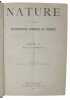
First appearance of Darwin's paper on Primrose flowers. Primrose flowers, and the flowers of related members of the Primulaceae are often removed from their stalks and scattered on the ground by green finches apparently consuming the ovaries and nectaries - here first described by Darwin. Freeman 1771
[Memorial to Gladstone] (+) Bree on Darwinism.
London and New York, Macmillan and Co., 1872. Royal8vo. In publisher's original red embossed cloth. In ""Nature. A Weekly Illustrated Journal of Science"", Vol. 6, May-October 1872. Stamp to title-page and p. 1 and ex-libris pasted on to pasted down front end-paper. Binding with wear and light soiling, spine loose and missing part of cloth to upper part.. Internally fine and clean. Darwin's paper (co-author): 211-216" P. 279. [Entire volume: XII, 548 pp].
First publication of these two short notices by Darwin. Freeman 1937 & 1756.
Pangenesis. - [DARWIN'S FERENSE OF HIS PANGENESIS-THEORY.]
London and New York, Macmillan and Co., 1871. Royal8vo. In publisher's original red embossed cloth. In ""Nature. A Weekly Illustrated Journal of Science"", Vol. 3, November 1870 - April 1871. Stamp to title-page and ex-libris pasted on to pasted down front end-paper. Binding with considerable wear"" spine partly disintegrated and front board bended vertically, but bookblock firmly attached. Internally fine and clean. Darwin's paper: Pp. 502-503. [Entire volume: XII, 520 pp].
![Pangenesis. - [DARWIN'S FERENSE OF HIS PANGENESIS-THEORY.]. "DARWIN, C. R.](https://static.livre-rare-book.com/pictures/LLX/60107_1_thumb.jpg)
![Pangenesis. - [DARWIN'S FERENSE OF HIS PANGENESIS-THEORY.]. "DARWIN, C. R.](https://static.livre-rare-book.com/pictures/LLX/60107_2_thumb.jpg)
![Pangenesis. - [DARWIN'S FERENSE OF HIS PANGENESIS-THEORY.]. "DARWIN, C. R.](https://static.livre-rare-book.com/pictures/LLX/60107_3_thumb.jpg)
First appearance of Darwin’s defense of his Pangenesis-theory. The Pangenesis theory was hypothetical mechanism for heredity, in which he proposed that each part of the body continually emitted its own type of small organic particles called gemmules that aggregated in the gonads, contributing heritable information to the gametes. He presented this 'provisional hypothesis' in his 1868 work The Variation of Animals and Plants Under Domestication, intending it to fill what he perceived as a major gap in evolutionary theory at the time. Darwin's half-cousin Francis Galton spent much time conducting wide-ranging inquiries into heredity which led him to refute Charles Darwin's hypothetical theory of pangenesis. In consultation with Darwin, he set out to see if gemmules were transported in the blood. Galton was troubled because he began the work in good faith, intending to prove Darwin right, and having praised pangenesis in Hereditary Genius in 1869. Cautiously, he criticized his cousin's theory, although qualifying his remarks by saying that Darwin's gemmules, which he called ""pangenes"", might be temporary inhabitants of the blood that his experiments had failed to pick up. In the present paper Darwin challenged the validity of Galton's experiment, giving his reasons in an article published in Nature where he wrote. “Now, in the chapter on Pangenesis in my Variation of Animals and Plants under Domestication, I have not said one word about the blood, or about any fluid proper to any circulating system. It is, indeed, obvious that the presence of gemmules in the blood can form no necessary part of my hypothesis" for I refer in illustration of it to the lowest animals, such as the Protozoa, which do not possess blood or any vessels" and I refer to plants in which the fluid, when present in the vessels, cannot be considered as true blood."" He goes on to admit: ""Nevertheless, when I first heard of Mr. Galton's experiments, I did not sufficiently reflect on the subject, and saw not the difficulty of believing in the presence of gemmules in the blood.” (From the present paper) The hypothesis was finally refuted in the 1900ies after Gregor Mendel's theory of the particulate nature of inheritance was accepted. The Pangenesis-theory, however, may be considered an eclectic mix of DNA, RNA, proteins and prions, and can be regarded as being one of the earliest steps toward the modern mechanism for heredity, namely DNA and RNA. Freeman 1751
Habits of ants (+) On the males and complemental males of certain cirripedes, and on rudimentary structures [C. R. Darwin] (+) Variations of organs [G. H. Darwin].
(London and New York, Macmillan and Co., 1873). Royal8vo. In contemporary cloth. In ""Nature. A Weekly Illustrated Journal of Science"", Vol. 8, July 1873 - October 1873. Extremities with wear and end papers brownspottet. Internally fine and clean. C. R. Darwin's papers: P. 244" Pp. 431-432. G. H. Darwin's paper: p. 505 . [Entire volume: Pp. 237-562].
![Habits of ants (+) On the males and complemental males of certain cirripedes, and on rudimentary structures [C. R. Darwin] (+) Variations of organs ...](https://static.livre-rare-book.com/pictures/LLX/60116_1_thumb.jpg)
![Habits of ants (+) On the males and complemental males of certain cirripedes, and on rudimentary structures [C. R. Darwin] (+) Variations of organs ...](https://static.livre-rare-book.com/pictures/LLX/60116_2_thumb.jpg)
First appearance of these three papes, two by Charles Darwin and one by his son. Freeman 1761, 1762 & 1763
Charles Darwin's Beagle Diary.
1988 xxix, 464 p., num. figs & pls, hardbound (dust jacket). Good dust jacket but has the spine portion discoloured.
Papers presented at a symposium organized jointly by the Linnean Society and the Systematics Association on ''Darwin - a hundred years on''.
1983 135 p., num. figs, paperbound. Published in: Biological Journal of the Linnean Society. Volume 20, no. 1.
The Botanic Garden. A Poem in two parts. Part I. Containing The Economy of Vegetation. Part II. The Loves of the Plants. With Philosophical Notes / The Temple of Nature, or the Origin of Society: a Poem, with Philosophical Notes.
1824-1825 3 volumes in 1. 203, 100 p., 10 pls (of 18?), frontispiece, contemporary hcalf (rubbed, label missing). Some scattered foxing. With ex libris of George Henry Parke. An original copy, not a low quality recent reprint!
Les mathématiques de l'amour
Michel Lafon. 2007. In-8. Broché. Bon état, Couv. convenable, Dos satisfaisant, Intérieur frais. 460 pages.. . . . Classification Dewey : 820-Littératures anglaise et anglo-saxonne
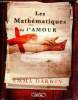
Traduit de l'anglais par Gouyé-Guilbert Nathalie. Classification Dewey : 820-Littératures anglaise et anglo-saxonne
THE MATHEMATICS OF LOVE
Quality Paperbacks Direct. 2006. In-8. Broché. Etat d'usage, Couv. convenable, Dos plié, Mouillures. 404 pages.. . . . Classification Dewey : 420-Langue anglaise. Anglo-saxon
Novel. Classification Dewey : 420-Langue anglaise. Anglo-saxon
Darwin Emma Gouyé-Guilbert Nathalie Gouyé-Guilbert Nathalie
Reference : 122406
(2007)
ISBN : 9782749906485
Les Mathématiques de l'amour
Michel Lafon 2007 460 pages 18 8x15x4 2cm. 2007. Broché. 460 pages.
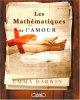
Très Bon Etat
The Life and Letters of Charles Darwin, including an autobiographical chapter
John Murray, 1887, in-8, 3 vol, 3 portraits-front, IX-[1]-395-[1] pp, 1 pl. + [4]-393-[1] pp, 1 pl. + IV-418 pp, Demi-veau rouge à coins, dos lisses et filetés, tranches rouges, Papillon d'erratum au T. I (devant la p. 1). Vie et correspondance de Charles Darwin (1809-1882) par son fils Francis (1845-1925). Seconde édition, parue la même année que l'originale. Francis Darwin, botaniste spécialisé en physiologie végétale, collabora avec son père à partir de 1875, notamment pour la rédaction de The Power of Movement in Plants (1880). Il enseigna à Cambridge à partir de 1884 et y occupa la chaire de botanique de 1888 à 1904. Petites rousseurs, pages légèrement jaunies. Petits accrocs aux dos. Bon exemplaire. Couverture rigide
Bon 3 vol., 3 portraits-front.,

