 Write to the booksellers
-
Type
Book (5466)
Magazine (20)
Manuscript (1)
Old papers (1)
Photographs (3)
-
Latest
Last 24h (4)
Last month (6)
-
Language
English (10)
French (5477)
German (1)
Greek (1)
Italian (1)
Latin (1)
-
Century
16th (2)
17th (8)
18th (245)
19th (886)
20th (2953)
21st (133)
-
Countries
Belgium (265)
Canada (3)
Côte d'Ivoire (13)
Denmark (1365)
France (3544)
Switzerland (301)
-
Syndicate
ALAC (3)
CLAM (2)
ILAB (4130)
NVVA (139)
SLACES (139)
SLAM (2604)
SNCAO (15)
Atomteori og Naturbeskrivelse. 3 Artikler med en indledende Oversigt.
Kbhvn., 1929. Lex8vo. 83 pp. (Festskrift til Kbhvn's Universitet).
Originaludgaven.

Determination of the Surface-Tension of Water by the Method of Jet Vibration. [Offprint from: Philosophical Transactions of the Royal Society of London, Series A, Vol. 209. pp. 281-317.] - [BOHR'S FIRST PUBLISHED PAPER - PRESENTATION COPY]
(London, Harrison & Sons, 1909). Large 4to. Original printed wrappers" wrappers loose and with lack of paper, mostly to back wrapper, which is quite chipped and nicked, with tears, and lacking a bigger part of the upper right corner. Front wrapper merely lacking a few smaller pieces at the top, not affecting the presentation inscription. Pp. 281-317.
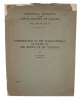
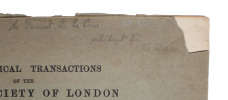
Extremely scarce first edition, off-print issue with presentation-inscription, of Bohr's first published paper, constituting his only ever work in experimental physics. ""His first research project, a precision measurement of the surface tension of water by the observation of a regularly vibrating jet, was completed in 1906, when he was still a student, and it won him the gold medal from the Academy of Sciences. It is a mature piece of work, remarkable for the care and thoroughness with which both the experimental and theoretical parts of the problem were handled."" (DSB).The work is inscribed to renowned Danish physicist and meteorologist Dan la Cour (1876-1942), son of the great Poul la Cour (1846-1908), who is considered the ""Danish Edison"". The inscription reads as thus: ""Hr. Docent D. la Cour/ ærbødigst/ fra/ Forfatteren."" [In Danish, i.e.: ""Mr. Assistant Professor D. la Cour/ with great respect / from/ the author.""].Dan la Cour was the assistant of Niels Bohr's father, Christian Bohr, and a well known scientist. From 1903, he was head of the department of the Meteorological Institute, and from 1923 leader thereof. From 1908 he was Associate Professor at the Polytechnic College. His original scientific works are highly respected, as are his original apparati for measuring earth magnetism which are considered highly valuable. ""His original intelligence, which in many ways resemble that of his father, also bore fruit in his patenting of various inventions: the ""Pyknoprobe"", developed to quickly determine the different layers of the sea"" a use of termite in quickly heating food and drinks out in the open under unfavourable weather conditions."" (From the Danish Encyclopaedia - own translation). He wrote a number of important and esteemed works and was member of the Danish Scientific Academy as well as many prominent international scientific commissions of meteorology and geophysics (i.e. president of the International Geodetical and Geophysical Union). He was also honorary Doctor at the George Washington University. This Bohr's fist paper grew out of a work which Bohr did in 1906, and for which he won a gold medal from the Academy of Sciences. The subject was to experimentally investigate a method, proposed by Lord Rayleigh, for measuring the surface tension of water by the observation of a regularly vibrating jet. ""Bohr [...] included in his work essential improvements on Rayleigh's theory by taking into account the influence of the liquid's viscosity and of the ambient air, and by extending the earlier theory from infinitesimal to arbitrary large vibration amplitudes. In order to execute his experiments he had first of all to cope with one complication. The university had no physics laboratory."" (Pais, p. 101). Bohr thus constructed many of the instruments himself using his father's laboratory. """"I did the experiments completely alone alone in the physiological laboratory... it was a great amount of work"", which was technically demanding."" (Pais, p. 102). In spite of being Bohr's only ever work in experimental physics, it documents his deep understanding of the methods of experimentalists.""On 23 February 1907 the Academy notified him that he had won its gold medal. In 1908 he submitted a modified version to the Royal Society in London. It was his first and last paper on experiments he himself performed. His second publication was his last to deal with surface tension of liquids"" it was purely theoretical. Both papers were favorably referred to in later literature.The manuscript of the prize essay, never published in its original form, is preserved in the Bohr Archives. It is handwritten, by Harald Bohr [i.e. his brother]."" (Pais, p. 102), Rosenfeld, Bohr Bibliography No. 1. Rosenfeld, Dictionary of Scientific Biography II, pp. 239. Pais, Niels Bohr's Times, pp. 101-02.
Determination of the Surface-Tension of Water by the Method of Jet Vibration. Offprint from: Philosophical Transactions of the Royal Society of London, Series A, Vol. 209. pp. 281-317. - [BOHR'S FIRST PUBLISHED PAPER - PRESENTATION COPY]
London, Harrison & Sons, 1909 Large4to. Original printed wrappers. Offprint from: ""Philosophical Transactions of the Royal Society of London, Series A, Vol. 209. pp. 281-317."" With cloth backstrip and I small nick to upper and lower corner of front wrapper. A fine and clean copy. Pp. 281-317.
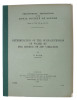
Scarce first edition, off-print issue, of Bohr's first published paper, constituting his only ever work in experimental physics. ""His first research project, a precision measurement of the surface tension of water by the observation of a regularly vibrating jet, was completed in 1906, when he was still a student, and it won him the gold medal from the Academy of Sciences. It is a mature piece of work, remarkable for the care and thoroughness with which both the experimental and theoretical parts of the problem were handled."" (DSB).This Bohr's fist paper grew out of a work which Bohr did in 1906, and for which he won a gold medal from the Academy of Sciences. The subject was to experimentally investigate a method, proposed by Lord Rayleigh, for measuring the surface tension of water by the observation of a regularly vibrating jet. ""Bohr [...] included in his work essential improvements on Rayleigh's theory by taking into account the influence of the liquid's viscosity and of the ambient air, and by extending the earlier theory from infinitesimal to arbitrary large vibration amplitudes. In order to execute his experiments he had first of all to cope with one complication. The university had no physics laboratory."" (Pais, p. 101). Bohr thus constructed many of the instruments himself using his father's laboratory. """"I did the experiments completely alone alone in the physiological laboratory... it was a great amount of work"", which was technically demanding."" (Pais, p. 102). In spite of being Bohr's only ever work in experimental physics, it documents his deep understanding of the methods of experimentalists.""On 23 February 1907 the Academy notified him that he had won its gold medal. In 1908 he submitted a modified version to the Royal Society in London. It was his first and last paper on experiments he himself performed. His second publication was his last to deal with surface tension of liquids"" it was purely theoretical. Both papers were favorably referred to in later literature.The manuscript of the prize essay, never published in its original form, is preserved in the Bohr Archives. It is handwritten, by Harald Bohr [i.e. his brother]."" (Pais, p. 102), Rosenfeld, Bohr Bibliography No. 1. Rosenfeld, Dictionary of Scientific Biography II, pp. 239. Pais, Niels Bohr's Times, pp. 101-02.
Drei Aufsätze über Spektren and Atombau. Mit sieben Abbildungen.
Braunschw., 1922. Orig.printed wrappers. VIII,148 pp.
First edition in bookform of ""Ueber die Wasser stoffspektrum"", ""Ueber die Serienspektren der Elemente"", ""der Bau der Atome und die physikalischen und chemischen Eigenschaften der Elemente"" - Rosenfeldt:24.
Journal of Jocular Physics. Volume III. October 7, 1955. - [""THIS IS THE ATOM THAT BOHR BUILT""]
Copenhagen, Institute for Theoretical Physics, 1955. Small folio (A4). Blank wrappers, stapled under cloth back-stip. Stenciled manuscript. 48 numbered leaves with printing on rectos only. Illustrated.
One of the few scarce original stenciled copies of the ""Journal of Jocular Physics, Vol. III,"" the 1955-volume of the privately circulated amateur-comedy-journal that Bohr's students made on the occasions of Bohr's most important birthdays (beginning with his 50th in 1935), in this case his 70th. The ""Journal"" is an eclectic blend of funny and clever stories, songs, poems, aphorisms, humorous descriptions of recent developments in physics, etc., all written in an informal tone with the underlying subject being Bohr's birthday.Since 1929 most of the greatest physicists of the 20th century had been gathering around Niels Bohr for a conference in Copenhagen at the Bohr Institute. Since 1931 this conference had also included a skit prepared by the youngest of the participants, the ""Copenhagen Faust"" of 1932 being the most famous and important of them. It is this skit that later develops into the ""Journal of Jocular Physics"" which was prepared and compiled for Bohr's 50th, 60th and 70th birthdays, the first in 1935, the second in 1945, and the third (the present) in 1955. The 1955 ""Jocular Physics"" was the last of them. ""The early decades of the present century witnessed the heady development of the Quantum Theory of the atom, and during that era the roads of theoreticians of all nationalities led, not to Rome, but to Copenhagen, the home city of Niels Bohr, who was the first to formulate the correct atomic model. It became customary at the end of each spring conference at Blegdamsvej 15 (the street address of Bohr's Institute of Theoretical Physics) to produce a stunt pertaining to recent developments in physics.However Copenhagen was also the home of abundant humor. As a respite from the intensive and highly competitive efforts taking place to characterize fundamental interactions on an atomic scale, physicists took the time to develop satirical letters, articles, plays and other works."" (Gamow, Thirty Years that Shook Physics, pp. 167-68).In his Report at the Niels Bohr Archive Symposium, ""Copenhagen' and beyond: Drama meets history of science"", Yu.V. Gaponov accounts for the history of ""physical art"": ""The 1950s and 1960s were the golden age of the utmost prosperity in Physics. The atomic revolution having opened for the scientists a new world of quanta led soon to the nuclear fission discovery and to the first steps in techniques to dominate the atomic energy. The realization of national atomic programs which first took place in USA and then in Russia (USSR) and Great Britain had attracted the whole world's attention and placed Physics and the natural sciences in general in a top position. Being concerned with matters of physics became then exclusive and prestigious and physicists as individuals attracted the society's attention. They became heroes of literature, theater, movies, press. This process was observed in many advanced countries. It was also typical for the former USSR of those times, although owing to special social circumstances it had acquired some particular forms. One such form was the creation of ""Physical Art"" traditions... The birth of these traditions is commonly associated with the appearance at MSU PhysFac in 1960 of a Student Humor Festival called ""Birthday of Archimedes"" (later ""Physics Day"") along with a comic buffoonery opera ""Archimedes"" (authors - physicists and poets V. Kaner, V. Milyaev). However, MSU physicists consider the ""Physical Art"" traditions to have started earlier. Here are some remarkable milestones: In 1932 the well known ""Faust"" jocular opera and in 1935 the special issue of the ""Jocular Physics"" journal were written by some eminent physicists in connection with the 50th birthday of Niels Bohr.""The present 1955-volume contains numerous very funny contributions by physicists around Bohr, all based on physics humour, physics word-games etc. We have for instance ""A Voyage to Laplacia"" by L. Rosenfeld, a ""Confidential"" report ""Standardization of (physics) Papers"" by J. Lindhard,""Broken English"" by H.B.G. Casimir (""There exists today a universal language that is spoken and understood almost everywhere: it is Broken English. I am not referring to Pidgin English a highly formalized and restricted branch of B.E. but to the much more general language that is used by waiters in Hawai, prostitutes in Paris and ambassadors in Washington, by business-men from Buenos Aires, by scientists at international meetings and by dirty-postcard-peddlers in Greece, in short honourable people like myself all over the world..."" (p. 14), aphorisms (like: ""One Bohr can answer more questions than 10 philosophers can ask"", """"I will have to sleep on that"" the physicist said, he lay down on the floor"", etc.), ""A Remarkable ""V-event"""" by M. Sheep, ""The Heart on the other Side"" by G. Gamow (""""But father will never give his consent... He is looking for a son-in-law who can help him in his business, and eventually take it over. You can't possibly qualify for that, can you?"" ""No, I guess I can't,"" agreed Stan Situs sadly. ""I cannot possibly see how the kind of mathematics I am doing or, in fact, ANY kind of mathematics can help the production and selling of shoes...""), the poem ""The Atom that Bohr Built"", etc. The ""Journal of Jocular Physics"" is an important document portraying both one of the main physical centres of this physically important period and how one of the greatest scientific minds of the 20th century was viewed by his students and collaborators - as being not only brilliant in his field of research but also as a funny, likeable and sympathetic person. See also:Gino Segrè. Faust in Copenhagen. A Struggle for the Soul of Physics and the Birth of the Nuclear Age.""Pimlico, 2008.George Gamow. Thirty Years that Shook Physics. The Story of Quantum Theory. New York, 1966.
Journal of Jocular Physics. Volume III. October 7, 1955. - [""THIS IS THE ATOM THAT BOHR BUILT""]
Copenhagen, Institute for Theoretical Physics, 1955. Small folio (A4). Stapled, unbound. Stenciled manuscript. Edges a bit bumped. A bit of spotting to first leaf. 48 numbered leaves with printing on rectos only. Illustrated.
One of the few scarce original stenciled copies of the ""Journal of Jocular Physics, Vol. III,"" the 1955-volume of the privately circulated amateur-comedy-journal that Bohr's students made on the occasions of Bohr's most important birthdays (beginning with his 50th in 1935), in this case his 70th. The ""Journal"" is an eclectic blend of funny and clever stories, songs, poems, aphorisms, humorous descriptions of recent developments in physics, etc., all written in an informal tone with the underlying subject being Bohr's birthday.Since 1929 most of the greatest physicists of the 20th century had been gathering around Niels Bohr for a conference in Copenhagen at the Bohr Institute. Since 1931 this conference had also included a skit prepared by the youngest of the participants, the ""Copenhagen Faust"" of 1932 being the most famous and important of them. It is this skit that later develops into the ""Journal of Jocular Physics"" which was prepared and compiled for Bohr's 50th, 60th and 70th birthdays, the first in 1935, the second in 1945, and the third (the present) in 1955. The 1955 ""Jocular Physics"" was the last of them. ""The early decades of the present century witnessed the heady development of the Quantum Theory of the atom, and during that era the roads of theoreticians of all nationalities led, not to Rome, but to Copenhagen, the home city of Niels Bohr, who was the first to formulate the correct atomic model. It became customary at the end of each spring conference at Blegdamsvej 15 (the street address of Bohr's Institute of Theoretical Physics) to produce a stunt pertaining to recent developments in physics.However Copenhagen was also the home of abundant humor. As a respite from the intensive and highly competitive efforts taking place to characterize fundamental interactions on an atomic scale, physicists took the time to develop satirical letters, articles, plays and other works."" (Gamow, Thirty Years that Shook Physics, pp. 167-68).In his Report at the Niels Bohr Archive Symposium, ""Copenhagen' and beyond: Drama meets history of science"", Yu.V. Gaponov accounts for the history of ""physical art"": ""The 1950s and 1960s were the golden age of the utmost prosperity in Physics. The atomic revolution having opened for the scientists a new world of quanta led soon to the nuclear fission discovery and to the first steps in techniques to dominate the atomic energy. The realization of national atomic programs which first took place in USA and then in Russia (USSR) and Great Britain had attracted the whole world's attention and placed Physics and the natural sciences in general in a top position. Being concerned with matters of physics became then exclusive and prestigious and physicists as individuals attracted the society's attention. They became heroes of literature, theater, movies, press. This process was observed in many advanced countries. It was also typical for the former USSR of those times, although owing to special social circumstances it had acquired some particular forms. One such form was the creation of ""Physical Art"" traditions... The birth of these traditions is commonly associated with the appearance at MSU PhysFac in 1960 of a Student Humor Festival called ""Birthday of Archimedes"" (later ""Physics Day"") along with a comic buffoonery opera ""Archimedes"" (authors - physicists and poets V. Kaner, V. Milyaev). However, MSU physicists consider the ""Physical Art"" traditions to have started earlier. Here are some remarkable milestones: In 1932 the well known ""Faust"" jocular opera and in 1935 the special issue of the ""Jocular Physics"" journal were written by some eminent physicists in connection with the 50th birthday of Niels Bohr.""The present 1955-volume contains numerous very funny contributions by physicists around Bohr, all based on physics humour, physics word-games etc. We have for instance ""A Voyage to Laplacia"" by L. Rosenfeld, a ""Confidential"" report ""Standardization of (physics) Papers"" by J. Lindhard,""Broken English"" by H.B.G. Casimir (""There exists today a universal language that is spoken and understood almost everywhere: it is Broken English. I am not referring to Pidgin English a highly formalized and restricted branch of B.E. but to the much more general language that is used by waiters in Hawai, prostitutes in Paris and ambassadors in Washington, by business-men from Buenos Aires, by scientists at international meetings and by dirty-postcard-peddlers in Greece, in short honourable people like myself all over the world..."" (p. 14), aphorisms (like: ""One Bohr can answer more questions than 10 philosophers can ask"", """"I will have to sleep on that"" the physicist said, he lay down on the floor"", etc.), ""A Remarkable ""V-event"""" by M. Sheep, ""The Heart on the other Side"" by G. Gamow (""""But father will never give his consent... He is looking for a son-in-law who can help him in his business, and eventually take it over. You can't possibly qualify for that, can you?"" ""No, I guess I can't,"" agreed Stan Situs sadly. ""I cannot possibly see how the kind of mathematics I am doing or, in fact, ANY kind of mathematics can help the production and selling of shoes...""), the poem ""The Atom that Bohr Built"", etc. The ""Journal of Jocular Physics"" is an important document portraying both one of the main physical centres of this physically important period and how one of the greatest scientific minds of the 20th century was viewed by his students and collaborators - as being not only brilliant in his field of research but also as a funny, likeable and sympathetic person. See also:Gino Segrè. Faust in Copenhagen. A Struggle for the Soul of Physics and the Birth of the Nuclear Age.""Pimlico, 2008.George Gamow. Thirty Years that Shook Physics. The Story of Quantum Theory. New York, 1966.
Les Spectres et la Structure de L'Atome Trois Conferences. Traduit sur le Manuscrit de l'Auteur par A. Corvisy.
Paris, Libraire Scientifique, 1923. 8vo. Uncut in orig. printed wrappers. Tears to backstrip but preserved. A small nick to upper left corner of frontwrapper.
First French editions of the three famous papers: ""Ueber die Wasser stoffspektrum"", ""Ueber die Serienspektren der Elemente"", ""Der Bau der Atome und die physikalischen und chemischen Eigenschaften der Elemente"" - Rosenfeld:24.
Linienspektren und Atombau.
Leipzig, Johann Ambrosius Barth, 1923. Contemp. full buckram. In: ""Annalen der Physik"", Vierte Folge, band 71. Stamp on verso of titlepage. Portrait as frontisp. (2),605,VI pp. (Entire volume offered). Bohr's paper: pp. 228-288 and 8 plates (on 2 leaves). Punched with cords in inner margins. Clean and fine.
First appearance of the only part of Bohr's planned new comprehensive treatise on atomic structure, announcing that this was 'the first of a series of essays....on atomic structure'.
Nyere Undersøgelser over Atomkernernes Omdannelser.
Oslo, Grøndal & Søn, 1941. 8vo. Offprint from: Fra Fysikkens Verden. Original printed wrappers. Fine condition. 34 pp.
First edition.
On the Quantum Theory of Line-Spectra. Part I-II. [Off-print from ""D. Kgl. Danske Vidensk. Selsk. Skrifter"". - [BOHR'S CORRESPONDENCE PRINCIPLE - PRESENTATION-COPIES]
Copenhagen, Bianco Lunos, 1918. 4to. Both parts uncut and in the original printed wrappers. Wrappers detached and with small nicks and tears to extremities. Internally fine and clean. Part I unopened. 36 pp. + pp. (37) - 100.
First editions, author's off-prints (with ""Separate Copy"" printed to front wrappers), presentation-copies, of the first two parts of Bohr's seminal work ""On the Quantum Theory of the Line-Spectra"" (which appeared in three parts and which was never finished, the third part of which, published 4 years later, is almost never found in presentation-sets), in which Bohr gave his first clear presentation of his groundbreaking ""correspondence principle"": ""Which would play a pivotal role in the later development of atomic theory and its transformation into quantum mechanics."" (Kragh, Quantum Generations, p. 56). It eventually became a cornerstone in the quantum mechanics formulated by Heisenberg and Schrödinger. ""There was rarely in the history of physics a comprehensive theory which owed so much to one principle as quantum mechanics owed to Bohr's correspondence principle"" (Jammer 1966, p. 118). The evolution of quantum theory is divided into two distinct periods"" from 1900 to 1925, usually referred to as the period with the old quantum theory still grounded in classical physics and the second period with quantum mechanics from 1925 onwards. The general rules of quantum mechanics are very successful in describing objects on an atomic level. But macroscopic systems are accurately described by classical theories like classical mechanics and classical electrodynamics. If quantum mechanics were to be applicable to macroscopic objects, there must be some limit in which quantum mechanics reduces to classical mechanics. Bohr's correspondence principle demands that classical physics and quantum physics give the same answer when the systems become large. ""A major tool he developed for dealing with quantum problem, [...], was the correspondence principle, which establishes links between predictions of the classical theory and expectations for the quantum theory."" (Pais, Niels Bohr's Times, p. 20.). In this sense, the correspondence principle is not only an exceedingly important methodological principle, it also represents the transition to quantum mechanics and modern physics in general and it became the cornerstone of Bohr's philosophical interpretation of quantum mechanics which later would be closely tied to his thesis of complementarity and to the Copenhagen interpretation. Another version of the correspondence principle lives on in philosophical literature where it has taken form as a more general concept representing a development of new scientific theories.""By 1918 Bohr had visualized, at least in outline, the whole theory of atomic phenomena. ... He of course realized that he was still very far from a logically consistent framework wide enough to incorporate both the quantum postulates and those aspects of classical mechanics and electrodynamics that seemed to retain some validity. Nevertheless, he at once started writing up a synthetic exposition of his arguments and of all the evidence upon which they could have any bearing" in testing how well he could summarize what was known, he found occasion to check the soundness of his ideas and to improve their formulation. In the present case, however, he could hardly keep pace with the growth of the subject the paper he had in mind at the beginning developed into a four-part treatise, 'On the Theory of Line Spectra', publication of which dragged over four years without being completed" the first three parts appeared between 1918 and 1922 [of which the two first from 1918 are offered here], and the fourth, unfortunately, was never published. Thus, the full impact of Bohr's view remained confined to the small but brilliant circle of his disciples, who indeed managed better than their master to make them more widely known by the prompter publication of their own results"" (D.S.B. II: 246-47).Inscribed to ""Hr. Docent D. la Cour/ Venskabeligst/ fra/ Forfatteren"" on both front wrappers. The renowned Danish physicist and meteorologist Dan la Cour (1876-1942), was the son of the great Poul la Cour (1846-1908), who is considered the ""Danish Edison"". Dan la Cour was the assistant of Niels Bohr's father, Christian Bohr, and a well known scientist. From 1903, he was head of the department of the Meteorological Institute, and from 1923 leader thereof. From 1908 he was Associate Professor at the Polytechnic College. His original scientific works are highly respected, as are his original apparati for measuring earth magnetism which are considered highly valuable. ""His original intelligence, which in many ways resemble that of his father, also bore fruit in his patenting of various inventions: the ""Pyknoprobe"", developed to quickly determine the different layers of the sea"" a use of termite in quickly heating food and drinks out in the open under unfavourable weather conditions."" (From the Danish Encyclopaedia - own translation). He wrote a number of important and esteemed works and was member of the Danish Scientific Academy as well as many prominent international scientific commissions of meteorology and geophysics (i.e. president of the International Geodetical and Geophysical Union). He was also honorary Doctor at the George Washington University. Rosenfeld, Bohr-Bibliography, 15.
On the Quantum Theory of Line-Spectra, Part I - III. - [BOHR'S CORRESPONDENCE PRINCIPLE]
København, Bianco Lunos Bogtrykkeri, 1918 - 1922. 4to. Uncut unopened in the original printed wrappers. In ""D. Kgl. Danske Vidensk. Selsk. Skrifter, afd., 8, række IV, 1-3"" / ""Mémoires de l'Académie Royale des Sciences et des Lettres de Danemark"". Wrapper with a few minor nicks and tears but otherwise a very fine and clean copy. 118 pp.
Collected offprint-edition of Bohr's seminal work ""On the Quantum Theory of the Line-Spectra"", marking the beginning of the quantum revolution in physics, introduced the concept of quantized energy levels, provided an explanation for the observed line spectra, and served as a foundational model that inspired further developments in quantum mechanics. It is conseidered one of Bohr's most important papers and the basis for his Nobel Prize. These papers give the first clear formulation of his 'correspondence principle' establishing the limit agreement of quantum and classical physics. ""By 1918 Bohr had visualized, at least in outline, the whole theory of atomic phenomena. ... He of course realized that he was still very far from a logically consistent framework wide enough to incorporate both the quantum postulates and those aspects of classical mechanics and electrodynamics that seemed to retain some validity. Nevertheless, he at once started writing up a synthetic exposition of his arguments and of all the evidence upon which they could have any bearing" in testing how well he could summarize what was known, he found occasion to check the soundness of his ideas and to improve their formulation. In the present case, however, he could hardly keep pace with the growth of the subject the paper he had in mind at the beginning developed into a four-part treatise, 'On the Theory of Line Spectra', publication of which dragged over four years without being completed" the first three parts appeared between 1918 and 1922, and the fourth, unfortunately, was never published. Thus, the full impact of Bohr's view remained confined to the small but brilliant circle of his disciples, who indeed managed better than their master to make them more widely known by the prompter publication of their own results"" (D.S.B. 2: 246-47).
On the Quantum Theory of Line-Spectra. Part I-III.
K., 1918-22. (Unchanged reprint of the original. Coph., 1928). 4to. 118 pp.
On the Quantum Theory of Line-Spectra. Part II, On the Hydrogen Spectrum. - [AUTHOR'S OFFPRINT - PRESENTATION-COPY]
Copenhagen, Bianco Lunos, 1918. 4to. Original printed wrappers. Lower right corner of front wrapper bent. Small closed tear to front wrapper. Spine strip renewed. Otherwise fine and clean throughtout.
First printing of the second part of Bohr's seminal work ""On the Quantum Theory of the Line-Spectra"" (which appeared in three parts and which was never finished), author's off-print (with ""Separate copy"" printed on front wrapper), presentation-copy, inscribed by Bohr: ""Hr. Professor K. Prytz / med venlig Hilsen / fra Forfatteren"".""By 1918 Bohr had visualized, at least in outline, the whole theory of atomic phenomena. ... He of course realized that he was still very far from a logically consistent framework wide enough to incorporate both the quantum postulates and those aspects of classical mechanics and electrodynamics that seemed to retain some validity. Nevertheless, he at once started writing up a synthetic exposition of his arguments and of all the evidence upon which they could have any bearing" in testing how well he could summarize what was known, he found occasion to check the soundness of his ideas and to improve their formulation. In the present case, however, he could hardly keep pace with the growth of the subject the paper he had in mind at the beginning developed into a four-part treatise, 'On the Theory of Line Spectra', publication of which dragged over four years without being completed" the first three parts appeared between 1918 and 1922 [of which the second from 1918 is offered here], and the fourth, unfortunately, was never published. Thus, the full impact of Bohr's view remained confined to the small but brilliant circle of his disciples, who indeed managed better than their master to make them more widely known by the prompter publication of their own results"" (D.S.B. 2: 246-47).The present second part deals with the hydrogen spectrum, whereas the first part dealt with the general theory, and the third with the spectra of elements of higher atomic structure. Peter Kristian Prytz (1851-1929), to whom the work is inscribed, was an important physicist of the generation before Bohr. He did immense work to better the conditions of the teaching of physics at the Polytechnic Institute in Copenhagen, where Bohr studied for many years and where he later became a teacher. Prytz introduced the teaching of experimental physics here and fought for more space, more apparatus, more money for teaching assistance and more time for teaching. Thus, he played a great role in the physics-environment in Copenhagen both during Bohr's years as a student and as a teacher.Most importantly, it was Prytz who (in 1907) attracted the necessary money for the institute which enabled him to create the physical laboratory that constituted the foundation of Danish experimental physics, the field of which Bohr became professor in 1916 (till 1920 - the years during which he was working on the ""On the Quantum Theory of the Line Spectra"").Rosenfeld, Bohr-Bibliography, 15.
On the Theory of Decrease of Velocity of Moving Electrified Particles on passing through Matter. In: Philosophical Magazine Vol. 25, No. 145, January 1913 pp. 10-31. - [BOHR'S FIRST WORK ON NUCLEAR PHYSICS]
London, Taylor & Francis, 1913. 8vo. Original printed wrappers" chipped, backstrip lacks. The whole issue. 200 pp., 2 plates.
First edition of Bohr's first work on nuclear physics, published just before his 'On the Constitution of Atoms and Molecules'. During his visit to Manchester Bohr had the chance to get a first hand account of Rutherford's investigations on the penetration of alpha-particles through matter. In order to explain the large-angle scattering of alpha rays, which Rutherford had observed, he proposed his ""nuclear"" model of the atom in contrast to J.J. Thomson's ""plum pudding"" model in 1910. Bohr eagerly took up the new model and soon recognized its far-reaching implications. In particular, he pointed out that the nuclear model of the atom implied a sharp separation between the chemical properties, ascribed to the peripherical electrons, and the radioactive properties, which affected the nucleas itself. In this paper the theory of the decrease of velocity of moving electrified particles in passing through matter is given in a form, such that the rate of the decrease in the velocity depends on the frequency of vibration of the electrons in the atoms of the absorbing material. In the conclusion Bohr could state 'that a hydrogen atom contains only 1 electron outside the positively charged nucleas, and that a helium atom only contains 2 electrons outside the nucleas'.Rosenfeld, Bohr Bibliography No. 5. Rosenfeld, Dictionary of Scientific Biography II, pp. 240-41.
On the Theory of Decrease of Velocity of Moving Electrified Particles on passing through Matter - [THE FOUNDATION OF BOHR'S ATOMIC THEORY]
London, Taylor & Francis, 1913. 8vo. Bound in one nice contemporary half calf binding with gilt leather title-label to spine. Published in ""The London, Edinburgh, and Dublin Philosophical Magazine and Journal of Science"", Vol. 25. No. 145-150 offered. Small repair to spine and blind stamped to lower part of title page. The Bohr papers: pp. 10-31. [Entire volume: VIII, 876 pp.+ 10 plates].
![On the Theory of Decrease of Velocity of Moving Electrified Particles on passing through Matter - [THE FOUNDATION OF BOHR'S ATOMIC THEORY]. "BOHR, ...](https://static.livre-rare-book.com/pictures/LLX/51729_1_thumb.jpg)
![On the Theory of Decrease of Velocity of Moving Electrified Particles on passing through Matter - [THE FOUNDATION OF BOHR'S ATOMIC THEORY]. "BOHR, ...](https://static.livre-rare-book.com/pictures/LLX/51729_2_thumb.jpg)
Bohr's seminal first work on nuclear physics, being the work that lays the foundation for his atomic theory (published before his ""On the Constitution of Atoms and Molecules""), in which he is able to conclude ""that a hydrogen atom contains only 1 electron outside the positively charged nucleus, and that a helium atom only contains 2 electrons outside the nucleus ."" ""Bohr's 1913 paper on alpha-particles [i.e. the present], which he had begun in Manchester, and which had led him to the question of atomic structure, marks the transition to his great work, also of 1913, on that same problem. While still in Manchester, he had already begun an early sketch of those entirely new ideas."" (Pais, p. 128). The present work must be considered one of the most important to the birth of modern atomic theory.After finishing his studies in Copenhagen, Bohr went to Cambridge in order to pursue his studies on electron theory under the guidance of J.J. Thompson. Thompson, who was beginning to lose interest in the subject by now, did, however, not recognize the genious of the young Bohr, and as soon as he could, Bohr went to Manchester, where Ernest Rutherford had established a laboratory. ""There, from March to July 1912, working with utmost concentration, he [i.e. Bohr] laid the foundation for his greatest achievements in physics, the theory of the atomic constitution."" (DSB). Bohr's survey of the implications of Rutherford's atomic model had led him to attack the much harder problem which lay at the core of it, namely determining the exact nature of the relation between the atomic number and the number of electrons in the atom. ""Bohr obtained a much deeper insight into the problem by a brilliant piece of work, which he - working, as he said, ""day and night"" - completed with astonishing speed"" (DSB), that paper being the present ""On the Theory of the Decrease of Velocity of Moving electrified Particles on passing through Matter"", which thus constitutes his very first publication on the subject, published immediately after this dense period of 1912, in the Philosophical Magazine of January 1913. ""The problem was one of immediate interest for Rutherford's laboratory: in their passage through a material medium, alpha particles continually lose energy by ionizing the atoms they encounter, at a rate depending on their velocity. Their energy loss limits the depth to which the particles can penetrate into the medium, and the relation between this depth, or range, and the velocity offers a way of determining this velocity. What Bohr did was to analyze the ionizing process on the basis of the Rutherford model of the atom and thus express the rate of energy loss in terms of the velocity by a much more accurate formula than had so far been achieved-a formula, in fact, to which modern quantum mechanics adds only nonessential refinements"" (DSB). In the present work, Bohr was thus able to conclude: ""In this paper the theory of the decrease of velocity of moving electrified particles in passing through matter is given in a form, such that the rate of the decrease in the velocity depends on the frequency of vibration of the electrons in the atoms of the absorbing material."" as well as the seminal words that have been formative for the birth of the modern atomic theory: ""Adopting Prof. Rutherford's theory of the constitution of atoms, it seems that it can be concluded with great certainty, from the absorption of alpha-rays, that a hydrogen atom contains only 1 electron outside the positively charged nucleus, and that a helium atom only contains 2 electrons outside the nucleus "". Bohr continues: ""These questions and some further information about the constitution of atoms which may be got from experiments on the absorption of alpha-rays, will be discussed in more detail in a later paper."" (pp. 30-31 of the original paper) - the last sentence referring directly to his three part ""On the Constitution of Atoms and Molecules"", in which he went on to present his postulates of the orbital structure of the electrons and their quantized radiation. Rosenfeld, Bohr Bibliography No. 5. Rosenfeld, Dictionary of Scientific Biography II, pp. 240-41. Pais, Niels Bohr's Times, pp. 117-31.
On the Theory of the Decrease of Velocity of Moving Electrified Particles on passing through Matter. [Off-print From the Philosophical Magazine (Vol. 25, No. 145) for January 1913 ]. - [THE FOUNDATION OF BOHR'S ATOMIC THEORY - PRESENTATION-COPY]
[London, Taylor & Francis], 1913. 8vo. Original printed wrappers. The fragile wrappers are detached, but fully intact. Merely tiny parts of the thin backstrip lacking. Three small tears to front wrapper, no loss, as well as a couple of creses. Back wrapper with a slight bend to the corner and minor fading to extremities. Pp. (9)-31.
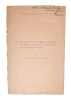


Scarce first edition, off-print issue with presentation-inscription, of Bohr's seminal first work on nuclear physics, being the work that lays the foundation for his atomic theory (published before his ""On the Constitution of Atoms and Molecules""), in which he is able to conclude ""that a hydrogen atom contains only 1 electron outside the positively charged nucleus, and that a helium atom only contains 2 electrons outside the nucleus ."" ""Bohr's 1913 paper on alpha-particles [i.e. the present], which he had begun in Manchester, and which had led him to the question of atomic structure, marks the transition to his great work, also of 1913, on that same problem. While still in Manchester, he had already begun an early sketch of those entirely new ideas."" (Pais, p. 128). The present work must be considered one of the most important to the birth of modern atomic theory.The work is inscribed to renowned Danish physicist and meteorologist Dan la Cour (1876-1942), son of the great Poul la Cour (1846-1908), who is considered the ""Danish Edison"". The inscription reads as thus: ""Hr. Docent Afdelingschef D. la Cour/ med venlig Hilsen/ fra/ Forfatteren."" [In Danish, i.e.: ""Mr. Assistant Professor Head of Department D. la Cour/ with kind regards/ from/ the author.""].Dan la Cour was the assistant of Niels Bohr's father, Christian Bohr, and a well known scientist. From 1903, he was head of the department of the Meteorological Institute, and from 1923 leader thereof. From 1908 he was Associate Professor at the Polytechnic College. His original scientific works are highly respected, as are his original apparati for measuring earth magnetism which are considered highly valuable. ""His original intelligence, which in many ways resemble that of his father, also bore fruit in his patenting of various inventions: the ""Pyknoprobe"", developed to quickly determine the different layers of the sea"" a use of termite in quickly heating food and drinks out in the open under unfavourable weather conditions."" (From the Danish Encyclopaedia - own translation). He wrote a number of important and esteemed works and was member of the Danish Scientific Academy as well as many prominent international scientific commissions of meteorology and geophysics (i.e. president of the International Geodetical and Geophysical Union). He was also honorary Doctor at the George Washington University. After finishing his studies in Copenhagen, Bohr went to Cambridge in order to pursue his studies on electron theory under the guidance of J.J. Thompson. Thompson, who was beginning to lose interest in the subject by now, did, however, not recognize the genious of the young Bohr, and as soon as he could, Bohr went to Manchester, where Ernest Rutherford had established a laboratory. ""There, from March to July 1912, working with utmost concentration, he [i.e. Bohr] laid the foundation for his greatest achievements in physics, the theory of the atomic constitution."" (DSB). Bohr's survey of the implications of Rutherford's atomic model had led him to attack the much harder problem which lay at the core of it, namely determining the exact nature of the relation between the atomic number and the number of electrons in the atom. ""Bohr obtained a much deeper insight into the problem by a brilliant piece of work, which he - working, as he said, ""day and night"" - completed with astonishing speed"" (DSB), that paper being the present ""On the Theory of the Decrease of Velocity of Moving electrified Particles on passing through Matter"", which thus constitutes his very first publication on the subject, published immediately after this dense period of 1912, in the Philosophical Magazine of January 1913. ""The problem was one of immediate interest for Rutherford's laboratory: in their passage through a material medium, alpha particles continually lose energy by ionizing the atoms they encounter, at a rate depending on their velocity. Their energy loss limits the depth to which the particles can penetrate into the medium, and the relation between this depth, or range, and the velocity offers a way of determining this velocity. What Bohr did was to analyze the ionizing process on the basis of the Rutherford model of the atom and thus express the rate of energy loss in terms of the velocity by a much more accurate formula than had so far been achieved-a formula, in fact, to which modern quantum mechanics adds only nonessential refinements"" (DSB). In the present work, Bohr was thus able to conclude: ""In this paper the theory of the decrease of velocity of moving electrified particles in passing through matter is given in a form, such that the rate of the decrease in the velocity depends on the frequency of vibration of the electrons in the atoms of the absorbing material."" as well as the seminal words that have been formative for the birth of the modern atomic theory: ""Adopting Prof. Rutherford's theory of the constitution of atoms, it seems that it can be concluded with great certainty, from the absorption of alpha-rays, that a hydrogen atom contains only 1 electron outside the positively charged nucleus, and that a helium atom only contains 2 electrons outside the nucleus "". Bohr continues: ""These questions and some further information about the constitution of atoms which may be got from experiments on the absorption of alpha-rays, will be discussed in more detail in a later paper."" (pp. 30-31 of the original paper) - the last sentence referring directly to his three part ""On the Constitution of Atoms and Molecules"", in which he went on to present his postulates of the orbital structure of the electrons and their quantized radiation. Rosenfeld, Bohr Bibliography No. 5. Rosenfeld, Dictionary of Scientific Biography II, pp. 240-41. Pais, Niels Bohr's Times, pp. 117-31.
Original photography.
""Geneva / 12-15. Februar 1952"". 17 x 11,7 cm. A stamp on the back stating: ""Copyright / URS G. ARNI / REPORTER-PHOTOGRAPHIE / 15, R. CHARLES-GIRON TÉL 2.37.55 / GENÈVE"". In pencil: ""Nils Bohr / atomphysikkonferens / Geneva / 12-15. Februari 1952"". The photo depicts an elderly Bohr with a briefcase under his arm in white shirt, tie and three piece suit.
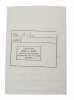
The picture shows Bohr participating in what would become one of the most important physic conferences in the second half of the 20th century. Here CERN, the European Organization for Nuclear Research, was established. Niels Bohr had been one of the central figures in the development of atomic theory in the early 20th century and was the father to the exceedingly important Copenhagen Interpretation. These merits made him the head of the theoretical division of CERN which was located in Copenhagen. ""In Geneva the representatives of 12 European governments signed the convention setting up the interim organization, which came into being on 15 February 1952 with the title of ""European Council for Nuclear Research"", called ""CERN"" for short after the initials of the French title. Belgium, Denmark, France, the German Federal Republic, Greece, Italy, the Netherlands, Norway, Sweden, Switzerland and Yugoslavia were then provisionally united to carry out nuclear research. During the whole lifetime of the interim CERN, the United Kingdom remained simply an observer, although the interest shown in the project by that country soon took the shape of new ideas, the provision of consultants and gifts."" (CERN COURIER).
Physical Science and the Study of religions.
(Copenhagen), Munksgaard, 1953. Royal8vo. In orig. printed wrappers. Offprint from ""Studia Orientalia Ioanni Pedersen septuagenario""., pp. 385-390.
First edition. - Rosenfeld: 95.
PHYSIQUE ATOMIQUE ET CONNAISSANCE HUMAINE
DENOEL GONTHIER. 1964. In-12. Broché. Bon état, Couv. convenable, Dos satisfaisant, Intérieur frais. 181 pages- nombreuses annotations à l'encre sur la page de faux titre. . . . Classification Dewey : 530-Physique
COLLECTION BIBLIOTHEQUE MEDIATIONS N°18 Classification Dewey : 530-Physique

"Physique atomique et connaissance humaine - collection ""Bibliothèque médiations"""
Denoël/Gonthier. 1964. In-12. Broché. Etat d'usage, Couv. légèrement passée, Dos satisfaisant, Papier jauni. 181 pages.. . . . Classification Dewey : 530-Physique

Classification Dewey : 530-Physique
Physique atomique et connaissance humaine. Traduit par Edmond Bauer et Roland Omnes
Gauthier-Villars 1961 In-8 broché 24,2 cm sur 15,8. 98 pages. Dos muet. Bon état d’occasion.
Bon état d’occasion
The Penetration of Atomic Particles through Matter.
Copenhagen., 1948. Orig. printed wrappers. 144 pp.
First edition
The quantum postulate and the recent development of atomic theory. - [COINING THE TERM 'COMPLEMENTARITY']
London, Macmillan and Co., 1928. Royal8vo. In recent full blue cloth with gilt lettering to spine. Extracted from ""Nature"", January - June, 1928, Vol. 121. Entire April 14-issue offered. Fine and clean. [Bohr:] Pp. 580-90. [Entire issue:] Pp. 561-608.
First edition of Bohr's exceedingly influential statement of his 'complementarity' principle, the basis of what became known as the 'Copenhagen interpretation' of quantum mechanics. In the paper he coined the term 'complementarity' and thereby created an entire new fundamental principle of quantum mechanics.""Immediately after Heisenberg's work on uncertainty relations, Bohr presented his concept of complementarity at a conference a Lake Como in Italy. Bohr's lecture marked the first attempt to provide a genuine philosophical underpinning to the new advances in physics. The uncertainty relations had provided Bohr a concrete measure of the consequences of the wave-particle duality and thereby a physics-based justification for the ideas he was working on. Bohr had already embraced the wave-particle duality underlying quantum theory and he presented the concept of complementarity as the fundamental feature of a new conceptual framework broad enough to include it"" (Paul McEvoy, Niels Bohr). ""For Bohr, complementarity was an almost religious belief that the paradoxes of the quantum world must be accepted as fundamental, not to be 'solved' or trivialized by attempts to find out 'what's really going on down there.' Bohr used the word in an unusual way: the 'complementarity' of waves and particles, for example (or of position and momentum), meant that when one existed fully, its complement did not exist at all"" (Louisa Gilder, The Age of Entanglement). ""The lecture was published in Nature in 1928 in a revised form It sparked significant debate in the years that followed and solidified the boundaries between those who accepted Bohr's view of the consequences of quantum theory and those who were seeking a more 'realistic' microscopic theory or a more realistic interpretation of quantum theory itself"" (McEvoy, P. 70).The paper was published almost simultaneously in English, Danish, English, French and German, the present English publication being the first.
Zur Frage der Polarisation der Strahlung in der Quantentheorie. - [TOWARDS QUANTUM THEORY]
Braunschweig und Berlin, Vieweg & Sohn, Julius Springer, 1921. Contemp. hcloth. Stamp on titlepage. In ""Zeitschrift für Physik. Hrasg. von Karl Scheel"", vol. 6., IV,416 pp. Bohr's paper: pp. 1-9. A faint dampstain in right margin.
First edition. ""...in the hands of Bohr and his school the correspondence principle was like ""a magic wand that allowed the results of the classical wave theory to be of use for the quantum theory...but a costly price had to be paid. For taking resort to classical physics in order to establish quantum-theoretic predictions, or in other words, constructing a theory whose corroboration depends on premises which conflict with the substance of the theory, is of course a serious inconsistency from the logical point of view. Being fully aware of this difficulty, Bohr attempted repeatedly to show ""the correspondence principle must be regarded purely as a law of quantum theory, which can in no way diminish the contrast between the postulates and electrodynamic theory."" The earliest allusion to such a conception may perhaps be found as early as 1921 in a paper (the paper offered) in which Bohr briefly discussed the function of the principle...""(Max Jammer).
Zur Frage der Polarisation der Strahlung in der Quantentheorie. - [TOWARDS QUANTUM THEORY - THE CORRESPONDENCE PRINCIPLE]
Braunschweig und Berlin, Vieweg & Sohn, Julius Springer, 1921. 8vo. Bound in Contemporary half cloth. Stamp on title-page. In ""Zeitschrift für Physik. Hrasg. von Karl Scheel"", vol. 6. [Bohr's paper:] pp. 1-9. [Entire volume: IV, 416 pp].
First edition of this seminal contribution to the correspondence principle. ""...in the hands of Bohr and his school the correspondence principle was like ""a magic wand that allowed the results of the classical wave theory to be of use for the quantum theory...but a costly price had to be paid. For taking resort to classical physics in order to establish quantum-theoretic predictions, or in other words, constructing a theory whose corroboration depends on premises which conflict with the substance of the theory, is of course a serious inconsistency from the logical point of view. Being fully aware of this difficulty, Bohr attempted repeatedly to show ""the correspondence principle must be regarded purely as a law of quantum theory, which can in no way diminish the contrast between the postulates and electrodynamic theory."" The earliest allusion to such a conception may perhaps be found as early as 1921 in a paper (the paper offered) in which Bohr briefly discussed the function of the principle...""(Max Jammer).The volume contains paper by famous phycisists such as E. Brody, H. Pauli, M. Born, W. Pauli Jr. and many others.

