 Write to the booksellers
-
Type
Art print (2)
Book (5901)
Magazine (20)
Manuscript (1)
Old papers (1)
Photographs (3)
-
Latest
Last 3 days (4)
Last month (5)
-
Language
English (10)
French (5913)
German (1)
Greek (1)
Italian (1)
Latin (2)
-
Century
16th (2)
17th (9)
18th (247)
19th (891)
20th (2978)
21st (135)
-
Countries
Belgium (265)
Canada (3)
Côte d'Ivoire (13)
Denmark (1365)
France (3981)
Switzerland (301)
-
Syndicate
ALAC (3)
CLAM (2)
ILAB (4151)
NVVA (139)
SLACES (139)
SLAM (2625)
SNCAO (15)
Elementary Modes of Nuclear Excitations and Their Coupling
Paris, Anatole-France, 1964. 8vo. In the original printed wrappers. Offprint from ""Comptes Rendus dy Congrès International de Physique Nucléaire"". 30. Anniversaire de la découverte de la radioactivité artificielle. Pp. 487-492.
Offprint of Aage Bohr's contribution to the International nuclear physics congress held in Paris 1964.

On the Hyperfine Structure of Deuterium.
U.S.A. Physical Review, 1947. Royal8vo. Without wrappers (as issued). Offprint from ""The Physical Review"", Vol. 73, No. 9, May 1, 1948. Fine and clean. Pp. 1109-1111 + 1 blank.
Offprint of Bohr's paper in which he suggested that internal structure of the deuteron might explain the theoretical discrepancy shown in the hyperfine structure of H2.
Rotational States of Atomic Nuclei.
København, Munksgaard, 1954. Orig. printed wrappers. 55 pp.
First printing Aage Bohr's doctorial dissertation. Bohr became a professor at the University of Copenhagen in 1956, and, following his father's death in 1962, succeeded him as director of the Niels Bohr Institute, a position he held until 1970. As well as his father he was awarded the Nobel Prize in Physics ""for the discovery of the connection between collective motion and particle motion in atomic nuclei and the development of the theory of the structure of the atomic nucleus based on this connection"".
Influence of Nuclear Structure on the Hyperfine Structure of Heavy Elements.
Lancaster, American Institute of Physics, 1950. Lex8vo. In the original printed wrappers. Entire volume 77, January 1 of ""The Physical Review"". A small nick to spine, otherwise a fine and clean copy. Pp: . [Entire volume: Pp. ix, (1), 1100.].
First printing of Bohr and Weisskopf's important paper on the influence of nuclear structure on the hyperfine structure of heavy elements in which they follow up Aage Bohr's suggestion two years earlier that internal structure of the deuteron might explain the theoretical discrepancy shown in the hyperfine structure of H2.
Isopin Mixing in Nuclear Ground States and Mermi Beta-decays.
Amsterdam, North-Holland Publ. Comp., 1967 8vo. Without wrappers (as issued). Offprint from ""Nuclear Structure"", 1967. Very fine and clean. 10 pp.
Offprint of Aage Bohr and Mottelson's paper on Fermi Beta-decay. In 1975 the were both awarded The Nobel Prize in Physics ""for the discovery of the connection between collective motion and particle motion in atomic nuclei and the development of the theory of the structure of the atomic nucleus based on this connection"".
Röntgenspektren und periodisches System der Elemente. Mit vier Abbildungen.
Berlin, Julius Springer, 1923. 8vo. Entire volume 12 of ""Zeitschrift für Physik"" bound in contemporary black half cloth with gilt title to spine. Library stamp to title-page and paper label pasted on to lower part of spine. Minor wear to extremities. A nice and clean copy. Pp. 342-75. [Entire volume: IV, 380 pp.].
First printing of Bohr's conceptions about atomic structure including electronic orbits. The paper was written in the months during which element 72 was discovered (first named Hafnia, the Latin name for Copehagen, then Danium, and finally the official name became Hafnium), and in the paper, element 72 is mentioned but not named. This is Bohr's first paper with joint authorship.""Element 72 is included, but it is still indicated as unknown. In the second section of the paper a classification is given of the known X-ray spectra of 48 elements, from magnesium to uranium."" (Bohr. Collected Works: The periodic system (1920-1923), p. 33).The volume also contains the following paper by Erwin Schrödinger:""Über eine bemerkenswerte Eigenschaft der Quantenbahnen eines einzelnen Elektrons"" in which he made a new remarkable characteristic of the quanta channnel of a single electron.
Röntgenspektren und periodisches System der Elemente. Mit vier Abbildungen.
Berlin, Julius Springer, 1923. 8vo. Contemp. hcloth. A stamp to titlepage. Entire volume 12 of ""Zeitschrift für Physik"". IV, 380 pp. Entire volume offered). The paper: pp. 342-75. Internally clean and fine.
First printing of Bohr's conceptions about atomic structure including electronic orbits and chemical bonds. The paper was written in the months during which element 72 was discovered (first named Hafnia, the Latin name for Copehagen, then Danium, and finally the official name became Hafnium), and in the paper, element 72 is mentioned but not named. This is Bohr's first paper with joint authorship.""Element 72 is included, but it is still indicated as unknown. In the second section of the paper a classification is given of the known X-ray spectra of 48 elements, from magnesium to uranium."" (Bohr. Collected Works: The periodic system (1920-1923), p. 33).The volume also contains the following paper by Erwin Schrödinger:Über eine bemerkenswerte Eigenschaft der Quantenbahnen eines einzelnen Elektrons. Pp. 13-23
Röntgenspektren und periodisches System der Elemente. Mit vier Abbildungen.
Berlin, Julius Springer, 1923. 8vo. Bound in contemporary half cloth with gilt lettering to spine. In ""Zeitschrift für Physik"", 12 band, 1923. The entire volume offered. Library stamp to title page. Internally a fine and clean copy. Pp. 272-286. [Entire volume: IV, 383 pp.].
First printing of Bohr's conceptions about atomic structure including electronic orbits. The paper was written in the months during which element 72 was discovered (first named Hafnia, the Latin name for Copehagen, then Danium, and finally the official name became Hafnium), and in the paper, element 72 is mentioned but not named. This is Bohr's first paper with joint authorship.""Element 72 is included, but it is still indicated as unknown. In the second section of the paper a classification is given of the known X-ray spectra of 48 elements, from magnesium to uranium."" (Bohr. Collected Works: The periodic system (1920-1923), p. 33).The volume also contains the following paper by Erwin Schrödinger:""Über eine bemerkenswerte Eigenschaft der Quantenbahnen eines einzelnen Elektrons"" in which he made a new remarkable characteristic of the quanta channnel of a single electron.
Abhandlungen über Atombau aus dem Jahren 1913-1916. Aut. Deutsche Übers. mit einem Geleitwort von N. Bohr von Hugo stintzing.
Braunschw., 1921. Cont. hcalf. XX, 156 pp.
First German edition.
Abhandlungen über Atombau aus den Jahren 1913-1916.
Braunschweig, Friedr. Vieweg, 1921. Uncut in orig. printed wrappers. Lower right corner of frontwrapper gone, no loss of text. 2 small nicks in upper part of frontwrapper. Some of the first quires loosening. XX, 156 pp. Internally clean. Backstrip intact.
A collection of 8 papers by Bohr. First edition of ""Die Anwendung der Quententheorie auf periodische Systeme"" and 7 first translations into German of nearly all Bohr's papers published between 1913 and 1916, beginning with his ""On the Constitution of Atoms and Molecules"".
Atomfysik og menneskelig erkendelse.
Kbhvn., 1957. Frisk eksemplar med orig. omslag. 124 pp.
Originaludgavens 1. oplag.
Atomteorien og Grundprincpperne for Naturbeskrivelsn.
København, 1930. Orig. bogtrykte omslag. 12 pp. Særtryk af Fysisk Tidsskrift.
First edition. Offprint from ""Fysisk Tidsskrift"".
Atomteori og Naturbeskrivelse. 3 Artikler med en indledende Oversigt.
Kbhvn., 1929. Lex8vo. 83 pp. (Festskrift til Kbhvn's Universitet).
Originaludgaven.
Atomtheorie und Naturbeschreibung vier aufsätze mit einer einleitenden ubersicht -- EDITION ORIGINALE -- BON EXEMPLAIRE
Berlin, Springer, 1931, un volume in 8, broché, couverture imprimée, (2), 77pp.
---- EDITION ORIGINALE ---- BON EXEMPLAIRE ---- "N. Bohr reçut le Prix Nobel de physique en 1922. En 1913, il élabore une théorie de la structure de l'atome rompant radicalement avec les conceptions classiques ---- DSB II pp. 239/254 ---- Einleitende ¥bersicht 1929 mit Addendum 1931 - Atomtheorie und Mechanik 1925 - Das Quantenpostulat und die neuere Entwicklung der Atomistik 1927 - Wirkungsquantum und Naturbeschreibung 1929 - Die Atomtheorie und die Prinzipien der Naturbeschreibung 1929**6642/M2
Determination of the Surface-Tension of Water by the Method of Jet Vibration. [Offprint from: Philosophical Transactions of the Royal Society of London, Series A, Vol. 209. pp. 281-317.] - [BOHR'S FIRST PUBLISHED PAPER - PRESENTATION COPY]
(London, Harrison & Sons, 1909). Large 4to. Original printed wrappers" wrappers loose and with lack of paper, mostly to back wrapper, which is quite chipped and nicked, with tears, and lacking a bigger part of the upper right corner. Front wrapper merely lacking a few smaller pieces at the top, not affecting the presentation inscription. Pp. 281-317.
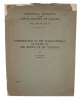
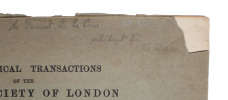
Extremely scarce first edition, off-print issue with presentation-inscription, of Bohr's first published paper, constituting his only ever work in experimental physics. ""His first research project, a precision measurement of the surface tension of water by the observation of a regularly vibrating jet, was completed in 1906, when he was still a student, and it won him the gold medal from the Academy of Sciences. It is a mature piece of work, remarkable for the care and thoroughness with which both the experimental and theoretical parts of the problem were handled."" (DSB).The work is inscribed to renowned Danish physicist and meteorologist Dan la Cour (1876-1942), son of the great Poul la Cour (1846-1908), who is considered the ""Danish Edison"". The inscription reads as thus: ""Hr. Docent D. la Cour/ ærbødigst/ fra/ Forfatteren."" [In Danish, i.e.: ""Mr. Assistant Professor D. la Cour/ with great respect / from/ the author.""].Dan la Cour was the assistant of Niels Bohr's father, Christian Bohr, and a well known scientist. From 1903, he was head of the department of the Meteorological Institute, and from 1923 leader thereof. From 1908 he was Associate Professor at the Polytechnic College. His original scientific works are highly respected, as are his original apparati for measuring earth magnetism which are considered highly valuable. ""His original intelligence, which in many ways resemble that of his father, also bore fruit in his patenting of various inventions: the ""Pyknoprobe"", developed to quickly determine the different layers of the sea"" a use of termite in quickly heating food and drinks out in the open under unfavourable weather conditions."" (From the Danish Encyclopaedia - own translation). He wrote a number of important and esteemed works and was member of the Danish Scientific Academy as well as many prominent international scientific commissions of meteorology and geophysics (i.e. president of the International Geodetical and Geophysical Union). He was also honorary Doctor at the George Washington University. This Bohr's fist paper grew out of a work which Bohr did in 1906, and for which he won a gold medal from the Academy of Sciences. The subject was to experimentally investigate a method, proposed by Lord Rayleigh, for measuring the surface tension of water by the observation of a regularly vibrating jet. ""Bohr [...] included in his work essential improvements on Rayleigh's theory by taking into account the influence of the liquid's viscosity and of the ambient air, and by extending the earlier theory from infinitesimal to arbitrary large vibration amplitudes. In order to execute his experiments he had first of all to cope with one complication. The university had no physics laboratory."" (Pais, p. 101). Bohr thus constructed many of the instruments himself using his father's laboratory. """"I did the experiments completely alone alone in the physiological laboratory... it was a great amount of work"", which was technically demanding."" (Pais, p. 102). In spite of being Bohr's only ever work in experimental physics, it documents his deep understanding of the methods of experimentalists.""On 23 February 1907 the Academy notified him that he had won its gold medal. In 1908 he submitted a modified version to the Royal Society in London. It was his first and last paper on experiments he himself performed. His second publication was his last to deal with surface tension of liquids"" it was purely theoretical. Both papers were favorably referred to in later literature.The manuscript of the prize essay, never published in its original form, is preserved in the Bohr Archives. It is handwritten, by Harald Bohr [i.e. his brother]."" (Pais, p. 102), Rosenfeld, Bohr Bibliography No. 1. Rosenfeld, Dictionary of Scientific Biography II, pp. 239. Pais, Niels Bohr's Times, pp. 101-02.
Determination of the Surface-Tension of Water by the Method of Jet Vibration. Offprint from: Philosophical Transactions of the Royal Society of London, Series A, Vol. 209. pp. 281-317. - [BOHR'S FIRST PUBLISHED PAPER - PRESENTATION COPY]
London, Harrison & Sons, 1909 Large4to. Original printed wrappers. Offprint from: ""Philosophical Transactions of the Royal Society of London, Series A, Vol. 209. pp. 281-317."" With cloth backstrip and I small nick to upper and lower corner of front wrapper. A fine and clean copy. Pp. 281-317.
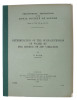
Scarce first edition, off-print issue, of Bohr's first published paper, constituting his only ever work in experimental physics. ""His first research project, a precision measurement of the surface tension of water by the observation of a regularly vibrating jet, was completed in 1906, when he was still a student, and it won him the gold medal from the Academy of Sciences. It is a mature piece of work, remarkable for the care and thoroughness with which both the experimental and theoretical parts of the problem were handled."" (DSB).This Bohr's fist paper grew out of a work which Bohr did in 1906, and for which he won a gold medal from the Academy of Sciences. The subject was to experimentally investigate a method, proposed by Lord Rayleigh, for measuring the surface tension of water by the observation of a regularly vibrating jet. ""Bohr [...] included in his work essential improvements on Rayleigh's theory by taking into account the influence of the liquid's viscosity and of the ambient air, and by extending the earlier theory from infinitesimal to arbitrary large vibration amplitudes. In order to execute his experiments he had first of all to cope with one complication. The university had no physics laboratory."" (Pais, p. 101). Bohr thus constructed many of the instruments himself using his father's laboratory. """"I did the experiments completely alone alone in the physiological laboratory... it was a great amount of work"", which was technically demanding."" (Pais, p. 102). In spite of being Bohr's only ever work in experimental physics, it documents his deep understanding of the methods of experimentalists.""On 23 February 1907 the Academy notified him that he had won its gold medal. In 1908 he submitted a modified version to the Royal Society in London. It was his first and last paper on experiments he himself performed. His second publication was his last to deal with surface tension of liquids"" it was purely theoretical. Both papers were favorably referred to in later literature.The manuscript of the prize essay, never published in its original form, is preserved in the Bohr Archives. It is handwritten, by Harald Bohr [i.e. his brother]."" (Pais, p. 102), Rosenfeld, Bohr Bibliography No. 1. Rosenfeld, Dictionary of Scientific Biography II, pp. 239. Pais, Niels Bohr's Times, pp. 101-02.
Drei Aufsätze über Spektren and Atombau. Mit sieben Abbildungen.
Braunschw., 1922. Orig.printed wrappers. VIII,148 pp.
First edition in bookform of ""Ueber die Wasser stoffspektrum"", ""Ueber die Serienspektren der Elemente"", ""der Bau der Atome und die physikalischen und chemischen Eigenschaften der Elemente"" - Rosenfeldt:24.
Journal of Jocular Physics. Volume III. October 7, 1955. - [""THIS IS THE ATOM THAT BOHR BUILT""]
Copenhagen, Institute for Theoretical Physics, 1955. Small folio (A4). Blank wrappers, stapled under cloth back-stip. Stenciled manuscript. 48 numbered leaves with printing on rectos only. Illustrated.
One of the few scarce original stenciled copies of the ""Journal of Jocular Physics, Vol. III,"" the 1955-volume of the privately circulated amateur-comedy-journal that Bohr's students made on the occasions of Bohr's most important birthdays (beginning with his 50th in 1935), in this case his 70th. The ""Journal"" is an eclectic blend of funny and clever stories, songs, poems, aphorisms, humorous descriptions of recent developments in physics, etc., all written in an informal tone with the underlying subject being Bohr's birthday.Since 1929 most of the greatest physicists of the 20th century had been gathering around Niels Bohr for a conference in Copenhagen at the Bohr Institute. Since 1931 this conference had also included a skit prepared by the youngest of the participants, the ""Copenhagen Faust"" of 1932 being the most famous and important of them. It is this skit that later develops into the ""Journal of Jocular Physics"" which was prepared and compiled for Bohr's 50th, 60th and 70th birthdays, the first in 1935, the second in 1945, and the third (the present) in 1955. The 1955 ""Jocular Physics"" was the last of them. ""The early decades of the present century witnessed the heady development of the Quantum Theory of the atom, and during that era the roads of theoreticians of all nationalities led, not to Rome, but to Copenhagen, the home city of Niels Bohr, who was the first to formulate the correct atomic model. It became customary at the end of each spring conference at Blegdamsvej 15 (the street address of Bohr's Institute of Theoretical Physics) to produce a stunt pertaining to recent developments in physics.However Copenhagen was also the home of abundant humor. As a respite from the intensive and highly competitive efforts taking place to characterize fundamental interactions on an atomic scale, physicists took the time to develop satirical letters, articles, plays and other works."" (Gamow, Thirty Years that Shook Physics, pp. 167-68).In his Report at the Niels Bohr Archive Symposium, ""Copenhagen' and beyond: Drama meets history of science"", Yu.V. Gaponov accounts for the history of ""physical art"": ""The 1950s and 1960s were the golden age of the utmost prosperity in Physics. The atomic revolution having opened for the scientists a new world of quanta led soon to the nuclear fission discovery and to the first steps in techniques to dominate the atomic energy. The realization of national atomic programs which first took place in USA and then in Russia (USSR) and Great Britain had attracted the whole world's attention and placed Physics and the natural sciences in general in a top position. Being concerned with matters of physics became then exclusive and prestigious and physicists as individuals attracted the society's attention. They became heroes of literature, theater, movies, press. This process was observed in many advanced countries. It was also typical for the former USSR of those times, although owing to special social circumstances it had acquired some particular forms. One such form was the creation of ""Physical Art"" traditions... The birth of these traditions is commonly associated with the appearance at MSU PhysFac in 1960 of a Student Humor Festival called ""Birthday of Archimedes"" (later ""Physics Day"") along with a comic buffoonery opera ""Archimedes"" (authors - physicists and poets V. Kaner, V. Milyaev). However, MSU physicists consider the ""Physical Art"" traditions to have started earlier. Here are some remarkable milestones: In 1932 the well known ""Faust"" jocular opera and in 1935 the special issue of the ""Jocular Physics"" journal were written by some eminent physicists in connection with the 50th birthday of Niels Bohr.""The present 1955-volume contains numerous very funny contributions by physicists around Bohr, all based on physics humour, physics word-games etc. We have for instance ""A Voyage to Laplacia"" by L. Rosenfeld, a ""Confidential"" report ""Standardization of (physics) Papers"" by J. Lindhard,""Broken English"" by H.B.G. Casimir (""There exists today a universal language that is spoken and understood almost everywhere: it is Broken English. I am not referring to Pidgin English a highly formalized and restricted branch of B.E. but to the much more general language that is used by waiters in Hawai, prostitutes in Paris and ambassadors in Washington, by business-men from Buenos Aires, by scientists at international meetings and by dirty-postcard-peddlers in Greece, in short honourable people like myself all over the world..."" (p. 14), aphorisms (like: ""One Bohr can answer more questions than 10 philosophers can ask"", """"I will have to sleep on that"" the physicist said, he lay down on the floor"", etc.), ""A Remarkable ""V-event"""" by M. Sheep, ""The Heart on the other Side"" by G. Gamow (""""But father will never give his consent... He is looking for a son-in-law who can help him in his business, and eventually take it over. You can't possibly qualify for that, can you?"" ""No, I guess I can't,"" agreed Stan Situs sadly. ""I cannot possibly see how the kind of mathematics I am doing or, in fact, ANY kind of mathematics can help the production and selling of shoes...""), the poem ""The Atom that Bohr Built"", etc. The ""Journal of Jocular Physics"" is an important document portraying both one of the main physical centres of this physically important period and how one of the greatest scientific minds of the 20th century was viewed by his students and collaborators - as being not only brilliant in his field of research but also as a funny, likeable and sympathetic person. See also:Gino Segrè. Faust in Copenhagen. A Struggle for the Soul of Physics and the Birth of the Nuclear Age.""Pimlico, 2008.George Gamow. Thirty Years that Shook Physics. The Story of Quantum Theory. New York, 1966.
Journal of Jocular Physics. Volume III. October 7, 1955. - [""THIS IS THE ATOM THAT BOHR BUILT""]
Copenhagen, Institute for Theoretical Physics, 1955. Small folio (A4). Stapled, unbound. Stenciled manuscript. Edges a bit bumped. A bit of spotting to first leaf. 48 numbered leaves with printing on rectos only. Illustrated.
One of the few scarce original stenciled copies of the ""Journal of Jocular Physics, Vol. III,"" the 1955-volume of the privately circulated amateur-comedy-journal that Bohr's students made on the occasions of Bohr's most important birthdays (beginning with his 50th in 1935), in this case his 70th. The ""Journal"" is an eclectic blend of funny and clever stories, songs, poems, aphorisms, humorous descriptions of recent developments in physics, etc., all written in an informal tone with the underlying subject being Bohr's birthday.Since 1929 most of the greatest physicists of the 20th century had been gathering around Niels Bohr for a conference in Copenhagen at the Bohr Institute. Since 1931 this conference had also included a skit prepared by the youngest of the participants, the ""Copenhagen Faust"" of 1932 being the most famous and important of them. It is this skit that later develops into the ""Journal of Jocular Physics"" which was prepared and compiled for Bohr's 50th, 60th and 70th birthdays, the first in 1935, the second in 1945, and the third (the present) in 1955. The 1955 ""Jocular Physics"" was the last of them. ""The early decades of the present century witnessed the heady development of the Quantum Theory of the atom, and during that era the roads of theoreticians of all nationalities led, not to Rome, but to Copenhagen, the home city of Niels Bohr, who was the first to formulate the correct atomic model. It became customary at the end of each spring conference at Blegdamsvej 15 (the street address of Bohr's Institute of Theoretical Physics) to produce a stunt pertaining to recent developments in physics.However Copenhagen was also the home of abundant humor. As a respite from the intensive and highly competitive efforts taking place to characterize fundamental interactions on an atomic scale, physicists took the time to develop satirical letters, articles, plays and other works."" (Gamow, Thirty Years that Shook Physics, pp. 167-68).In his Report at the Niels Bohr Archive Symposium, ""Copenhagen' and beyond: Drama meets history of science"", Yu.V. Gaponov accounts for the history of ""physical art"": ""The 1950s and 1960s were the golden age of the utmost prosperity in Physics. The atomic revolution having opened for the scientists a new world of quanta led soon to the nuclear fission discovery and to the first steps in techniques to dominate the atomic energy. The realization of national atomic programs which first took place in USA and then in Russia (USSR) and Great Britain had attracted the whole world's attention and placed Physics and the natural sciences in general in a top position. Being concerned with matters of physics became then exclusive and prestigious and physicists as individuals attracted the society's attention. They became heroes of literature, theater, movies, press. This process was observed in many advanced countries. It was also typical for the former USSR of those times, although owing to special social circumstances it had acquired some particular forms. One such form was the creation of ""Physical Art"" traditions... The birth of these traditions is commonly associated with the appearance at MSU PhysFac in 1960 of a Student Humor Festival called ""Birthday of Archimedes"" (later ""Physics Day"") along with a comic buffoonery opera ""Archimedes"" (authors - physicists and poets V. Kaner, V. Milyaev). However, MSU physicists consider the ""Physical Art"" traditions to have started earlier. Here are some remarkable milestones: In 1932 the well known ""Faust"" jocular opera and in 1935 the special issue of the ""Jocular Physics"" journal were written by some eminent physicists in connection with the 50th birthday of Niels Bohr.""The present 1955-volume contains numerous very funny contributions by physicists around Bohr, all based on physics humour, physics word-games etc. We have for instance ""A Voyage to Laplacia"" by L. Rosenfeld, a ""Confidential"" report ""Standardization of (physics) Papers"" by J. Lindhard,""Broken English"" by H.B.G. Casimir (""There exists today a universal language that is spoken and understood almost everywhere: it is Broken English. I am not referring to Pidgin English a highly formalized and restricted branch of B.E. but to the much more general language that is used by waiters in Hawai, prostitutes in Paris and ambassadors in Washington, by business-men from Buenos Aires, by scientists at international meetings and by dirty-postcard-peddlers in Greece, in short honourable people like myself all over the world..."" (p. 14), aphorisms (like: ""One Bohr can answer more questions than 10 philosophers can ask"", """"I will have to sleep on that"" the physicist said, he lay down on the floor"", etc.), ""A Remarkable ""V-event"""" by M. Sheep, ""The Heart on the other Side"" by G. Gamow (""""But father will never give his consent... He is looking for a son-in-law who can help him in his business, and eventually take it over. You can't possibly qualify for that, can you?"" ""No, I guess I can't,"" agreed Stan Situs sadly. ""I cannot possibly see how the kind of mathematics I am doing or, in fact, ANY kind of mathematics can help the production and selling of shoes...""), the poem ""The Atom that Bohr Built"", etc. The ""Journal of Jocular Physics"" is an important document portraying both one of the main physical centres of this physically important period and how one of the greatest scientific minds of the 20th century was viewed by his students and collaborators - as being not only brilliant in his field of research but also as a funny, likeable and sympathetic person. See also:Gino Segrè. Faust in Copenhagen. A Struggle for the Soul of Physics and the Birth of the Nuclear Age.""Pimlico, 2008.George Gamow. Thirty Years that Shook Physics. The Story of Quantum Theory. New York, 1966.
Les Spectres et la Structure de L'Atome Trois Conferences. Traduit sur le Manuscrit de l'Auteur par A. Corvisy.
Paris, Libraire Scientifique, 1923. 8vo. Uncut in orig. printed wrappers. Tears to backstrip but preserved. A small nick to upper left corner of frontwrapper.
First French editions of the three famous papers: ""Ueber die Wasser stoffspektrum"", ""Ueber die Serienspektren der Elemente"", ""Der Bau der Atome und die physikalischen und chemischen Eigenschaften der Elemente"" - Rosenfeld:24.
Linienspektren und Atombau.
Leipzig, Johann Ambrosius Barth, 1923. Contemp. full buckram. In: ""Annalen der Physik"", Vierte Folge, band 71. Stamp on verso of titlepage. Portrait as frontisp. (2),605,VI pp. (Entire volume offered). Bohr's paper: pp. 228-288 and 8 plates (on 2 leaves). Punched with cords in inner margins. Clean and fine.
First appearance of the only part of Bohr's planned new comprehensive treatise on atomic structure, announcing that this was 'the first of a series of essays....on atomic structure'.
Nyere Undersøgelser over Atomkernernes Omdannelser.
Oslo, Grøndal & Søn, 1941. 8vo. Offprint from: Fra Fysikkens Verden. Original printed wrappers. Fine condition. 34 pp.
First edition.
On the Quantum Theory of Line-Spectra. Part I-II. [Off-print from ""D. Kgl. Danske Vidensk. Selsk. Skrifter"". - [BOHR'S CORRESPONDENCE PRINCIPLE - PRESENTATION-COPIES]
Copenhagen, Bianco Lunos, 1918. 4to. Both parts uncut and in the original printed wrappers. Wrappers detached and with small nicks and tears to extremities. Internally fine and clean. Part I unopened. 36 pp. + pp. (37) - 100.
First editions, author's off-prints (with ""Separate Copy"" printed to front wrappers), presentation-copies, of the first two parts of Bohr's seminal work ""On the Quantum Theory of the Line-Spectra"" (which appeared in three parts and which was never finished, the third part of which, published 4 years later, is almost never found in presentation-sets), in which Bohr gave his first clear presentation of his groundbreaking ""correspondence principle"": ""Which would play a pivotal role in the later development of atomic theory and its transformation into quantum mechanics."" (Kragh, Quantum Generations, p. 56). It eventually became a cornerstone in the quantum mechanics formulated by Heisenberg and Schrödinger. ""There was rarely in the history of physics a comprehensive theory which owed so much to one principle as quantum mechanics owed to Bohr's correspondence principle"" (Jammer 1966, p. 118). The evolution of quantum theory is divided into two distinct periods"" from 1900 to 1925, usually referred to as the period with the old quantum theory still grounded in classical physics and the second period with quantum mechanics from 1925 onwards. The general rules of quantum mechanics are very successful in describing objects on an atomic level. But macroscopic systems are accurately described by classical theories like classical mechanics and classical electrodynamics. If quantum mechanics were to be applicable to macroscopic objects, there must be some limit in which quantum mechanics reduces to classical mechanics. Bohr's correspondence principle demands that classical physics and quantum physics give the same answer when the systems become large. ""A major tool he developed for dealing with quantum problem, [...], was the correspondence principle, which establishes links between predictions of the classical theory and expectations for the quantum theory."" (Pais, Niels Bohr's Times, p. 20.). In this sense, the correspondence principle is not only an exceedingly important methodological principle, it also represents the transition to quantum mechanics and modern physics in general and it became the cornerstone of Bohr's philosophical interpretation of quantum mechanics which later would be closely tied to his thesis of complementarity and to the Copenhagen interpretation. Another version of the correspondence principle lives on in philosophical literature where it has taken form as a more general concept representing a development of new scientific theories.""By 1918 Bohr had visualized, at least in outline, the whole theory of atomic phenomena. ... He of course realized that he was still very far from a logically consistent framework wide enough to incorporate both the quantum postulates and those aspects of classical mechanics and electrodynamics that seemed to retain some validity. Nevertheless, he at once started writing up a synthetic exposition of his arguments and of all the evidence upon which they could have any bearing" in testing how well he could summarize what was known, he found occasion to check the soundness of his ideas and to improve their formulation. In the present case, however, he could hardly keep pace with the growth of the subject the paper he had in mind at the beginning developed into a four-part treatise, 'On the Theory of Line Spectra', publication of which dragged over four years without being completed" the first three parts appeared between 1918 and 1922 [of which the two first from 1918 are offered here], and the fourth, unfortunately, was never published. Thus, the full impact of Bohr's view remained confined to the small but brilliant circle of his disciples, who indeed managed better than their master to make them more widely known by the prompter publication of their own results"" (D.S.B. II: 246-47).Inscribed to ""Hr. Docent D. la Cour/ Venskabeligst/ fra/ Forfatteren"" on both front wrappers. The renowned Danish physicist and meteorologist Dan la Cour (1876-1942), was the son of the great Poul la Cour (1846-1908), who is considered the ""Danish Edison"". Dan la Cour was the assistant of Niels Bohr's father, Christian Bohr, and a well known scientist. From 1903, he was head of the department of the Meteorological Institute, and from 1923 leader thereof. From 1908 he was Associate Professor at the Polytechnic College. His original scientific works are highly respected, as are his original apparati for measuring earth magnetism which are considered highly valuable. ""His original intelligence, which in many ways resemble that of his father, also bore fruit in his patenting of various inventions: the ""Pyknoprobe"", developed to quickly determine the different layers of the sea"" a use of termite in quickly heating food and drinks out in the open under unfavourable weather conditions."" (From the Danish Encyclopaedia - own translation). He wrote a number of important and esteemed works and was member of the Danish Scientific Academy as well as many prominent international scientific commissions of meteorology and geophysics (i.e. president of the International Geodetical and Geophysical Union). He was also honorary Doctor at the George Washington University. Rosenfeld, Bohr-Bibliography, 15.
On the Quantum Theory of Line-Spectra, Part I - III. - [BOHR'S CORRESPONDENCE PRINCIPLE]
København, Bianco Lunos Bogtrykkeri, 1918 - 1922. 4to. Uncut unopened in the original printed wrappers. In ""D. Kgl. Danske Vidensk. Selsk. Skrifter, afd., 8, række IV, 1-3"" / ""Mémoires de l'Académie Royale des Sciences et des Lettres de Danemark"". Wrapper with a few minor nicks and tears but otherwise a very fine and clean copy. 118 pp.
Collected offprint-edition of Bohr's seminal work ""On the Quantum Theory of the Line-Spectra"", marking the beginning of the quantum revolution in physics, introduced the concept of quantized energy levels, provided an explanation for the observed line spectra, and served as a foundational model that inspired further developments in quantum mechanics. It is conseidered one of Bohr's most important papers and the basis for his Nobel Prize. These papers give the first clear formulation of his 'correspondence principle' establishing the limit agreement of quantum and classical physics. ""By 1918 Bohr had visualized, at least in outline, the whole theory of atomic phenomena. ... He of course realized that he was still very far from a logically consistent framework wide enough to incorporate both the quantum postulates and those aspects of classical mechanics and electrodynamics that seemed to retain some validity. Nevertheless, he at once started writing up a synthetic exposition of his arguments and of all the evidence upon which they could have any bearing" in testing how well he could summarize what was known, he found occasion to check the soundness of his ideas and to improve their formulation. In the present case, however, he could hardly keep pace with the growth of the subject the paper he had in mind at the beginning developed into a four-part treatise, 'On the Theory of Line Spectra', publication of which dragged over four years without being completed" the first three parts appeared between 1918 and 1922, and the fourth, unfortunately, was never published. Thus, the full impact of Bohr's view remained confined to the small but brilliant circle of his disciples, who indeed managed better than their master to make them more widely known by the prompter publication of their own results"" (D.S.B. 2: 246-47).
On the Quantum Theory of Line-Spectra. Part I-III.
K., 1918-22. (Unchanged reprint of the original. Coph., 1928). 4to. 118 pp.

