 Write to the booksellers
-
Type
Book (5464)
Magazine (20)
Manuscript (1)
Old papers (1)
Photographs (3)
-
Latest
Last month (4)
Last week (2)
-
Language
English (10)
French (5475)
German (1)
Greek (1)
Italian (1)
Latin (1)
-
Century
16th (2)
17th (8)
18th (243)
19th (885)
20th (2949)
21st (132)
-
Countries
Belgium (266)
Canada (3)
Côte d'Ivoire (13)
Denmark (1363)
France (3543)
Switzerland (301)
-
Syndicate
ALAC (3)
CLAM (3)
ILAB (4129)
NVVA (139)
SLACES (139)
SLAM (2604)
SNCAO (15)
Essai D'un Cours Élémentaire et Général Des Sciences Physiques - Partie Physique, Deuxième Édition
Paris Chez Verdière 1821 Fort In-8 Ex-libris d'Isidor Godart, ancien Maire d'Epernay en chromolithographie XIV - 572 et XIII Planches dépliantes + 5 planches. Etat d'usage, mors un peu fendus, mais exemplaire attrayant, à toutes marges
Ex-libris Étiquette Manuscrite état D'usage Cartonnage Bradel D'époque
Physique. ‘Essai d'un cours élémentaire et général des sciences physiques’. 2e édition.
Paris, (Abel Lanoe pour) Verdière, 1821, in-8°, XVIII + 672 p. + 18 planches de figures gravées (par Adam d'après Girard, et par N.L. Rousseau), 1 exlibris ‘Johannes Aeby’, reliure en demi-cuir, dos sobrement orné en or, quelques petites traces de vers, tranches jaspées.
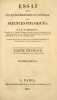
Ouvrage adopté par le Conseil Royal d'Instruction Publique pour l'enseignement dans les collèges royaux. Nouvelle édition, “mise au niveau des connaissances actuelles”. Beudant fut professeur de minéralogie et de sciences physiques à la Faculté des Sciences de la Sorbonne. Image disp.

(SLACES, NVVA)
Phone number : 41 (0)26 3223808
Historische Übersicht über die Untersuchungen der Verteilung der Wärme im Sonnenspektrum. ‘Wiss. Beil. z. 19 Jahresber. Realgymn. Neuwied’.
Neuwied, Heuser, 1896, in-8vo, 48 S. + 2 Tafeln, Broschüre o. Umschl.
(SLACES, NVVA)
Phone number : 41 (0)26 3223808
La Chaleur. 2e édition.
P., Hachette (Bibliothèque des Merveilles), 1868, in 12 relié demi-chagrin rouge, dos orné, II-323 pages ; des frottis ; trace de mouillure ancienne.
Illustré d'un frontispice et de 92 vignettes dans le texte. PHOTOS sur DEMANDE. ...................... Photos sur demande ...................

Phone number : 04 77 32 63 69
La vapeur. 2e édition.
P., Hachette (Bibliothèque des Merveilles), 1876, in 12 relié demi-chagrin noir, plats de percaline ornés à chaud et à froid, fer du Lycée de St-Etienne frappés sur le plat supérieur, dos très orné, 320 pages.
Ouvrage illustré de 113 vignettes in et hors-texte. PHOTOS sur DEMANDE. ...................... Photos sur demande ...................
Phone number : 04 77 32 63 69
Pourquoi ça s'évapore.
Couverture souple. Brochure de 40 pages. 15 x 23 cm.
Livre. Par le Chantier ICEM Sciences à l'école élémentaire. Institut coopératif de l'école moderne (Collection : BT N° 859), Cannes, Mars 1978.
Pourquoi ça s'évapore.
Couverture souple. Brochure de 40 pages. 15 x 23 cm.
Livre. Par le Chantier ICEM Sciences à l'école élémentaire. Institut coopératif de l'école moderne (Collection : BT N° 859), Cannes, Mars 1978.
De la turbine à l'atome.
Gauthier-villars. 1933. In-8. Broché. Etat d'usage, Couv. convenable, Coiffe en tête abîmée, Papier jauni. VI + 198 pages.. . . . Classification Dewey : 530-Physique
Préface de M.Charles Fabry. Classification Dewey : 530-Physique
HISTOIRE DE LA PHYSIQUE MODERNE
Paris Editions La Découverte 1993 in 8 (22x13,5) 1 volume broché, 239 pages. Collection ''Histoire des sciences''. Bel exemplaire ( Photographies sur demande / We can send pictures of this book on simple request )
Très bon
Histoire de la physique moderne.
La Découverte, 1993, in-8°, 239 pp, biblio, index. Très bon état
Désormais les frais d'envoi sont de 6 € seulement pour les livres jusqu'à 1 kg (colissimo suivi), pour la France métropolitaine.
Essay de l'Application des Forces centrales aux Effets de la Poudre a Canon, d'ou l'on déduira une Théorie propre à perfectionner les differentes bouches à feu.
Paris, Jombert, 1737. Contemp. hcalf. Spine gilt. Titlelabel with gilt lettering. Stamp on title-page. (12),163,(5) pp., 1 folded engraved plate. 2 leaves at end remargined. Clean and fine.
PHYSIQUE ET CHIMIE, 1re ANNEE
Hatier. 1916. In-12. Relié. Etat passable, Plats abîmés, Dos abîmé, Intérieur acceptable. 134 pages. Illustré de nombreuses gravures en noir et blanc dans le texte. Couverture très abîmée, salie et se détachant. Nombreuses annotations et taches dans l'ouvrage (ouvrage de travail).. . . . Classification Dewey : 530-Physique
Enseignement Primaire Supérieur. Classification Dewey : 530-Physique
PHYSIQUE ET CHIMIE, 3e ANNEE
Hatier. 1916. In-12. Relié. Etat d'usage, Plats abîmés, Dos fané, Intérieur bon état. 208 pages, puis 78 pages. Illustré de nombreuses gravures en noir et blanc dans le texte. Dos muet. Plats très abîmés avec manques. Annotation sur la tranche.. . . . Classification Dewey : 530-Physique
Enseignement primaire supérieur. Classification Dewey : 530-Physique
Traité d’optique physique. 2 volumes.
Paris, Mallet-Bachelier 1858, 215x135mm, XV + VIII + XVI - 540 + 640pages, reliure demi-basane. Titre au dos doré, coiffes endomagées, cuir par endroit frotté.
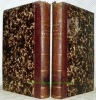
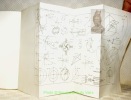
14 planches gravées dépliantes, Pour un paiement via PayPal, veuillez nous en faire la demande et nous vous enverrons une facture PayPal
Physique tome 1: observer - mesurer - raisonner
Foucher in8. Sans date. Broché.
réparation antérieure tranches fânées intérieur assez propre
Climatologie. Avec un supplément: Magnétisme terrestre. / Klimatologie. Mit einem Anhang: Erdmagnetismus. ‘Bibliographie der schweizerischen Landeskunde’, Fasz. IV4.
Bern, Wyss, 1927, gr. in-8°, XVI +140 p. + 9 p., brochure originale.
(SLACES, NVVA)
Phone number : 41 (0)26 3223808
Neu=eröffnete Mathematische Werck=Schule, Oder Gründliche Anweisung, Wie die Mathematische Instrumenten nicht allein schicklich und recht zu gebrauchen, sondern auch auf die beste und accurateste Manier zu verfertigen, zu probiren, und allerzeit in gu...
Nürnberg, C.C. Monath, 1726, 1727, 1728. 4to. Cont. full vellum. Richly gilt back. Engraved frontispiece, 3 titlepages in red/black. (14),432(8),48(10),176 pp. and 62 large folded engraved plates (30+20+12). Stamp at foot of first title (Greve Scheel). A few of the first section of plates with some small tears, no loss. A few margins with light browning, but fine.
This third edition of the esteemed work on instruments, was the largest and most profusely illustrated and it was enlarged by Doppelmayr. - Poggendorff I:194.
Précis Elémentaire de Physique Expérimentale. TOME II - AVEC DES PLANCHES EN TAILLE DOUCE - 7 photos disponibles.
DETERVILLE. 3ème édition. 1824. In-12. Relié demi-cuir. Etat d'usage, Couv. légèrement passée, Coiffe en pied abîmée, Intérieur bon état. 781 pages + 12 planches dépliantes d'illustrations en noir et blanc hors-texte en fin d'ouvrage. Titre, tomaison et roulettes dorés sur le dos en cuir marron. Mors fendus et arrachés. Tranches marbrées - ex-libris à l'encre noir sur la page de faux-titre - 7 photos disponibles.. . . . Classification Dewey : 530-Physique
Du Magnétisme. De la Lumière. De la Polarisation de la Lumière. Du Calorique - 7 photos disponibles. Classification Dewey : 530-Physique
Précis Élémentaire de Physique experimentale. Ouvrage destiné a L'Enseignement Public, par Arrèté de la Commission de L'Instruction publique...Tome I-II. 2 vols. - [A PIONEER-WORK]
Paris, deterville, 1817. 2 contemp. blue boards. Gilt lettering to spine. Binding with some scratches along edges. X,576"(4),IV,608 pp. and 14 large folded engraved plates with many figs. A few minor brownspots.
First edition of this important work as it was one of the best textbooks of the period on physics, and in which he reports his investigations on the rotatory dispersion of plane-polarized light. Apart from the physical part, the work also deals with the chemical properties of gases, exothermic reactions, electrolytes, and Voltaic piles. In a long and importent chapter (vol. II, pp.. 397-500), Biot gives the first full exposition of the effect on plane-polarized light of various compounds. ""The present pioneer-work led to the later epochal discoveries of such giants as Pasteur, Le Bel and van't Hoff, and Werner. Partington (IV, 750-51) discusses the importence of Biot's work on optical activity."" (Roy G. Neville Historical Chemical Liobrary, vol. I, p.154.
Précis élémentaire de Physique expérimentale. ouvrage destiné à l'enseignement public par Arrêté de la Commission de l'Instruction publique, en date du 22 fev. 1817.
1817 P., Deterville, 1817, 2 volumes in 8° reliés pleine basane racinée de l'époque, dos lisses très ornés, étiquettes de titre et de tomaison noires, roulette dorée sur les coupes, X-576 et IV-608 pages ; table alphabétique des matières à la fin du Tome II ; quelques rousseurs et petites taches ; infimes défauts aux reliures et deux coins émoussés;

EDITION ORIGINALE. Bel exemplaire, bien complet des 14 planches dépliantes (au lieu des 12 annoncées sur les faux-titres). .......... Jean-Baptiste BIOT devint professeur de physique au Collège de France en 1800, à l'âge de 26 ans. ...................... Photos sur demande ...................
Phone number : 04 77 32 63 69
Traité d'astronomie physique
Paris, J. Klostermann fils, 1810-1811. 3 vol. in-8, XX-455 pp. 21 pl. + 563-XI pp. 9 pl. + XVI-243-215-192-58-4 pp. 11 pl, demi-basane fauve de l'époque, dos lisse orné de quadruples filets dorés, pièce de titre rouge, pièce de tomaison verte, tranches mouchetées (mors fendus, petits manque et épidermures, quelques petites rousseurs et taches
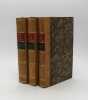
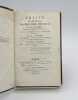
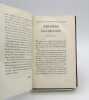
Seconde édition destinée à l'enseignement dans les Lycées impériaux, illustrée de nombreuses planches dessinées par Brulard et Mathieu et gravées par Jourdan et Tardieu. Elles représentent pour la plupart des figures géométriques mais également des instruments scientifiques. Complet des additions (dont 5 tableaux dépliants), du Traité des calculs de l'astronomie nautique et des notes (comportant également des tableaux dépliants) des tables d'astronomie nautique et du catalogue de la librairie Bachelier. Voir photographie(s) / See picture(s) * Membre du SLAM et de la LILA / ILAB Member. La librairie est ouverte du lundi au vendredi de 14h à 19h. Merci de nous prévenir avant de passer,certains de nos livres étant entreposés dans une réserve.
BIOT, J.-B. (Jean Baptiste) (1774-1862) & FECHNER, Gustav Theodor:
Reference : 132740aaf
Lehrbuch der Experimental-Physik oder Erfahrungs-Naturlehre. 2. Auflage der deutschen Bearbeitung. Mit Hinzufügung der neuern und einheimischen Entdeckungen von Gustav Theodor Fechner. Band 4 & 5 (von 5).
Leipzig, (J.B. Hirschfeld for) Leopold Voss, 1829, in-8vo, mit gef. Tafeln, Original-Pappband.
Poggendorff I/195; DSB II/133-140; Engelmann 40; Fromm -.
(SLACES, NVVA)
Phone number : 41 (0)26 3223808
Franz. Physiker.
Paris, (ca. 1840). Lithographie (Brustbild) von Lemercier nach Aug. Lemoine auf Japanpier, montiert. Bildformat:19,5 x 25 cm. Blattgrösse: 27 x 39 cm.
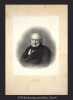
Rand gebräunt, stockfleckig u. mit 2 cm Einriss (Lithographie fleckenlos).
"BIOT, JEAN BAPTISTE. (ET AL.). - MATHEMATICAL TREATMENT OF VOLTA'S CONTACT FORCE.
Reference : 45704
(1804)
Rapport sur les Expériences du Citoyen Volta. Au nom d'une commission composée des citoyens Laplace, Coulomb, Hallé, Monge, Fourcroy, Vaugelin, Pelletan, Charles, Brisson, Sabatier, Guyton et Biot. (+) Notes relatives au rapport...
(Paris, Baudouin, AN XII (1804)). 4to. Without wrappers. Uncut. Extracted from ""Mémoires de L'Institut National des Sciences et Arts"", Tome Cinquieme. Pp. 195-22.
First printing of this early rapport on the Voltaic Pile in which Biot quantizises Volta's Contact Theory.In the first part of the rapport Biot asserted the priority of Coulomb's notions over the entire science of electricity, while in the second part he introduces a mathematical model of the battery that established no link with Coulomb's Law.Wheeler Gift: No. 668.
Deux heures de physique
Kra, Collection Fontenelle, 1930 12 x 19, 247 pp., 90 figures, broché, Bon état - couvertures défraichies, 5ème édition

