 Write to the booksellers
-
Type
Book (5464)
Magazine (20)
Manuscript (1)
Old papers (1)
Photographs (3)
-
Latest
Last month (4)
Last week (2)
-
Language
English (10)
French (5475)
German (1)
Greek (1)
Italian (1)
Latin (1)
-
Century
16th (2)
17th (8)
18th (243)
19th (885)
20th (2949)
21st (132)
-
Countries
Belgium (266)
Canada (3)
Côte d'Ivoire (13)
Denmark (1363)
France (3543)
Switzerland (301)
-
Syndicate
ALAC (3)
CLAM (3)
ILAB (4129)
NVVA (139)
SLACES (139)
SLAM (2604)
SNCAO (15)
Lettres sur la Physique, par Alex. Bertrand, auteur des Lettres sur les révolutions du globe.
Paris et leipzig, 1824, 2 volumes in 8° reliés pleine basane racinée du temps, dos lisses très ornés, étiquettes vertes, plats encadrés d'une roulette dorée, tranches marbrées, VII-517 et 568 pages ; des rousseurs éparses, pâles généralement ; petits défauts d'usage aux reliures, une coiffe supérieure usée, coins légèrement émoussés.
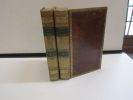
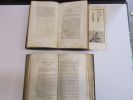
Bel exemplaire, malgré les menus défauts d'usage, de la rarissime édition originale de cet ouvrage, bien complet des deux planches dépliantes. ...................... Photos sur demande ...................


Phone number : 04 77 32 63 69
Lettres sur la Physique.
Paris, et Leipzig, Bossange, 1824-25. 2 volumes in-8 en demi-veau au dos lisse orné de filets et fleurons dorés. Tranches marbrées. Illustré de 2 planches dépliantes, une à chaque fin de volume. Edition Originale. Frottements aux dos avec un manque de cuir. Intérieur comportant des rousseurs éparses.
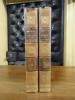
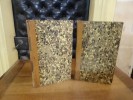
"Alexandre Bertrand, (1795-1831), Médecin né à rennes. Il s'est particulièrement occupé du magnétisme animal, du somnambulisme, de l'extase, dont il chercha à expliquer scientifiquement les phénomènes. Il écrivit aussi deux ouvrages de vulgarisations scientifique qui furent estimés dont celui-ci ". Il fut aussi l'un des fondateurs du Globe.
Réveil matin fait par Monsieur Bertrand pour réveiller les prétendus savants mathématiciens de l’Académie Royale de Paris, &c.
Hambourg, Imprimé par Bertrand libraire ordinaire de l’Académie de Bertrand, 1674-1676. In-8 de (36) pp. 1 f.bl., 75 pp., 3 planches hors texte.BERTRAND DE LA COSTE. Ne trompez plus personne ou Suite du Reveil-matin des pretendus savans Matematiciens de l’Academie royale de Paris. Hambourg. Bertrand, 1675. In-8 de (24)-69-(1) ppBERTRAND DE LA COSTE. Le monde désabusé ou la Demonstration des deux lignes moyennes proportionnelles. Hambourg, 1675. In-8 de 40 pp.BERTRAND DE LA COSTE. Ce n’est pas la mort aux rats ny aux souris, mais c’est la mort des mathématiciens de Paris et la démonstration de la trisection de tous triangles. Hambourg, 1676. In-8 de (28)-14-(6) pp.4 pièces reliées en 1 vol. petit in-8 (16,5 x 10 cm), vélin rigide, dos lisse, pièce de titre en maroquin rouge (reliure moderne).
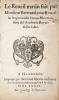
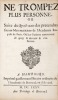
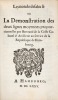
Édition originale de la plus grande rareté des quatre pamphlets de l’artilleur-mathématicien Bertrand de La Coste adressés à l’Académie royale des sciences qui rejeta sa Machine d’Archimède présentée en 1671.Colonel d’artillerie à Hambourg, Bertrand de la Coste retourna dans sa ville de garnison où il reçut en 1674 l’approbation de Frédéric Wilhem, électeur de Brandebourg qui accueillit favorablement cette découverte, et fit délivrer à l’auteur un certificat qu’on peut lire parmi les pièces liminaires avec l’« Extrait du Privilège et le Passeport de l’Académie de Bertrand », société fictive et satirique créée pour venger Bertrand de La Coste de l’académie parisienne.3 planches hors texte illustrent le premier des quatre opuscules (le Réveil matin), dont le portrait de l’auteur, une épigraphe gravée et une grande planche repliée qui représente les armoiries de l’Académie : un écusson chargé d’une botte de foin supporté par deux ânes dont l’un porte des grelots attachés aux oreilles avec des rubans (le directeur Caricavy) et l’autre une devise, Le premier professeur de mathématiques de sa Société (Roberval) ; un troisième âne est posé en cimier avec Niquet gravé au-dessus de sa tête et ce titre : Voilà trois renommés mathématiciens. Pierre de Carcavy (1603-1684) était directeur de l'Académie royale des sciences, Antoine de Niquet (1641-1726), ingénieur du Roi protégé de Colbert et Vauban, et Gilles Personne de Roberval (1602-1675) l’inventeur de la balance à deux fléaux. Les trois autres opuscules sont illustrés de nombreux diagrammes dans le texte.« On peut rapprocher du cas Abraham Bosse un autre exemple de marginalisation académique, touchant dix ans plus tard un autre protestant, persuadé lui aussi de détenir, seul contre tous, une vérité géométrique universelle, et ayant lui aussi voué son existence à la démonstration d’une question au moins aussi problématique, pour les siècles passés et à venir, que ne l’était celle des fondements objectifs de la perspective. Il s’agit de Bertrand de La Coste, auteur de quatre opuscules publiés à Hambourg en 1674, 1675, 1676 dont le rejet par l’Académie des Sciences en 1671 n’est pas moins révélateur des normes implicites nouvellement engendrées par cette institution que l’exclusion de Bosse pour l’Académie de peinture et de sculpture. Militaire autodidacte et précédemment auteur, en 1663 d’un ouvrage consacré à la résolution de la quadrature du cercle, Bertrand de La Coste avait envoyé à Colbert en 1671 les plans d’une machine d’Archimède, machine dite à mouvement perpétuel. Colbert l’ayant adressé à l’Académie des Sciences pour expertise, il s’y présenta la même année avec une maquette exécutée à ses frais par un ébéniste. Mais après avoir été soumis par les Académiciens à un rapide examen oral de ses connaissances mathématiques, il fut renvoyé sans qu’on lui eût même laissé présenter son invention (…) C’est bien de cette classe de “visionnaires mystiques” (Montucla) que La Coste eut le douloureux privilège d’être le premier représentant avant que le phénomène ne se généralisât au 18e siècle (…) c’est d’une fictive “Académie Bertrand“ que La Coste se réclame pour admonester la même académie décrivant ainsi un processus de mise à l’écart du monde scientifique qui illustre parfaitement la frontière qui commençait alors à s’établir entre professionnels et amateurs. Car c’est bien dans cette dernière catégorie que se voit impitoyablement rejeté l’artilleur-mathématicien, de manière d’autant plus radicale que - plus que son invention pas même examinée - c’est sa personne même qui se voit disqualifiée et rejetée, du fait que l’examen préalable qu’on lui fait, contre toute attente, subir est destiné à évaluer sa compétence scientifique bien plutôt que son produit. Cette expérience va plonger La Coste dans une véritable crise d’identité qu’il va tenter de résoudre en se livrant, à travers ses quatre pamphlets à une dénonciation en règle » (Nathalie Heinich). Salissures marginales sur le premier feuillet de titre, petit manque de papier sur la planche repliée sans atteinte à la gravure.2 exemplaires complets des 4 parties au Catalogue collectif de France (BnF, BM La Rochelle).Caillet, II, 5915bis : « Ouvrage extrêmement rare » ; Brunet, VI, 7756 ; Arthur Dinaux, Les Sociétés badines, bachiques, chantantes et littéraires (1867) I, p. 84 ; Blavier, Les Fous littéraires, p. 354 ; Nathalie Heinich, Arts et sciences à l'âge classique. In: Actes de la recherche en sciences sociales. Vol. 66-67, mars 1987. Histoires d’art. pp. 47-78.
BIOPHYSIQUE- 2 TOMES EN 2 VOLUMES- 1: PHYSICO-CHIMIE-ELECTROPHYSIOLOGIE / 2: UTILISATION MEDICALE DES RAYONNEMENTS- VISION- AUDITION
MASSON. 1978. In-8. Broché. Bon état, Couv. convenable, Dos satisfaisant, Intérieur frais. 195+ 251 pages- quelques croquis, schémas dans le texte. . . . Classification Dewey : 530-Physique
Classification Dewey : 530-Physique
PROBLEMES DE PHYSIQUE - AVEC SOLUTIONS ET COMMENTAIRES / CAPES 1960-1974.
VUIBERT. 1975. In-4. Broché. Etat d'usage, Coins frottés, Dos satisfaisant, Intérieur acceptable. 390 pages illustrées de nombreuses figures dans le texte.. . . . Classification Dewey : 530-Physique
Classification Dewey : 530-Physique
Årsberättelser om Vetenskapernas Framsteg, afgivne af Kongl. Vetenskaps-Academiens Embetsmän D. 31. Mars 1821. (= 1. årg.).
Stockholm, J.P. Lindhs Enka, 1822. Samtidigt helshirtbd. Rygforgyldning. Titeletiketten lidt slidt. (6),368,(1) pp.
Heri beskrives Ørsteds opdagelse af elektromagnetismen samt redegørelse for Amperes og Aragos forsøg hermed. (pp. 26-30).
La rélativité simplement
Dunod. 1930. In-12. Broché. Etat d'usage, Couv. légèrement passée, Dos fané, Intérieur bon état. 148 pages. Coiffe en tête légèrement abîmée. OUvrage illustré de 34 figures en noir dans le texte.. . . . Classification Dewey : 530-Physique
Classification Dewey : 530-Physique
Zur Theorie der Metalle. - [THE BETHE ANSATZ]
Berlin, Springer, 1931. 8vo. Bound in contemporary half cloth with gilt lettering, In ""Zeitschrift für Physik"", Band 71, 1931. Entire issue offered. Library stamp to title page and a three cm tear to upper front hindge, otherwise fine. Pp. 205-226. [Entire volume : VII, (1), 823 pp.].
First appearance of Bethe's paper containing his famous and much used method for finding the exact solutions of certain one-dimensional quantum many-body models. Bethe here found the exact eigenvalues and eigenvectors of the one-dimensional antiferromagnetic Heisenberg model Hamiltonian. Since then the method has been extended to other models in one dimension: Bose gas, Hubbard model, etc.
Zur Theorie der Metalle. - [THE BETHE ANSATZ]
Berlin, Springer, 1931. 8vo. Bound in contemporary half cloth with gilt lettering, In ""Zeitschrift für Physik"", Band 71, 1931. Entire volume offered. Library stamp to title page and a three cm tear to upper front hindge, otherwise fine. Pp. 205-226. [Entire volume : VII, (1), 823 pp.].
First appearance of Bethe's paper containing his famous and much used method for finding the exact solutions of certain one-dimensional quantum many-body models. Bethe here found the exact eigenvalues and eigenvectors of the one-dimensional antiferromagnetic Heisenberg model Hamiltonian. Since then the method has been extended to other models in one dimension: Bose gas, Hubbard model, etc.
Range-Energy Relation for Slow Alpha-Particles and Protons in Air.
Lancaster, American Physical Society, 1950. Lex8vo. Entire volume in the original printed orange wrappers. Minor miscolouring to front wrapper, otherwise a fine and clean copy. [Bethe:] Pp. 212-19. [Entire issue: 119-219 pp].
First printing of Bethe's much used paper which sums the research within Slow Alpha-Particles. In an interview Bethe was asked:""INTERVIEWER: It[The present paper] is certainly bringing every- thing up to date and making some corrections, and also it apparently is the first Reviews of Modern Physics paper since the three articles in the thirties. So it is significant in that double sense. I would like to ask if I am right in my interpretation of this kind of mediating service role, and whether you were conscious about playing that role, and what led up to this 1950 version of it?BETHE: I was very conscious of it and I think I had become even more conscious at Los Alamos where this was a very essential function to perform, to give something to the experimenters that was really useful and derived from the theory. I have felt that all the time. I felt also the obligation of keeping things somewhat organized in the scientific sense, that when people go off on tangents and do something that obviously is not very closely related to the subject, to reemphasize what is the important point in the subject. I think up to the middle of the fifties I was conscious of that role and to some extent was able to do so. Since then, I know I haven't, certainly not in particle physics."" (Interview with Hans A. Bethe by Charles Weiner at Cornell University, May 8, 1972).""Bethe was one of the great physicists of the twentieth century. After the advent of quantum mechanics, in two classic articles published in 1933 in the Handbuch der Physik he detailed the applications of the new quantum theory to atomic and solid state physics. After the discovery of the neutron in 1932 in a series of articles in the Reviews of Modern Physics, he did the same for nuclear physics. In 1938 he formulated the nuclear physics responsible for energy production in stars. During World War II he contributed importantly to the development of radar and of atomic weapons. Because of his involvement in making A- and H-bombs possible, he subsequently devoted considerable efforts in limiting further developments of atomic weaponry and bringing about international agreements for the reduction of extant nuclear weapons and the curtailment of their production and design. He made Cornell University, his base of operation from 1935 until his death, an outstanding center of theoretical physics and a model research community in all branches of physics."" (DSB).
The Electromagnetic Shift of Energy Levels.
Lancaster, American Physical Society, 1947. Lex8vo. Entire volume offered in the original blue wrappers. With small stamp to front wrapper. In ""The Physical Review"" Volume 72, August 15, No. 4, 1947 of , Second Series. Spine lacking (but leaves still firmly attached). Holes near spine after hanving being stapled. Internally fine and clean. Pp. 339-341. [Entire volume: Pp. 263-356].
First printing of Bethe's famous paper on electromagnetic shift of energy levels which gave the first indication of a possible way out of the unequivocally exposed discrepancies of Lamb shift and magnetic moments.Bethe completed the first non-relativistic computation of the shift of the lines of the hydrogen atom as measured by Lamb and Retherford. Despite the limitations of the computation, agreement was excellent. Based on Bethe's intuition and fundamental papers on the subject by Sin-Itiro Tomonaga Julian Schwinger Richard Feynman it was finally possible to get fully covariant formulations that were finite at any order in a perturbation series of quantum electrodynamics.
Theorie der beugung von elektronen an kristallen. - [BETHE'S DOCTORAL THESIS]
Leipzig, Ambrosius Barth, 1928. 8vo. In contemporary full cloth with gilt lettering to spine. In ""Annalen der Physik"", Vierte Folge, Band 87. Entire volume offered. Library labels pasted on the pasted down front free end paper. Stamp to title page, othrewise a fine copy. Pp. 55-129 [Entire volume: (1), 736, VII pp.].
First appearance of Bethe's important doctoral thesis on the theory electron diffraction by nickel crystals which remains of fundamental value in understanding observational data. ""Bethe obtained his doctorate-summa cum laude-in 1928 with a thesis that analyzed and explained the results that Clinton Joseph Davisson and Lester Germer had obtained in their experiments on electron diffraction by nickel crystals. When the de Broglie wave length of electrons is comparable to the lattice spacings of a crystal they diffract in a manner similar to x-rays. Bethe made use of the methods that von Laue and Ewald had formulated for x-ray diffraction by crystals and found that their results could readily and successfully be adapted to the electron case."" (DSB).""Bethe was one of the great physicists of the twentieth century. After the advent of quantum mechanics, in two classic articles published in 1933 in the Handbuch der Physik he detailed the applications of the new quantum theory to atomic and solid state physics. After the discovery of the neutron in 1932 in a series of articles in the Reviews of Modern Physics, he did the same for nuclear physics. In 1938 he formulated the nuclear physics responsible for energy production in stars. During World War II he contributed importantly to the development of radar and of atomic weapons. Because of his involvement in making A- and H-bombs possible, he subsequently devoted considerable efforts in limiting further developments of atomic weaponry and bringing about international agreements for the reduction of extant nuclear weapons and the curtailment of their production and design. He made Cornell University, his base of operation from 1935 until his death, an outstanding center of theoretical physics and a model research community in all branches of physics."" (DSB).
Relativistic Equation for Bound-State Problems. - [THE BETHE-SALPETER EQUATION]
Lancaster, American Institute of Physics, 1951. Lex8vo. Volume 84, December 15, No. 6, 1951 of ""The Physical Review"", Second Series. Entire volume offered in the original printed blue wrappers. Previous owner's stamp to front wrapper. Minor wear to extremities and a bit of discolouring to spine and extremities. Front wrapper with light tie-markings after having been bundled and tied. Fine and clean. Pp. 1232-1242. [Entire issue: Pp. 1079-1286, iii-x].
First publication of the influential and groundbreaking description (the detailed description including the derivation) of the Bethe-Salpeter equation. Due to its generality, it has been used in nearly all branches of theoretical physics and has been presented in many different forms. In general, the theory describes the bound states of a two-body quantum field theoretical system in a relativistically covariant formalism. In Early 1951, Bethe and Salpeter published a paper in which they introduced the concept of the Bethe-Salpeter equation but had not made the final calculations and derivations. This paper presents the theory including the derivation and is therefore known as the first documented publication of the theory.
"BETHE, H. A. (+) J. R. OPPENHEIMER (+) G. M. VOLKOFF (+) RICHARD TOLMAN.
Reference : 46901
(1939)
Energy Production in Stars (+) On Massive Neutron Cores (+) Neutron Stars and the Tolman-Oppenheimer-Volkov Limit. - [HANS BETHE'S NOBEL PRIZE WINNING PAPER AND GENERAL RELATIVISTIC THEORY OF STELLAR STRUCTURE]
[Lancaster], American Institute of Physics, 1939. Royal8vo. Bound in contemporary full red cloth with gilt lettering to spine. Entire volume of ""The Physical Review"", Volume 55, Second Series, January 1 - June 15, 1939. ""Development Department"" in small gilt lettering to lower part of spine. A very fine and clean copy. [Bethe:] Pp. 434-456. [Oppenheimer & Volkoff:] Pp. 374-381. [Entire volume: 1300 pp.].
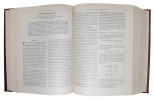
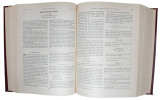
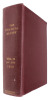
First printing of ""ENERGY PRODUCTION IN STARS"", Hans Bethe's seminal Nobel Prize winning paper on neucleosynthesis. It was the first time an astrophysical subject was recognized by the Nobel Committee. Bethe's work on nuclear reactions led him to discover the reactions that supply the energy in stars. In this paper, Bethe shows that ""the most important source of energy in ordinary stars is the reactions of carbon and nitrogen with protons"" (Bethe, Energy Production in Stars). Bethe began by analyzing the different possibilities for reactions by which hydrogen is fused into helium. He showed two processes to be the sources of energy generation capable of keeping stars hot. The first, the proton-proton chain, is the dominant energy source in stars with masses up to about the mass of the Sun. The second, the carbon-nitrogen-oxygen cycle, is the most important in more massive stars. ""ON MASSIVE NEUTRON CORES"" and NEUTRON STARS AND THE TOLMAN-OPPENHEIMER-VOLKOV LIMIT, two landmark papers which ""for the first time laid a general relativistic theory of stellar structure"" (Pais, Subtle is the Lord), thereby proving Einstein wrong in his conclusion that no star could collapse indefinitely.In the paper they addressed the question that Landau's paper, and also Oppenheimer and Serber's, had failed to consider: what is the maximum mass for stable neutron-star? This paper applied Tolman's method to calculate the gravitational equilibrium of a neutron star and predict the conditions under which it will continue collapsing into a black hole (the Tolman-Oppenheimer-Volkov Limit). The issue contain several other papers of interest: 1. Tolman, Richard. ""Static Solutions of Einstein's Field Equations for Spheres of Fluid"" - This paper developed a method for applying Einstein's field equations to static spheres of fluid in such a manner as to facilitate the development of exact solutions using known analytic functions)"" Jenkins and Segre's ""Quadratic Zeeman Effect"" and ""Zeeman Effect of the Forbidden Lines of Potassium"" .2. Gamow & Teller. ""On the Origin of Great Nebulae"". 3. Seaborg & Segre. ""Nuclear Isomerism in Element 43"" 4. Gentner & Segre. ""Appendix on the Calibration of the Ionization Chamber"". 5. Bethe. ""On the Absence of Polarization in Electron Scattering"" & ""Meson Theory of Nuclear Forces.""
Dipole Transitions in the Nuclear Photo-Effect.
Lancaster, American Physical Society, 1950. Lex8vo. Entire volume offered in the original blue wrappers with previous owner´s stamps [C. Møller, Danish physician] to front wrapper. In ""The Physical Review"" Volume 78, April 15, No. 2, 1950 of , Second Series. A fine and clean copy. Pp. 115-29. [Entire volume: Pp. 95-187].
First printing of Bethe's paper on the Nuclear Photo-Effect.
Quantum mechanics of one and two electron atoms
Plenum press. 1977. In-8. Broché. Bon état, Couv. convenable, Dos satisfaisant, Intérieur frais. 369 pages.. . . . Classification Dewey : 530-Physique
Etiquette sur coiffe en pied. Tampon bibliothèque. texte écrit en anglais. Classification Dewey : 530-Physique
Negative meson absorption in liquid hydrogen.
Lancaster PA, American Physical Society, 1962. Royal8vo. In the original blue printed wrappers. In ""The Physical Review"", Volume 127, Second Series, Number 2, July 15. A very fine and clean copy. Pp. 636-647. [Entire issue: Pp. 335-670].
First printing of Bethe's paper on negative meson absorption in liquid hydrogen.
PHYSIQUE, CLASSE DE 2de
Hachette. 1931. In-8. Relié. Bon état, Couv. convenable, Dos satisfaisant, Quelques rousseurs. 346 pages. 1er plat illustré en noir et rouge. Gravure en noir et blanc en page de titre. Illustré de nombreuses gravures en noir et blanc. Annotation en page de garde. Dernière page de garde et dos du 2e plat défraîchis.. . . . Classification Dewey : 530-Physique
Forces et poids. Grandeurs dérivées de la force. Liquides... Classification Dewey : 530-Physique
PHYSIQUE, CLASSE DE MATHEMATIQUES
Hachette. 1931. In-8. Relié. Etat d'usage, Couv. légèrement passée, Dos frotté, Quelques rousseurs. 426 pages. 1er plat illustré en noir et violet. Gravure en noir et blanc en page de titre. Illustré de nombreuses gravures en noir et blanc.. . . . Classification Dewey : 530-Physique
Force et mouvement. Energie. Mouvements périodique. Acoustique. Classification Dewey : 530-Physique
Physique. Classe de mathématiques. Programmes de 1931.
Paris, Librairie hachette, 1932. In-12 cartonné, 426 pp. Figures en noir.
Physique, Classe de première.
Paris, Hachette, 1928. 12 x 19, 394 pp., 303 figures, cartonnage d'édition dos toilé, bon état.
Physique. Classe de Première. Programmes de 1931
Hachette. 1931. In-8. Cartonnage d'éditeurs. Bon état, Couv. défraîchie, Dos satisfaisant, Intérieur frais. 378 pp. - 1 PHOTO DISPONIBLE.. . . . Classification Dewey : 530-Physique
Classification Dewey : 530-Physique
Physique. Résumés synoptiques à l'usage des candidats aux divers baccalauréats. Augmentés d'exercices résolus et à résoudre.
Couverture rigide. Reliure de l'éditeur. 92 pages. 22, 5 x 18 cm à l'italienne.
Livre. Librairie Eugène Belin, 1904.
Essai d'un cours élémentaire et général des sciences physiques... Partie physique. 3e édition
Paris, chez Verdière 1824 In-8 21,5 x 13 cm. Reliure de l’époque veau havane, dos lisse orné de petits fers dorés encadrés de roulettes dorées, plats encadrés de roulettes dorées, pièce de titre maroquin grenat, XIV-676 pp., 14 planches repliées, table des matières. Coiffe de tête arrachée, reliure frottée, rousseurs marginales, intérieur correct.
Bon état d’occasion
ESSAI D ' UN COURS ELEMENTAIRE ET GENERAL DES SCIENCES PHYSIQUES . PARTIE PHYSIQUE.
Paris , Tillard , Croullebois , Verdiere , 1815 , in8 1/2 basane , LII - 639 pp . 13 planches hors texte dépliantes. 1 ère édition . Dos restauré très fatigué . Intérieur très propre . Langue: Français

