 Write to the booksellers
-
Type
Book (5472)
Magazine (20)
Manuscript (1)
Old papers (1)
Photographs (3)
-
Latest
Last month (4)
Last week (2)
-
Language
English (10)
French (5483)
German (1)
Greek (1)
Italian (1)
Latin (1)
-
Century
16th (2)
17th (8)
18th (243)
19th (885)
20th (2950)
21st (133)
-
Countries
Belgium (266)
Canada (3)
Côte d'Ivoire (13)
Denmark (1363)
France (3551)
Switzerland (301)
-
Syndicate
ALAC (3)
CLAM (3)
ILAB (4129)
NVVA (139)
SLACES (139)
SLAM (2604)
SNCAO (15)
Quinze hommes et un secret -
Paris : Gallimard (Coll. "L'air du temps"), 1956 - un volume broché de 292 pages - bon état -

Tous nos livres sont visibles sur notre site : https://www.livrepoesie.com/
Introduction to the theory of relativity. With a foreword by Albert Einstein.
Englewood Cliffs N.J., Prentice-Hall, 1964, grand in 8° relié pleine percaline noire de l'éditeur, XVI-287 pages ; traces de ruban adhésif sur les gardes.
PHOTOS SUR DEMANDE. Fermeture du 1er au 23 Août


Phone number : 04 77 32 63 69
La vision des couleurs.
P., Dunod (Bibliothèque Technique Philips), 1960, in 8° cartonnage illustré de l'éditeur, X-86 pages ; infime defaut au premier plat.
Illustré de 21 figures dont 2 en couleurs et de 2 planches en couleurs dont 1 dépliante. Fermeture du 1er au 23 Août
Phone number : 04 77 32 63 69
LA PHYSIQUE DE TOUS LES JOURS / TROISIEME EDITION.
VUIBERT. 1998. In-4. Broché. Bon état, Couv. convenable, Dos satisfaisant, Intérieur frais. 368 pages illustrées de nombreux dessins en noir et blanc - Coin rogné sur le 1er plat (illustré d'un dessin en couleurs).. . . . Classification Dewey : 530-Physique
Classification Dewey : 530-Physique
A la recherche du réel. Le regard d'un physicien.
Broché, 24X15 cm, 1983, 194 pages, éditions Gauthier-Villars. De petites marques d'usage, bon état.
Album de modèles de mécanique et d'électricité avec organes superposés et démontables.
Paris: E. Bernard Editeur, s.d. Album in-4 oblong, réunissant 7 modèles de machines mécaniques et électriques, chacun accompagnée d'un texte avec illustrations dans le texte et d'un modèle en carton de couleur avec les organes superposés et démontables: Moteur à gaz Otto (12 pages), La machine à vapeur (20 pages, sans page de titre), La locomotive (24 pages), La dynamo (30 pages), L'accumulateur (28 pages), Moteur à courant triphasé (12 pages), Lampes à arc et compteurs d'électricité (16 pages). Tous les modèles sont bien complets et en parfait état, seul le modèle de la dynamo présente une pliure sans gravité. Cartonnage édit., titre argent et 3 modèles de machines en noir sur le premier plat, légères épidermures et usures, sinon bel exemplaire.
Album de modèles de mécanique et d'électricité avec organes superposés et démontables. (Paris: E. Bernard Editeur, c. 1900). [M.C.: sciences, physique, enfantina, livre éducatif, modèles démontables]
Masers et lasers. Voyage au pays de l'électronique quantique. Préface d'Alfred Kastler.
P., PUF (Collection "La Science Vivante"), 1964, in 8° broché, VIII-148 pages ; 47 figures ; traces de scotch.
Fermeture du 1er au 23 Août
Phone number : 04 77 32 63 69
La luminescence.
Couverture souple. Broché. 128 pages.
Livre. Editions P.U.F (Collection : Que sais-je? N° 921), 1974.
Que sais-je ? La luminescence
Presses universitaires de France. Non daté. In-12. Broché. Etat d'usage, 1er plat abîmé, Dos satisfaisant, Intérieur frais. 126 pages.Exemplaire de bibliothèque . Etiquette sur le premier plat et au dos. Tampon sur certaines pages. Range fichette sur la dernière page.. . . . Classification Dewey : 530-Physique
Classification Dewey : 530-Physique
Que sais-je? N° 921 La luminescence
Presses Universitaires de France Edition originale Premirèe édition 2ème trimestre 1961. 1961. In-12. Broché. Bon état, Couv. convenable, Dos satisfaisant, Intérieur frais. 128 pages illustrées de quelques dessins en noir et blanc. . . . Classification Dewey : 530-Physique
La première encyclopédie de poche fondée en 1941 par Paul Angoulvent, traduite en 43 langues, diffusée, pour les éditions françaises, à plus de 160 millions d'exemplaires, la collection Que sais-je? est l'une des plus importantes bases de données internationnales, construite pour le grand public par des spécialistes. 3800 titres ont été publiés depuis l'origine par 2500 auteurs. Classification Dewey : 530-Physique
Elementarisches Handbuch der industriellen Physik, Mechanik und Hydraulik. In 2 Bde.
Stuttgasrt und Tübingen, Cotta, 1834, 1835, in-8vo, XII + 371 S. +7 lithogr. Tafeln / Titelbl. + 316 S. + 11 lithogr. Tafeln, leicht stockfleckig, original Halb-Lederband, orangem Titelschildchen am Rücken, Scharnier oben Band 1 leicht eingerissen.
(SLACES, NVVA)
Phone number : 41 (0)26 3223808
Grundzüge der Elementarphysik oder methodischer Leitfaden für den ersten physikalischen Unterricht auf Schulen.
Halle, Hemmerbe und Schwetschke, 1807, kl. in-8vo, XXIV + 126 S. + 1 gef. gest. Tafel, Original-Pappband. Lederrückenschild.
Erstausgabe dieser physischen Schrift von Christoph Bernoulli, Naturforscher und Technologe. Spross der berühmten Basler Gelehrtenfamilie, Christoph war Gründer und Leiter des philotechnischen Instituts, Professor der Naturgeschichte in Basel. HBLS II/194; Poggendorff I/163. Image disp.
(SLACES, NVVA)
Phone number : 41 (0)26 3223808
Nouveau Probleme de Mecanique resolu.
(Berlin, Haude et Spener, 1746). 4to. No wrappers, as issued in ""Mémoires de l'Academie Royale des Sciences et Belles-Lettres"", 1745, tome I. Pp. 54-70 and with halftitlepage to the section.
First printing of an importent papeer in which Bernoulli gives his solution of the problem of a mass point constrained to slide within a rigid rotating body. His solution was obtained from other principles than Euler, who gave a solution at the same time, obtaining the same result. This paper was translated into German and reprinted in Ostwald’s Klassiker der Exacten Wissenschaften, no. 191.""The principle of areas and an extended version of the principle concerning the conservation of live force, both of which furnished integrals of Newton’s basic equations, were published by Bernoulli, probably with Euler’s assistance, in the Berlin Mémoires in 1745 and 1748. The principle of areas was used and clearly formulated almost simultaneously by Bernoulli and Euler in their treatments of the problem involving the movement of a tube rotating around a fixed point and containing freely moving bodies.!(DSB).The Bernoulli paper comes together with LEONHARD EULER ""De la Force de Percussion et de sa veritable Mesure. Traduit de Latin"" (Percussion and its true measurement), pp. 21-53, but lacking the plate. (Enestroem: E 82). An importent on the forces of percussions.
Remarques sur le Principe de la Conservation des Forces Vives pris dans un sens General.
(Berlin, Haude et Spener, 1750). 4to. No wrappers, as issued in ""Mémoires de l'Academie Royale des Sciences et Belles-Lettres"", 1748, tome IV, Titlepage to the volume in red/black with engraved titlevignette a. pp. 356-364. A stamp on titlepage.c
First printing of this memoir. In various connections Bernoulli used the principle of the coservation of 'Vis Viva' within the main areas of mechanics. ""Similarly, in an essay (1747) on the motion of a heavenly body and the three-body problem he worked out from the first integral of Newton’s second law, which related the square of its velocity to, in effect, its level of potential under attraction. In a sequel study (1750, the paper offered) on the generality of the principle he included the case where the body was acted upon by more than one centre of force. This was a most unusual way of working within celestial mechanics"" Newton had rarely invoked energy equations or relationships, although he had also found results about external attraction and equipotential surfaces.""(I. Grattan-Guiness).
Sur la Cohérence des Corps, Second (- Troisieme) Mémoire. (I. Problemes sur la Force et la Courbure des Lames élastiques. II. Problemes sur la Résistance des Poutres.).
(Berlin, Haude et Spener, 1768). 4to. No wrappers. Extracted from ""Mémoires de l'Academie Royale des Sciences et Belles-Lettres"", tome XXII, pp. 99-107 a. 1 folded engraved plate + pp. 108-116 a. 2 folded engraved plates.
First appearance of two importent papers in the theory of elasticity of materials in which Bernoulli gives, for the first time, the solution to a main problem, and stating a formula which expresses the shape of the loaded beam without reference to the load acting or to the elastic properties of the materials.
"BERNOULLI, (JOHANN). (+) NICOLAS (NIKOLAUS) BERNOULLI. - VIS-VIVA CONTROVERSY
Reference : 44748
(1714)
Extrait D'une Lettre de M. Bernoulli, écrite de Basle 10. Janvier 1711, touchant la maniere de trouver les forces centrales dans des milieux resistans en raisons composée de leurs densites & des puissances quelques des vitesses du mobile. (+) Addition...
(Paris, L'Imprimerie Royale, 1714). 4to. Without wrappers. Extracted from ""Mémoires de l'Academie des Sciences. Année 1711"". Pp. 47-53 a. pp. 53-56 (Nicolas).
First appearance of an importent paper in mathematical physics. Bernoulli had shown that the principle of virtual velocities could be shown in analytical form. The principle can be derived from the energy principle and he applied this principle several times to mechanical systems of central forces. For these forces he applied the vis viva equation to the inverse two-body problem. For the corresponding problem of centrally accelerated motion in resisting medium he solved the differential equations and determined the central force in accordance with the Huygens formula(in the paper offered). - The Addenda by his his nephew, Nicolas Bernoulli, best known for the fundamental work ""Ars Conjectandi"" from 1713.
Nouvelle Theorie du Centre D'Oscillation. Contenant une Regle pour déterminer dans les Pendules composés & balancans non-seulement dans la vuide, mais aussi dans les liqueeurs" laquelle Regle est appuyée sur un fondement plus seûr qu'aucun qu'on a...
(Paris, L'Imprimerie Royale, 1717). 4to. Without wrappers. Extracted from ""Mémoires de l'Academie des Sciences. Année 1714"". Pp. 208-229, 7 textfigs.
First appearance of this importent paper in which John Bernoulli gives his famous solution to the question of the center of oscillation. The solutions of Bernoulli and Brook Taylor were in principle identical and became an occasion of a grat dispute between these two eminent mathematicians.
Atom-molecule collision theory a guide for the experimentalist Sommaire: Interaction potentials I: Atom - Molecule potentials; Rotational excitation I: The quantal treatment ; Electronic excitation: nonadiabatic transitions ...
Plenum press. 1979. In-8. Relié. Bon état, Couv. convenable, Dos satisfaisant, Intérieur frais. 779 pages.. . . . Classification Dewey : 530-Physique

Etiquette sur coiffe en pied. Tampon bibliothèque. texte écrit en anglais. Sommaire: Interaction potentials I: Atom - Molecule potentials; Rotational excitation I: The quantal treatment ; Electronic excitation: nonadiabatic transitions ... Classification Dewey : 530-Physique
Cours de Physique.
MAISON QUANTIN / PICARD & KAAN. Non daté. In-12. Cartonnage d'éditeurs. Bon état, Couv. convenable, Dos satisfaisant, Intérieur frais. 176 pages. Nombreuses illustrations en noir et blanc dans le texte. Relié pleine toile marron.. . . . Classification Dewey : 530-Physique
Bibliothèque de l'Enseignement Secondaire spécial. 2ème année. Classification Dewey : 530-Physique
Bases de l'électronique quantique Tome 1 : mécanique quantique des électrons et atomes. Préface de Georges Goudet.
P., Eyrolles, 1965, grand in 8° relié pleine toile orange de l'éditeur, 454 pages.
PHOTOS SUR DEMANDE. Fermeture du 1er au 23 Août
Phone number : 04 77 32 63 69
Le noyau atomique
Centre national de la recherche scientifique/ Gauthier-Villars. 1948. In-8. Broché. Etat d'usage, Couv. légèrement passée, Dos fané, Papier jauni. 32 Pages. Nombreuses rousseurs.. . . . Classification Dewey : 530-Physique
Conférences rapports sur les recherches récentes en physique. Classification Dewey : 530-Physique
De l'atome a l'énergie nucléaire préface de F. Joliot curie
Corréa 1947 in8. 1947. Broché.
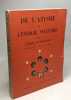
couverture défraîchie quelques accrocs intérieur propre
Le défi quantique: un siècle de découvertes et de controverses
1998 Diffusion Lavoisier Tec et Doc - 1998 - In-8 broché - 481 pages
assez Bon état, coins émoussés, couverture un peu défraichie
La Constitution des Atomes.
PAYOT & Cie. 1922. In-16. Cartonnage d'éditeurs. Très bon état, Couv. fraîche, Dos satisfaisant, Intérieur frais. 154 pages. Quelques figures en noir et blanc, dans le texte.. Avec Jaquette. . . Classification Dewey : 530-Physique
Collection Payot. Classification Dewey : 530-Physique
LA CONSTITUTION DES ATOMES
1922 reliure cartonnée in-douze, dos gris jaune, couverture titre et encadrement illustré en bleu, orné de 18 figures dans le texte, 157 pages, 1922 Paris Payot Editeur,
"collection Payot" trés pointue, parfait état.

