 Write to the booksellers
-
Type
Art print (2)
Book (5892)
Magazine (20)
Manuscript (1)
Old papers (1)
Photographs (3)
-
Latest
Last 3 days (3)
Last month (35)
Last week (3)
-
Language
English (10)
French (5904)
German (1)
Greek (1)
Italian (1)
Latin (2)
-
Century
16th (2)
17th (9)
18th (246)
19th (886)
20th (2973)
21st (132)
-
Countries
Belgium (264)
Canada (3)
Côte d'Ivoire (13)
Denmark (1369)
France (3969)
Switzerland (301)
-
Syndicate
ALAC (3)
CLAM (3)
ILAB (4124)
NVVA (139)
SLACES (139)
SLAM (2593)
SNCAO (15)
Union Minière du Haut Katanga. L'utilisation du Radium en gammagraphie pour le contrôle non destructif des métaux.
Bruxelles, 1950, petit in 8° broché, 80 pages ; illustrations ; cachets sur le titre.
PHOTOS SUR DEMANDE. ...................... Photos sur demande ...................


Phone number : 04 77 32 63 69
Que sais-je? N° 1337 Le gyroscope
Presses Universitaires de France Edition originale Première édition 2ème trimestre 1969. 1969. In-12. Broché. Bon état, Couv. convenable, Dos satisfaisant, Intérieur frais. 128 pages illustrées de quelques dessins en noir et blanc. . . . Classification Dewey : 530-Physique
La première encyclopédie de poche fondée en 1941 par Paul Angoulvent, traduite en 43 langues, diffusée, pour les éditions françaises, à plus de 160 millions d'exemplaires, la collection Que sais-je? est l'une des plus importantes bases de données internationnales, construite pour le grand public par des spécialistes. 3800 titres ont été publiés depuis l'origine par 2500 auteurs. Classification Dewey : 530-Physique
Die Entwicklung der Elektronenlawine in den Funkenkanal. - [THE RAETHER LIMIT]
Berlin, Springer, 1939. 8vo. In contemporary halv cloth with gilt lettering to spine. In ""Zeitschrift für Physik"", Bd. 112, 1939. Entire volume offered. Stamp to front free end-paper. Fine and clean. Pp. 464-489. [Entire volume: VIII, 772 pp.].
First appearance of Raether's paper in which he presented his theory of discharge - the first based on experimental observation - including what later was to be known as the Raether limit" the physical limiting value of the multiplication factor (M) or gas gain in an ionization avalanche process.
Les systèmes asservis échantillonnés
Dunod. 1962. In-8. Relié. Bon état, Couv. convenable, Dos satisfaisant, Intérieur frais. 352 pages augmentées de quelques figures en noir et blanc dans texte.. . . . Classification Dewey : 530-Physique
Etiquette sur coiffe en pied. Tampon bibliothèque. Traduit par un groue de travail de aection genevoise de l'Association suisse pour l'Automatique (ASSPA). Préface de Gerecke Edouard. Classification Dewey : 530-Physique
APPAREILS ET METHODES DE MESURES MECANIQUES
Armand Colin. 1928. In-16. Broché. Etat d'usage, Couv. légèrement passée, Manque en coiffe de tête, Intérieur acceptable. 214 pages. Illustré de nombreuses figures en noir et blanc dans le texte. Couverture partiellement jaunie.. . . . Classification Dewey : 530-Physique
Collection Armand Colin, Physique, n° 99. Classification Dewey : 530-Physique
"L'agence internationale de l'énergie atomique - ""Relations et institutions internationales"""
Armand Colin. 1970. In-12. Broché. Etat d'usage, Couv. légèrement pliée, Dos satisfaisant, Intérieur frais. 237 pages.. . . . Classification Dewey : 530-Physique
Classification Dewey : 530-Physique
Etude des forces électromotrices des éléments voltaïques.
Thèse de Doctorat es-Sciences Physique. P. Mallet-Bachelier, 1863. In-4 (27/21cm), 100 pages. Broché. Couvertures imprimées.
"Importante thèse de ce célèbre physicien français (1830-1901) dont le principal titre de gloire est l'étude des solutions qui le conduisit aux ""lois de Raoult"" et à la cryoscopie. 2 planches dépliantes in fine contenant 11 figures. Bon état."
Sur les Potentiels explosifs et la rigidité diélectrique de l'air. Thèse présentée à la faculté des sciences de l'Université de Fribourg (Suisse) pour obtenir le Grade de Docteur ès-sciences par Ulrich Rappel de Chicago.
1 vol. in-8 br., Imprimerie Saint-Paul, Fribourg, 1909, 99 pp.
Etat moyen (ancienne cote de bibliothèque au dos en queue, couv. débrochée). Thèse de doctorat par un religieux marianiste (Société de Marie) américain, Ulrich J. Rappel (1880-1940). Après sa thèse, il retourna aux U.S.A.. Il devint Head of the Departement of Electrical Engineering à l'Université de Dayton (Ohio), l'une des plus grandes universités catholiques américaines, fondée par les pères Marianistes en 1850. Peu courant désormais. - Fair condition (old library shelf mark on the back at the foot of the spine, detached cover). Doctoral dissertation by an American Marianist religious (Society of Mary), Ulrich J. Rappel (1880–1940). After his thesis, he returned to the U.S.A. He became Head of the Department of Electrical Engineering at the University of Dayton (Ohio), one of the largest American Catholic universities, founded by the Marianist Fathers in 1850. Scarce nowadays.
Histoire des Sciences Arabes2 - Mathématique et Physique
Seuil, 1997 - Fort In-8, broché, couverture souple sobre ill, 429 pages, index, bibliographie, très agréable exemplaire.
Bel Exemplaire Mise à jour du Samedi 27 Juin 2026. Paiement PayPal immédiat, Mondial Relay pour : France, Allemagne, Autriche, Belgique, Espagne, Italie, Portugal, Luxembourg, Pays-Bas, Pologne (Communiquer votre point ou locker si connu). Une participation supplémentaire peut être demandée pour les colis lourds hors France où les envois compris entre 5 et 25 kg sont dégressifs : 2 à 4 kilogrammes - 7.99 / 5 à 10 kg - 15.99 / 15 -25 kg - 25.99. Certaines de nos collections ( Vian, Céline, Camus (...) peuvent être expédiées en Franco de port. Pour linternational hors Europe (Suisse, Canada, Japon, Etats-Unis, les frais dexpéditions peuvent varier selon le poids (mise à jour : 1 juin 2026).
L'oscillographie cathodique et ses applications.
Couverture souple. Broché. 128 pages.
Livre. Editions P.U.F (Collection : Que sais-je? N° 1297), 1977.
QUELQUES VUES GENERALES SUR LES VARIATIONS SECULAIRES DU MAGNETISME TERRESTRE
In 8° ( 130x 220 mm) relié demi veau époque, 91pp, 1 planche H.T. Dépliantes
The theory of sound with a historical introduction by Robert Bruce Lindsay. Second edition revised an charged.
New-York, Dover, 1945 (1970), 2 volumes in 8° brochés, XLII-480 et XVI-504 pages.
PHOTOS sur DEMANDE. ...................... Photos sur demande ...................
Phone number : 04 77 32 63 69
Experiments, by the Method of Lorentz, for the further Determination of the Absolute Value of the British Association Unit Resistance, with an Appendix on the Determination of the pitch of a Standard Tuning-Fork. Received December 8, 1882, - Read Janu...
(London, Harrison and Sons, 1884). 4to. No wrappers as extracted from ""Philosophical Transactions"" Year 1883, Volume 174. - Pp. 295-322. Textillustr. Clean and fine.
First printing of an importent paper in the search for determining the value of the Ohm.""In the third phase (in the standardization of electrical units), ayleigh employed a method for determining the value of the Ohm introduced by L. Lorentz in 1873. This method, Rayleigh found, possessed the importent advantage of producing results that weree free of the influence of terrestrial magnetism and of thermoelectrical effects. Rayleigh modified Lorentz' method to make it more efficient, but without altering its essential character.""(Dong-Won Kim).
On the Clark Cell as a Standard of Electro-motive Force. Received Jan. 7, - Read Jan. 21, 1886.
(London, Harrison and Sons, 1886). 4to. No wrappers as extracted from ""Philosophical Transactions"" Year 1885, Volume 176 - Part II. - Pp. 781-800. Clean and fine.
First printing of Rayleigh's investigation of the Clark Cell that became known as the Board of Trade Cell of 1894. ""Rayleigh's grasp of such widely diversed fields as optics and hydrodynamics, acoustics and electromagnetic theory, was phenomenal"" and only Maxwell, Kelvin, and Helmholtz came near him in this aspect of his genius.""(DSB XIII, p.102).
On the Constant of Magnetic Rotation of Light in Bisulphide of Carbon Received December29, 1884 - Read January 15, 1885.
(London, Harrison and Sons, 1886). 4to. No wrappers as extracted from ""Philosophical Transactions"" Year 1885, Volume 176 - Part II. - Pp. 343-366, textillustrations. Clean and ine.
First printing.In this paper Rayleigh describes that in certain arrangements of 2 Nicol prism when light passing one way it is completely stopped by the second icl, but light passing the other way is completely transmitted. ""Rayleigh's grasp of such widely diversed fields as optics and hydrodynamics, acoustics and electromagnetic theory, was phenomenal"" and only Maxwell, Kelvin, and Helmholtz came near him in this aspect of his genius.""(DSB XIII, p.102).
On the Specific Resistance of Mercury. Received April 24 - Read May 4, 1881.
(London, Harrison and Sons, 1883). 4to. No wrappers as extracted from ""Philosophical Transactions"" Year 1883, Volume 174. Pp. 173-185, textillustration. Clean and fine.
First printing of one of the importent papers by Rayleigh in the search for determining the value of the Ohm.""Rayleigh's grasp of such widely diversed fields as optics and hydrodynamics, acoustics and electromagnetic theory, was phenomenal"" and only Maxwell, Kelvin, and Helmholtz came near him in this aspect of his genius.""(DSB XIII, p.102).
Théorie des électrons.
Félix Alcan. 1938. In-8. Relié. Etat d'usage, Coins frottés, Dos satisfaisant, Papier jauni. XIV + 441 pages - nombreuses figures en noir et blanc dans le texte - coins frottés - tampon sur page de garde et sur page de faux titre.. . . . Classification Dewey : 530-Physique
Préface de Léon Brillouin - traduit de l'allemand par Ed.Labin. Classification Dewey : 530-Physique
Introduction à l'étude de la thermodynamique.
Gauthier-villars et fils. 1888. In-4. Relié demi-cuir. Etat d'usage, Couv. convenable, Dos satisfaisant, Papier jauni. IX + 112 pages - quelques figures en noir et blanc dans le texte - plats, contre plats et gardes jaspés - auteur et titre dorés sur pièce de titre bordeaux - étiquette collée sur la coiffe en pied - filets dorés sur le dos - tampon sur la page de faux titre.. . . . Classification Dewey : 530-Physique
Classification Dewey : 530-Physique
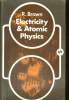
ELECTRICITY AND ATOMIC PHYSICS
MACMILLAN. 1973. In-8. Broché. Etat d'usage, Couv. convenable, Dos satisfaisant, Intérieur frais. 576 pages. Premier plat illustré en couleurs. Ouvrage de bibliothèque plastifié. Texte en anglais.. . . . Classification Dewey : 530-Physique
Classification Dewey : 530-Physique
Un axiome universel ses applications aux sciences expérimentales - Collection monographies des probabilités fascicule VII.
Gauthier-Villars. 1950. In-8. Broché. Etat d'usage, Couv. convenable, Dos satisfaisant, Papier jauni. XX+148 pages - quelques figures en noir et blanc dans le texte.. . . . Classification Dewey : 530-Physique
Collection monographies des probabilités fascicule VII. Classification Dewey : 530-Physique
[Imprimerie de la Charité] - REBOUL, G. et J.-A. [ REBOUL, Georges et Jean-Antoine ]
Reference : 43494
(1942)
Sciences expérimentales et probabilités.
1 vol. in-8 br., Facultés des Sciences et de Médecine de Montpellier, Imprimerie de la Charité, Montpellier, 1942, 109 pp.
![Sciences expérimentales et probabilités.. REBOUL, G. et J.-A. [ REBOUL, Georges et Jean-Antoine ]](https://static.livre-rare-book.com/pictures/CDL/43494_thumb.jpg)
![Sciences expérimentales et probabilités.. REBOUL, G. et J.-A. [ REBOUL, Georges et Jean-Antoine ]](https://static.livre-rare-book.com/pictures/CDL/43494_2_thumb.jpg)
![Sciences expérimentales et probabilités.. REBOUL, G. et J.-A. [ REBOUL, Georges et Jean-Antoine ]](https://static.livre-rare-book.com/pictures/CDL/43494_3_thumb.jpg)
Bon exemplaire (parfait état)
Theorie des elektrischen Elektronenmikroskops für Selbststrahler
Berlin, Springer, 1941. 8vo. In contemporary halv cloth with gilt lettering to spine. In ""Zeitschrift für Physik"", Bd. 117, 1941. Entire volume offered. Stamp to front free end-paper. Fine and clean. Pp. 689-708. [Entire volume: VIII, 818 pp.].
First printing of Recknagel's paper in which he showed that the immersion objective lens, which is a crucial part of a Emission Electron Microscope that accelerates the electrons emitted at quite low energy E0 to some final energy E and forms the first image of the emitting surface, has surprisingly good properties. Its basic aberration coefficients are proportional to the ratio E0/E so that they keep decreasing down to lowest emission energies.Here he concluded that there were no reason in principle to prevent the emission microscope from attaining the resolution of the light microscope.
Théorie générale des effets dynamiques de la chaleur
Paris, Mallet-Bachelier, 1854. In-4, IV-212-16 pp. 1 pl., broché, couverture originale imprimée (quelques rousseurs, minuscules déchirures marginales à la couverture).
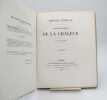
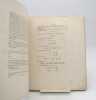
Édition originale de ce tiré à part extrait du Journal de mathématiques pures et appliquées paru l'année précédente. Reech y développe pour la première fois les notions d'entropie et de potentiels thermodynamiques. Malheureusement ce traité ne rencontre pas son public à sa parution et ses découvertes régulièrement imputées à d'autres. Rare. Complet du catalogue de l'éditeur. Voir photographie(s) / See picture(s) * Membre du SLAM et de la LILA / ILAB Member. La librairie est ouverte du lundi au vendredi de 14h à 19h. Merci de nous prévenir avant de passer,certains de nos livres étant entreposés dans une réserve.
Entretiens Physiques d'Aristide de d'Eudoxe, ou Physique nouvelle en Dialogues, qui renferme précisement ce qui s'est découvert de plus curieux & de plus utile dans la Nature, Septième Edition revue & corrigée (5 volumes).
Chez David, l'aîné/ Durand, 1745, 5 volumes de 100x170 mm environ, tome I : (1) f., xxiij-414 pages, (3) ff. (approbation, permission, privilège), (1) f., - tome II : (1) f., iv-450 pages, (1) f., - tome III : (1) f., iv-376-xxiv pages, (1) f. (errata), (1) f., - tome IV : (1) f., iv-442 pages, (1) f., - tome V : (1) f., xiij-388 pages, (1) f., reliures plein veau marbré fauve, dos à 5 nerfs portant titres et tomaisons dorés, ornés de caissons à motifs dorés, coupes dorées, gardes marbrées, tranches rouges. Dorures ternies, 4 coiffes ébréchées, coins émoussés, quelques rousseurs, des mouillures dans les marges, frottements et petites épidermures, 1 erreur de pagination, bon état pour le reste.
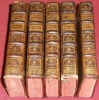
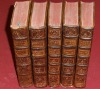
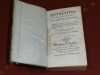
Tome I : 31 planches - Tome II : 20 planches - Tome III : 23 planches - Tome IV : 25 planches - Tome V : 2 planches (99+2 planches au total). Merci de nous contacter à l'avance si vous souhaitez consulter une référence au sein de notre librairie.
Recherches sur les chaleurs spécifiques des fluides élastiques (3).
(Paris, Bachelier), 1853. 4to. No wrappers. In: ""Comptes Rendus Hebdomadaires des Séances de L'Academie des Sciences"", Tome 36, No 16. Pp. (669-) 707. (Entire issue offered). Regnault's paper: pp. 676-687. A few marginal brownspots.
First apperance of this very importent paper where Regnault declared his acceptance of the conservation of energy.""Speculation and discussions of theory are noticeably absent from Regnault’s published work, as they are from his surviving notebooks. But in 1853 he declared his acceptance of the principle of the conservation of energy"" and later he measured the mechanical equivalent of heat, although with only moderate success. In declaring his support for the principle, Regnault stated that he had subscribed to the mechanical theory of heat “for a long time” and that he had been led to it independently through his own experiments ""Comptes rendus... de AcademiE des sciences..."" (The paper offered). ""(DSB).Roberts & Trent ""Bibliotheca Mechanica"", p. 275.

