 Write to the booksellers
-
Type
Art print (2)
Book (5895)
Magazine (20)
Manuscript (1)
Old papers (1)
Photographs (3)
-
Latest
Last 24h (3)
Last 3 days (1)
Last month (36)
Last week (2)
-
Language
English (10)
French (5907)
German (1)
Greek (1)
Italian (1)
Latin (2)
-
Century
16th (2)
17th (9)
18th (246)
19th (886)
20th (2976)
21st (132)
-
Countries
Belgium (264)
Canada (3)
Côte d'Ivoire (13)
Denmark (1369)
France (3972)
Switzerland (301)
-
Syndicate
ALAC (3)
CLAM (3)
ILAB (4127)
NVVA (139)
SLACES (139)
SLAM (2596)
SNCAO (15)
Ueber den Zustand des Gleichgewichts des Meers, wenn es von Sonne und Mond angezogen wird.
(Leipzig, Johann Ambrosius Barth, 1808). Without wrappers as extracted from ""Annalen der Physik und der Physikalischen Chemie. Hrsg. Ludwig Wilhelm Gilbert"", Bd. 30, pp. 29-53 a. 1 engraved plate.
First German edition of Euler's memoir published in Actis Acad. Sc. Imp. Petropol. 1780, on the tides.
"EULER, LEONHARD. - ANALYSING RELATIVE MOTION MATHEMATICALLY.
Reference : 48879
(1753)
Application de la machine hydraulique de M. Segner a toutes sortes d'ouvrages et de ses avantages sur les autres machines hydrauliques dont on se sert ordinairement. (The application of Mr. Segner's hydrological machine to all sorts of work and its ...
(Berlin, Haude et Spener, 1753). 4to. No wrappers as issued in ""Memoires de l'Academie Royale des Sciences et Belles Lettres"". Tome VII, 1751. Pp. 271-304 a. 2 folded engraved plates. Clean and fine.
First apperance of an importent paper in the theory of hydraulic analysis, exemplifying an early example of the theory of relative motion. The work is a more detailed analysis of an idea set forth in an earlier paper.Enestroem: E 202.
Construction des Objectifs composés de deux différentes Sortes de verre qui ne produisent aucune Confusion, ni par leur Ouverture, ni par la Différente Réfrangibilité des Rayons, avec la Maniere la plus Avantageuse d'en faire des Lunettes. (+) Const...
(Berlin, Haude et Spener, 1768) 4to. No wrappers, as issued in ""Mémoires de l'Academie Royale des Sciences et Belles-Lettres"", tome XXII, Année 1766. Pp. 119-170 , pp. 171-201 and 2 folded engraved plates., pp. 202-212 and 1 folded engraved plate.
First printing of three importent Euler-papers on the construction of composite lenses in order to avoid confusion. Euler presents the mathematical theory to explain the effects. The third paper describe how to analyze refraction phenomena in glasses by way of prisms. - Eneström E 359, E 360, E 361.
Sur la Confusion que cause dans les Instrumens dioptriques la diverse Réfrangibilité des Rayons. (+) Considerations sur les nouvelles Lunettes D'Angleterre de mr. Dollond, et sur le Principe qui en est le Fondement. (2 Mémoirs).
(Berlin, Haude et Spener, 1769) 4to. No wrappers, as issued in ""Mémoires de l'Academie Royale des Sciences et Belles-Lettres"", tome XVIII, Année 1762. Pp. 195-225 and 1 folded engraved plate. + Pp. 226-248.
First printing of two importent Euler-papers on the mathematical theory of dioptrics, and how to avoid the confusions of lenses. - Eneström E 379 a. 380.
De la Propagation du Son (On the Propagation of Sound). (And same author:) Supplement aux Recherches sur la Propagation du Son (Supplement to the Research on the Propagation of Sound). (And same author:) Continuation des Recherches sur la Propagation ... - [THE WAVE EQUIATION FOR AERIAL ACOUSTICS DISCOVERED]
(Berlin, Haude et Spener, 1766). 4to. Without wrappers as issued in ""Mémoires de L'Academie Royale des Sciences et Belles-Lettres"", tome XV, pp. 185-209 a. 1 engraved plate, pp.210-240 a. 2 engraved plates, pp. 241-264 and 1 engraved plate.
First editions of Eulers three main papers on the theory of sounds in which he formulated the WAVE EQUATION for the propagation of sounds in the air. In the first paper Euler analyzes the forces that act on a slice of air that is in a disturbed state at y but was initially at x. The analysis is customary in the modern elementary works. In the second paper Euler gets a result that is equivalent to the general formula ofinversion for partial differentiations, noting in addition that cylindrical and spherical waves also follow it.""Euler, Lagrange, and others worked on the propagation of sound in air. Euler wrote on the subject of sound frequently from the time he was twenty years old (1727) and established this field as a branch of mathematical physics...Three fine and definitive papers were read to the Berlin Academy in 1759 (the papers offered here). (Morris Kline). - Eneroth: E 305, E 306, E 307.
"EULER, LEONHARD. - MATHEMATICAL THEORY OF TELESCOPIC LENSES.
Reference : 45125
(1769)
Méthode pour porter les verres objectifs des Lunettes a un plus haut degré de Perfection. (Methods to apply for improving the degree of perfection in the manufacture of telescopic lenses)
(Berlin, Haude et Spener, 1769). 4to. No wrappers, as issued in ""Mémoires de l'Academie Royale des Sciences et Belles Lettres"", Année 1767, tome XXIII, pp. 131-164 a. 1 engraved plate.
First printing, dealing with compound lenses for making telescopes and the mathematical theory.Enestroem: E 383.
"EULER, LEONHARD. - MATHEMATICAL THEORY OF TELESCOPIC LENSES.
Reference : 49807
(1769)
Méthode pour porter les verres objectifs des Lunettes a un plus haut degré de Perfection. (Methods to apply for improving the degree of perfection in the manufacture of telescopic lenses)
(Berlin, Haude et Spener, 1769). 4to. No wrappers, as issued in ""Mémoires de l'Academie Royale des Sciences et Belles Lettres"", Année 1767, tome XXIII, pp. 131-164 a. 1 engraved plate.
First printing, dealing with compound lenses for making telescopes and the mathematical theory.Enestroem: E 383.
Physikalische Briefe für Gebildete aller Stände. Neue, vermehrte und verbesserte Auflage in 4 Theilen, mit vielen Holzschnitten. Erster bis vierter Theil in einem Band.
Leipzig und Stuttgart, J. B. Müller, 1853, in-8vo, 2 Bl. + 204 S.; 1 Bl. + 258 S.; 1 Bl. + 170 S.; 3 Bl. + 66 S., Privater Halblederband der Zeit.
Ohne die in der Bibliographie von Eneström erwähnten XIV Seiten am Anfang. Angeregt durch Liebigs „Chemische Briefe" übersetzte der Freiburger Physiker Johann Müller (1801-1858) zunächst Eulers klassische „Briefe an eine deutsche Prinzessin” über verschiedene Gegenstände der Physik und Philosophie" (1769-1773) aus dem Französischen und trug den Fortschritten der Physik seither Rechnung, indem er dem Werk zur Verdeutlichung zahlreiche Illustrationen sowie schließlich einen dritten und vierten Theil hinzufügte. Hier die letzte Ausgabe, die erstmals Teil 4 enthält. Eneström: Verz. der Schriften Leonhard Eulers. n° 343 B6. & 417 B6. Image disp.

(SLACES, NVVA)
Phone number : 41 (0)26 3223808
"EULER, LEONHARD. - ON MAUPERTUIS' PRINCIPLE OF LEAST ACTION
Reference : 46426
(1752)
Lettre de M. Euler a M. Merian. (+) Expose concernant L'Examen de la Lettre de M. de Leibnitz, alleguée par M. Le Prof. Koenig, dans le Mois de Mars, 1751, des Actes de Leipzig a l'Occassion du Principe de la Moindre Action.
(Berlin, Haude et Spener, 1752). 4to. No wrappers, as issued in ""Mémoires de l'Academie Royale des Sciences et Belles-Lettres"", 1750, tome VI, Titlepage to the section. (3), pp. 520-532 (+) pp. 52-64 (Expose).
In 1751, Maupertuis' priority for the principle of least action was challenged in print (Nova Acta Eruditorum of Leipzig) by an old acquaintance, Johann Samuel Koenig, who quoted a 1707 letter purportedly from Leibniz that described results similar to those derived by Euler in 1744. However, Maupertuis and others demanded that Koenig produce the original of the letter to authenticate its having been written by Leibniz. Koenig only had a copy and no clue as to the whereabouts of the original. Consequently, the Berlin Academy under Euler's direction declared the letter to be a forgery and that its President Maupertuis could continue to claim priority for having invented the principle.Enestroem: 182.
Reflexions sur L'Espace et le Temps. (Reflections on space and time).
(Berlin, Haude et Spener, 1750). 4to. No wrappers, as issued in ""Mémoires de l'Academie Royale des Sciences et Belles-Lettres"", 1748, tome IV, Titlepage to the section. a. pp. 324-333.
First appearance of this importent paper in which Euler defends Newton's conceptions of space and time against the thesis that space and time are ideal, and motions relative. He outlays his views on the relation between Metaphysics and Mechanics. The truths of mechanics are ""so indubitably constant"" that they must be founded in the natures of bodies. Metaphysics is the study of the nature of bodies, therefore the laws of Mechanics constrain Metaphysical theories. In fact, any Metaphysical idea or conclusion corresponding to a Mechanical one must agree in all its implications with Mechanics. This applies in particular to space and time. Real, absolute, space and time are assumed by the laws of Mechanics. Therefore, Metaphysical arguments for the unreality of space and time must be unfounded and ""hide some parlogism"".
Discussion plus particuliere de diverses Manieres d'elever de L'Eau par le moyen des Pompes avec le plus grand Avantage. (In depth explanation concerning different methods with which to raise water through pumps with the greatest effectiveness).
(Berlin, Haude et Spener, 1754) 4to. No wrappers, as issued in ""Mémoires de l'Academie Royale des Sciences et Belles-Lettres"", tome VIII, Année 1752. Pp. 149-184 and 1 folded engraved plates.
First appearance of an importent work on different kinds of water-pumps, analyzing their different amounts of force used.""Euler also investigated a number of concrete problems on the motion of liquids and gases in pipes, on vibration of air in pipes, and on propagation of sound. Along with this, he worked on problems of hydrotechnology, discussed, in part, above. Especially remarkable were the improvements he introduced into the design of a hydraulic machine imagined by Segner in 1749 and the theory of hydraulic turbines, which he created in accordance with the principle of action and reaction (1752-1761).""(DSB).Eneström E 207.
Réfléxions sur quelques Loix génerales de la Nature qui s'observent dans les Effets des Forces quelconques. (Reflection on some general laws of nature which are observed in the effects of random forces).
(Berlin, Haude et Spener, 1750). 4to. No wrappers as issued in ""Mémoires de l'Academie Royale des Sciences et Belles-Lettres"" Tome IV, Année 1748. Pp. (189-) 218 and 1 engraved plate.
First appearance of this paper, in which Euler proves that given the static principle, he can derive the equilibrium conditions for a fluid, and from these, he obtains the integrability conditions for a ""Pfaffian"" form in three variables. He also looks at the equilibrium of a weight suspended from three elastic cords by looking, via analogy, to a special case of the problem for fluids.""In his 1748 paper, Euler in ""Reflexions sur quelques loix generales de la nature.."" starts by declaring his commitment to the least-action principle. His expression corresponds to what we would now call potential energy, so that his statement of least action (formulated by Maupertuis in 1746) in statics is equivalent to the principle that a system of bodies at rest will adopt a configuration that minimizes total potential energy. Euler called this quantity ""effort"".""Enestrom: E 146.
Considerations sur les difficultes qu'on rencontre dans l'execution des verres objectifs de toute confusion. (Considerations on the difficulties that one encounters during the manufacture of objective lenses)
(Berlin, Haude et Spener, 1769). 4to. No wrappers as issued in ""Memoires de l'Academie Royale des Sciences et Belles Lettres"". tome XVIII, 1762. With halftitle ""Classe de Mathematique"" (2) pp. + pp. 117-142. Clean and fine.
An original paper ( first printing) by Euler dealing with the mathematics of problems in the manufacturing of lenses.Enestroem: E 376.
Recherches sur les Télescopes à Réflexion et les Moyens de les perfectionner.
(Berlin, Haude et Spener, 1769). 4to. No wrappers as issued in ""Mémoires de l'Academie Royale des Sciences et belles-Lettres"" Tome XVIII, pp. 143-184.
First edition. - Enestrom: E 377.
Recherches sur une autre Construction des Télescopes à Réflexion.
(Berlin, Haude et Spener, 1769). 4to. No wrappers as issued in ""Mémoires de l'Academie Royale des Sciences et Belles-Lettres"" Tome XVIII, pp. 185-194 and 1 folded engraved plate.
First edition. - Enestrom: E 378.
"EULER, LEONHARD. - SOLVING FOR THE FIRST TIME THE CONTACT PROBLEM OF FRICTION.
Reference : 45497
(1750)
Sur l'atmosphere de la Lune prouvée par la derniere eclipse annulaire du Soleil. (On the atmosphere of the moon as proved by the last ringed eclipse of the sun) + Sur le frottement des corps solides. (On the friction of solid bodies) + Sur la diminu...
(Berlin, Haude et Spener, 1750). 4to. No wrappers, as issued in ""Mémoires de l'Academie Royale des Sciences et Belles-Lettres"", tome IV, pp. 103-121 + pp. 122-132 + pp. 133-148 and 6 engraved plates (on 5).
Three first editions by Euler. Euler's goal in the first paper is to show that certain phenomena that resulted from the eclipse of July 25, 1748 are evidence that the moon has an atmosphere that is almost 200 times less dense than that of the earth. (The phenomena Euler observed are optical effects of light passing close to a sharp edge, and not the refraction of a lunar atmosphere).The other papers on the physics of rigid bodies are groundbreaking as Euler here set forth what is known as ""Euler's dynamical equations of the motion of the mass-center of any solid"", and thus STATING FOR THE FIRST TIME THE LAW OF DRY FRICTION, mathematically. Euler explains his experiments with the inclined plane and discovers the DIFFERENCE BETWEEN KINETIC AND STATIC FRICTION.""Leonhard Euler occupied himself with the mathematical point of view of friction as well as the experimental. He introduced the differentiation between static frictional forces and kinetic frictional forces, and solved the problem of rope friction, probably the first contact problem to be analytically solved in history. (1750, the papers offered). He was the first to lay the foundations of the mathematically way of dealing with the law of dry friction and in this way promoted further development. We have to thank for the symbol as the coefficient of friction. Euler worked with the idea that friction originates from the interlocation, between small triangular irregularities.This understanding survived, in different variations,for a hundred years and is also used today as the ""Tomlinson Model"" in connection with friction on atomic scale.""(L. Popov ""History of the Contact Mechanics and the Physics of Function"", p.3).Eneström: E142, E143, E144.
Mémoire sur la Réfraction des Fluides. Premier-Cinquieme Mémoire. (1.Sur la Réfraction. -2. Experiences sur la Qiantité de Réfraction des Fluides. - 3. Sur la Refraction des Fluides.- 4. Experiences sur la Réfraction de quelques Fluides. - 5. D L'Infl...
(Berlin, Haude et Spener, 1769). 4to. No wrappers, as issued in ""Mémoires de l'Academie Royale des Sciences et Belles-Lettres"", tome XVIII, pp. 279-342.and 1 folded engraved plate.
First printing of these 5 memoirs on hydrodynamis by the son of Leonhard Euler.
Physique avec 400 exercices et problèmes - Classes de seconde A C M et M' - cours de physique et chimie - nouvelle édition entièrement refondue - programme 1957
Hachette 1961 in8. 1961. Cartonné.

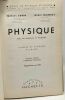
Bon état général cependant bords frottés intérieur propre
Physique avec 417 exercices et problèmes - Classes de première classique A' C C' moderne M M' - Nouvelle édition entièrement revisée.
Hachette. 1966. In-8. Cartonné. Etat passable, Couv. défraîchie, Dos abîmé, Papier jauni. 330 pages - nombreuses figures en noir et blanc et en noir et rouge dans le texte - dos absent - coins, tranches, plats frottés - corps de l'ouvrage désolidarisé des plats.. . . . Classification Dewey : 530-Physique

Classification Dewey : 530-Physique
PHYSIQUE, CLASSES DE 1re, CLASSIQUE A ET B
Hachette. 1959. In-8. Relié. Etat d'usage, Couv. légèrement passée, Dos frotté, Intérieur bon état. 181 pages. Illustré de nombreux schémas et photos en noir et blanc. Tampon en page de titre.. . . . Classification Dewey : 530-Physique
Nouvelle édition. Cours de Physique et Chimie. Avec 223 exercices et problèmes. Classification Dewey : 530-Physique
PHYSIQUE, CLASSES DE 1re, CLASSIQUE C MODERNE ET TECHNIQUE
Hachette. 1954. In-8. Relié. Etat d'usage, Couv. légèrement passée, Dos frotté, Intérieur bon état. 298 pages. Illustré de nombreux schémas et photos en noir et blanc. Mors légèrement fendus (1er exemplaire). Scotch sur le dos (2e exemplaire).. . . . Classification Dewey : 530-Physique
Nouvelle édition. Cours de Physique et Chimie. Avec 363 exercices et problèmes. Classification Dewey : 530-Physique
PHYSIQUE, CLASSES DE 2de CLASSIQUE A ET B
Hachette. 1961. In-8. Broché. Etat d'usage, Couv. légèrement passée, Dos frotté, Intérieur bon état. 208 pages. Illustré de nombreux schémas en noir et blanc. Coins de certaines pages pliés.. . . . Classification Dewey : 530-Physique
Nouvelle édition refondue. Cours de Physique et Chimie. Avec 248 exercices et problèmes. Classification Dewey : 530-Physique
SCIENCES PHYSIQUES, CLASSE DE PHILOSOPHIE
Hachette. 1959. In-8. Relié. Bon état, Couv. convenable, Dos frotté, Intérieur bon état. 298 pages. Illustré de nombreux schémas en noir et blanc.. . . . Classification Dewey : 530-Physique
Nouvelle édition avec unités conformes aux programmes 1957. . Cours de Physique et Chimie. Avec 281 exercices et problèmes. Classification Dewey : 530-Physique
PHYSIQUE, 1re CDT
Hachette. 1967. In-8. Relié. Etat d'usage, Couv. légèrement passée, Dos abîmé, Intérieur bon état. 363 pages. Illustré de nombreux schémas et photos en noir et blanc.Trace de rouille sur une page du texte. Quelques annotations au crayon dans le texte.. . . . Classification Dewey : 530-Physique
Cours de Sciences physiques, sous la dir. de H. Baïssas. Programme de juin 1966. Classification Dewey : 530-Physique
Le noyau atomique; traduit par A. Bussière, C. Stephan, J. Vernotte.
P., Dunod, 1961, grand et fort in 8° relié pleine toile grise de l'éditeur, XIV-752 pages.
PHOTOS sur DEMANDE. ...................... Photos sur demande ...................

Phone number : 04 77 32 63 69

