 Write to the booksellers
-
Type
Art print (2)
Book (5892)
Magazine (20)
Manuscript (1)
Old papers (1)
Photographs (3)
-
Latest
Last 3 days (3)
Last month (35)
Last week (3)
-
Language
English (10)
French (5904)
German (1)
Greek (1)
Italian (1)
Latin (2)
-
Century
16th (2)
17th (9)
18th (246)
19th (886)
20th (2973)
21st (132)
-
Countries
Belgium (264)
Canada (3)
Côte d'Ivoire (13)
Denmark (1369)
France (3969)
Switzerland (301)
-
Syndicate
ALAC (3)
CLAM (3)
ILAB (4124)
NVVA (139)
SLACES (139)
SLAM (2593)
SNCAO (15)
Physique. Ecoles primaires supérieures, cours complémentaires, préparation au brevet élémentaire.
Couverture rigide. Cartonnage de l'éditeur. 410 pages.
Livre. Programme de 1920. Ouvrage orné de 426 figures et gravures et contenant 660 exercices et problèmes. Librairie Hachette, Vers 1921.
Physique. Ecoles primaires supérieures, cours complémentaires, préparation au brevet élémentaire.
Couverture rigide. Cartonnage de l'éditeur. 410 pages.
Livre. Programme de 1920. Ouvrage orné de 426 figures et gravures et contenant 660 exercices et problèmes. Librairie Hachette, Vers 1930.
PHYSIQUE, EPS, CC, PREPARATION AU BREVET ELEMENTAIRE
Hachette. Non daté. In-8. Relié. Très bon état, Couv. fraîche, Dos impeccable, Intérieur bon état. 414 pages. Illustré de nombreuses gravures en noir et blanc. Tampon Mairie de Bordeaux, Instruction publique sur le 2e plat.. . . . Classification Dewey : 530-Physique
Edition revue. Enseignement primaire supérieur. Programmes de 1920. Orné de 420 figures et gravures, et contenant 660 exercices et problèmes. Classification Dewey : 530-Physique
SCIENCES PHYSIQUES, 1re ANNEE DES EPS ET DES CC, CLASSE DE 5e
Hachette. Non daté. In-8. Relié. Etat d'usage, Couv. légèrement passée, Dos frotté, Quelques rousseurs. 147 pages. Illustré de nombreux schémas et gravures en noir et blanc.. . . . Classification Dewey : 530-Physique
Enseignement du second degré. Classification Dewey : 530-Physique
SCIENCES PHYSIQUES, 2e ANNEE DES EPS ET DES CC, CLASSE DE 4e
Hachette. Non daté. In-8. Relié. Etat d'usage, Couv. légèrement passée, Dos frotté, Quelques rousseurs. 280 pages. Illustré de nombreux schémas et gravures en noir et blanc.. . . . Classification Dewey : 530-Physique
Enseignement du second degré. Classification Dewey : 530-Physique
SCIENCES PHYSIQUES, 3e ANNEE DES EPS ET DES CC, CLASSE DE 3e
Hachette. Non daté. In-8. Relié. Etat d'usage, Tâchée, Dos frotté, Quelques rousseurs. 292 pages. Illustré de nombreux schémas et gravures en noir et blanc. Annotations au dos du 1er plat et en page de garde. 1re page de garde manquante.. . . . Classification Dewey : 530-Physique
Enseignement du second degré. Classification Dewey : 530-Physique
COMPLEMENTS D'HYDRAULIQUE, 1re PARTIE
Edouard Privat. 1947. In-8. Broché. Etat d'usage, Couv. légèrement passée, Dos fané, Intérieur frais. 220 pages. Illustré de nombreux graphiques et photos en noir et blanc, dans et hors texte. Etiquette de code sur le dos. Tampons et annotations de bibliothèque sur le 1er plat et en page de titre.. . . . Classification Dewey : 530-Physique
Institut Electrotechnique et Institut de Mécanique des Fluides. de l'Univ. de Toulouse. Préface de C. Camichel. Classification Dewey : 530-Physique
Notice sur les Travaux scientifiques de M. Léopold Escande. [ Livre dédicacé par l'auteur ]
1 vol. in-4 br., Edouard Privat, Toulouse, 1953, 151 pp.
![Notice sur les Travaux scientifiques de M. Léopold Escande. [ Livre dédicacé par l'auteur ]. ESCANDE, Léopold](https://static.livre-rare-book.com/pictures/CDL/41862_thumb.jpg)
![Notice sur les Travaux scientifiques de M. Léopold Escande. [ Livre dédicacé par l'auteur ]. ESCANDE, Léopold](https://static.livre-rare-book.com/pictures/CDL/41862_2_thumb.jpg)
![Notice sur les Travaux scientifiques de M. Léopold Escande. [ Livre dédicacé par l'auteur ]. ESCANDE, Léopold](https://static.livre-rare-book.com/pictures/CDL/41862_3_thumb.jpg)
Etat satisfaisant (deux feuillets contrecollés abimées - sur un schéma -).
LA CHALEUR, NOTIONS DE THERMODYNAMIQUE, LES CHANGEMENTS D'ETAT, C.P.E.M.
Editions Universitaires TEX. 1968. In-4. Broché. Etat d'usage, Couv. légèrement passée, Dos satisfaisant, Intérieur acceptable. 163 pages. Illustré de nombreux schémas en noir et blanc dans le texte. 1er plat légèrement taché. Annotations dans le texte.. . . . Classification Dewey : 530-Physique
1re édition. Dilatation des corps. Loirs des gaz parfaits. Principes de Thermodynamique. Fusion-solidification. Vaporisation... Classification Dewey : 530-Physique
Edison ou la vie d'un grand inventeur. Collection : OSL, N° 131.
Zurich, Ruvre suisse de lecture pour la jeunesse, s.d. (ca 1941). 13 x 21, 32 pp., quelques illustrations, broché, bon état (couverture légèrement défraîchie).
L'astronautique + L'exploration par fusées de la très haute atmosphère et la possibilité des voyages interplanétaires. Conférence faite à l'Assemblée générale de la Société Astronomique de France le 8 Juin 1927. - [FIRST TEXTBOOK ON ROCKETRY - PRESENTATION-COPY]
Paris, 1930 + 1928. Two 8vo-volumes. In a nice custommade leather-backed cloth-box with gilt lettering to front: ""Space Travel/ Robert Esnault-Pelterie"". L'astronautique: Uncut and unopened in original red printed wrappers (mounted with thick paper on inside of wrappers), spine restored, no loss of lettering. (4), 248, (2) pp. (in between pages 4 and 8, which are both numbered are actually 2 leaves, i.e. 4 pp. that are unnumbered""one is only printed on recto and one only on verso (errata) + 9 large folded plated. L'exploration de la très haute atmosphère et la possibilité des voyages interplanétaires: Uncut and unopened in the original printed wrappers (L'Astronomie, Revue mensuelle d'astronomie...). A few closed tears to spine and restoration to lower margin of front wrapper, far from affecting text. A fine copy. VII, (1), 96 pp.
First edition, presentation-copy, of the first text-book on rocketry and space-craft, together with the first edition of the important text of Esnault-Pelterie's 1927-symposium on the possibility of interplanetary travel. L'Astronautique with signed presentation-inscription to page 9: ""With compliments / Esnault / Oct 1932"". ""Robert Albert Charles Esnault-Pelterie (1881 - 1957) was a pioneering French spaceflight theorist and aircraft designer. He combined a mixture of theoretical and practical work and is well known for being the inventor of the control stick of the aeroplane. He was furthermore the fourth man in France to obtain the pilot's license.""L'Astronautique outlined the key steps involved in the launching of an Earth satellite, interplanetary travel and rockettrajectories. Esnault-Pelterie began building his own rocket engine early the following year [1931]. In 1932 a rocket engine experiment went horribly wrong when the tetranitromethane fuel with which he was working exploded and he lost four fingers."" (Harvey, Brian. Europe's Space Programme: To Ariane and Beyond, Springer, 2003, 3 pp.)Besides being remembered as a spaceflight-pioneer, Esnault-Pelteries has given name to the Esnault-Pelterie-crater on the Moon. ""In the 1937 universal exhibition he stages an 'Astronautics Hall' and his moon rocket became the basis of Tin Tin's cartoon moon rocket."" (Ibid., 4 pp.) L'Astronautique: Norman 715 (""Esnault-Pelterie's most important contribution to rocketry"")""L'exploration par fusées de la très haute atmosphère et la possibilité des voyages interplanétaires"" is based on a symposium given by Esnault-Pelterie to the french Astronautics Society on June 8, 1927. - issued as the ""Supplément au Bulletin de Mars 1928"" of ""L'Astronomie. Revue mensuelle d'astronomie de Météorologie et de Physique du Globe et Bulletin de la Société Astronomique de France.Richard Green 105.
A la recherche du réel. Le regard d'un physicien.
P., Gauthier-Villars, 1979, grand in 8° beoché, 174 pages.
...................... Photos sur demande ...................


Phone number : 04 77 32 63 69
Conceptions de la physique contemporaine. Les interprétations de la mécanique quantique et de la mesure.
P., Hermann, 1965, in 8° cartonnage illustré de l'éditeur, 154 pages ; traces d'adhésif sur les gardes.
PHOTOS SUR DEMANDE. ...................... Photos sur demande ...................
Phone number : 04 77 32 63 69
CANDIDE ET LE PHYSICIEN
FAYARD. 2008. In-8. Broché. Bon état, Couv. convenable, Dos satisfaisant, Intérieur frais. 314 pages. . . . Classification Dewey : 530-Physique
LE TEMPS DES SCIENCES Classification Dewey : 530-Physique
Anfangsgründe der Physik.
Wien, Carl Gerold, 1844. 8°. XVI, 487 (1) S. Mit 5 gef. Kupfertafeln. Blindgeprägter Orig.-Leinenband.
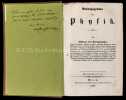
Erste Ausgabe. - Mit handschr. Widmung des Verfassers. Andreas von Ettingshausen (1796-1878), österreichischer Naturwissenschaftler und Philosoph war Professor für Physik in Innsbruck und für Mathematik in Wien. - Mit Exlibris und Blindprägestempel. - Papier durchgehend etwas stockfleckig. Einband berieben und bestossen.
ALBERT EINSTEIN : KOSMOA PENTSAGAI
GAIAK. non daté. In-8. Broché. Bon état, Couv. convenable, Dos satisfaisant, Intérieur frais. 217 pages. Nombreuses illustrations en noir et blanc dans le texte et hors texte. Deux envoi manuscrit de l'auteur.. . . . Classification Dewey : 530-Physique
Classification Dewey : 530-Physique
La victoire sur la crise
Félix Alcan. 1935. In-12. Broché. Bon état, Couv. défraîchie, Dos satisfaisant, Intérieur bon état. 238 p. légère mouillure en bas de 1er plat.. . . . Classification Dewey : 530-Physique
"""cet ouvrage à été conçu en fonction d'un idéal et d'une synthèse, nous l'avons voulu néanmoins concret, pratuque pour préparer à l'action féconde, afin que, route ou sentier, il nous sorte des ruines accumulées par l'égoïsme et l'ignorance"" Classification Dewey : 530-Physique"
Premier (- Cinquieme) Mémoire de L'Influence de la Chaleur sur la Réfraction. (5 Parts).
(Berlin, Haude et Spener, 1769). 4to. No wrappers, as issued in ""Mémoires de l'Academie Royale des Sciences et Belles-Lettres"", 1762, tome XVIII. Pp. 279-342 a. 1 folded engraved plate.
Johann Albrecht Euler (1734 - 1800) was a mathematician and the first child of Leonhard Euler himself. In 1754 he became a member of the Berlin Academy. On Euler's return to St. Petersburg in 1765, he was appointed as the chair of physics at the St. Petersburg Academy. In St. Petersburg, he lived in his father's house" Johann Albrecht's family occupied the ground floor. He won a total of 7 international academy prizes.
Théorie de L'Inclination de LÉguille magnetique confirmé par des Expériences. Traduit du Latin.
(Berlin, Haude et Spener, 1757). 4to. No wrappers, as issued in ""Mémoires de l'Academie Royale des Sciences et Belles-Lettres"", tome XI, Année 1755, pp. 117-201 and 2 folded engraved plates.
First printing of Johann Euler's large memoir on earth magnetism.""Johann Albrecht Euler (27 November 1734 in St. Petersburg - 17 September 1800 in St. Petersburg) was an astronomer and mathematician. He was the first child of Leonhard Euler himself. In 1754 he became a member of the Berlin Academy. On Euler's return to St. Petersburg in 1765, he was appointed as the chair of physics at the St. Petersburg Academy. In St. Petersburg, he lived in his father's house"" Johann Albrecht's family occupied the ground floor. He won a total of 7 international academy prizes.""
Lettres de L. Euler à une princesse d'Allemagne sur divers sujets de physique et de philosophie précédées de l'éloge d'Euler par Condorcet et annotées par M. A.A. Cournot -- 2 VOLUMES (COMPLETE SET) -- BON EXEMPLAIRE
P., Hachette, 1842; 2 volumes in 8 reliés en demi-basane verte, dos ornés de filets dorés (reliures de l'époque), (quelques rousseurs), T.1 : 51pp., 472pp., 2 planches dépliantes, T.2 : (2), 524pp., 4 planches dépliantes
---- BON EXEMPLAIRE ---- Ces lettres, écrites à la Princesse d'Anhalt-Dassau à qui Euler avait donné des cours de physique, influencèrent profondément la philosophie. Euler's Lettres à une Princesse d'Allemagne (mainly on cosmology and physics), in which he attacked Leibniz's monadology, had an immense success and profoundly influenced contemporary philosophy . (Printing & the Mind of Man N 196)**2004/L2-1999/ARB.PLAC-2006/CART5
Lettres à une Princesse d'Allemagne sur divers sujets de physique et de philosophie -- TRES BEL EXEMPLAIRE -- 3 VOLUMES (COMPLETE SET)
Berne, Société Typographique, 1775, 3 volumes in 8 reliés en plein veau, dos ornés de fers dorés, tranches jaspées (reliures de l'époque), T.1 : 8pp., 309pp., 4 PLANCHES DEPLIANTES, T.2 : 8pp., 315pp., 4 PLANCHES DEPLIANTES, T.3 : 10pp., 351pp., 11 PLANCHES DEPLIANTES
---- TRES BEL EXEMPLAIRE ---- Ces lettres, écrites à la Princesse d'Anhalt-Dassau à qui Euler avait donné des cours de physique, influencèrent profondément la philosophie ---- "Euler's Lettres à une Princesse d'Allemagne (mainly on cosmology and physics), in which he attacked Leibniz's monadology, had an immense success and profoundly influenced contemporary philosophy". (Printing & the Mind of Man N° 196)**8065/ARB3
Recherches sur la Cause physiques de L'Electricité.
(Berlin, Haude et Spener, 1759). 4to. No wrappers, as issued in ""Mémoires de L'Academie Royale des Sciences et belles-Lettres"", tome XIII, 1757. With titlepage to the year 1757 with engraved titlevignette and pp. 125-159 and 1 folded engraved plate. A Stamp to titlepage.
First appearance of this paper which expands his prize-winning memoir from the Petersbourg Academy. He is now convinced by Aepinus of the importence of Franklin's distinction between positive and negative electricity. He elaborates his theory of the identity of the electrical fluid with the ether.
Essai d'une Explication physique des Couleurs engendrees sur des Surfaces extrémement minces. (Essay concerning the physical explanation of colors which are issued from extremely thin surfaces). - [EULER'S WAVE-THEORY OF LIGHT]
(Berlin, Haude et Spener, 1754). 4to. Without wrappers as extracted from ""Mémoires de L'Academie Royale des Sciences et belles Lettres"", Tome VIII, pp. 262-282.
First printing of Eulers's importent paper in which he defended the wave-theory of light in opposition to the newtonian corpuscular hypothesis.Most of the scientists and philosophers of the 18th century defended the corpuscular theory of light, but Euler ""being impressed by the notion that the emission of particles would cause a diminuation in the mass of the radiating body, which was not observed, while the emission of waves involved no such consequence...he insisted strongly on the resamblance between light and sound" the whole of the space through which the heavenly bodies move is filled with a subtle matter, the aether, and light consists in vibrations of this aether 'light is the same thing as sound in air'....The chief novelty of Euler's writings on light is his explanation of the manner in which material bodies appear coloured when wieved with white light" and, in particular the way in which colours of thin plates are produced."" (Whittaker,A History of the Theories of Aether and Electricity: pp. 97-98.). - Euler's worg comes here together with a paper by L'Abbe Mazeas on ""Observations sur les Coleurs engendres par le Frottement des Surfaces plane et transparentes."". - Enestrom E:209.
Mémoire sur la plus grande Équation des Planetes, Par Mr. Euler.
(Berlin, Haude et Spener, 1748). 4to. No wrappers as issued in ""Memoires des L'Academie Royale des Sciences et Belles Lettres"", tome II, pp. 225-248.
First edition. This is one of Euler's importent papers in the development of the new gravitational astronomy, which advanced the theory of Lunar and Planetary motion. - Enestrom: 105.
Ueber den Zustand des Gleichgewichts des Meers, wenn es von Sonne und Mond angezogen wird.
(Leipzig, Johann Ambrosius Barth, 1808). Without wrappers as extracted from ""Annalen der Physik und der Physikalischen Chemie. Hrsg. Ludwig Wilhelm Gilbert"", Bd. 30, pp. 29-53 a. 1 engraved plate.
First German edition of Euler's memoir published in Actis Acad. Sc. Imp. Petropol. 1780, on the tides.

