 Write to the booksellers
-
Type
Art print (2)
Book (5892)
Magazine (20)
Manuscript (1)
Old papers (1)
Photographs (3)
-
Latest
Last 24h (3)
Last 3 days (1)
Last month (36)
Last week (2)
-
Language
English (10)
French (5904)
German (1)
Greek (1)
Italian (1)
Latin (2)
-
Century
16th (2)
17th (9)
18th (246)
19th (886)
20th (2973)
21st (132)
-
Countries
Belgium (264)
Canada (3)
Côte d'Ivoire (13)
Denmark (1369)
France (3969)
Switzerland (301)
-
Syndicate
ALAC (3)
CLAM (3)
ILAB (4124)
NVVA (139)
SLACES (139)
SLAM (2593)
SNCAO (15)
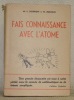
Fais connaissance avec l’atome. Illustrations de Maurice Sendak.
Genève, Editions Jeheber 1948, 190x135mm, XIII - 465pages, broché. Sous jaquette. Petites déchirures sur le haut et le bas du dos de la jaquette, autrement bel exemplaire.
Pour un paiement via PayPal, veuillez nous en faire la demande et nous vous enverrons une facture PayPal
Comment je vois le monde -- PREMIERE EDITION FRANCAISE -- BEL EXEMPLAIRE
P., Flammarion, 1934, un volume in 8, broché, couverture imprimée, 258pp.
---- PREMIERE EDITION FRANCAISE ---- BEL EXEMPLAIRE**9069/M6DE
Einstein's theory of relativity. Revised edition prepared with the collaboration of Günther Leibfried and Walter Biem.
New-York, Dover, 1962, in 8° broché, VII-376 pages ; traces d'adhésif sur les gardes.
PHOTOS sur DEMANDE. ...................... Photos sur demande ...................


Phone number : 04 77 32 63 69
Lehrbuch der Physik zum gebrauche bei Vorlesungen und zum Selbstunterrichte. Mit 554 in den Text gedr. Holzschnitten. Sechste verb. u. verm. Aufl.
Stuttg., 1852. Cont. hcalf. St.o.t. VI, 658 pp. The illustr. depicting many instruments.
La Physique Dans La Vie Quotidienne
Paris Pierre Roger et Cie 1910 Grand In-12 379 pp, (.) Son rôle et ses phénomènes ; 12 conférences. Dos légèrement passé avec frottis sur mors et coiffes. Intérieur frais
Très Correct Broché à raba
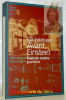
Avant Einstein. Relativité, lumière, gravitation. Coll. “Science Ouverte”.
Paris, Seuil 2005, 220x145mm, 349pages, broché. Bel exemplaire.
Pour un paiement via PayPal, veuillez nous en faire la demande et nous vous enverrons une facture PayPal
Einstein et la relativité générale - Les chemins de l'espace-temps.
"Cnrs éditions. 2002. In-8. Broché. Bon état, Couv. convenable, Dos satisfaisant, Intérieur frais. 344 pages - nombreuses figures en noir et blanc dans et hors texte - en supplément un article de magazine de 8 pages "" la singularité voilée, Jérôme Perez, Jean Michel Alimi"".. . . . Classification Dewey : 530-Physique"

Préface de Thibault Damour. Classification Dewey : 530-Physique
L’Evolution des idées en physique des premiers concepts aux théories de la relativité et des quanta
France loisirs 1983 Cartonnage éditeur sous jaquette. Très bon état d’occasion.
Très bon état d’occasion
EKBERT HERING, ROLF MARTIN, MARTIN STOHRER
Reference : RO60080840
(1997)
ISBN : 3540624422
PHYSIK FÜR INGENIEURE
SPRINGER. 1997. In-8. Cartonné. Etat d'usage, Couv. légèrement passée, Dos frotté, Intérieur frais. 744 pages. Premier plat illustré en couleurs. Nombreus schémas et quelques illustrations en noir et blanc dans le texte. 2 dépliants de 4 pages en couleurs en fin d'ouvrage. Texte en allemand.. . . . Classification Dewey : 530-Physique
Classification Dewey : 530-Physique
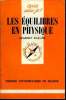
Les équilibres en physique. Collection : Que sais-je ?, N° 1711.
Paris, Presses Universitaires de France (PUF), 1978. 12 x 18, 123 pp., 28 figures, broché, très bon état.
Que sais-je? N° 1711 Les équilibres en physique
Presses Universitaires de France Editiono originale Première édition 2ème tripmestre 1978. 1978. In-12. Broché. Bon état, Couv. convenable, Dos satisfaisant, Intérieur frais. 128 pages illustrées de quelques dessins en noir et blanc. . . . Classification Dewey : 530-Physique
La première encyclopédie de poche fondée en 1941 par Paul Angoulvent, traduite en 43 langues, diffusée, pour les éditions françaises, à plus de 160 millions d'exemplaires, la collection Que sais-je? est l'une des plus importantes bases de données internationnales, construite pour le grand public par des spécialistes. 3800 titres ont été publiés depuis l'origine par 2500 auteurs. Classification Dewey : 530-Physique
Hydromagnetic Dynamo Theory.
Lancaster, American Physical Society, 1956. Lex8vo. Volume 28, April, No. 2, 1955 of ""Reviews of Modern Physics"". Entire volume in the original printed orange wrappers. Previous owner's name to upper margin of front wrapper. A 2 cm long tear to upper left corner of front wrapper. Otherwise a very nice and clean copy. [Elasser:] Pp. 135-163. [Entire issue: Pp. 103-170].
First printing of Elsasser's paper on the Hydromagnetic Dynamo Theory. Elsasser, considered the father of the presently accepted dynamo theory as an explanation of the Earth's magnetism, proposed that this magnetic field resulted from electric currents induced in the fluid outer core of the Earth. He revealed the history of the Earth's magnetic field through pioneering the study of the magnetic orientation of minerals in rocks.""His [Elsasser] main attention became focused on a research field he had been cultivating almost as a diversion alongside his official duties since the late 1930s: geomagnetism. Discounting a hypothesis popularized by Einstein and Patrick Maynard Stuart Blackett that Earth's magnetic field is a property of its rotation per se, he thought instead of a self-sustaining dynamo in the molten metallic core. A key clue for Elsasser in his approach to the problem was a similarity between maps of the long-term variations in Earth's magnetic field and the maps of atmospheric flows familiar from his work in meteorology. Elsasser theorized that Coriolis forces and convection currents in the conductive liquid combined to produce poloidal magnetic and toroidal electric fields (the former extending beyond Earth's surface, the latter interior to it) that had a feedback effect on each other. Though some details were unclear, he argued that the dynamo theory gave the right order of magnitude for the magnetic field's strength and potentially accounted for its secular variations. By the mid-1950s, Elsasser's junior colleague at Utah, Eugene Newman Parker, and the British physicists Edward Crisp Bullard and the Australian-born George Keith Batchelor had explored alternative dynamo models and elaborated the mathematics showing that the field was self-sustaining. The dynamo theory ultimately received wide acceptance. It subsequently also became a key element of Hannes Alfvén's Nobel Prize-winning work on plasma electrodynamics. In the 1960s, Elsasser's geophysical interests moved into modeling seismic deformation in the context of the burgeoning theory of plate tectonics."" (DSB)
Ueber die Electrisirung der Gase durch glühende Körper.
Leipzig, Johann Ambrosius Barth, 1887. Without wrappers as issued in ""Annalen der Physik und Chemie. Hrsg. von G. Wiedemann."", Neue Folge Bd. 31, 5. Heft. Pp. 1-144 a. 1 folded plate.(entire issue offered ""Heft"" 5). The Elster-Geitel-paper: pp. 109-126. Clean and fine.
First edition.""In 1887 Elster and Geitel discovered the ""electrification of gases by means of incandescent bodies"", a finding that later was very significant in thermionics. Their finding of the emission of negative electricity from incandescent filaments was decisive in the proof that Thomson’s ""corpuscles"" (electrons) are a constituents of all matter.""(DSB).The issue contains another importent paper by BUNSEN ""Ueber das Dampfcalorimeter"", pp. 1-14, in which Bunsen describes his invention of the Vapor Calorimeter.
Zur Theorie des Starkeffektes. - [FIRST EQUATION ON THE STARK EFFECT IN HYDROGEN]
Leipzig, Ambrosius, 1916. 8vo. In full black cloth with gilt lettering to spine. In ""Annalen der Physik"", Fourth series, No. 50, 1916. Entire issue offered. Library labels pasted on to front end-papers and stamps to title page, otherwise fine. Pp. 489-520. [Entire volume: VIII, 972 pp + 5 folded plates].
First printing of Epstein's seminal paper in which he was able to derive equations for the linear and quadratic Stark effect in hydrogen.""In his classic paper on the theory of the Stark effect [The present], the splitting of the spectral lines in a hydrogen atom by a strong electric field, he worked out the quantization rules in an invariant form and then used them to calculate the splitting of the hydrogen lines. The splitting effect, first observed by Johannes Stark in 1913, could not be explained along classical lines. Showing that Niels Bohr's Quantum description of the hydrogen atom could solve the problem made Epstein's reputation as a theoretical physicist. The match between his theoretical predictions and Stark's data furnished striking support for the RutherfordBohr atomic theory.Working independently, the German astronomer Karl Schwarzschild publicly announced the solution to the same problem one day after Epstein's paper appeared. (As Epstein relates it, Schwarzchild initially had the wrong formula. He corrected it after seeing an announcement of the development of Epstein's result.) Epstein's other contributions to the development of the quantum theory of atomic structure between 1916 and 1921 ranged from his extension of Bohr's theory to nonperiodic motions, including beta decay and the photoelectric effect, to the interference of spectral lines."" (DSB).
Résonances magnétiques. Recueil de travaux des sessions de perfectionnement. Institut National des Sciences Appliquées. Lyon. Coordinateur A. Erbia.
P., Masson, 1969, grand in 8° broché, IX-269 pages.
PHOTOS SUR DEMANDE. ...................... Photos sur demande ...................
Phone number : 04 77 32 63 69
Vierzehnter bank
Berlin, Springer, 1935, un volume in 8 relié en pleine toile éditeur, 273pp., figures dans le texte
---- EDITION ORIGINALE ---- Fleischmann (R.) & Bothe (W.). Kunstliche Kernumwandlung - Geiger (H.). Die Sekundäreffekte der kosmischen Ultrastrahlung - Hippel (v. A.). Der elektrische Durchschlag in Gasen und festen Isolatoren - Falkenhagen (H.). Struktur elektroytischer Lösungen - Hiedemann (E.). Ultraschall**1984/L7AR
Anfangsgründe der Naturlehre. Zweyte sehr verbesserte und vermerte Auflage.
Göttingen, Johann Christian Dieterich, 1777. Contemp. hcalf. Gilt spine. Titlelabel with gilt lettering. A paperlabel pasted on top of spine. Stamps on title-page. (32),632 pp. and 8 folded engraved plates. Internally clean and fine.
Poggendorff I, 679.
CHIMIE, EPS, CC, PREPARATION AU BREVET ELEMENTAIRE
Hachette. Non daté. In-8. Relié. Bon état, Couv. convenable, Dos satisfaisant, Intérieur bon état. 385 pages. Illustré de nombreux schémas en noir et blanc. Tampon Ville de Bordeaux, Instruction publique sur le 2e plat (1er exemplaire).. . . . Classification Dewey : 530-Physique
Enseignement primaire supérieur. Programmes de 1920. Orné de 291 figures et 267 exercices et problèmes. Classification Dewey : 530-Physique
Physique
Hachette. 1932. In-12. Broché. Bon état, Couv. convenable, Dos satisfaisant, Intérieur bon état. 412p. 420 figures et gravures. 660 exercises et problèmes.. . . . Classification Dewey : 530-Physique
Ecoles primaires supérieures, cours complémentairs, préparation au Brevet élémentaire. Classification Dewey : 530-Physique
PHYSIQUE
Hachette. Non daté. In-8. Relié. Etat d'usage, Couv. légèrement passée, Dos frotté, Rousseurs. Non daté. Illustré de nombreuses gravures en noir et blanc.. . . . Classification Dewey : 530-Physique
Orné de 420 figures et gravures, et contenant 660 exercices et problèmes. Classification Dewey : 530-Physique
PHYSIQUE, CLASSE DE 3e DES COURS COMPLEMENTAIRES
Hachette. Non daté. In-8. Relié. Etat d'usage, Couv. légèrement passée, Dos frotté, Quelques rousseurs. 306 pages. 1er plat illustré en noir et blanc. Illustré de nombreuses gravures en noir et blanc. Spécimen (1er exemplaire).. . . . Classification Dewey : 530-Physique
Programmes de juillet 1947. Classification Dewey : 530-Physique
PHYSIQUE, CLASSE DE 4e DES COURS COMPLEMENTAIRES
Hachette. 1948. In-8. Relié. Etat d'usage, Couv. défraîchie, Dos frotté, Intérieur bon état. 206 pages. 1er plat illustré en noir et blanc. Illustré de nombreuses gravures en noir et blanc. Tampons en page de titre. Page de titre légèrement passée.. . . . Classification Dewey : 530-Physique
Programmes de juillet 1947. Classification Dewey : 530-Physique
PHYSIQUE, COURS COMPLEMENTAIRES, PREPARATION AU BREVET ELEMENTAIRE
Hachette. 1947. In-8. Broché. Etat d'usage, Couv. légèrement passée, Dos frotté, Intérieur bon état. 414 pages. Illustré de nombreuses gravures en noir et blanc. 1er plat très légèrement abîmé.. . . . Classification Dewey : 530-Physique
Orné de 420 figures et gravures, et contenant 660 exercices et problèmes. Classification Dewey : 530-Physique

