 Write to the booksellers
-
Type
Art print (2)
Book (5880)
Magazine (20)
Manuscript (1)
Old papers (1)
Photographs (3)
-
Latest
Last 24h (13)
Last 3 days (1)
Last month (34)
Last week (4)
-
Language
English (10)
French (5892)
German (1)
Greek (1)
Italian (1)
Latin (2)
-
Century
16th (2)
17th (9)
18th (246)
19th (886)
20th (2963)
21st (132)
-
Countries
Belgium (277)
Canada (3)
Côte d'Ivoire (13)
Denmark (1369)
France (3944)
Switzerland (301)
-
Syndicate
ALAC (3)
CLAM (3)
ILAB (4120)
NVVA (139)
SLACES (139)
SLAM (2589)
SNCAO (15)
Recente problemen in verband met het fysisch onderzoek bij zeer lage temperaturen. Colloquium ter gelegenheid van het 25-jarig bestaan van het laboratorium voor lage temperaturen, gehouden te Leuven op 9 en 10 november 1959
Brussel, Paleis der Academiën 1959 118pp.with ills., 26cm., in the series "Koninklijke Vlaamse Academie voor Wetenschappen, Letteren en Schone Kunsten van België", original softcover, few foxing on edges, text VG, [contributions in English, German and French], W73087
Spécial relativity. The fondation of macroscopic physics.
Cambridge, Cambridge University Press, 1978, grand in 8° relié pleine toile verte de l'éditeur, X-261 pages.
PHOTOS SUR DEMANDE. ...................... Photos sur demande ...................


Phone number : 04 77 32 63 69
Balistique. Indication de quelques Experiences propres à comléter la théorie du Mouvement des Projectiles de l'artillerie: Précédée de L'Analyse nécessaire.
Starsbourg, F.G. Levrault, 1814. Contemp. hcalf, gilt spine with gilt lettering. Stamps on titlepage. (4),203,(3) pp. and 3 folded engraved plates. First three leaves slightly brownspotted, otherwise fine and clean printed on good paper
Balistique. Indication de quelques Experiences propres à comléter la théorie du Mouvement des Projectiles de l'artillerie: Précédée de L'Analyse nécessaire.
Starsbourg, F.G. Levrault, 1814. Uncut in original blank wraooers. Orig.inal printed titlelabel on spine. Nicks to spine-paper. (4),203,(3) pp. and 3 folded engraved plates. A faint dampstain on upper right corners on the 2 first leaves. A few scattered brownspots.
Examen des théories relatives a la nature des agents physiques.
S.N. Rotterdam 1865 In-4 ( 280 X 235 mm ) de 179-[2] pages, cartonnage d'éditeur. Mémoire couronné de ma médaille d'or de la société batave de philosophie expérimentale de Rotterdam. Avec envoi manuscrit a M. DE LA BOISSIERE. Plats détachés mais présents, bel état intérieur.
La Naissance et l'Evanouissement de la Matière
1919. Paris Éditions du Mercure de France 1919 e.o. - Broché 11 5 cm x 18 cm 78 pages - Texte du Docteur Gustave Le Bon - Non coupé couv. et premières pages tachées sinon bon état
PHYSIQUE ET METAPHYSIQUE
LIBRAIRIE MALOINE. 1947. In-12. Broché. Bon état, Couv. convenable, Dos satisfaisant, Intérieur frais. 174 pages. Quelques annotations au crayon dans le texte.. . . . Classification Dewey : 530-Physique
Classification Dewey : 530-Physique
Le deuxième principe de la thérmodynamique
SEDES. 1965. In-8. Broché. Bon état, Couv. convenable, Dos satisfaisant, Intérieur frais. 152 pages. Tampons sur plusieurs pages. Traces de scotch sur les contreplats.. . . . Classification Dewey : 530-Physique
Préface de A. Kastler. Classification Dewey : 530-Physique
TRAVAUX MANUELS - GARCONS DEUXIEME ANNEE
Delagrave. 1895. In-12. Cartonnage d'éditeurs. Bon état, Couv. convenable, Dos satisfaisant, Rousseurs. 121 pages.. . . . Classification Dewey : 530-Physique
D'après les programmes officiels du 18 août 1920. Classification Dewey : 530-Physique
Explanatio novae rationis, Angulos, sub quibus obiecta in telescopiis spectantur, metiendi. Excerpta ex Transact. Philosop. Vol. XLVIII...ex Anglio sermonte translata.
Leipzig, Gleditsch & Lanckisiii, 1756. 4to. No wrappers. In: ""Nova Acta Eruditorum"", Anno 1756, No. X (September issue). Pp. 481-528 (entire issue offered). Dollonds paper: pp. 496-505 and 1 engraved plate. Wide-margined. Some browning and brownspots.
First Latin edition of Dollond's importent paper ""An Explanation of an Instrument for measuring Small Angles,"" pawing the way for his invention of the Acromatic Telescope. The paper was first printed in The Philosophical Transactions, 1754. The plate shows the combination of two lenses of crown glass and flint glass correcting the errors arising from the different refrangibility of the rays of light.
An Account of an Apparatus applied to the equatorial Instrument for correcting the Errors arising from the Refraction in Altitude. Read March 4, 1779.
(London, J. Nichols, 1779). 4to. Extract from ""Philosophical Transactions, of the Royal Society of London."" Vol. 69, Year 1779 - Part II. Pp. 332-336 and 1 engraved plate showing apparatus.
Théorie mathématique de l'électricité. Première partie : Introduction aux équations de Maxwell.
P., Gauthier-Villars, 1925, in 4° broché, 198 pages.
Bien complet des 6 pages d'errata et d'addenda, volantes. PHOTOS SUR DEMANDE. ...................... Photos sur demande ...................
Phone number : 04 77 32 63 69
L'image et les réflexes conditionnels dans les travaux de Pavlov.
Félix Alcan. 1914. In-12. Broché. Etat d'usage, 1er plat abîmé, Dos abîmé, Papier jauni. XVI+176+36 pages - 1er plat absent - coiffe en tête absente - coiffe en pied abîmée.. . . . Classification Dewey : 530-Physique
Préface de M.G.Bohn. Classification Dewey : 530-Physique
Zwei Abhandlungen aus dem Gebiete der Optik: 1. Optisches Diastemometer. 2. Über ein Mittel, periodische Probleme von ungemeiner Schnelligkeit noch wahrnehmbar zu machen und zu bestimmen.
Prag, Borrosch & André, 1845. Offprint from: 'Abhandlungen der königlichen böhmischen Gesellschaft der Wissenschaften' 5th series, volume 3. 4to. Original printed wrappers. 16 pp. Light wear to extremeties, a little browning throughout, else fine and clean.
First edition.
Etude cinétique et spectrale de la décomposition thermique de N2O et de la réaction H2-15N2O dan le domaine de longueurs d'onde compris entre 2500 et 4400 A- Thèse présentée à l'Université de Bordeaux 1- Docteur ES sciences physiques- le 19 juin 1973
Université de Bordeaux 1. 1973. In-4. Broché. Etat passable, Coins frottés, Dos frotté, Papier jauni. 130 pages. Nombreuses courbes. Quelques rousseurs.. . . . Classification Dewey : 530-Physique
Classification Dewey : 530-Physique
DISSERTATION sur LA GLACE, ou EXPLICATION PHYSIQUE de la formation de la Glace, & de ses divers phénomènes.
Paris de l'imprimerie royale 1749 un volume in-12°, XXIX pp. (préface) [5] ff. (table) 384 XX pp. Reliure d'époque, dos à nerfs, tranches rouges. (volume très frotté avec d'importants manques au dos et aux plats, traces d'humidité en coin à plusieurs feuillets avec parfois atteinte au texte). Ouvrage illustré d'un beau frontispice gravé de Ingram et de cinq planches repliées in fine. La meilleure édition selon Michaud (XXVI, 291), revue par l'auteur et augmentée de plusieurs observations importantes.
Techniques modernes et applications de la cryométrie.
P., Dunod (Collection "Monographies Dunod" N°16), 1959, in 12 relié pleine toile verte de l'éditeur, IX-225 pages.
PHOTOS sur DEMANDE. ...................... Photos sur demande ...................
Phone number : 04 77 32 63 69
DOUGLASS, ROBERT (+) WILLIAM MOUNTAINE (+) NEVIL MASKELYNE (+) EDMOND HALLEY
Reference : 60034
(1776)
The Variation of the Compass" Containing 1719 Observations to, in, and from, the East Indies, Guinea, West Indies, and Mediterranean, with the Latitudes and Longitudes at the Time of Observation. The Longitude for the Most Part Reckoned from the Merid...
London, Lockyer Davis, 1776. 4to. In recent marbled paper wrappers. In ""Philosophical Transactions of The Royal Society"", vol 66. All leaves reinforced in margin, light miscolouring to first and last leaves. Otherwise fine. VII, (1), 72 pp.
FASTES DE PHYSIQUE, BACCALAUREAT C ET E, EPREUVES CORRIGEES, 1978-1979
Belin. 1978. In-8. Broché. Bon état, Couv. légèrement passée, Dos frotté, Intérieur frais. 224 pages. Illustré de schémas en noir et blanc dans le texte.. . . . Classification Dewey : 530-Physique
Collection Dia. Classification Dewey : 530-Physique
EFFET PIEZOELECTRIQUE RECIPROQUE ET REFLECTIVITE DU QUARTZ (THESE)
F. Stettler. 1978. In-8. Broché. Bon état, Couv. convenable, Dos satisfaisant, Intérieur frais. 91 pages. Etiquette de code sur le dos. Tampons et annotation de bibliothèque sur le 1er plat et en page de titre.. . . . Classification Dewey : 530-Physique
Institut de Physique de l'Univ. de Fribourg (Suisse). Thèse prés. à la Faculté des Sciences de l'Université de Fribourg. Classification Dewey : 530-Physique
Les théories physico-chimiques - 3e édition entièrement refondue et cmplétée.
Henri Lamertin. 1903. In-8. Relié. Bon état, Couv. convenable, Dos satisfaisant, Papier jauni. VIII+499 pages - nombreuses figures en noir et blanc dans le texte - auteur, titre et filets dorés sur le dos - une étiquette collée sur le 1er contre plat.. . . . Classification Dewey : 530-Physique
Classification Dewey : 530-Physique
Le corps quantique - Les fabuleux pouvoirs de guérison de votre esprit - Collection j'ai lu aventure secrète n°9058.
J'ai lu. 1990. In-12. Broché. Bon état, Couv. convenable, Dos satisfaisant, Intérieur frais. 343 pages.. . . . Classification Dewey : 530-Physique
Traduit de l'américain par Nicole Romain-Hartvick - Collection j'ai lu aventure secrète n°9058. Classification Dewey : 530-Physique
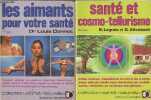
"Lot de 2 livres de la collection ""Santé naturelle"" : Les aimants pour votre santé + Santé et cosmo-tellurisme"
Dangles. 1985-88. In-12. Broché. Etat d'usage, Coins frottés, Dos abîmé, Intérieur acceptable. 162 + 138 pages - nombreuses photos et illustrations en noir et blanc dans et hors texte. Dos pliés, frottés. Coins frottés.. . . . Classification Dewey : 530-Physique
Classification Dewey : 530-Physique
Solubles ou Insolubles.
PAUL-MARTIAL. 1926. In-12. Broché. Bon état, Couv. légèrement passée, Dos satisfaisant, Intérieur acceptable. 96 pages. Quelques planches de photos en noir et blanc. Quelques pages non coupées.. . . . Classification Dewey : 530-Physique
Les Cahiers Médicaux. Classification Dewey : 530-Physique
Leçons sur la Résistance des Matériaux. TOME I
EYROLLES Léon. 1935. In-8. Relié demi-cuir. Etat d'usage, Couv. convenable, Dos frotté, Intérieur frais. 758 pages. Nombreuses figures dans le texte. Pièce de titre rouge. Titre et roulettes dorés sur le dos cuir marron. Texte en police style manuscrit.. . . . Classification Dewey : 530-Physique
Encyclopédie Industrielle et Commerciale. Classification Dewey : 530-Physique

