 Write to the booksellers
-
Type
Autograph (1)
Book (1623)
Magazine (2)
-
Latest
Last month (24)
Last week (5)
-
Century
17th (1)
18th (3)
19th (47)
20th (483)
21st (49)
-
Countries
Belgium (1171)
Canada (4)
Côte d'Ivoire (3)
France (175)
Switzerland (273)
-
Syndicate
ALAC (4)
CNE (1)
ILAB (52)
NVVA (2)
SLACES (2)
SLAM (26)
"Quoi ? Quand ? Comment ?; la recherche musicale. Collection : Musique/Passé/Présent."
Paris, Christian Bourgois Editeur, 1985. 14 x 22, 296 pp., broché, bon état.
"Textes réunis et présentés par Tod Machover; traduction de Denis Collins, Emmanuel Gresset, Patrick Greussay, Martin Kaltenecker, Monique Lebailly et Tod Machover."
"Quoi ? Quand ? Comment ?,; la recherche musicale. Collection : Musique/Passé/Présent."
Paris, Christian Bourgois, 1985. 14 x 23, 296 pp., broché, très bon état.
"Textes réunis et présentés par Tod Machover; traduction par Collins Dennis, Emmanuel Gresset, et autres."
Catalogue descriptif et analytique du Musée Instrumental du Conservatoire royal de musique de Bruxelles. Quatrième volume, 1e livraison (nos. 2056 à 2229)
Gand, Ad. Hoste 1909 85pp., 20cm., brochure originale, bon état, M101926
Catalogue descriptif et analytique du Musée Instrumental du Conservatoire royal de musique de Bruxelles. Deuxième volume (nos. 577 à 1321)
Gand, Ad. Hoste 1909 vi + 521pp., avec illustrations et exemples de musique dans le texte, 20cm., brochure originale, la plupart des pages toujours non coupées, bon état, M101928
Catalogue descriptif et analytique du Musée Instrumental du Conservatoire royal de musique de Bruxelles. Cinquième volume (nos. 2962 à 3300)
Bruxelles, Lombaerts 1922 vii + 236pp., avec illustrations et exemples de musique dans le texte, 20cm., brochure originale (dos peu restauré), qqs. rousseurs, sinon en bon état, M101929
Puccinis musikalische Formgebung, untersucht an der Oper 'La Bohème'
Neustadt, 1934 90pp., 22cm., text in German in Gotic script, Doctoral Dissertation (Inaugural-Dissertation zur Erlangung der Doktorwürde der hohen philosophischen Fakultät der Friedrich-Alexanders-Universität zu Erlangen), softcover, stamp at verso of title page, text is clean and bright, M113471
Die aus frühen böhmischen Quellen überlieferten Piae Cantiones-Melodien
Jyvaskyla, 1964 176pp. With music examples + 2 foldings plates, 25cm., text in German, published in the series "Studia Historica Jyvaskylaensia" II, Doctoral Dissertation, stamp at verso of title page, text and interior are clean and bright, good condition, M109020
Beethoven the European. Transcultural Contexts of Performance, Interpretation and Reception
, Brepols, 2023 Hardback, xix + 410 pages, Size:210 x 270 mm, Illustrations:27 b/w, 71 musical examples, Language: English. ISBN 9782503602905.
Summary Beethoven's music, stemming from its 18th- and 19th-century European context, communicates values of the Enlightenment bearing a seemingly universal, timeless significance. More than a quarter millenium after his birth, a 21st-century perspective offers a timely opportunity ? against a backdrop of the reconfiguration of Europe and tensional power shifts across continents ? to explore ways in which notions of European ideals impacted the works of Beethoven and his contemporaries and which social-political contexts shaped its reception. The essays in this volume offer cutting-edge research shedding new light on varied aspects of Beethoven's music, and the ways it has been adapted and adopted by the musical world up to the present-day. Foremost international experts and younger scholars, gathered together with the editors William Kinderman and Malcolm Miller, share insights about Beethoven reception both within and beyond Europe, covering France, Italy, Britain, Spain, the USA and Japan. Innovative contextual studies consider topics on criticism and interpretation, performance and publication, and a variety of less familiar personalities, institutions and performing organisations. Studies of individual works illuminate Beethoven's well-known masterpieces through novel, sometimes polemical, contextual and analytical frameworks. The volume as a whole celebrates Beethoven's genius as European and global, marking a fascinating turning-point between the particular and the universal. TABLE OF CONTENTS Malcolm Miller - William Kinderman Preface Politics, Aesthetics and Ideology William Kinderman Beethoven's Ninth Symphony as a Disputed Symbol of Community: From Thomas Mann's Doktor Faustus to the Brexiteers of 2019 Michael Christoforidis - Peter Tregear Beethoven, the Congress of Verona, and the Concert of Europe in 1822/1823 David B. Dennis Beethoven's 100th Todestag in 1927: Ideological Battles over the Composer and His Music in Weimar Political Culture Sanna Iitti Patriotism and Islam in Ludwig van Beethoven's The Ruins of Athens, Op. 113, and King Stephen, Op. 117 Arabella Pare Beethoven as a Transnational Composer: Straßenmusik, Verbunkos and the Trio Op. 11 'Gassenhauer' Susan Cooper Beethoven, His Circle and Horace Reception across Europe and beyond María Encina Cortizo - Ramón Sobrino Interpreting Beethoven in Spain in the 19th Century: The Arrival of His Symphonic Music to a Nascent Concert Life Chiara Sintoni Ludwig van Beethoven and His Reception in Piano Methods of the First Half of the 19th Century Frédéric de La Grandville Who Are You, Mr Bethowen? David Hurwitz Beethoven's French Liturgical Organ Music - No, Really David Rowland Further Light on Clementi's 1807 Contract with Beethoven Mai Koshikakezawa Beethoven's 'Moonlight' Sonata and the Japanese Reception of Western Music Alison Minkus Reception and Reflection of Beethoven's Works at the Philharmonic Society of New York (1842-1892) Performance and Analysis Barry Cooper Performing Beethoven's Vocal Music in the 21st Century Ned Kellenberger Beethoven's Violin Concerto Opus 61: Toward Performance of Alternate Solo Violin Parts Malcolm Miller Beethoven's Registral Structures and Strategies of Transcendence in the Late Piano Sonatas Eftychia Papanikolaou Uwe Scholz's Choreographic Conception of Beethoven's Seventh Symphony Peng Du Krol The Whimsical Character of Beethoven's Salieri Piano Variations, WoO 73 (1799) Abstracts and Biographies Index of Names
Lettres à Alma.
Paris, Editions Francis Van De Velde, 1979. 15 x 23, 213 pp., quelques illustrations en N/B, broché, bon état.
Textes et traduction par M. et R. D'asfeld.
Rameau. Collection : Solfèges, Microcosme, N° 18.
Paris, Editions du Seuil/Microcosme, 1980. 12 x 18, 191 pp., nombreuses illustrations en N/B, notations musicales, broché, très bon état.
Des musiques de jazz. Collection : Epistrophy.
Roquevaire, Editions Parenthèses, 1983. 15 x 24, 203 pp., broché, couverture à rabats, très bon état.
Préface de Michel P. Philippot.
Histoire du jazz et de la musique afro-américaine. Collection : 10-18, N° 1085.
Paris, Union Général d'Editions/10-18, 1976. 11 x 18, 314 pp., broché, très bon état.
Histoire du jazz moderne. Collection : L'Ordre du jour.
Paris, La Table Ronde, 1961. 14 x 20, 258 pp., reliure rexine rouge, très bon état.
Reliure très solide et en parfait état.
Les maîtres du jazz. Collection : Que sais-je ?, N° 548.
Paris, Presses Universitaires de France (PUF), 1962. 11 x 17, 128 pp., broché, très bon état .
Le jazz. Collection : Que sais-je ?, N° 2392.
Paris, Presses Universitaires de France (PUF), 1987. 11 x 17, 125 pp., broché, très bon état .
Des musiques de Jazz
1983 Editions Parenthèses, Collection Epistrophy - 1983 - In-8 broché avec couverture rempliée - 204 pages
Bon état. Petite mouillure brune sur la tranche latérale.
L'art de chant. Collection : Que sais-je ?, N° 1366.
Paris, Presses Universitaires de France (PUF), 1969. 12 x 18, 126 pp., broché, très bon état.
La musique populaire hongroise et ses instruments
Budapest, Corvina 1969 78pp. + 48 planches hors-texte dont 16 en couleurs, 20cm., reliure cart. illustrée d'éditeur, bon état, dans la série "Art populaire hongrois" tome 2, M94859
The nuclear theme as a determinant of Patet in Javanese Music.
Groningen, Djakarta: J. B. Wolters, 1954 in-8, xi-324 pages, 18 ills. h.-t. Index. Broché, lég. défr. sinon bel exemplaire.
The nuclear theme as a determinant of Patet in Javanese Music. (Groningen, Djakarta: J. B. Wolters, 1954). [M.C.: Indonésie, musique, musicologie, ethnomusicologie]
Maurice Ravel et son oeuvre.
Paris, A. Durand et Fils, 1914. 14 x 20, 49 pp., quelques planches et tableaux, broché, état moyen (couverture défraîchie).
Basso Continuo in Italy. Sources, Pedagogy and Performance
, Brepols, 2023 Hardback, xxx + 345 pages, Size:210 x 270 mm, Illustrations:30 b/w, 70 musical examples, Language(s):English, Italian. ISBN 9782503608501.
Summary The volume explores the long-lasting phenomenon of basso continuo in the Italian peninsula, from its origins ? i.e. from the «regole per suonare sopra il basso» which collects and develops the contrappunto alla mente's legacy ? up to the late partimento pedagogy. In addition to a bibliographic update, the volume presents case studies providing the reader with new information on performative contexts and performance practice between the sixteenth and nineteenth centuries, and shedding new lights on sacred and secular genres and repertoires cultivated in churches, theatres, academies, noble chambers and domestic environments. Particular attention is given to the relationship between counterpoint, improvisation and instrumentation, to the analysis of primary sources in relation to book formats and the type of notation chosen to convey the accompaniment. Furthermore, a few chapters focus on peculiar issues of accompaniment pedagogy according to unpublished or neglected sources. TABLE OF CONTENTS Marcello Mazzetti, Introduction Performance Practice Issues: Stylistic Features and Historical Contexts 1. Naomi Matsumoto, Realising Arianna: The Problematic Accompaniments of Claudio Monteverdi's «Lamento d'Arianna» 2. Galliano Ciliberti, La pratica del basso continuo a S. Luigi dei Francesi a Roma nel Seicento 3. Giulia Nuti, Antonio Vivaldi's Use of Figures: «Per li coglioni» and Other Examples Sources, Formats, and Accompaniment Layout: Stylistic Features and Historical Contexts 4. Augusta Campagne, Basso Continuo: The Beginnings in Italy 5. Thomas Neal, Between Practice and Print: Performing Palestrina's «Missarum liber quartus» (1582) with Alessandro Nuvoloni's «basso prencipale co'l soprano» (1610) 6. Marina Toffetti, Fossil Traces of Vanished Voices: The Basso Continuo Part and the Reconstruction of Incomplete Polyphony 7. Marcos Krieger, Figured Bass and Figured Melody: Printed Figures in Italian Continuo Sources and Idiosyncratic Continuo Notation Practices as Found in Three 17th Century Italian Prints The Accompaniment between Pedagogy and Performance 8. Catherine Bahn - Giovanna Barbati, The Partimenti of Rocco Greco: Reconstructing the Pedagogical Tradition for the Early Violoncello 9. Peter van Tour, The Teaching of Counterpoint and Partimento in the School of Francesco Feo 10. Eric Boaro, Partimento Teaching at the Convent of Santi Marcellino e Festo in Naples: New Early Eighteenth-Century Sources of Realisations of Partimenti by Francesco Durante (c. 1707-1715) 11. Marco Pollaci, Vincenzo Bellini's «Studio del Contrappunto» Notebook: An Investigation of a New Source of Partimento and Counterpoint in Early Nineteenth-Century Italy Fundamental Issues: Counterpoint, Improvisation and Instrumentation 12. Edoardo Bellotti, Basso continuo e contrappunto nelle fonti seicentesche: un moderno approccio alla didattica musicale 13. Livio Ticli, «Contrapunto alla mente» or Basso Continuo? Agostino Agazzari and His «Sonare sopra'l Basso» Abstracts and Biographies Index of Names
Body in Musical Performance Knowledge, Gesture, and Identity.
, Brepols - Harvey Miller, 2026 Hardback,Pages: xx + 276 p.,Size:210 x 270 mm, Illustrations:19 b/w, 5 tables b/w., 22 musical examples Language(s):English. ISBN 9782503621920.
Summary This volume offers a groundbreaking exploration of musical embodiment across time, geography, and genre, bringing together thirteen essays that reframe the performing body as a site of knowledge, creation, and critical reception. From early modern opera to nineteenth-century improvisation, from experimental multimedia theatre to contemporary performance analysis, the contributors reveal how gesture, physical technique, proprioception, and symbolic constructions of the body shape, and are shaped by, musical meaning. Uniting historically grounded inquiry with performance theory and cognitive approaches, the essays cluster around four main axes: the embodiment of musical meaning in the interaction between performer and listener; the body as cultural and ideological construct in gendered, stigmatised, and national identities; the transmission and reactivation of embodied knowledge in historical performance; and the creative body as agent in composition, pedagogy, and ritual. Drawing on sources as diverse as early wax-cylinder recordings, liturgical chant, zarzuela reviews, and postwar ballet-opera hybrids, the volume foregrounds embodiment as both material and epistemic. Rather than treating the body as an expressive vehicle alone, these essays demonstrate that musical works themselves ? whether composed, improvised, or remembered ? are shaped through the performer?s somatic intelligence and the listener?s imaginative co-presence. With contributions from leading scholars and practitioner-researchers, this collection sets a new standard for interdisciplinary studies of musical performance. It will be essential reading for musicologists, performers, theorists, and historians of the body seeking to understand how music happens in and through the body, across eras and expressive systems. TABLE OF CONTENTS Bodies, Meanings, and Musical Knowledge: An Introduction Marcello Mazzetti I. Embodiment and Musical Meaning: From Performer to Listener The Role of Embodiment in Forming Aesthetic Judgements of Musical Recordings Hamish Robb Embodying Puccini?s Manon Lescaut, Based on Lived-Experience Interviews with International Interpreters Sandra Oman Farren «[?] any unnecessary movement was discouraged»: Bodily Gesture and the Ideology of Artistic Autonomy in Early Twentieth-Century Pianists Luís Bastos Machado Richard Strauss?s Lieder in ?Song-Ballets? Choreographed by Eliot Feld Wayne Heisler Jr. II. Embodied Identities: Gender, Stigma, Nationality The Stigma of Castration: Medicine, Sex and Women in the Life of the Singer Carlo Broschi Farinelli Daniel Martín Sáez Body, Music and the Stage: The Role of Corporality in the Shows at the Teatro Apolo in Madrid (1890?1913) Jonathan Mallada Álvarez Boccherini and the ?Spanish Body?: Reflections on Popular Dance and National Identity Aurèlia Pessarrodona III. Historical Embodiment: Transmission, Performance, Recording (Re)constructing Julius Block: Embodied Responses to Early Recordings Inja Stanovi? Embodiment and Disembodiment in Musical Sources of the 17th and 18th Centuries Berthold Over IV. Creating through the Body: Pedagogy, Improvisation, Dramaturgy The Art of Preluding: Body and Technique in Nineteenth-Century Piano Improvisation Roberto Cornacchioni Alegre Roman Vlad, Carla Fracci, and the Dancing Body Antonella Manca From the Body and to the Body: Performativity and Sensory Experience from Liturgical Rites to the Cantigas de Santa Maria Maria Incoronata Colantuono Abstracts and Biographies Index of Names
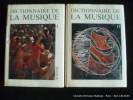
Dictionnaire de la musique. En 2 volumes.
Paris, Bordas, 1990, in-4, Relié-Jaquette éditeur, 1200 pages. Bon état.
Histoire de la musique moderne et des musiciens célèbres en Italie, en Allemagne et en France depuis l'ère chrétienne jusqu'à nos jours.
Paris, Sandoz et Fischbacher, 1876. "14 x 22, 512 pp., 22 planches, reliure dos cuir, bon état (reliure : dos en très bon état, bords et coins émoussés; rousseurs sur les toutes premières pages)."
Erasme et la musique
Paris, Vrin 1965 139pp. + 8 planches hors-texte, 25cm., brochure originale, dans la série "De Pétrarque à Descartes" volume IX, pages pour la plupart non coupées, bon état, M100806

