 Write to the booksellers
-
Type
Book (7245)
Disk (45)
Drawings (1)
Engraving (9)
Magazine (89)
Maps (4)
Music sheets (135)
New book (2)
Old papers (1)
Photographs (19)
Posters (1)
-
Latest
Last 3 days (2)
Last month (866)
Last week (109)
-
Language
Czech (1)
Dutch (9)
English (156)
French (7372)
German (4)
Italian (2)
Latin (3)
Russian (4)
-
Century
16th (16)
17th (43)
18th (196)
19th (878)
20th (2477)
21st (1562)
-
Countries
Belgium (1156)
Canada (32)
China (56)
Côte d'Ivoire (7)
Denmark (1063)
France (4887)
Germany (1)
Netherlands (181)
Switzerland (155)
United Kingdom (9)
United States of America (4)
-
Syndicate
ALAC (25)
CLAM (25)
CLAQ (2)
ILAB (2236)
NVVA (15)
SLACES (15)
SLAM (1028)
SNCAO (4)
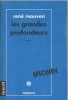
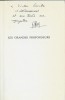
Les Grandes Profondeurs. ( Avec cordiale dédicace de René Reouven ).
Editions Denoël / Collection " Présences " 1991. In-8 broché de 234 pages au format 14 x 20,5 cm. Couvertures bleues avec titre imprimé en noir. Dos carré. Plats et intérieur frais. Exemplaire du service de presse noté " Spécimen " au 1er plat. Excellent roman de science-fiction où une machine matérialisant les pensées, permet à Jack L'Eventreur - Jack the Ripper de prendre vie...Superbe état, proche du parfait. Edition originale enrichie d'une belle dédicace autographe, signée, de l'auteur. ( Collection personnelle ).
Vente exclusivement par correspondance. Le libraire ne reçoit, exceptionnellement que sur rendez-vous. Il est préférable de téléphoner avant tout déplacement.Forfait de port pour un livre 10 € sauf si épaisseur supérieure à 3 cm ou valeur supérieure ou égale à 100 €, dans ce cas expédition obligatoire au tarif Colissimo en vigueur. A partir de 2 livres envoi en colissimo obligatoire. Port à la charge de l'acheteur pour le reste du monde.Les Chèques ne sont plus acceptés.Pour destinations extra-planétaire s'adresser à la NASA.Membre du Syndicat Lusitanien Amateurs Morues
( Jack l'éventreur - Jack the Ripper ) - Claude Ferny sous le pseudonyme de Peter Marsh.
Reference : 7121
(1956)
J'étais Jack l'Eventreur.
Editions Métal 1956. In-12 broché de 189 pages au format 11 x 18 cm. Couverture illustrée par Grèl Gardon. Dos bien carré. Plats et intérieur frais, malgré d'infimes frottis aux coins. Edition originale en superbe état, proche du parfait, du meilleur roman écrit à ce jour sur Jack l'éventreur. De toute rareté, surtout aussi frais.

Vente exclusivement par correspondance. Le libraire ne reçoit, exceptionnellement que sur rendez-vous. Il est préférable de téléphoner avant tout déplacement.Forfait de port pour un livre 10 € sauf si épaisseur supérieure à 3 cm ou valeur supérieure ou égale à 100 €, dans ce cas expédition obligatoire au tarif Colissimo en vigueur. A partir de 2 livres envoi en colissimo obligatoire. Port à la charge de l'acheteur pour le reste du monde.Les Chèques ne sont plus acceptés.Pour destinations extra-planétaire s'adresser à la NASA.Membre du Syndicat Lusitanien Amateurs Morues
( Jack l'éventreur - Jack the Ripper - Jules Verne - Alexandre Dumas - Thomas de Quincey - Pastiches ) - René Reouven - Guillaume Sorel.
Reference : 9890
(2005)
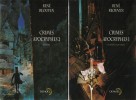
Intégrale " Crimes Apocryphes ", tome 1 et 2.
Editions Denoël / Collection " Lunes d'Encre " 2005. Deux forts in-8 brochés de 674 et 708 pages au format 14 x 3,5 x 20,5 cm, chacun. Superbes couvertures illustrées par Guillaume Sorel. Dos carré. Plats et intérieur frais. Intégrale de tous les romans " pastiches " de René Reouven. Tome 1 : Tobie or not Tobie - Le Grand Sacrilège - Un fils de Prométhée - Les Confessions d'un Enfant du Crime - Le Rêveur des Plaines ( Western fantastique inédit ) - Tome 2 : Les Grandes Profondeurs ( Jack l'Eventreur ) - Voyage au Centre du Mystère ( Jules Verne ) - Le Cercle de Quincey ( Thomas de Quincey ) - 4 : Souvenez-vous de Monte-Cristo ( Alexandre Dumas ). Bibliographie et préface par Jacques Baudou. Edition originale collective en état, proche du neuf.
Vente exclusivement par correspondance. Le libraire ne reçoit, exceptionnellement que sur rendez-vous. Il est préférable de téléphoner avant tout déplacement.Forfait de port pour un livre 10 € sauf si épaisseur supérieure à 3 cm ou valeur supérieure ou égale à 100 €, dans ce cas expédition obligatoire au tarif Colissimo en vigueur. A partir de 2 livres envoi en colissimo obligatoire. Port à la charge de l'acheteur pour le reste du monde.Les Chèques ne sont plus acceptés.Pour destinations extra-planétaire s'adresser à la NASA.Membre du Syndicat Lusitanien Amateurs Morues
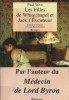
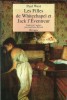
Les Filles de Whitechapel et Jack l'Eventreur.
Editions Rivages 1991. Fort in-8 broché de 410 pages au format 14,5 x 22 cm. Superbe couverture illustrée à rabats. Dos carré. Plats et intérieur frais. Complet de la rare bande annonce. Un des meilleurs romans, jamais écrits sur Jack L'Eventreur. Edition originale en superbe état général.
Vente exclusivement par correspondance. Le libraire ne reçoit, exceptionnellement que sur rendez-vous. Il est préférable de téléphoner avant tout déplacement.Forfait de port pour un livre 10 € sauf si épaisseur supérieure à 3 cm ou valeur supérieure ou égale à 100 €, dans ce cas expédition obligatoire au tarif Colissimo en vigueur. A partir de 2 livres envoi en colissimo obligatoire. Port à la charge de l'acheteur pour le reste du monde.Les Chèques ne sont plus acceptés.Pour destinations extra-planétaire s'adresser à la NASA.Membre du Syndicat Lusitanien Amateurs Morues
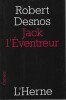
Jack l'éventreur.
Editions de l'Herne / Collection Carnets 2009. In-16 broché de 44 pages au format 16,5 x 11 cm. Couverture à rabats avec titre imprimé. Dos carré. Plats et intérieur frais. Textes et articles consacrés à Jack l'éventreur, publiés à l'origine dans les Cahiers de L'Herne Robert Desnos n° 54 de 1987. Edition originale, séparée, en état de neuf.
Vente exclusivement par correspondance. Le libraire ne reçoit, exceptionnellement que sur rendez-vous. Il est préférable de téléphoner avant tout déplacement.Forfait de port pour un livre 10 € sauf si épaisseur supérieure à 3 cm ou valeur supérieure ou égale à 100 €, dans ce cas expédition obligatoire au tarif Colissimo en vigueur. A partir de 2 livres envoi en colissimo obligatoire. Port à la charge de l'acheteur pour le reste du monde.Les Chèques ne sont plus acceptés.Pour destinations extra-planétaire s'adresser à la NASA.Membre du Syndicat Lusitanien Amateurs Morues
( Jack l'éventreur - Jack the Ripper - Sherlock Holmes ) - Stéphane Bourgoin - André de Lorde et Pierre Chaine - Jean Petithuguenin - Ray Russel - Kay Rogers - Hugh Reid - William F.Nolan.
Reference : 19720
(1998)
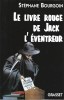
Le Livre rouge de Jack l'Eventreur. Avec 9 nouvelles inédites : " Dossiers secrets du Roi des Détective, Jack L'Eventreur " - Jack l'Eventreur - Dans l'Abattoir - Le Démon Spirite - Ethel King: Jack l'Eventreur, le Tueur de Femmes - Love Story - Dulcie - Sagittaire - Le Retour de Jack l'Eventreur.
Editions Bernard Grasset & Fasquelle 1998. In-8 broché de 386 pages au format 24 x 15,5 cm. Couverture illustrée par Christian Baude. Dos carré. Plats et intérieur frais. Excellente étude de 144 pages suivie de 9 textes inédits de fiction consacrés à jack l'Eventreur, de 2 importantes bibliographies et d'une filmographie commentée. Dossier de photos d'époque au milieu du livre. L'intérêt principal de cet ouvrage réside dans les 9 nouvelles, réunies. On y trouve pour la première fois réédité le texte du mythique 16 ème fascicule des " Dossiers secrets du Roi des Détective, Jack L'Eventreur ", paru en 1908 chez Fernand Laven et qui est le premier pastiche Holmésien à opposer Sherlock Holmes à Jack l'Eventreur !, ainsi que la pièce du Grand-Guignol datant de 1934 : " Jack l'Eventreur " par André de Lorde et Pierre Chaine. Contient aussi : Dans l'Abattoir ( anonyme, 1891 ) - Le Démon Spirite ( Hume Nisbet, 1894 ) - Ethel King ; Jack l'Eventreur, le tueur de femmes ( Jean Petithuguenin, 1912 ) - Love Story ( Kay Rogers, 1951 ) - Dulcie ( Hugh Reid, 1963 ) - Sagittaire ( Ray Russell, 1967 ) - Le Retour de Jack l'Eventreur ( William F.Nolan, 1985 ). Edition originale en état de neuf.
Vente exclusivement par correspondance. Le libraire ne reçoit, exceptionnellement que sur rendez-vous. Il est préférable de téléphoner avant tout déplacement.Forfait de port pour un livre 10 € sauf si épaisseur supérieure à 3 cm ou valeur supérieure ou égale à 100 €, dans ce cas expédition obligatoire au tarif Colissimo en vigueur. A partir de 2 livres envoi en colissimo obligatoire. Port à la charge de l'acheteur pour le reste du monde.Les Chèques ne sont plus acceptés.Pour destinations extra-planétaire s'adresser à la NASA.Membre du Syndicat Lusitanien Amateurs Morues
( Jack l'éventreur - Jack the Ripper - Sherlock Holmes ) - Stéphane Bourgoin - André de Lorde et Pierre Chaine - Jean Petithuguenin - Ray Russel - Kay Rogers - Hugh Reid - William F.Nolan.
Reference : 31334
(1998)
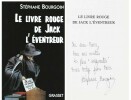
Le Livre rouge de Jack l'Eventreur. Avec 9 nouvelles inédites : " Dossiers secrets du Roi des Détective, Jack L'Eventreur " - Jack l'Eventreur - Dans l'Abattoir - Le Démon Spirite - Ethel King: Jack l'Eventreur, le Tueur de Femmes - Love Story - Dulcie - Sagittaire - Le Retour de Jack l'Eventreur. ( Avec belle dédicace de Stéphane Bourgoin ).
Editions Bernard Grasset & Fasquelle 1998. In-8 broché de 386 pages au format 24 x 15,5 cm cm. Couverture illustrée par Christian Baude. Dos carré. Plats et intérieur frais. Excellente étude de 144 pages suivie de 9 textes inédits de fiction consacrés à jack l'Eventreur, de 2 importantes bibliographies et d'une filmographie commentée. Dossier de photos d'époque au milieu du livre. L'intérêt principal de cet ouvrage réside dans les 9 nouvelles, réunies. On y trouve pour la première fois réédité le texte du mythique 16 ème fascicule des " Dossiers secrets du Roi des Détective, Jack L'Eventreur ", paru en 1908 chez Fernand Laven et qui est le premier pastiche Holmésien à opposer Sherlock Holmes à Jack l'Eventreur !, ainsi que la pièce du Grand-Guignol datant de 1934 : " Jack l'Eventreur " par André de Lorde et Pierre Chaine. Contient aussi : Dans l'Abattoir ( anonyme, 1891 ) - Le Démon Spirite ( Hume Nisbet, 1894 ) - Ethel King ; Jack l'Eventreur, le tueur de femmes ( Jean Petithuguenin, 1912 ) - Love Story ( Kay Rogers, 1951 ) - Dulcie ( Hugh Reid, 1963 ) - Sagittaire ( Ray Russell, 1967 ) - Le Retour de Jack l'Eventreur ( William F.Nolan, 1985 ). Edition originale en état de neuf. Précieux exemplaire enrichi d'une belle dédicace autographe, signée, de Stéphane Bourgoin.
Vente exclusivement par correspondance. Le libraire ne reçoit, exceptionnellement que sur rendez-vous. Il est préférable de téléphoner avant tout déplacement.Forfait de port pour un livre 10 € sauf si épaisseur supérieure à 3 cm ou valeur supérieure ou égale à 100 €, dans ce cas expédition obligatoire au tarif Colissimo en vigueur. A partir de 2 livres envoi en colissimo obligatoire. Port à la charge de l'acheteur pour le reste du monde.Les Chèques ne sont plus acceptés.Pour destinations extra-planétaire s'adresser à la NASA.Membre du Syndicat Lusitanien Amateurs Morues
De theoremate Abeliano observatio.
Berlin, G. Reimer, 1832. 4to. Without wrappers. Extracted from ""Journal für die reine und angewandte Mathematik. Hrsg. von A.L. Crelle"", 9. Bd. pp. 99-104.
First printing.

Sur la rotation d'un corps.
(Berlin, Georg Reimer, 1850). 4to. Later marbled wrappers. In ""Journal für die reine und angewandte Mathematik, 39. Band, 24 Heft. Jacobi's paper takes up the whole issue . pp. 293-350.
First printing of main paper in Rigic Body Dynamics, where Jacobi studied the motion of a top and derived the analytic solution for the motion of a free body and defined the so-called ""Jacobi analytic functions"". The problem was first treated by Leonhard Euler in 1758 in the case where the fixed point is the centre of gravity of the top, but it was Jacobi who first solved the problem completely, making use of elliptic functions which he himself had introduced.
"JACOBI, C.G.J. - PAVING THE WAY FOR DOUBLE PERIODIC FUNCTIONS.
Reference : 41885
(1835)
De functionibus duarum variabilium quadrupliciter periodicis, quibus theoria transcendentium Abelianarum innititur.
(Berlin, G. Reimer, 1835) 4to. No wrappers as extracted from""Journal für die reine und angewandte Mathematik. Hrsg. von A.L. Crelle"", Bd. 13. Jacobi's paper: pp. 55-78.
First appearance of an importent paper on the functions of a complex variable.In an importent paper of 1835 (the item offered) Jacobi showed that a single-valued function of a single variable which for every finite value of the argument has the character of a rational function (that is, is a meromorphic function) cannot have more than two periods, the ratio of the periodics is necessarily a nonreal number. This discovery opened up a new direction of work, namely, the problem of finding all double periodic functions."" (Morris Kline).
Le Nom
Liège A la lampe d'Aladdin 1926 In-12 Broché Ed. originale
Edition originale tirée à 396 exemplaires numérotés. Un des 300 sur vergé baroque thé. Très bon 0
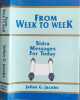
From Week to Week: Sidra Messages for Today
The Aviva Press 1992 344 pages in8. 1992. Reliure Editeur avec jaquette. 344 pages. From Week to Week: Sidra Messages for Today est un livre de Julian G. Jacobs publié par The Aviva Press en 1992. Il s'agit d'un recueil de commentaires ou messages basés sur les sidras (lectures hebdomadaires de la Torah) destiné à un public anglophone intéressé par la spiritualité juive
Très bon état
Jacques Cartier
ANCRE DE MARINE 2000 228 pages 2x22x16cm. 2000. Broché. 228 pages.

Très bon état intérieur propre bonne tenue
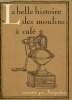
La belle histoire des moulins à café.
Promos-Paris. non daté. In-12. Broché. Etat d'usage, Couv. convenable, Agrafes rouillées, Intérieur acceptable. Fascicule de 24 pages agrafées - quelques figures en couleurs et en noir et blanc dans le texte.. . . . Classification Dewey : 633.7-Plantes alcaloïdes (tabac, thé, cacao, café, pavot)
Classification Dewey : 633.7-Plantes alcaloïdes (tabac, thé, cacao, café, pavot)

aurige et les chasseurs, Chef-d'oeuvre d'orfevrerie antique, The charioteer and the hunters, a masterpiece of ancient silversmithing.
Switzeland , Chaman , 2007 Bound in hardcover, illustrated. ISBN 2970043548.
very fine condition of this rare book.
Jacques Chiquet Le Nouveau et Curieux Atlas Geographique et Historique.
Reference : 22872
(1719)
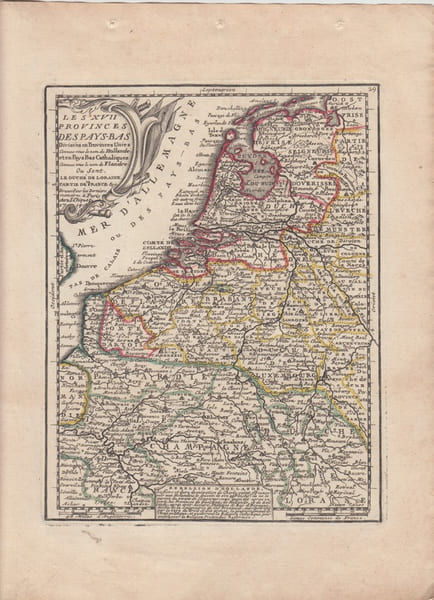
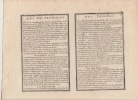
LES XVII PROVINCES DES PAYS BAS divisées en Provinces unies connues sous le nom de Hollande et en Pays Bas catholiques connues sous le nom de Flandres ou sont le duché de Lorraine partie de France,Dressée suivant les derniers memoires.Carte gravée d'époque coloris époque avec feuillet de texte imprimé joint .The 17 provinces of the Low Countries,extrait du Nouveau et Curieux Atlas Geographique et Historique.
1719 Nouveau et Curieux Atlas Geographique et historique., c.1719.. The 17 provinces of the Low Countries. Copper engraving. Original colour with later additions. Fine condition, good margins. 16.5 x 21.5 cm. (6? x 8? inches) Map of Holland, Belgium and northern France, with provinces in outline cartouche at top left, short historical text at lower centre. In the early eighteenth century, French cartography overtook the Dutch in terms of accuracy and design. Chiquet's delightful Nouveau et Curieux Atlas was typical product of the time
Cartographe :Jacques ChiquetNé en 1673 à Paris et Mort dans cette même Ville en 1721, Est un Graveur Editeur et Marchand d'Estampes Français, il Publiera en 1719 Le Nouveau et Curieux Atlas Géographique et Historique, Destiné à un Public Riche Dont Cette Carte est Tirée. Remise de 20% pour toutes commandes supérieures à 200 €
Jacques DEMOUGIN Alain-Gérard Slama Jean-Michel Gaillard Jean-François Chanet Paul Vannier Jean-Pierre Debaere Daniel Meiller
Reference : 500046805
(1999)
ISBN : 9782080126566
L'ABCDaire de l'école de la France
Flammarion 1999 119 pages 12 2x0 8x21 8cm. 1999. Broché. 119 pages.
Très bon état - légères marques de lecture et/ou de stockage mais du reste en très bon état- expédié soigneusement depuis la France
Jacques Louis Nyst - Catalogue raisonn tabli par un homme distrait/Een beredeneerd catalogus samengesteld door een verstrooid man.
Brussel, Vereniging voor Tentoonstellingen van het Paleis voor Schone Kunsten te Brussel, 1977 Oorspronkelijk uitgevers omslag, oblong, Met teksten van Jacques Louis Nyst in het Frans en Nederlands en zwart-witfoto's en video's / genummerd.
Vroege uitgave van Jacques Louis Nyst, uitgegeven ter gelegenheid van een tentoonstelling in het Paleis voor Schone Kunsten te Brussel in 1977 in een oplage van 500 genummerde exemplaren. Dit exemplaar is genummerd N 440.
Jacques Theys Christian Du Tertre Felix Rauschmayer
Reference : 500136695
(2010)
ISBN : 9782815900423
Le Développement durable la seconde étape
Editions de l'Aube 2010 240 pages 12 4x1 8x18 2cm. 2010. Broché. 240 pages. Exemplaire de bibliothèque déclassé
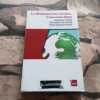
Etat correct
Changer ou disparaître : Plan pour la survie
Fayard 1972 in8. 1972. Broché.
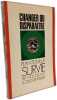
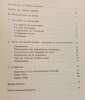
couverture défraîchie intérieur propre
"(JAILLOT, A.H.) - SEA-CHART OF THE ESTUARY OF THE THAMES FROM ""LE NEPTUNE FRANCOIS"".
Reference : 16120
(1693)
Carte de L'Entrée de la Tamise. Avec les Bancs, Passes, Isles et Costes comprises entre Sandwich et Clay. (No place, no date (1693)).
Large engraved seechart, measuring 46 x 89 cm. in original outline colouring. The chart showing the South-east coast of England from Sandwich to Clay. With inset view of The Thames between London and Greane Island. A fine impression on good thick paper with watermark: BYCOLUMBIER. Folded down the center.
The ""Neptune Francois"" was published in 1693, and its charts are larger and more lavishly decorated than those of any preceding book of its kind. This chart is without year, place and ""par Ordre du Roi"", pointing to a later issue, but issued from the original copperplate. It is also without ""Imprimerie Royale"" belonging to the imprints from 1792. Koeman IV,425:8.
"(JAILLOT, A.H.) - SEA-CHART OF THE NORTHERN PART OF SCOTLAND, IRELAND, ORKNEY ISLANDS, FAROE ISLANDS, SHETLAND FROM ""LE NEPTUNE FRANCOIS"".
Reference : 16116
(1693)
Carte de la Mer D'Ecosse contenant les Isles et Costes Septentrionale et Occidentales D'Ecosse et les Costes Septentrionale D'Irlande.
(No place, no date(1693)). Very large engraved seechart, measuring 60 x 86,5 cm. in original outline colouring. The chart showing the Northern part of England from Lancaster to Banf, of Ireland from Blackrock to Carlingford and all the Islands to the north: Shetland, Orkney, Faroe etc. etc. A fine impression on good thick paper with the watermark: BYCOLUMBIER. Folded down the center.
The ""Neptune Francois"" was published in 1693, and its charts are larger and more lavishly decorated than those of any preceding book of its kind. The chart is without year, place and ""par Ordre du Roi"", pointing to a later impression, but issued from the original copperplate. It is also without ""Imprimerie Royale"" belonging to the imprints from 1792. Koeman IV,425:9.
"(JAILLOT, A.H.) - SEA-CHART OF THE WESTCOAST OF IRELAND FROM ""LE NEPTUNE FRANCOIS"".
Reference : 16118
(1693)
Carte Particuliere des Costes Occidentales D'Irlande qui comprend la Baye de Galloway Et la Riviere de Lymerick, Comme elles paroissent a basse mer dans les grandes Marées. (No date, no place (1693)).
Very large engraved seechart, measuring 61 x 87,5 cm. in original outline colouring with large inset view of the harbour of Kinsal and Kinsal River. The chart showing the Westcoast of Ireland from Bay of Roonstahound to Kiriec (in lower left corner C. Berey scr.) A fine impression on good thick paper with the watermark: BYCOLUMBIER. fOLDED DOWN THE CENTER.
The ""Neptune Francois"" was published in 1693, and its charts are larger and more lavishly decorated than those of any preceding book of its kind. The chart is without year, place and ""par Ordre du Roi"", pointing to a later issue, but issued from the original copperplate. It is also without ""Imprimerie Royale"" belonging to the imprints from 1792. Koeman IV,425:11.
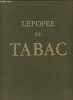
L'épopée du Tabac
Ed. d'Art et Industrie. 1971. In-4. Relié. Etat d'usage, Couv. partiel. décollorée, Dos satisfaisant, Intérieur acceptable. 257 pages - nombreuses photos et illustrations en noir et blanc dans et hors texte. Jaquette légèrement frottée en coins.. Avec Jaquette. . . Classification Dewey : 633.7-Plantes alcaloïdes (tabac, thé, cacao, café, pavot)

Classification Dewey : 633.7-Plantes alcaloïdes (tabac, thé, cacao, café, pavot)
L'épopée du tabac.
d'Art et industrie. 1971. In-4. Relié toilé. Bon état, Couv. convenable, Dos satisfaisant, Papier jauni. 257 pages, nombreuses reproductions, illustrations et photos en noir et blanc et en couleur dans et hors texte.. . . . Classification Dewey : 633.7-Plantes alcaloïdes (tabac, thé, cacao, café, pavot)
Classification Dewey : 633.7-Plantes alcaloïdes (tabac, thé, cacao, café, pavot)

