 Write to the booksellers
-
Type
Book (7256)
Disk (44)
Drawings (1)
Engraving (9)
Magazine (89)
Maps (4)
Music sheets (135)
New book (2)
Old papers (1)
Photographs (19)
Posters (1)
-
Latest
Last 24h (12)
Last 3 days (1)
Last month (950)
Last week (5)
-
Language
Czech (1)
Dutch (11)
English (156)
French (7380)
German (4)
Italian (2)
Latin (3)
Russian (4)
-
Century
16th (17)
17th (43)
18th (199)
19th (882)
20th (2482)
21st (1567)
-
Countries
Belgium (1158)
Canada (34)
China (56)
Côte d'Ivoire (7)
Denmark (1063)
France (4893)
Germany (1)
Netherlands (181)
Switzerland (155)
United Kingdom (9)
United States of America (4)
-
Syndicate
ALAC (27)
CLAM (27)
CLAQ (2)
ILAB (2238)
NVVA (15)
SLACES (15)
SLAM (1026)
SNCAO (4)
Experimental Researches in Electricity. - Tenth Series. 16. On an improved form of the Voltaic Battery. 17. Some practical results respecting the construction and use of the Voltaic Battery. (Sections 1119-1160). Received June 16, - Read June 18, 1...
(London, Richard Taylor, 1835). 4to. No wrappers as extracted from ""Philosophical Transactions"" 1835 - Part II. Pp. 263-274. Clean and fine.
First appearance of this paper in which Faraday describes his improvements of the Voltaic battery.""This paper relates altogether to the practical construction and use of the voltaic battery. Guided by the principles developed in former series, the author concluded that in voltaic instruments in which the copper surrounded the zinc, there was no occasion for insulation of the contiguos coppers, provided they did not come into metallic contact"" and therefore in the cionstruction of some new instruments he interposed paper only between the coppers instead of the usual insulating plate of porcelain or glass.""(Abstract)..From 1831 to 1852 Michael Faraday published his ""Experimental Researches in Electricity"" in The Philosophical Transactions of the Royal Society. These papers contain not only an impressive series of experimental discoveries, but also a collection of heterodox theoretical concepts on the nature of these phenomena expressed in terms of lines of forces and fields. He published 30 papers in all under this general title.They represents Faraday's most importent work, are classics in both chemistry and physics and are the experimental foundations for Maxwell's electro-magnetic theory of light, using Faraday's concepts of lines of force or tubes of magnetic and electrical forces. His many experiments on the effects of electricity and magnetism presented in these papers lead to the fundamental discoveries of 'induced electricity' (the Farday current), the electronic state of matter, the identity of electricity from different sources, equivalents in electro-chemical decomposition, electrostatic induction, hydro-electricity, diamagnetism, relation of gravity to electricity, atmospheric magnetism and many other.""Among experimental philosophers Faraday holds by universal consent the foremost place. The memoirs in which his discoveries are enshrined will never ceaseto be read with admiration and delight"" and future generations will preserve with an affection not less enduring the personal records and familiar letters, which recall the memory of his humble and unselfish spirit.""(Edmund Whittaker in A History of the Theories of Aether and Electricity).

"FARADAY, MICHAEL. - THE DISCOVERY OF ELECTRO-MAGNETIC INDUCTION (PMM 308) - GERMAN VERSION.
Reference : 44146
(1832)
Experimental-Untersuchungen über Elektricität. (Frei übersetzt aus dem Philosop. Transact. f. 1832). (Erste-) Zweite Reihe. ( I-V). (I. Vertheilung elektrischer Ströme. II. Electricitätserregung durc Magnetismus. III. Neuer elektrischer Zustand der M...
Leipzig, Johann Ambrosius Barth, 1832. Contemp. hcalf., raised bands, gilt spine. Light wear along edges. In ""Annalen der Physik und Chemie. Hrsg. von J.C. Poggendorff"", Band 25. (Entire volume offered). VIII,648 pp. and 6 folded engraved plates. Small stamps on verso of titlepage and plates. Faraday's papers: pp. 91-142 a. pp. 142-186. with 3 folded engraved plates. Clean and fine.
First German editions of the 2 first memoirs of Faradays groundbreaking researches on electricity, constituting the first 2 papers of his ""Experimental Researches in Electricity"", and containing his fundamental discovery of electromagnetic induction, THE FOUNDATION OF NEARLY ALL THE ELECTRICITY IN USE TODAY. In 1820 Oersted had generated magnetism from electricity, Faraday here finds the opposite effect, generating electricity by magnetism. He also described the first electrical generator (second paper). THESE PAPERS ARE SOME OF THE GREAT CLASSICS OF CHEMISTRY AND PHYSICS.""Faraday demonstrated this theory involving the lines of force....by inserting a magnet into a coil of wire attached to a galvanometer. While the magnet was being inserted or removd, current flowed through the wire. If the magnet was held stationary and the coil moved over it one way or the other, there was current in the wire. In either case the magnetic lines of force about the magnet were cut by the wire.If the magnet and coil were both held motionless, whether the magnet was within the coil or not, there was no current...Faraday hd thus discovered electricalinduction...It was to lead to great things, but this was not apparent.""(Asimov).""Although his discovery of the electric motor and the dynamo was almost entirely identical to his theoretical discoveries, it laid the foundation of the modern electrical industry - electric light and power, teælephony, wireless telegraphy, televison etc. - by providing for the production of continous mechanical motion from an electrical source, and vice versa."" (PMM, 308).Horblit, 29 - Milestones, 62. - Dibner, 64. - PMM, 308.The volume contains further notable papers. Elie de Beaumont ""Zweiter geologischer Brief...an A.v. Humboldt über die relative Alter der Gebirgszüge"", pp. 1-58 a. 2 plates (one handcoloured), papers by Döbereiner, E. Lenz, Moser, Mitscherlich, de Saussure, J. Dumas, F.E. Neumann, Gay-Lussac, Johannes Müller ""Beobachtungen zur Analyse der Lymphe, des Bluts und des Chylus"", pp. 513-590.
"FARADAY, MICHAEL. - THE DISCOVERY OF ELECTRO-MAGNETIC INDUCTION (PMM 308) - FRENCH VERSION.
Reference : 44145
(1832)
Recherches expérimentales sur l'Electricité. I-V. (I. Sur l'induction des courans l'èlectriques. II. Sur le développement de l'électricité par le magnetisme. III. Sur une nouvelle condition électrique de la matière. IV. Sur les phénomènes magnét...
Paris, Crochard, 1832. Contemp. hcalf., gilt spine, light wear along edges. In: ""Annales de Chimie et de Physique, Par MM. Gay-Lussac et Arago."", tome 50, Series 2. (Entire volume offered). 448 pp. 2 folded engraved plates. Faraday's papers: pp. 5-67 a. pp. 113-162.
First French editions of the 2 first memoirs of Faradays groundbreaking researches on electricity, constituting the first 2 papers of his ""Experimental Researches in Electricity"", and containing his fundamental discovery of electromagnetic induction, THE FOUNDATION OF NEARLY ALL THE ELECTRICITY IN USE TODAY. In 1820 Oersted had generated magnetism from electricity, Faraday here finds the opposite effect, generating electricity by magnetism. He also described the first electrical generator (second paper). THESE PAPERS ARE SOME OF THE GREAT CLASSICS OF CHEMISTRY AND PHYSICS.""Faraday demonstrated this theory involving the lines of force....by inserting a magnet into a coil of wire attached to a galvanometer. While the magnet was being inserted or removd, current flowed through the wire. If the magnet was held stationary and the coil moved over it one way or the other, there was current in the wire. In either case the magnetic lines of force about the magnet were cut by the wire.If the magnet and coil were both held motionless, whether the magnet was within the coil or not, there was no current...Faraday hd thus discovered electricalinduction...It was to lead to great things, but this was not apparent.""(Asimov).""Although his discovery of the electric motor and the dynamo was almost entirely identical to his theoretical discoveries, it laid the foundation of the modern electrical industry - electric light and power, teælephony, wireless telegraphy, televison etc. - by providing for the production of continous mechanical motion from an electrical source, and vice versa."" (PMM, 308).Horblit, 29 - Milestones, 62. - Dibner, 64. - PMM, 308.
"FARADAY, MICHAEL. - THE DISCOVERY OF ELECTRO-MAGNETIC INDUCTION (PMM 308) - FRENCH VERSION.
Reference : 48987
(1832)
Recherches expérimentales sur l'Electricité. I-V. (I. Sur l'induction des courans l'èlectriques. II. Sur le développement de l'électricité par le magnetisme. III. Sur une nouvelle condition électrique de la matière. IV. Sur les phénomènes magnét...
Paris, Crochard, 1832. Contemp. hcloth, gilt lettering to spine. In: ""Annales de Chimie et de Physique, Par MM. Gay-Lussac et Arago."", tome 50, Series 2. (Entire volume offered). 448 pp. 2 folded engraved plates. Faraday's papers: pp. 5-67 a. pp. 113-162. Some scattered brownspots.
First French editions of the 2 first memoirs of Faradays groundbreaking researches on electricity, constituting the first 2 papers of his ""Experimental Researches in Electricity"", and containing his fundamental discovery of electromagnetic induction, THE FOUNDATION OF NEARLY ALL THE ELECTRICITY IN USE TODAY. In 1820 Oersted had generated magnetism from electricity, Faraday here finds the opposite effect, generating electricity by magnetism. He also described the first electrical generator (second paper). THESE PAPERS ARE SOME OF THE GREAT CLASSICS OF CHEMISTRY AND PHYSICS.""Faraday demonstrated this theory involving the lines of force....by inserting a magnet into a coil of wire attached to a galvanometer. While the magnet was being inserted or removd, current flowed through the wire. If the magnet was held stationary and the coil moved over it one way or the other, there was current in the wire. In either case the magnetic lines of force about the magnet were cut by the wire.If the magnet and coil were both held motionless, whether the magnet was within the coil or not, there was no current...Faraday hd thus discovered electricalinduction...It was to lead to great things, but this was not apparent.""(Asimov).""Although his discovery of the electric motor and the dynamo was almost entirely identical to his theoretical discoveries, it laid the foundation of the modern electrical industry - electric light and power, teælephony, wireless telegraphy, televison etc. - by providing for the production of continous mechanical motion from an electrical source, and vice versa."" (PMM, 308).Horblit, 29 - Milestones, 62. - Dibner, 64. - PMM, 308.The volume contains further notable papers. Elie de Beaumont ""Zweiter geologischer Brief...an A.v. Humboldt über die relative Alter der Gebirgszüge"", pp. 1-58 a. 2 plates (one handcoloured), papers by Döbereiner, E. Lenz, Moser, Mitscherlich, de Saussure, J. Dumas, F.E. Neumann, Gay-Lussac, Johannes Müller ""Beobachtungen zur Analyse der Lymphe, des Bluts und des Chylus"", pp. 513-590.
"FARADAY, MICHAEL. - ""THE ELECTRO-MAGNETIC THEORY OF LIGHT""
Reference : 49069
(1846)
Sur de nouvelles relations entre l'électricité, la lumière et le magnétisme. (Extrait d'une Lettre de M. Faraday à M. Dumas).
(Paris, Bachelier), 1846. 4to. No wrappers. In: ""Comptes Rendus Hebdomadaires des Séances de L'Academie des Sciences"", Tome 22, No 3. Pp. (92-) 134. (Entire issue offered). Faraday's letter: pp. 113-115.
First printing of an interesting paper where faraday explicitly, but in an embryonic form, set forth the electro-magnetic theory of light as he here describes the magnetic rotation of light, disclosing relations between magnetism, electricity and light.
"FARADAY, MICHAEL. - THE FIRST ELECTRIC GENERATOR - FIRST FRENCH EDITION. (PMM 308).
Reference : 44738
(1846)
Recherches éxperimentales sur LÉlectricite. Sur la magnétitisation de la lumière et l'illumination des lignes de forces magnétique. (I). I-III. (1. Series 1-97).
Paris, Victor Msson, 1846. Extracted from ""Annales de Chimie et de Physique"", 3e Series - Tome 17. Pp. 359-392, three textillustrations. Some scattered brownspots.
First French edition of one of Faraday's most importent papers in which he announced his discovery of electromagnetic induction and hereby also created the first electric generator explained by ""lines of force"". This is the first Franch edition of the first series of Faradays ""Experimental Researches in Electricity"".""In 1821 a series of brilliant researches culminated in the discovery of electromagnetic rotation"" in 1831, seemingly out of nowhere, came the discovery of electromagnetic induction and the beginning of the experimental researches in electricity which were to lead Faraday to the discovery of the laws of electrochemistry, specific inductive capacity, the Faraday effect, and the foundations of classical field theory.""(DSB).""Among experimental philosophers Faraday holds by universal consent the foremost place. The memoirs in which his discoveries are enshrined will never ceaseto be read with admiration and delight"" and future generations will preserve with an affection not less enduring the personal records and familiar letters, which recall the memory of his humble and unselfish spirit.""(Edmund Whittaker in 'A History of the Theories of Aether and Electricity' p. 197.
"FARADAY, MICHAEL. - THE FIRST ELECTRIC MOTOR - INTRODUCING ""LINES OF FORCE"" AND THE UNIVERSE OF ""FIELDS"" (FRENCH EDITION).
Reference : 43750
(1821)
Sur les Mouvemens électro-magnétiques et la théorie du magnétisme. (Traduit par M. Anatole-Riffault). + (André-Marie Ampere et Felix Savary:) Notes relatives au Mémoire de M. Faraday.
(Paris, Crochard, 1821). No wrappers. In: ""Annales de Chimie et de Physique, Par MM. Gay-Lussac et Arago."", tome 18 (Septembre Cahier). Pp. 337-443. (Entire issue offered). Faraday's paper: pp. 337-370 a. 2 folded engraved plates (showing the experimental apparatus). Ampère & Savary's Notes: pp. 370-379. Clean and fine.
First French edition of Faraday's famous paper ""On some new Electro-Magnetical Motion, and on the Theory of Magnetism. By Michael Faraday, Chemical Assistant in the Royal Institution. (1821)"", recording one of the most influential discoveries in physics in the 19th Century, as Faraday here, as the very first, showed how to CONVERT THE ELECTRICAL AND MAGNETIC FORCES INTO CONTINUAL MECHANICAL MOVEMENT, thus creating the first electric motor, using the principle of electromagnetic rotation. In the first paper he introduced for the first time the concept of ""LINE OF FORCE"" and hereby deliniating ""a picture of the universe as consisting of fields of various types, one that was more subtle, flexible, and useful than the purely mechanical picture of Galileo and Newton. The FIELD UNIVERSE was to be recognized with Maxwell half a century later and with Einstein, after an interval of another halfcentury.""(Asimov).""Ever since Hans Christian oersted's announcement of the discovery of electromagnetism in the summer of 1820, editors of scientific journals had been inundated with articles on the phenomenon. Theories to explain it had multiplied, and the net effect was confusion. Were all the effects reported real ? Did the theories fit the facts ? It was to answer these questions that Phillips turned to Faraday and asked him to review the experiments and theories of the past months and separate truth from fiction,...Faraday agreed to to undertake a short historical survey...His entusiasm was aroused in September 1821, when he turned to the investigation of the peculiar nature of the magnetic force created by an electrical current. Oersted had spoken of the ""electrical conflict"" surrounding the wiree and had noted that ""this conflict performs circles"".....Yet as he experimented he saw precisely what was happening. Using a small magnetic needle to map the pattern of magnetic force, he noted that oneof the poles of the needle turned in a circle as it was carried around the wire. He immediately realized that a single magnetic pole would rotate unceasingly around a current-carrying wire so long as the current flowed. He then set about devising an instrument to illustrate this effect. His paper ""On some new Electro-Magnetical Motion, and on the Theory of Magnetism"" appeared in the 21 October 1821 issue of the ""Quarterly Journal of Science"" (The paper offered in the first French edition). It records the first conversion of electrical into mechanical energy. It also contained the first notion of the line of force.""(DSB IV, pp. 533).
"FARADAY, MICHAEL. - THE FIRST ELECTRIC MOTOR - INTRODUCING ""LINES OF FORCE"" AND THE UNIVERSE OF ""FIELDS"" (GERMAN EDITION).
Reference : 43751
(1822)
Ueber electrisch-magnetische ewegungen, und die Theorie des Magnetismus"" von Faraday, chem. Assistenten in d. Roy. Inst. (geschrieben London d. 11 Sept. 1821: mit Anmerkungen von einem Freunde des Hrn Ampère. Frei bearbeitet und mit einigen Erläuterun...
Leipzig, Johann Ambrosius Barth, 1822. Without wrappers as extracted from ""Annalen der Physik und der Physikalischen Chemie. Hrsg. Ludwig Wilhelm Gilbert"", Bd. 71. Titlepage to vol. 71, pp. 124-171 a. pp. 172-176 and 1 folded engraved plate showing experimental apparatus. Clean and fine.
First German edition of Faraday's famous paper ""On some new Electro-Magnetical Motion, and on the Theory of Magnetism. By Michael Faraday, Chemical Assistant in the Royal Institution. (1821)"", recording one of the most influential discoveries in physics in the 19th Century, as Faraday here, as the very first, showed how to CONVERT THE ELECTRICAL AND MAGNETIC FORCES INTO CONTINUAL MECHANICAL MOVEMENT, thus creating the first electric motor, using the principle of electromagnetic rotation. In the first paper he introduced for the first time the concept of ""LINE OF FORCE"" and hereby deliniating ""a picture of the universe as consisting of fields of various types, one that was more subtle, flexible, and useful than the purely mechanical picture of Galileo and Newton. The FIELD UNIVERSE was to be recognized with Maxwell half a century later and with Einstein, after an interval of another halfcentury.""(Asimov).""Ever since Hans Christian oersted's announcement of the discovery of electromagnetism in the summer of 1820, editors of scientific journals had been inundated with articles on the phenomenon. Theories to explain it had multiplied, and the net effect was confusion. Were all the effects reported real ? Did the theories fit the facts ? It was to answer these questions that Phillips turned to Faraday and asked him to review the experiments and theories of the past months and separate truth from fiction,...Faraday agreed to to undertake a short historical survey...His entusiasm was aroused in September 1821, when he turned to the investigation of the peculiar nature of the magnetic force created by an electrical current. Oersted had spoken of the ""electrical conflict"" surrounding the wiree and had noted that ""this conflict performs circles"".....Yet as he experimented he saw precisely what was happening. Using a small magnetic needle to map the pattern of magnetic force, he noted that oneof the poles of the needle turned in a circle as it was carried around the wire. He immediately realized that a single magnetic pole would rotate unceasingly around a current-carrying wire so long as the current flowed. He then set about devising an instrument to illustrate this effect. His paper ""On some new Electro-Magnetical Motion, and on the Theory of Magnetism"" appeared in the 21 October 1821 issue of the ""Quarterly Journal of Science"" (The paper offered in the first German edition). It records the first conversion of electrical into mechanical energy. It also contained the first notion of the line of force.""(DSB IV, pp. 533).
"FARADAY, MICHAEL. - THE ""LAW OF ELECTRO-CHEMICAL EQUIVALENTS"", THE GERMAN VERSION.
Reference : 49065
(1834)
Sechste Reihe von Experimental-Untersuchungen über Elektricität. (564-660) + Siebente Reihe von Experimental-Untersuchungen über Elektricität. (661-874)
Leipzig, Barth, 1834. Contemp. hcalf., raised bands, spine gilt. Spine with light wear. in. ""Annalen der Physik und Chemie. J.C. Poggendorff"", Zweite reine, 3. bd.VIII,558,(4) pp. and 5 plates. (Entire volume offerd). Faradays papers: pp. 149-189 (Sixth series) + pp. 301-331 a. 481-520 (Seventh series). Internally clean and fine, printed on good paper.
First appearance in German - prepared by Faraday himself for publication in Annalen - of 2 historical papers in chemistry and physiscs in which Faraday in the first detects a new recombination-effect in electrolysis and in the second we have the MILESTONE PAPER in which Faraday announces the discoveries of further laws of electrochemistry, stating the general relations of electricity to chemistry and introducing new terms with precise meanings. The first part of the paper introduces his new terminology, giving the words a limited and precise meaning. These words, devised with the assistance of William Whewell, are now familiar to all chemists, electrode, anode, cathode, ion, anion, and cation. He also introduces the ""Volta-electrometer"", and arrives at the ""Law of electro-chemical equivalents"". The paper offered is one of Farday's most famous papers.""Another section of the paper is devoted to a closer examination of the law of constant electrochemical action with respect to water and to the development of a gas electrometer to measure quantities of electricity. Faraday's ""Volta-electrometer"" provided the first practical means for the quantitative measurement of electricity."" (Source Book in Chemistry p. 280-81).The Sixth series: ""In the course of his experimental investigations of a general and importent law of electro-chemical action, which required the accurate measurement of thegases evolved during the decomposition of water and other substances, the author was lead to the detection of a curious effect, which had never been previously noticed, and of which the knowledge, had he before possessed it, would have prevented many of the errors and inconsistencies occurring in the conclusions he at first deduced from his earlier experiments. The phenomena observed was the gradual recombination of elements which had been previously separated from each other by voltaic action. This happened when, after water had been decomposed by voltaic electricity, the mixed gases resulting from such decomposition were left in contact with the platina wires or plates, which had acted as poles"" for under these circumstances they gradually diminished in vo.umes, water was reprioduced, and at lust the whole of the gases disappeared.""(Abstract) - Faraday explains the causes of this recombination.
Experimental Researches in Electricity. - Twenty-sixth Series. 32. Magnetic conducting power. i. Magnetic conduction. ii. Conducting polarity. iii. Magnecrystallic conduction. 33. Atmospheric magnetism. i. General principles (+) Twenty-seventh Ser...
(London, Richard Taylor, 1851). 4to. No wrappers as extracted from ""Philosophical Transactions"" 1851 - Part I. Pp. 29-84, textillustr. and pp. 85-122, textillustr. Both papers clean and fine.
First appearance of a historical paper in physiscs in which Faraday on purely theoretical grounds predicts the magnecrystallic effect and experimentally proves this prediction to be correct.Faraday was successfull in explaining the diagmagnetic phenomena with his lines of magnetics force, and he now applies his concept of ""lines of force"" to magnecrystallic bodies. ""A magnecrystallicsubstance would then be one which in the crystallised state would conduct onwards, or permit the exrtion of the magnetic force with more facility in one direction than another"" and that direction would be the magnecrystallic axis. hence, when in the magnetic field, the magnecrystallic axis would be urged into a position coincident with the magnetic axis, by a force correspondent to that difference, just as two different bodies were taken, when one with the greater conducting power displaces that which is weaker"" The prediction was shown to be correct"" a body like bismuth became less magnetc when its axis was parallel to the magnetic axis than when it is perpendicular to it.From 1831 to 1852 Michael Faraday published his ""Experimental Researches in Electricity"" in The Philosophical Transactions of the Royal Society. These papers contain not only an impressive series of experimental discoveries, but also a collection of heterodox theoretical concepts on the nature of these phenomena expressed in terms of lines of forces and fields. He published 30 papers in all under this general title.They represents Faraday's most importent work, are classics in both chemistry and physics and are the experimental foundations for Maxwell's electro-magnetic theory of light, using Faraday's concepts of lines of force or tubes of magnetic and electrical forces. His many experiments on the effects of electricity and magnetism presented in these papers lead to the fundamental discoveries of 'induced electricity' (the Farday current), the electronic state of matter, the identity of electricity from different sources, equivalents in electro-chemical decomposition, electrostatic induction, hydro-electricity, diamagnetism, relation of gravity to electricity, atmospheric magnetism and many other.""Among experimental philosophers Faraday holds by universal consent the foremost place. The memoirs in which his discoveries are enshrined will never ceaseto be read with admiration and delight"" and future generations will preserve with an affection not less enduring the personal records and familiar letters, which recall the memory of his humble and unselfish spirit.""(Edmund Whitta
FARADAY, MICHAEL. .- THE ORIGIN OF THE ELECTROMAGNETIC THEORY OF LIGHT.
Reference : 42292
(1852)
Experimental Researches in Electricity. - Twenty-eight Series. 36. On the Lines of Magnetic Force their definite character" and their distribution within a Magnet and through Space. (Sections 3070-3176). Recieved October 22, - Read November 27 and ...
(London, Richard Taylor and William Francis, 1852). 4to. No wrappers as extracted from ""Philosophical Transactions"" 1852 - Part I. Pp. 25-56, textillustr. Clean and fine.
First appearance of a historical paper in electromagnetical theory. Faraday in this paper defines his key concept ""lines of force"" and summarizes in what connections he used it and he shows how it explains the pehenomena of magnetism and electricity. His insistance of the importence of the electromagnetic fields of force was the historical starting point of the electrical side of modern theories of field physics. Maxwell later translated these ideas into mathematical form, and developed them into his theory of electromagnetic waves.Especially notable in this paper is: As all space is permeated by lines of force, Faraday suggests that light and radiant heat might be tranverse vibrations propagated along these lines of force. In this way he proposed to ""dismiss the aether"" and to replace it by lines of force between centres, the centres together with their lines of force constituting the particles of material substance. If the existance of a luminiferous aether were to be admitted he suggests that it might be the vehicle of magnetic force ""for it is not at all unlikely that if there be an aether, it should have other uses than simply the conveyance of radiations"" (section 3075 in this paper offered). This sentece may be regarded as THE ORIGIN OF THE ELECTROMAGNETIC THEORY OF LIGHT (Whittaker in: A History of the theories of the Aether and Electricity, I: pp. 194-95).From 1831 to 1852 Michael Faraday published his ""Experimental Researches in Electricity"" in The Philosophical Transactions of the Royal Society. These papers contain not only an impressive series of experimental discoveries, but also a collection of heterodox theoretical concepts on the nature of these phenomena expressed in terms of lines of forces and fields. He published 30 papers in all under this general title.They represents Faraday's most importent work, are classics in both chemistry and physics and are the experimental foundations for Maxwell's electro-magnetic theory of light, using Faraday's concepts of lines of force or tubes of magnetic and electrical forces. His many experiments on the effects of electricity and magnetism presented in these papers lead to the fundamental discoveries of 'induced electricity' (the Farday current), the electronic state of matter, the identity of electricity from different sources, equivalents in electro-chemical decomposition, electrostatic induction, hydro-electricity, diamagnetism, relation of gravity to electricity, atmospheric magnetism and many other.""Among experimental philosophers Faraday holds by universal consent the foremost place. The memoirs in which his discoveries are enshrined will never ceaseto be read with admiration and delight"" and future generations will preserve with an affection not less enduring the personal records and familiar letters, which recall the memory of his humble and unselfish spirit.""(Edmund Whittaker in A History of the Theories of Aether and Electricity).
"FARADAY, M. (MICHAEL). - THE DISCOVERY AND ISOLATION OF BENZENE.
Reference : 43119
(1825)
On new compounds of carbon and hydrogen, and on certain other products obtained during the decomposition of oil by heat. Read June 16, 1825.
(London, W. Nicol, 1825). 4to. No wrappers as extracted from ""Philosophical Transactions"" 1825 - Part II. Pp. 440-466. Clean and fine.
First appearance of this remarkable paper in which Faraday announces his discovery of Benzene. Berzelius described this research as ""without doubt one of the most importent which has enriched chemistry during 1825.""""The first public announcement of the discovery of benzene, the greatest chemical discovery made by Faraday. Originally named by him ""bicaburet of hydrogen"", benzene is the parent substance of all aromatic compounds. It constitutes the basis of thousands of organic compounds, dyes, perfumes, and medicinal products, as well as many polymers and structural materials. The discovery of benzene led to the creation of numerous chemical companies and the manufacture of materials previously unknown. This paper is a thourough study of the physical and chemical properties of benzene.""(Neville I, p. 443). - Parkinson ""Breakthrough"" 1825 C.
"FARADAY, M. (MICHAEL). - THE FIRST PERFORMED SUBSTITUTION REACTION IN CHEMISTRY.
Reference : 43117
(1821)
On two new compounds of Chlorine and Carbon, and on a new compound of Iodine, Carbon, and Hydrogen. By Mr. Faraday, ChemicalAssistent in the Royal Institution. Read December 21, 1820.
(London, W. Bulmer and W. Nicol, 1821). 4to. No wrappers as extracted from ""Philosophical Transactions"" 1821 - Part I. Pp. 47-74. Clean and fine.
First appearance of Faraday's first breakthrough in chemistry as he here synthesized for the first time chloro-carbons.""In 1820 he (Faraday) produced the first known compounds of chlorine and carbon, C2Cl6 and C2Cl4. These compounds had been produced by the substitution of chlorine for hydrogen in ""olefiant gas"", our modern ethylene. This was the first substitution reaction"" such reactions, in the hands of Charles Gerhardt and August Laurent in the 1840's, were to be used as a serious challenge to the dualistic electrochemical theories of J.J. Berzelius."" (DSB IV, p. 531).Parkinson ""Breakthrough"" 1820 C.
On the Condensation of several gases into liquids. Read April, 10, 1823.
(London, W. Nicol, 1823). 4to. No wrappers as extracted from ""Philosophical Transactions"" 1823 - Part II. Pp. 189-198. Clean and fine.
First appearance of this classical paper in chemistry, Faraday announces his success with the liquefaction of gases, and where he for the first time liquefied sulphur dioxide, hydrogen sylphide, chlorine dioxide, cyanogen, and ammonia.
The Roots Of Nubian Christianity Uncovered: The Triumph of The Last Pharaoh
Africa World Press 2012 296 pages in8. 2012. Broché. 296 pages.
Bon état
Dreams through the glass. Windows from Bergdorf Goodman.
2004 Editions Assouline Publishing - 2004 - In-folio, cartonnage gris sous jaquette illustrée en couleurs de l'éditeur - 159 p. - Très riche iconographie pleine page en couleurs - Ouvrage en anglais

Bon état - Exemplaire réformé de bibliothèque (vente autorisée) (tampons, étiquettes et altérations habituelles pour un livre de bibliothèque) - Jaquette légèrement frottée, notamment au niveau des coins - Coins légèrement tassés
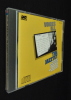
Voices all. The Jazztet (CD)
Toshiba-EMI Limited CD 1983 "CD ""Voices all"" de The Jazztet avec Art Farmer - Benny Golson - Curtis Fuller - Cedar Walton - Buster William - Albert Heath 1. Whisper not 2. Voices all 3. Killer Joe 4. Mow Nix 5. I remember Clifford 6. Evermore 7. Park Avenue petite ; très bon état. Livraison a domicile (La Poste) ou en Mondial Relay sur simple demande."

Comme une bête
Paris Editions Champ Libre - Collection "Chute libre" 1974 In-8 Broché, couverture illustrée à rabats
Édition originale de la traduction française de l'américain par François Lasquin. Couverture en couleurs illustrée par Moebius. >Bon exemplaire. Très bon 0
Gare à la bête
Paris Editions Champ Libre - Collection "Chute libre" 1975 In-8 Broché, couverture illustrée à rabats
Édition originale de la traduction française de l'américain par Michel Pétris. Couverture en couleurs illustrée par Moebius. >Bon exemplaire. Très bon 0
"FARR, WILLIAM. - THE USE OF SCHEUTZ'S THIRD DIFFERENTIAL ENGINE.
Reference : 43002
(1859)
On the Construction of Life-Tables, illustrated by a New Life-Table of the Healthy Districts of England. Received March 17, - Read April 7, 1859.
(London, Taylor and Francis, 1859). 4to. No wrappers as extracted from ""Philosophical Transactions"" 1859 - Vol. 149 - Part II. With the titlepage to Part II. Pp. 837-878, 1 folded engraved plate, tables in the text. The plate slightly browned. It includes 1 typeset by the Scheutz calculator.Clean and fine.
First appearance of a pioneer paper in statistical calculations of life-expectations., containing THE VERY FIRST APPLICATION OF A DIFFERENCE ENGINE TO MEDICAL STATISTICS.""Farr's preliminary report (the paper offered), describing the use of the Scheutz Engine no. 3 to prepare life tables, was published 5 years before his ""English Life Table"". Farr, a pioneer in the quantitative study of morbidity and mortality, was chief statistician of the General Register Office, Englands central statistical office. Influenced by Babbage, he had long been interested in the use of a calculating machine, such as Babbage's Difference Engine to compute life tables"" see page 854 of the present report, in which Farr refers to his 1843 letter on the subject to the registrar-general. Farr had seen and tested the machine's predecessor, the Scheutz Engine No. 2, when it was on display in London. It was at Farr's recommandation that the British government authorized in 1857 the sum of Pound 1200 for the Scheutz Engine no. 3 to be constructed by the firm Bryan Donkin, a manufacturer of machines for the color printing of bank notes and stamps....Farr's printing report, received by the Royal Society on March 17 of that year, was written while Scheutz Engine no. 3 was still ""in the course of construction by Messr. Donkin"" (p. 854). The reports table B1, ""Life-Table of Healthy English Districts"", made from stereotype plates produced by the calculator, represents the very first application of a difference engine to medical studies.""(Hook and Norman, Origins of Cyperspace, No. 77.). - Garrison & Morton: 1700.1.
Fasolo Chrystel Fontaine M Pascal M
Reference : 500220991
(2011)
ISBN : 9782011813954
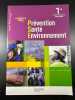
Prévention Santé Environnement 1re Bac Pro - Livre élève - Ed.2011
HACHETTE EDUC 2011 144 pages 21x1 2x29 6cm. 2011. Broché. 144 pages.
Très bon état
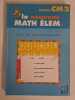
Le nouveau Math élem : Cycle des approfondissements manuel CM2: Manuel élève CM2 Cycle des appronfondissements
BELIN EDUCATION 2001 194 pages 19 8x1 2x27 6cm. 2001. Relié. 194 pages.
Bon état
Le guide marabout de l'aquarium d'eau douce
Marabout 1994 11 6x2x18cm. 1994. mass_market.
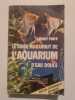
Etat correct
Fayon Sabine Bertone Cédric Gandilhon Nicole
Reference : 500074601
(2022)
ISBN : 9782047400173
Bordas Vacances - Je rentre en 5e: Révisions de la 6e en 30min/jour
Bordas 2022 48 pages 18 6x27 5x1 1cm. 2022. Broché. 48 pages.

Très bon état - légères marques de lecture et/ou de stockage mais du reste en très bon état- expédié soigneusement depuis la France
Fayon Sabine Bertone Cédric Gandilhon Nicole
Reference : 500096256
(2022)
ISBN : 9782047400173
Bordas Vacances - Je rentre en 5e: Révisions de la 6e en 30min/jour
Bordas 2022 48 pages 18 6x27 5x1 1cm. 2022. Broché. 48 pages.

Très bon état

