 Write to the booksellers
-
Type
Book (7151)
Disk (1)
Drawings (1)
Engraving (9)
Magazine (89)
Maps (4)
Music sheets (136)
New book (4)
Old papers (1)
Photographs (7)
-
Latest
Last 24h (4)
Last 3 days (5)
Last month (116)
Last week (20)
-
Language
Czech (1)
Dutch (9)
English (158)
French (7221)
German (4)
Italian (2)
Japanese (1)
Latin (3)
Russian (4)
-
Century
16th (9)
17th (43)
18th (194)
19th (879)
20th (2403)
21st (1535)
-
Countries
Belgium (1160)
Canada (34)
China (56)
Côte d'Ivoire (7)
Denmark (1063)
France (4730)
Germany (1)
Netherlands (181)
Switzerland (155)
United Kingdom (12)
United States of America (4)
-
Syndicate
ALAC (27)
CLAM (29)
CLAQ (2)
ILAB (2264)
NVVA (15)
SLACES (15)
SLAM (1047)
SNCAO (4)
Discours Prononcé A L'Assemblée Ordinaire De L'Académie Royale Des Sciences Et Belles-Lettres De Prusse, Le Jeudi II. Janvier 1770.
Berlin, Voss, 1770. 8vo. In later marbled paper covered boards. Paper on front hinge partly detached. Internally nice and clean. 32 pp.
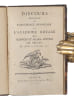
First seperate edition of this important philosophical essay by Frederick II of Prussia (1712–1786) originally delivered before the Royal Prussian Academy of Sciences and Belles-Lettres on 11 January 1770. Here Frederick examines the nature of self-love and its relationship to morality arguing that self-interest, when properly directed, can serve as a foundation for virtuous conduct and the welfare of society.

L'influence de la lune sur les cultures: - SAVOIR ET POUVOIR
FLAMMARION 1993 158 pages 13 6x1 2x18cm. 1993. Broché. 158 pages.
Bon état
The life and strange surprising adventures of Robinson Crusoe, of York, mariner
Harper & Brothers | New York 1900 | 15.50 x 23.50 cm | reliure de l'éditeur
Edition ornée de nombreuses illustrations (près d'une centaine) en noir in et hors-texte des frères Louis et de Frederick Rhead. L'ouvrage est également illustré d'un frontispice en couleurs. Reliure de l'éditeur en pleine percaline noire, dos lisse, mention dorée de l'éditeur en queue du dos, premier plat décoré d'une grande vignette en couleurs représentant Robinson chassant un fusil en mains, gardes et contreplats de papier crème. Petites rousseurs sur les gardes, sinon agréable exemplaire. - Photographies et détails sur www.Edition-Originale.com -

The art of the french book. From early manuscripts to the present time. Edited By André Lejard. Introduction by Philip James.
Paul Elek, London (1947). Bon exemplaire relié, reliure pleine toile, avec titres, gd in-4, 166 pages + planches.
"FRESNEL, A. (AUGUSTIN). - THE ""SECOND MEMOIR"" OF 1827, FIRST ENGLISH EDITION.
Reference : 47019
(1852)
Memoir on Double Refraction. (From the Mémoires de l'Academie Royale des Sciences d l'Institut de France, tome vii. 1827).
London, Taylor and Francis, 1852. 8vo. Without wrappers. In: ""Scientific Memoirs, selected from Transactions of Foreign Academies of Science... Edited by Richard Taylor."", Vol. V, Part XVIII. With titlepage to Vol. V. Pp. (151-) 352 (entire part offered). Fresnel's paper: pp. 238-333. Clean and fine. Titlepage with a small faint stamp.
First appearance in English of Fresnel's famous memoir - the memoir of 1827, his so-called second memoir - in which some of his groundbreaking discoveries concerning light is stated. He applies the concept of transverse waves to double refraction and representing the final construction, in the form of an equation of the fourth degree.In the paper Fresnel also explained the fact,that in some cases of quartz the rotation of polarization is from left to right and in other cases from right to left.. He proposed the term 'helical' to denote the property of rotating the plane of polarization, exhibited by such bodies as quartz. The term 'natural rotatory polarisation' is however, generally used.This memoir contains the first printing of three unpublished memoirs from 1821 and 1822 (Mémoire sur la double refraction.Extrait Read 26. Nov., 1821 - Supplement, presented 22 January 1822 - Second Supplement, presented April 1, 1822. - Explication de la réfraction dans le système des Ondes from ""Bulletin Soc. Philom."", 1821. See Jed. Z. Buchwald ""The Rise of the Wave Theory of Light"", pp. 461-63.
"FRESNEL, AUGUSTIN ( ARAGO, AMPÉRE, BIOT, FOURIER). - THE FINAL DOWNFALL OF THE CORPUSCULAR THEORY OF LIGHT.
Reference : 44516
(1816)
Mémoire sur la Diffraction de la lumière, où l'on examine particululièrement le phénomène des franges colorées que présentent les ombres des corps éclairés par un point lumineux. - Extrait d'une Lettre de M. Fresnel à M. Arago, sur l'influence de ...
Paris, Crochard, 1816-25. Bound in 2 fine recent hmorocco. In: ""Annales de Chimie et de Physique, Redigées par MM. Gay-Lussac et Arago"", Tome I, IV, IX, X, XI, XV, XVII, XX, XXI, XXIII, XXVIII and XXIX. Some memoirs with scattered brownspots. All but volume 15 with the orig. titlepages to the volumes. Vol. XV having instead of the titlepage, a sample of the orig. printed wrappers, December issue 1820. Bound at end of volume 2. The memoir, no. 25a below is inserted at the end of volume 2. Some of the memoirs having textillustrations. Some versos of titlepages with stamps.
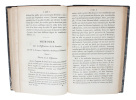
First appearances of this groundbreaking series of papers and memoirs in which Fresnel established the scientific basis for the wave theory of light and gave the theoretical framework for explaining, in the context of his theory of the transversal nature of lightwaves, the phenomena of double refraction, refraction, dispersion, polarization, interference, diffraction patterns, diffraction fringes as light spreads around objects, etc. He developed mathematically the hypothesis of the wave nature of light and he demonstrates its conformity with experience. His study of light was a dynamic interplay between theory and observation, between mathematics and experiment. - The offered series also comprises the contributions from Arago and the rapports from The French Academy's committees by Ampère, Biot and Fourier - see below nos. 6,11,14,15,a.nd 18.""From the point of view of method, his investigations extended from the manual operations of the laboratory to the most abstract mathematical analyses. Few physicists since Newton had been so versatile.""(Silliman in ""Historical Studies in the Physical Sciences"", vol. 4, p. 155.).""The wave-thory at this time was still encumbered with difficulties. Diffraction was not satisfactorily explained" for polarization no explanation of any kind was forthcoming the Huygenian construction appeared to require two different luminiferous media within double refracting bodies and the universality of that construction had been impugned by Brewster's discovery of biaxial crystals. The upholders of the emission theory, emboldened by the success of Laplace's theory of double refraction, thought the time ripe for their final triunph and as a step to this, in March 1817 they proposed Diffration as the subject of the Academy's prize for 1818. Their expectation was disappointed" and the successful memoir afforded the first of a series of reverses of which, in the short space of seven years, the corpuscular theory was completely owerthrown. The author was Augustin Fresnel...""(Whittaker ""A History of the Theories of Aether & Electricity"", vol. 1, p.107 ff.).""This concept of transverse waves met with the greatest hostility from the scientists of the day, who could not imagine an extremely fluid and rarified ether which at the same time possessed the mechanical properties of a rigid body. Even Arago admitted that he could not follow the exuberant engineer in his ideas. ButFresnel was convinced that at last he had the key to many mysteries, and with his model of waves he gave a full clarification of the phenomena of polarization. With insuperable precision he explained a long series of extremely complicated experiments, such as those of chromatic polarization that Arago himself had discovered by chance in 1811, and which the followers of Newton could not explain in spite of all their efforts. Following this line Fresnel reached the synthesis which is his masterpiece....we must recall the final interpretation that he gave of the famous phenomenon of partial reflection by transparent surfaces, that simple phenomenon which until then had puzzled Grimaldi, Newton, and Huygens, and which in Malus's experiments had unexpectedly acquired a special importencee as it had been compared to the great mystery of double refraction.""(Ronchi ""The Nature of Light"", p. 255 ff.).Comprising:1. Mémoire sur la Diffraction de la lumière, où l'on examine particululièrement le phénomène des franges colorées que présentent les ombres des corps éclairés par un point lumineux. ""Ann.Chim.P."" Tome 1. 1816. With titlepage to vol. 1. Pp. 239-281 and 1 folded engraved plate.2. Extrait d'une Lettre de M. Fresnel à M. Arago, sur l'influence de la chaleur dans les couleurs développées par la polarisation.Tome 4. 1817. With titlepage to vol. 4. Pp. 298-300.3. Lettre de M. Fresnel à M. Arago, sur l'influence du mouvement terrestres dans quelques phénomènes terrestres dans quelques phénoménes d'optique. Tome 9. 1818. With titlepage to vol. 18. Pp. 57-70.4. Note additionelle à la Lettre de M. Fresnel à M. Arago, insérée dans le dernier Cahier des Annales. Tome 9. 1818. Pp. 286-287.5. FRESNEL & ARAGO. Sur l'Action que le rayons de lumiére polarisés exercent les uns sur les autres. Tome 10. 1819. With titlepage to vol. 10. Pp. 288-305. - Also with ""Extrait d'un ouvrage du P. Grimaldi intitulé: Traité physico-mathérmatique de la lumiere des couleurs et de l'iris"". Pp. 306-312.6. ARAGO. Rapport par M. Arago à l'Academie des Sciences, au nom de la Commission qui avait été chargée d'examiner les Mémoires envoyés au concours pour le prix de la diffraction. Tome 11. 1819. With titlepage to vol. 11. Pp. 5-30.7. Mémoire sur la Diffraction de la Lumiere. (Extrait). (This importent Price-Memoir was only printed in full in 1826). Tome 11. 1819. Pp. 246-296.8. Suite Du Mémoire sur la Diffraction de la Lumière. Tome 11. 1819. Pp. 337-378. + Note sur des Essais ayant pour but de décomposer l'eau avec un aimant. Pp. 219-222.9. Note sur des Essais ayant pour but de décomposer l'eau avec un aimant. Tome 15. 1820. Pp. 219-222. No titlepage to vol. 15.10. Résume d'un Mémoire sur la Reflexion de la lumière. Tome 15. 1820. Pp. 379-386. Tome 15 is here represented with the last issue of the year (Decembre 1820, pp. 337-448) and instead of the titlepage having the orig. printed wrappers (bound at end of the second volume).11. ARAGO & AMPÈRE. Rapport fait à l'Academie des Sciences, le lundi 4 juin 1821, sur un Mémoire de M. Fresnel relatif aux couleurs des lames cristallisées douées de la double réfraction. Tome 17. 1821. Titlepage to vol. 17. Pp. 80-102.12. Note sur le Calcul des teintes que la polarisation développe dans les lames cristallisées. Tome 17. 1821. Pp. 102-111.13. IIe Note sur la Coloration des lames cristallisées. Tome 17. 1821. Pp. (167-)196.14. BIOT. Remarques de M. Biot sur un Rapport lu, le 4 juin 1821, à l'Academie des Sciences, par MM. Arago et Ampere. Tome 17. 1821. Pp. 225-258.15. ARAGO. Examen des Remarques de M. Biot. Tome 17. 1821. Pp. 258-273. 16. Addition à la IIe Note insérée dans le Cahier précédent, par M. Fresnel. Tome 17. 1821. Pp. 312-315.17. Note sur les remarques de M. Biot, publiées dans le Cahier précédent. Tome 17. 1821. Pp. 393-403.18. FOURIER, AMPÈRE ET ARAGO. Rapport fait à l'Academie sur un Mémoire de M. Fresnel, relatif à la double réfraction. Commission: Fourier, Ampère et Arago. Tome 20, 1822. With titlepage to vol. 20. Pp. 337-344.19. Note sur la double réfraction du verre comprimé. Tome 20. 1822. Pp. 376-383.20. Explication de la Réfraction dans le système des ondes. Tome 21, 1822. Titlepage to vol. 21. Pp. 225-241. + LAGRANGE. Sur la Théorie de la lumière d'Huygens. Pp. 241-246.21. Sur l'Ascension des nuages dans l'atmosphère. Tome 21, 1822. Pp. 260-263.22. Réponse de M. Fresnel à la Lettre de M. Poisson insérée dans le tome XXII des Annales, p. 270. Tome 23, 1823. Titlepage to vol. 23. Pp. 32-49.23. Note sur le Phénomène des anneaux colorés. Tome 23, 1823. Pp. 129-134.24. Suite de la Réponse de M.A. Fresnel à la Lettre de M. Poisson. Tome 23, 1823. Pp. 113-122.25. Extrait d'un Mémoire sur la double Réfraction particulière que présente le cristal de roche dans la irection de son axe. Tome 28, 1825. Titlepage to vol. 28. Pp. 147-161. + (25 a) Extrait d'un Mémoire sur la double Réfraction. Tome 28, 1825. Pp. 263-279. (According to Buchwald ""The Rise of the Wave Theory opf Light"" , p. 462, these 2 extracts composes the entire memoire.26. Note sur la Répulsion que des corps échauffés exercent les uns sur les autres à des distances sensibles. (Lue à l'Institut le 13 juin 1825). Tome 29, 1825. Titlepage to vol. 29. Pp. 57-62.27. Extrait d'un Mémoire sur la Loi des modifications imprimées à la lumière polarisée par sa réflexion totale dans l'intérieur des corps transparens. Tome 29, 1825. Pp. 175-187. (This paper was never printed in full).
Mémoire Sur les couleurs développées dans des Fluides homogènes par la lumière polarisée. (Presenté à l'Academie, le 30 mars 1818) (+) Mémoire sur la Réflexion de la Lumiere. (Presenté à l'Academie, le 15 novembre 1819). (2 Memoirs).
Paris, Victor Masson, 1846. No wrappers as extracted from ""Annales de Chimie et de Physique"", Tome 17, Troisieme Série. Titlepage to tome 17. Pp. 172-199 a. 1 engraved plate + pp. 316-338, textillustr. Brownspots to titlepage and some browspots to the second memoir.
First editions of two importent memoirs on polarization and reflexion of light by ""the founder of the new optics"".The first paper takes on a central role in Fresnel's dealing with polarization in general and specially with chromatioc polarization and the explaining the phenomena that arises when light travels through crystals. The paper was read at the Academy on march 30, was not printed at the time as it disappeared and only turned up many years later, around 1845, when it was found in the papers of Fresnel's brother. ""On croyait ou Mémoire perdu. Il a été retrouvé dans les papiers de M. Léonor Fresnel, frère de l'illustre académicien."" Thus, the offered paper is here PRINTED FOR THE FIRST TIME AND IN ITS FULL LENGHT.The second paper deals with reflection and explains the different phenomena seen when light is reflected from glassplates having two surfaces parallel or with curvature, interference of reflected waves and the measure of their different wavelenghts, all explained according to the wave theory of light. The paper offered is for the FIRST TIME PRINTED IN ITS FULL LENGHT, as it only appeared in the résumé-form in 1820 ""Résumé d'un Mémoire sur la Réflexion de la lumière"" (Annales de Chimie et de Physique, tome 15, pp. 379-386).""As it was, Fresnel succeeded fully in attaining his explicit goal, the establishment of the wave conception of light. Not long after his death scientific opinion definitely shiftedin favor of waves and opened up the pathway leading to the deeper insight of Maxwell. In broad context Fresnel's work can be viewed as the first successfull assault on the theory of imponderables and a major influence on the development of nineteenth-centurty energetics."" (DSB V, p. 171).
Ueber die durch polarisirtes Lichts in homogenen Flüssigkeiten hervorgebrachten Farben. (...der Pariser Academie am 30. März 1818 vorgelegt). (+) Ueber die Reflexion des Lichts. (Der Pariser Academie vorgelegt am 15. Nov. 1819). (2 Mémoirs).
Leipzig, Johann Ambrosius Barth, 1848. Without wrappers. In ""Annalen der Physik und Chemie. Hrsg. von J.C. Poggendorff"", Ergänzungsbd., Bd. II, Stück 2. Titlepage to Erg-Bd. 2. Pp. 193-368. (The entire issue offered). Fresnel's papers: pp. 304-331, textillustr. a. pp. 332-355, textillustr. A stamp on titlepage and verso of. Clean and fine.
First German editions of two importent memoirs on polarization and reflexion of light by ""the founder of the new optics"". The French versions of the papers appeared in ""Annales de Chimie et de Physique""(1846).The first paper takes on a central role in Fresnel's dealing with polarization in general and specially with chromatioc polarization and the explaining the phenomena that arises when light travels through crystals. The paper was read at the Academy on march 30, was not printed at the time as it disappeared and only turned up many years later, around 1845, when it was found in the papers of Fresnel's brother. ""On croyait ou Mémoire perdu. Il a été retrouvé dans les papiers de M. Léonor Fresnel, frère de l'illustre académicien."" Thus, the offered paper is here PRINTED FOR THE FIRST TIME AND IN ITS FULL LENGHT (in the German version).The second paper deals with reflection and explains the different phenomena seen when light is reflected from glassplates having two surfaces parallel or with curvature, interference of reflected waves and the measure of their different wavelenghts, all explained according to the wave theory of light. The paper offered is for the FIRST TIME PRINTED IN ITS FULL LENGHT (in the German version), as it only appeared in the résumé-form in 1820 ""Résumé d'un Mémoire sur la Réflexion de la lumière"" (Annales de Chimie et de Physique, tome 15, pp. 379-386).""As it was, Fresnel succeeded fully in attaining his explicit goal, the establishment of the wave conception of light. Not long after his death scientific opinion definitely shiftedin favor of waves and opened up the pathway leading to the deeper insight of Maxwell. In broad context Fresnel's work can be viewed as the first successfull assault on the theory of imponderables and a major influence on the development of nineteenth-centurty energetics."" (DSB V, p. 171).
"FRESNEL, AUGUSTIN. - FORMULATING THE GENERAL LAW OF DOUBLE REFRACTION.
Reference : 44090
(1825)
Extrait d'un Mémoire sur la double Réfraction. (Lu à l'Academie des Sciences le 26 novembre 1821).
Paris, Crochard, 1825. No wrappers. In: ""Annales de Chimie et de Physique, Par MM. Gay-Lussac et Arago."", tome 28, Cahier 3. Titlepage to vol. 28. Pp. 225-336. Fresnel's paper: pp. 263-279
First appearance of this importent paper - the paper was only published in full in the Mémoires two years later - in which he applies the concept of transverse waves to double refraction and representing the final construction, in the form of an equation of the fourth degree.In the paper Fresnel also explained the fact, that in some cases of quartz the rotation of polarization is from left to right and in other cases from right to left.. He proposed the term 'helical' to denote the property of rotating the plane of polarization, exhibited by such bodies as quartz. The term 'natural rotatory polarisation' is however, generally used.The issue contains further J. Berzelius: ""Examen chimique des eaux de Carlsbad, de Teplitz et de Konigswart"", pp. 225-263 (first part) and J.F.W. Herschel ""Sur certain Mouvemens produits dans les liquides conducteurs, lorsqu'ils transmettant le courant électrique"", pp. 280-318.
"FRESNEL, AUGUSTIN. - FORMULATING THE GENERAL LAW OF DOUBLE REFRACTION.
Reference : 59046
(1825)
Extrait d'un Mémoire sur la double Réfraction. (Lu à l'Academie des Sciences le 26 novembre 1821).
Paris, Crochard, 1825. Contemp. hcloth. Gilt lettering on spine. A few scattered brownspots. In: ""Annales de Chimie et de Physique, Par MM. Gay-Lussac et Arago."", tome 28. 448 pp. Entire volume offered. Fresnel's paper: pp. 263-279
First appearance of this importent paper - the paper was only published in full in the Mémoires two years later - in which he applies the concept of transverse waves to double refraction and representing the final construction, in the form of an equation of the fourth degree.In the paper Fresnel also explained the fact, that in some cases of quartz the rotation of polarization is from left to right and in other cases from right to left.. He proposed the term 'helical' to denote the property of rotating the plane of polarization, exhibited by such bodies as quartz. The term 'natural rotatory polarisation' is however, generally used.
Explication de la Réfraction dans le système des ondes. (+) Sur l'Ascension des nuages dans l'atmosphere.
Paris, Crochard, 1819. Contemp. hcalf. Spine gilt. Stamps to verso of titlepage. In ""Annales de Chimie et de Physique"", Tome XXI, 2. Series. 448 pp. a. 1 engraved plates. (Entire volume offered). Fresnel's papers. pp. 225-241, textillustr. and pp. 260-263. Clean and fine.
Both papers first appearances. Fresnel explains the phenomena of refraction and the refraction law in terms of his new undulatory theory of light and his postulate of the transversal motion of light.Also with Lagrange paper ""Surla Théorie de la lumière d'Huygens"", pp. 241-246.
Explication de la Réfraction dans le système des ondes. (+) Sur l'Ascension des nuages dans l'atmosphere.
Paris, Crochard, 1819. Contemp. hcloth. Gilt lettering to spine. In ""Annales de Chimie et de Physique"", Tome XXI, 2. Series. 448 pp. a. 1 engraved plates. (Entire volume offered). Fresnel's papers. pp. 225-241, textillustr. and pp. 260-263. Internally fine.
Both papers first appearances. Fresnel explains the phenomena of refraction and the refraction law in terms of his new undulatory theory of light and his postulate of the transversal motion of light.Also with Lagrange paper ""Surla Théorie de la lumière d'Huygens"", pp. 241-246.
"FRESNEL, AUGUSTIN. - OVERTHROWING THE CORPUSCULAR THEORY OF LIGHT
Reference : 44120
(1816)
Mémoire sur la Diffraction de la lumiere, où l'on examine particulierement le phènomene des franges colorées que présentent les ombres des corps éclairés par un point lumineux. (Ce Mémoire a été déposé a l'Institut le 33 octobre 1815). (+) Mémoire...
Paris, Crochard, 1816, 1819. Bound in 2 contemp. hcloth. Gilt lettering to spines. In: ""Annales de Chimie et de Physique"" Series 2, Tome 1 a. Tome 11. Entire volumes offered.(4),452 pp. a. 3 engraved folded plates. + 448 pp. a. 3 folded engraved plates. Fresnel's papers: pp. 239-281 a. pp. 246-296 a. pp. 337-378. Arago's paper: pp. 5-30. Some scattered brownspots.
First appearance of Fresnel's landmark papers on the phenomena of diffraction, presenting Fresnel's first priinted paper on the subject. These two papers won the Academy's prize for 1818 and were later expanded and published as a long memoir in 1826. The first paper offered initiated the attack on the corpuscular theory of light, which was completely owerthrown by a series of succesfull papers by Fresnel the next few years. In the second paper Fresnel summed up all his work prior to this date in completed form. The paper is called ""extract"", but the longer memoir was not published until 1826. The paper is A CLASSIC IN PHYSICS.""In broad context Fresnel's work can be viewed as the first successfull assault on the theory of imponderables and a major influence on the development of nineteenth-centurty energetics."" (DSB V, p. 171).Diffraction arises because of the way in which waves propagate" this is described by the Huygens-Fresnel principle. The propagation of a wave can be visualized by considering every point on a wavefront as a point source for a secondary radial wave. The subsequent propagation and addition of all these radial waves form the new wavefront. When waves are added together, their sum is determined by the relative phases as well as the amplitudes of the individual waves, an effect which is often known as wave interference. The summed amplitude of the waves can have any value between zero and the sum of the individual amplitudes. Hence, diffraction patterns usually have a series of maxima and minima. (Wikipedia)-The volumes contains many other importent papers by Arago & Petit, Vaugelin, Humphrey Davy, d'Arcet, Laplace, Gay-Lussac, Alex. v. Humboldt, Thenard, Will. Prout, Stromeyer, Berzelius, Brewster, Theod. de Saussure, Ampère etc.
"FRESNEL, AUGUSTIN. - OVERTHROWING THE CORPUSCULAR THEORY OF LIGHT.
Reference : 43910
(1816)
Mémoire Sur la Diffraction de la lumière, où l'on examine particulièrement le phénomène des franges colorées que présentent les ombres des corps éclairés par un point lumineux. (Memoir on the Diffraction of Light....)
(Paris, Crochard, 1816) No wrappers. In: 'Annales de Chimie et de Physique', Tome I, Sec. Series, Cahier Mars 1816. With htitle to vol. I. Pp. 225-336 and 1 folded engraved plate. (The entire issue offered). Fresnel's paper: pp. 239-281. The plate shows the diffraction patterns.
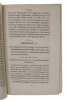
First appearance of Fresnel's landmark mémoir - this mémoir was his first paper on diffraction, and was later given the prize of the French Academy and published in Memoires de l'Academie in 1826 in full, together with his further developments of his light theory - in which he for the first time explained the causes of the diffraction effects as the mutual interference of the secondary waves emitted by those portions of the original wave-front which have not been obstructed by the diffraction screen. His methods of calculation utilized the principles of both Huygens and Young and he summed the effects due to different portions of the same primary wave-front. The memoir records also Fresnel's famous mirror-experiment.""In broad context Fresnel's work can be viewed as the first successfull assault on the theory of imponderables and a major influence on the development of nineteenth-centurty energetics."" (DSB V, p. 171).""Augustin Fresnel seems to have adopted a wave theory of light from the very beginning of his studies. His first paper, presented to the Academy...in October 1815, and entitled ""La Diffraction de la Lumiere"" (the paper offered), was written after a long correspondance with Arago, who had promised Fresnel his full support. ""The wave theory"" Fresnel wrote, ""is well suited to explaining the complicated propagation of light phenomena, and since, as we know from the case of sound, waves can surcomvent obstacles, I decided to make a study of shadows.....It is because they cross in regions common to them both that two pencils of rays can produce fringes. hence it follows that the vibrations of rays which cross at very small angles can cancel out whenever crests of one correspond to the throughs of the other.""
Lettre de M. Fresnel à M. Arago, sur l'influence du mouvement terrestre dans quelques phénomènes d'optique.
Paris, Crochard, 1818. No wrappers. In: ""Annales de Chimie et de Physique, Par MM. Gay-Lussac et Arago."", tome 9, Cahier 1. Titlepage to vol. 9. Pp. 5-112 a. 1 folded engraved plate. (The entire issue offered). Fresnel's paper: pp. 57-66. Small stamps on verso of titlepage.
First printing of Fresnel's importent memoir on the aberration effect from a moving earth.""In the same year in which the memoir on diffraction was submitted, Fresnel published an investigation of the influence of the earth's motion on light (the paper offered).....if we suppose the aether surrounding the earth to be at rest and unaffected by the earth's motion of the telescope, which we may suppose directed to the true place of the star, and the image of the star will therefore be displaced from the central spider-line at the focus by a distance equal to that which the earth describes while the light is travelling through the telescope. This agrees with what is actually observed.""(Whittaker ""A History of the Theories of Aether and Electricity"" I, pp. 108-9).
Lettre de M. Fresnel à M. Arago, sur l'influence du mouvement terrestre dans quelques phénomènes d'optique. (+) Note additionnelle à Lettre de M. Fresnel à M. Atago, insérée dans le dernier Cahier des Annales.
Paris, Crochard, 1818. No wrappers. In: ""Annales de Chimie et de Physique, Par MM. Gay-Lussac et Arago."", tome 9, Cahier 1 a. 3. Titlepage to vol. 9. Pp. 5-112 a. 1 folded engraved plate + pp. 225-336. (The entire issues offered). Fresnel's paper: pp. 57-66 a. pp. 286-287.
First printing of Fresnel's importent memoir on the aberration effect from a moving earth.""In the same year in which the memoir on diffraction was submitted, Fresnel published an investigation of the influence of the earth's motion on light (the paper offered).....if we suppose the aether surrounding the earth to be at rest and unaffected by the earth's motion of the telescope, which we may suppose directed to the true place of the star, and the image of the star will therefore be displaced from the central spider-line at the focus by a distance equal to that which the earth describes while the light is travelling through the telescope. This agrees with what is actually observed.""(Whittaker ""A History of the Theories of Aether and Electricity"" I, pp. 108-9).
"FRESNEL, AUGUSTIN. - THE UNDULATORY THEORY OF LIGHT ESTABLISHED.
Reference : 43919
(1833)
Ueber die Diffraction des Lichts. (Mèmoires de l'acad. roy. des Scences etc. T. V. p. 339). (+) Auszug aus einer Abhandlung über die Reflexion des Lichts. (Ann. de chim. et de phys. T. XV p.379).
(Leipzig, Joh. Ambrosius Barth, 1833). Contemp. hcalf. Spine gilt. Very light wear to spine ends and edges. In: ""Annalen der Physik und Chemie. Hrsg.von Poggendorff"", Jahrgang 1833 (Bd. 30), Ergäntzungsheft. 376 pp. a. 2 folded engraved plates. 2 small stamps to p.1 and a small stamp to verso of plates. (Entire volume offered). Fresnel's papers: pp. 100-255 a. pp. 255-261. Clean and fine.
First German edition of Fresnel's epoch-making memoir from the French Academy (1826) and incorporating his experimental results from the years 1815-19, in which he for the first time explained the causes of the diffraction effects as the mutual interference of the secondary waves emitted by those portions of the original wave-front which have not been obstructed by the diffraction screen. His methods of calculation utilized the principles of both Huygens and Young and he summed the effects due to different portions of the same primary wave-front. He demonstrates that the transverse wave theory of light explains the observed phenomena of reflection, refraction, interference, polarization, difraction patterns, diffraction fringes etc., making a strong case for the theory of the transverse nature of light waves. The memoir records also Fresnel's famous mirror-experiment.""In broad contect Fresnel's work can be viewed as the first successfull assault on the theory of imponderables and a major influence on the development of nineteenth-centurty energetics."" (DSB V, p. 171).""Augustin Fresnel seems to have adopted a wave theory of light from the very beginning of his studies. His first paper, presented to the Academy...in October 1815, and entitled ""La Diffraction de la Lumiere"" (the paper offered), was written after a long correspondance with Arago, who had promised Fresnel his full support. ""The wave theory"" Fresnel wrote, ""is well suited to explaining the complicated propagation of light phenomena, and since, as we know from the case of sound, waves can surcomvent obstacles, I decided to make a study of shadows.....It is because they cross in regions common to them both that two pencils of rays can produce fringes. hence it follows that the vibrations of rays which cross at very small angles can cancel out whenever crests of one correspond to the throughs of the other.""The voume contains further a notable paper by AMPÈRE ""Bestimmung der krummen Fläche der Lichtswellen in einem Mittel, dessen Elasticität verschieden ist nach den drei Hauptrichtungen, d.h. nach debjenigen, in welchem die von der Elasticität erregte Kraft in desselben Richtung wirkt, in der die Theilchen dieses Mittels verschoben wurden."" First German edition. Pp. 262-295.
enfants de choeur de Tolede a la Renaissance. Les "clerizones" de la cathedrale et le "colegio de los infantes",
Turnhout, Brepols, 2002 Paperback, 184 p., 155 x 240 mm._French_ ISBN 9782503521664.
Cette etude bipartite consacree aux enfants de ch?ur de Tolede est l'une des plus exhaustives qui soit par la masse d'archives mise en ?uvre. Elle s'interesse aux procedures de leur recrutement, a l'enseignement qu'ils recoivent, a leur participation a la liturgie. Leur mode de vie, souvent ignore par les precedents travaux, est ici largement detaille, notamment au sein du college fonde pour eux par le Cardinal Siliceo en 1546.
Transformation des aldéhydes et des acétones en alcools.
(Paris, Mallet-Bachelier), 1860. 4to. No wrappers. In: ""Comptes Rendus Hebdomadaires des Séances de L'Academie des Sciences"", Tome 55, No 1. Pp. (5-) 67. (Entire issue offered). Friedel's paper: pp. 53-58.
First apperance of the paper in which Charles Friedel described how he did the first preparation of isopropyl, the first secondary alcohol.Parkinson ""Breakthroughs"", 1862 C.
Nimegische Friedens-Tractaten. Das ist: Zusammen-Fassung aller Acten, Memorialien, Brieffen, Declarationen, Protestationen, Remonstrationen, General- und Particular Conferentien, welche deme zu Nimegen getroffenen Friedens-Schluss vorgegangen, und zu dessen Negotiation gedienet: Sammt den General- und Particular Tractaten die zu Nimegen geschlossen worden. Mit Fleiss zusammen getragen, verteutscht, und männiglichen zur Nachricht an das Liecht gegeben.
O.O., o. Dr., 1678. Kl.-4°. (4) Bl. (1 leer), 214 S., (1) leeres Bl. Pappband d. 18. Jh.
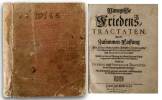
VD 17 12:194778A. - Enthält die bis 1678 geschlossenen Verträge zur Beilegung des Französisch-Niederländischen Krieges, weitere Verträge wurden 1679 in Saint-Germain abgeschlossen. Der auch als Holländischer Krieg bezeichnete Konflikt war ein gesamt europäischer, welcher von 1672-1678 dauerte, ausgelöst durch einen Angriff Frankreichs unter Ludwig XIV. und seinen Verbündeten England, Schweden und der Fürstbistümer Münster und Lüttich auf Holland. Um eine Vorherrschaft Frankreichs zu verhindern, verbündeten sich Spanien und das Hl. Römische Reich sich mit den Niederlanden. - Leicht gebräunt und teilw. mit kleinen Flecken. - Unter dem Impressung kleiner Zettel eingeklebt "Johannes W. à Iuvaltis (von Juvalt) Samadenensis Rhaetus, A. 1680" und hs. Einträge auf fliegendem Blatt vorn und im hinteren Innendeckel. - Einband berieben fleckig, Rücken abgeschabt und am Fuss defekt, hs. Inschrift auf Deckel IWI 88.
Probing the Limits of Representation: Nazism and the "Final Solution"
Harvard University Press 1992 414 pages 15 1x22 8x2 9cm. 1992. Broché. 414 pages.
Très bon état tranche un peu ternie intérieur propre bonne tenue
Men against Mccarthy
Columbia University Press 1976 428 pages 22 86x3 302x15 494cm. 1976. Cartonné. 428 pages. Ce livre publié au Royaume-Uni sous le titre 'The Canary That Sang' et aux États-Unis sous le titre 'The Valachi Papers' est la biographie de Joseph Valachi un ancien membre de la famille criminelle Genovese. Il raconte son témoignage historique en tant que premier indicieux issu de la mafia américaine détaillant l'organisation et les activités du crime organisé
Bon état sans jaquette fiche universitaire agrafée sur la garde intérieur propre
Aforismi e schizzi sulla storia
EDIZIONI SCIENTIFICHE ITALIANE - NAPOLI in8. Sans date. Broché. Dans 'The Future as History' l'économiste Robert L. Heilbroner analyse les courants de son époque en les reliant à leurs racines historiques et en examinant leur direction future. Il soutient que notre philosophie dominante est devenue trop étroite pour faire face aux réalités contemporaines et que notre maîtrise du monde est désormais remise en question
Bon état jaquette défraîchie dos annoté intériuer propre non daté
Microelectronics and Society: For Better or for Worse (Club of Rome Publications)
Pergamon 1982 370 pages 14 6x2 4x20 6cm. 1982. Broché. 370 pages.
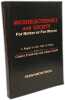
Très bon état de conservation intérieur propre étiquette sur la 4e de couverture
"FRIEDRICH, W., P. KNIPPING, MAX v. LAUE. - THE NATURE OF X RAYS AND THE ATOMIC STRUCTURE OF CRYSTALS.
Reference : 43821
(1913)
Inteferenzerscheinungen bei Röntgenstrahlen. (+ M. Laue:) Eine quantitative Prüfung der Theorie für die Inteferenzerscheinungen bei Röntgenstrahlen. (+ M. Laue und F. Tank:) Die gestalt der Interferenzpunkte bei den Röntgenstrahlinterferenzen. (3 pape...
(Leipzig, Ambrosius Barth, 1913). Without wrappers in ""Annalen der Physik"", Vierte Folge, Bd. 41, No.10. The entire issues offered. Pp. 873-1064 a. 6 plates. Laue's papers: pp. 971-988, pp. 989-1002 a. pp. 1003-1011. With the 5 famous plates in collotype (reproductions of the photographic plates), showing the X-Ray diffraction spectrum of different salt and substances (The ""Laue diagram"").
These papers represents the first full exposition of Laue's and his co-worker's discovery of the nature of X-Rays. The first two papers were printed the year before in ""Münchener Sitzungsberichte"", but finds their final form here and with the experimental confirmation by Laue and Tank. He showed that the regular spacing of the atoms in a crystal can serve as a grating of the desired precision, and he measures the wave-lenght of the X-rays.That crystals might be the appropriate grating for the X-rays proved to be well founded when Knipping, Friedrich and Tank found experimental confirmation of the theory.""It was in 1895 that Röntgen discovered a new form of radiation, to which, as its nature was so uncertain, he gave the name of the X-ray.....It was not until 1912, when von Laue showed it could be diffracted like ordinary light, that it was recognized with certainty as an ether wave of extremely short wave-lenght.Laue used a crystal for his diffraction grating...The X-ray is therefore identical with with light in respect to its nature, but differs greatly in quality: a state of things which is very favourable to an extension of our general knowledge of such radiations.""(William Bragg in ""The Universe of Light"", pp. 228 ff.).""It was the work of Laue and the experiments done by Friedrich and Knipping on his suggestion that cleared up the nature of X rays once and for all and that, moreover, beautifully demonstrated that crystals are composed of atoms arranged in a regular lattice......As in the case of Röntgen's original discovery, the photographs were extremely convincing. Other researchers immediately were attracted by the new field of X-ray spectroscopy and the discoveries by the Braggs and Mosely soon followed.""(Siegmund Brandt ""The harvest of a Century"", Episode 20, p. 80 ff.).""The awarding of the Nobel Prize in physics for 1914 to Laue indicated the significance of the discovery that Albert Einstein called ""ONE OF THE MOST BEAUTIFUL IN PHYSICS"". Subsequently it was possible to investigate X radiation itself by means of wavelenght determinations as well as to study the structure of the irradiated material. In the truest sense of the word scientists began to cast light on the structure of matter.""(DSB VIII, p. 51).PMM: 406 (the first 2 papers in Münchener Sitzungsberichte).The offered issue of ""Annalen"" contains also an importent paper by P. DEBYE & A. SOMMERFELD: ""Theorie des lichtelektrischen Effektes vom Standpunkt des Wirkungsquantums"", pp. 873-930

