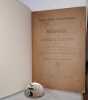
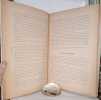
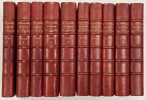
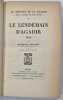
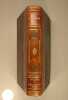
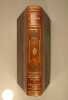
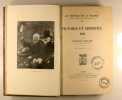
Georges Carré, éditeur à Paris Malicorne sur Sarthe, 72, Pays de la Loire, France 1894 Book condition, Etat : Très Bon relié, demi-basane havane, dos lisse, pièces de titres grand In-8 1 vol. - 343 pages
82 figures dans le texte en noir 1ere édition, édition originale, 1894 "Contents, Chapitres : 4 pages, Texte, 343 pages - Exposé de la théorie - Les oscillations hertziennes - Etude théorique des oscillations hertziennes - Phénomènes de résonance, propagation le long d'un fil, mesure directe de la vitesse de propagation - Propagation des oscillations dans l'air - Applications de la théorie - Propagation des oscillations électriques dans les diélectriques autres que l'air - Equations fondamentales de l'électrodynamique pour les corps en mouvement (ce dernier chapitre comporte 20 pages, pages 317 à 337). Etrange coincidence car on retrouve presque dans le titre du chapitre le titre exact de l'édition française du mémoire d'Albert Einstein présentant la relativité qui s'intitule ""Sur l'électrodynamique des corps en mouvement"". (Texte publié dans les Annalen de Physik, 1905, et en 1925 chez Gauthier-Villars en français). - Henri Poincaré est un mathématicien, physicien théoricien et philosophe des sciences français, né le 29 avril 1854 à Nancy et mort le 17 juillet 1912 à Paris. Poincaré a réalisé des travaux d'importance majeure en optique et en calcul infinitésimal. Ses avancées sur le problème des trois corps en font un fondateur de l'étude qualitativea des systèmes d'équations différentielles et de la théorie du chaos ; il est aussi un précurseur majeur de la théorie de la relativité restreinte et de la théorie des systèmes dynamiques. Il est considéré comme un des derniers grands savants universels, maîtrisant l'ensemble des branches des mathématiques de son époque et certaines branches de la physique. (source : Wikipedia)" "bel exemplaire frais et propre dans une reliure d'époque, le dos est à peine frotté, sans gravité, intérieur frais et propre, papier à peine jauni, quelques coins inférieurs de pages à peine pliés sans aucune gravité, cela reste un bel exemplaire d'un texte fondamental de Poincaré avec un dernier chapitre consacré aux ""équations fondametales pour l'électrodynamique des corps en mouvement"", qui est presque le titre homonyme de l'édition française de la relativité d'Einstein (Annalen de Physik 1905, paru chez Gauthier-Villars en 1930 sous le titre ""Sur l'électrodynamique des corps en mouvement""."
Arthème Fayard. Non daté. In-12. Broché. Etat d'usage, Couv. légèrement passée, Dos frotté, Quelques rousseurs. 32 pages. Non daté.. . . . Classification Dewey : 300-SCIENCES SOCIALES
Classification Dewey : 300-SCIENCES SOCIALES
Paris, A. Hermann et fils, 1911, in-8, XXV-294-[1] pp, Broché, couverture imprimée de l'éditeur, Première édition de ce recueil des leçons professées par Henri Poincaré (1854-1912) à la Sorbonne. Cet ouvrage critique et historique a été rédigé par Henri Vergne. Sans le papillon d'errata. Cette édition a été publiée sans le portrait (il sera inséré dans la seconde édition de 1913). Petits accrocs au dos, brochage fragile. Sinon bon exemplaire, tel que paru. Poggendorff V, 990. Couverture rigide
Bon XXV-294-[1] pp.
Paris, A. Hermann et fils 1913 In-8 24,5 x 16 cm. Reliure demi-basane verte, dos lisse, couvertures conservées, portrait de Henri Poncaré en frontispice, LXX-294 pp., 43 figures, index alphabétique, table des matières. Exemplaire en bon état.
Bon état d’occasion
[Berlin, Stockholm, Paris, F. & G. Beijer, 1882]. Large4to. As extracted from ""Acta Mathematica"", In ""Acta Mathematica"", volume 1. Clean and fine. Pp. 193-294.
First printing of Poincaré's famous paper which conjectured the uniformization theorem for (the Riemann surfaces of) algebraic curves. It also constitute the second paper in Poincaré's exceedingly important series of six paper's which together represent the discovery of Automorphic Functions. ""Before he was thirty years of age, Poincaré became world famous with his epoch-making discovery of the ""automorphic functions"" of one complex variable (or, as he called them, the ""fuchsian"" and ""kleinean"" functions)."" (DSB).These manuscripts, written between 28 June and 20 December 1880, show in detail how Poincaré exploited a series of insights to arrive at his first major contribution to mathematics: the discovery of the automorphic functions. In particular, the manuscripts corroborate Poincaré's introspective account of this discovery (1908), in which the real key to his discovery is given to be the recognition that the transformations he had used to define Fuchsian functions are identical with those of non-Euclidean geometry.The idea was to come in an indirect way from the work of his doctoral thesis on differential equations. His results applied only to restricted classes of functions and Poincaré wanted to generalize these results but, as a route towards this, he looked for a class functions where solutions did not exist. This led him to functions he named Fuchsian functions after Lazarus Fuchs but were later named automorphic functions. First editions and first publications of these epochmaking papers representing the discovery of ""automorphic functions"", or as Poincaré himself called them, the ""Fuchsian"" and ""Kleinian"" functions.""By 1884 Poincaré published five major papers on automorphic functions in the first five volumes of the new Acta Mathematica. When the first of these was published in the first volume of the new Acta Mathematica, Kronecker warned the editor, Mittag-Leffler, that this immature and obscure article would kill the journal. Guided by the theory of elliptic functions, Poincarë invented a new class of automorphic functions. This class was obtained by considering the inverse function of the ratio of two linear independent solutions of an equation. Thus this entire class of linear diffrential equations is solved by the use of these new transcendental functions of Poincaré."" (Morris Kline).Poincaré explains how he discovered the Automorphic Functions: ""For fifteen days I strove to prove that there could not be any functions like those I have since called Fuchsian functions, I was then very ignorant" every day I seated myself at my work table, stayed an hour or two, tried a great number of combinations and reached no results. One evening, contrary to my custom, I drank black coffee and could not sleep. Ideas rose in crowds I felt them collide until pairs interlocked, so to speak, making a stable combination. By the next morning I had established the existence of a Class of Fuchsian functions, those which come from hypergeometric series" i had only to write out the results, which took but a few hours...the transformations that I had used to define the Fuchsian functions were identical with those of Non-Euclidean geometry...""
Berlin, Stockholm, Paris, F. & G. Beijer, 1884. 4to. In contemporary half cloth. Stamps to title-page and last leaf. In ""Acta Mathematica"", no 5, 1884/1885. Entire issue offered. Pp. 209-278. [Entire issue: (4) 408 pp.].
First publication of this groundbreaking paper which together with his three other papers on the pubject (not offered here) constitute the discovery of Automorphic Functions. ""Before he was thirty years of age, Poincaré became world famous with his epoch-making discovery of the ""automorphic functions"" of one complex variable (or, as he called them, the ""fuchsian"" and ""kleinean"" functions)."" (DSB).These manuscripts, written between 28 June and 20 December 1880, show in detail how Poincaré exploited a series of insights to arrive at his first major contribution to mathematics: the discovery of the automorphic functions. In particular, the manuscripts corroborate Poincaré's introspective account of this discovery (1908), in which the real key to his discovery is given to be the recognition that the transformations he had used to define Fuchsian functions are identical with those of non-Euclidean geometry. (See Walter, Poincaré, Jules Henri French mathematician and scientist).The idea was to come in an indirect way from the work of his doctoral thesis on differential equations. His results applied only to restricted classes of functions and Poincaré wanted to generalize these results but, as a route towards this, he looked for a class functions where solutions did not exist. This led him to functions he named Fuchsian functions after Lazarus Fuchs but were later named automorphic functions. First editions and first publications of these epochmaking papers representing the discovery of ""automorphic functions"", or as Poincaré himself called them, the ""Fuchsian"" and ""Kleinian"" functions.""By 1884 Poincaré published five major papers on automorphic functions in the first five volumes of the new Acta Mathematica. When the first of these was published in the first volume of the new Acta Mathematica, Kronecker warned the editor, Mittag-Leffler, that this immature and obscure article would kill the journal. Guided by the theory of elliptic functions, Poincarë invented a new class of automorphic functions. This class was obtained by considering the inverse function of the ratio of two linear independent solutions of an equation. Thus this entire class of linear diffrential equations is solved by the use of these new transcendental functions of Poincaré."" (Morris Kline).Poincaré explains how he discovered the Automorphic Functions: ""For fifteen days I strove to prove that there could not be any functions like those I have since called Fuchsian functions, I was then very ignorant" every day I seated myself at my work table, stayed an hour or two, tried a great number of combinations and reached no results. One evening, contrary to my custom, I drank black coffee and could not sleep. Ideas rose in crowds I felt them collide until pairs interlocked, so to speak, making a stable combination. By the next morning I had established the existence of a Class of Fuchsian functions, those which come from hypergeometric series" i had only to write out the results, which took but a few hours...the transformations that I had used to define the Fuchsian functions were identical with those of Non-Euclidean geometry...""
E. Flammarion 1908 In-8 broché 21,5 cm sur 14,4. 333 pages. Couverture légèrement fragile avec petite déchirure en pied de dos. Bon état d’occasion.
Bon état d’occasion
Flammarion. Non daté. In-8. Broché. Etat d'usage, Couv. légèrement passée, Dos plié, Papier jauni. 332 pages.. . . . Classification Dewey : 500-SCIENCES DE LA NATURE ET MATHEMATIQUES
Classification Dewey : 500-SCIENCES DE LA NATURE ET MATHEMATIQUES
(Berlin, Uppsala & Stockholm, Paris, 1905. 4to. Bound in contemporary half cloth. In ""Acta Mathematica Hrsg. von G. Mittag-Leffler."", Bd. 29. Entires issue offered. Fine and clean. Pp. 235-272. [Entire volume: (4), 433 pp.].
Second of this paper in which Poincaré comments on the Swedish astronomer work.The offered issue contain many other papers by contemporary mathematicians.
(Berlin, Uppsala & Stockholm, Paris, 1892 a. 1897. 4to. Without wrappers as extracted from ""Acta Mathematica Hrsg. von G. Mittag-Leffler."", Bd. 16 and 20, pp. 297-339 and pp. 313-355.
First edition of these importent papers on the polarization of light. The geometrical representation of different states of polarization by points on a sphere are due to Poincare. The method shown to visualize the different states of polarization is given in these two papers and the method is called Poincare's Sphere.
(Berlin, Uppsala & Stockholm, Paris, 1892 a. 1897. 4to. Without wrappers as extracted from ""Acta Mathematica Hrsg. von G. Mittag-Leffler."", Bd. 16 and 20. Fine and clean. Pp. 297-339 (+) pp. 313-355.
First edition of these important papers on the polarization of light. The geometrical representation of different states of polarization by points on a sphere is due to Poincare. The method shown to visualize the different states of polarization is given in these two papers and the method is called Poincare's Sphere.
(Stockholm, F.& G. Beier), 1885. 4to. Orig. printed wrappers (to Acta Mathematica 4:3). Extracted from ""Acta Mathematica"", Vol. 4. Pp. 201-312. Clean and fine.
First appearance of a major paper on differential equations of the first order""...the whole theory of automorphic functions was from the start guided by the idea of integrating linear differential equations with algebraic coefficients. Poincaré simultaneously investigated the local problem of linear differential equation in the neighborhood of an ""irregular"" singular point, showing for the first time how asymptotic developments could be obtained for the integrals. A little later (1884, the paper offered) he took up the question, also started by I.L. Fuchs, of the determination of all differential equations of the first order (in the complex domain) algebraic in y and y' and having fixed singular points"" his rechearches was to be extended by Picard for equations of the second order, and to lead to the spectacular results of Painlevé and his school at the beginning of the tweentieth century.""(DSB).
(Berlin, Uppsala & Stockholm, Paris, 1886). 4to. Without wrappers as extracted from ""Acta Mathematica. Hrsg. von G. Mittag-Leffler."", Bd. 8, pp. 295-344.
First edition. ""The full recognition of the nature of those divergent series that are useful in the representation and calculation of functions and a formal definition of those series wer achieved by Poincaré and Stieltjes independently in 1886. Poincaré called these series asymptotic while Stieltjes continued to use the term semiconvergent. Poincaré took up the subject in order to further the solution of linear differential equations. Impressed by the usefulness of divergent series in astronomy, he sought to determine which were useful and why. he succededed in islolating and formulating the essential property...Poincaré applied his theory of asymptotic series to diffrential equations, and theree are many such uses in his treatise on celestical mechanics, 'Les Methodes nouvelles de la mechanique céleste"". (Morris Kline).
(Berlin, Uppsala & Stockholm, Paris, Almqvist & Wiksell, 1898). 4to. Without wrappers as extracted from ""Acta Mathematica. Hrsg. von G. Mittag-Leffler."", Bd. 22, pp. 89-178.
First edition. ""As soon as he came into contact with the work of Riemann and Weierstrass on Abelian Functions and algebraic geometry, Poincaré was very much attracted by those fields. His papers on these subjects occupy in his complete works as much space as those on automorphic functions, their dates ranging from 1881 to 1911. One of his main ideas in these papers is that of ""reduction"" of Abelian functions. Generalizing particular cases studied b Jacobi, Weierstrass, and Picard, Poincaré proved the general ""complete reducibility"" theorem...""(DSB).
Stockholm, Beijer, 1887. 4to. With the original wrappers in ""Acta Mathematica, 9:4. Band]. No backstrip. Fine and clean. Pp. 321-380. [Entire issue: Pp. 321-400]
First printing of Poincaré important - but partly unrecognized - paper which coined the term 'Poincaré lemma'. Even though it is named after Poincaré the discovery has by attributed to the Italian mathematician Vito Volterra who published a series of papers in 1889 on this subject.
(Berlin, Stockholm, Paris, Almqvist & Wiksell, 1907). 4to. Without wrappers as extracted from ""Acta Mathematica. Hrsg. von G. Mittag-Leffler"", Bd. 31, pp. 1-63.
First edition. Clebsch and Riemann tried to solve the problem of the uniformization for curves. ""In 1882 Klein gave a general uniformization theorem, but the proof was not complete. In 1883 Poincaré announced his general uniformization theorem but he too had no complete proof. Both Klein and Poincaré continued to work hard to prove this theorem but no decisive result was obtained for twent-five years. In 1907 Poincare (in the offered paper) and Paul Koebe independently gave a proof of this uniformization theorem...With the theorem on uniformization now rigorously established an improved treatment of algebraic functions and their integrals has become possible."" (Morris Kline).
(Berlin, Uppsala & Stockholm, Paris, Almqvist & Wiksell, 1897). 4to. No wrappers as extracted from ""Acta Mathematica. Hrsg. von G. Mittag-Leffler."", Bd. 21, pp. 83-97.
First edition. In this paper Poincaré arrives at a new theorem about canonical transformation, and in his later ""Methodes Nouvelles"", he proved this theorem using a variiational principle of mechanics, known today as the Hamilton principle.
Berlin, Stockholm, Paris, F. & G. Beijer, 1882-84. Large4to. As extracted from ""Acta Mathematica"", no backstrip. With title-page and the original wrappers. (except for paper no. 3 and 5 which only has the title page). In ""Acta Mathematica"", volume 1-5. Title pages with library stamp. Internally clean and fine. Vol. I, pp. 1-62" Pp. 193-294 Vol. II, pp. 97-113 Vol. III. pp. 49-92 Vol. IV pp. 201-312" Vol. V pp. 209-278.
First publication of these groundbreaking papers which together constitute the discovery of Automorphic Functions. ""Before he was thirty years of age, Poincaré became world famous with his epoch-making discovery of the ""automorphic functions"" of one complex variable (or, as he called them, the ""fuchsian"" and ""kleinean"" functions)."" (DSB).These manuscripts, written between 28 June and 20 December 1880, show in detail how Poincaré exploited a series of insights to arrive at his first major contribution to mathematics: the discovery of the automorphic functions. In particular, the manuscripts corroborate Poincaré's introspective account of this discovery (1908), in which the real key to his discovery is given to be the recognition that the transformations he had used to define Fuchsian functions are identical with those of non-Euclidean geometry. (See Walter, Poincaré, Jules Henri French mathematician and scientist).The idea was to come in an indirect way from the work of his doctoral thesis on differential equations. His results applied only to restricted classes of functions and Poincaré wanted to generalize these results but, as a route towards this, he looked for a class functions where solutions did not exist. This led him to functions he named Fuchsian functions after Lazarus Fuchs but were later named automorphic functions. First editions and first publications of these epochmaking papers representing the discovery of ""automorphic functions"", or as Poincaré himself called them, the ""Fuchsian"" and ""Kleinian"" functions.""By 1884 Poincaré published five major papers on automorphic functions in the first five volumes of the new Acta Mathematica. When the first of these was published in the first volume of the new Acta Mathematica, Kronecker warned the editor, Mittag-Leffler, that this immature and obscure article would kill the journal. Guided by the theory of elliptic functions, Poincarë invented a new class of automorphic functions. This class was obtained by considering the inverse function of the ratio of two linear independent solutions of an equation. Thus this entire class of linear diffrential equations is solved by the use of these new transcendental functions of Poincaré."" (Morris Kline).Poincaré explains how he discovered the Automorphic Functions: ""For fifteen days I strove to prove that there could not be any functions like those I have since called Fuchsian functions, I was then very ignorant" every day I seated myself at my work table, stayed an hour or two, tried a great number of combinations and reached no results. One evening, contrary to my custom, I drank black coffee and could not sleep. Ideas rose in crowds I felt them collide until pairs interlocked, so to speak, making a stable combination. By the next morning I had established the existence of a Class of Fuchsian functions, those which come from hypergeometric series" i had only to write out the results, which took but a few hours...the transformations that I had used to define the Fuchsian functions were identical with those of Non-Euclidean geometry...""
Berlin, Stockholm, Paris, F. & G. Beijer, 1882. Large4to. As extracted from ""Acta Mathematica"", no backstrip. With title-page and front free end-paper. In ""Acta Mathematica"", volume 1. Title pages with library stamp. A fine and clean copy. Pp. (6), 62.
First publication of this groundbreaking paper which became Poincaré first paper in his much celebrated and famous six-paper series which together constitute the discovery of Automorphic Functions. ""Before he was thirty years of age, Poincaré became world famous with his epoch-making discovery of the ""automorphic functions"" of one complex variable (or, as he called them, the ""fuchsian"" and ""kleinean"" functions)."" (DSB).These manuscripts, written between 28 June and 20 December 1880, show in detail how Poincaré exploited a series of insights to arrive at his first major contribution to mathematics: the discovery of the automorphic functions. In particular, the manuscripts corroborate Poincaré's introspective account of this discovery (1908), in which the real key to his discovery is given to be the recognition that the transformations he had used to define Fuchsian functions are identical with those of non-Euclidean geometry.The idea was to come in an indirect way from the work of his doctoral thesis on differential equations. His results applied only to restricted classes of functions and Poincaré wanted to generalize these results but, as a route towards this, he looked for a class functions where solutions did not exist. This led him to functions he named Fuchsian functions after Lazarus Fuchs but were later named automorphic functions. First editions and first publications of these epochmaking papers representing the discovery of ""automorphic functions"", or as Poincaré himself called them, the ""Fuchsian"" and ""Kleinian"" functions.""By 1884 Poincaré published five major papers on automorphic functions in the first five volumes of the new Acta Mathematica. When the first of these was published in the first volume of the new Acta Mathematica, Kronecker warned the editor, Mittag-Leffler, that this immature and obscure article would kill the journal. Guided by the theory of elliptic functions, Poincarë invented a new class of automorphic functions. This class was obtained by considering the inverse function of the ratio of two linear independent solutions of an equation. Thus this entire class of linear diffrential equations is solved by the use of these new transcendental functions of Poincaré."" (Morris Kline).Poincaré explains how he discovered the Automorphic Functions: ""For fifteen days I strove to prove that there could not be any functions like those I have since called Fuchsian functions, I was then very ignorant" every day I seated myself at my work table, stayed an hour or two, tried a great number of combinations and reached no results. One evening, contrary to my custom, I drank black coffee and could not sleep. Ideas rose in crowds I felt them collide until pairs interlocked, so to speak, making a stable combination. By the next morning I had established the existence of a Class of Fuchsian functions, those which come from hypergeometric series" i had only to write out the results, which took but a few hours...the transformations that I had used to define the Fuchsian functions were identical with those of Non-Euclidean geometry...""
Leipzig u. Berlin, Teubner, 1914. Orig. full cloth. IV,(2),283 pp.
First German edition.
(Stockholm, F.& G. Beier), 1885. 4to. No wrappers as extracted from ""Acta Mathematica"", Vol. 7. Pp. 259-288. Clean and fine.
First appearance of one of Poincaré's main papers.""Another famous paper of Poincar´we in celestial mechanics is the one he wrote in 1885 on the shape of a rotationg fluid mass submitted only to the forces of gravitation. Maclaurin had found as possible shapes some ellipsoids of revolution to which Jacobi had added other types of ellipsoids with unequal axes, and P.G. Tait and W.Thomson some annular shapes. By a penetrating analysis of the problem, Poincaré showed that still other ""pyriform"" shaoes exosted. One of the features of his interesting argument is that, apparently for the first time, he was confronted with the problem of minimizing a quadratic form in ""infinitely"" many variables.""(DSB).
Gauthier-Villars et Cie, éditeurs à Paris , Oeuvres d'Henri Poincaré - Académie des Sciences Malicorne sur Sarthe, 72, Pays de la Loire, France 1950 Book condition, Etat : Bon broché, sous couverture imprimée éditeur crème In-4 1 vol. - 560 pages
1ere édition, 1950 "Contents, Chapitres : Préface de Louis de Broglie, note d'Albert Chatelet, viii, Texte, 552 pages - Analyse de ses travaux sur l'algèbre et l'arithmétique fait par H. Poincaré - Bibliographie des travaux d'algèbre et d'arithmétique - L'avenir des mathématiques -Etude algébrique des formes - Formes invariantes pour des substitutions - Nombres hypercomplexes - Zéros des polynomes - Algèbre de l'infini - Réseaux et formes quadratiques binaires - Fractions continues - Invariants arithmétiques - Formes quadratiques ternaires et groupes fuchsiens - Fonctions fuchsiennes arithmétiques - Etude arithmétique des formes cubiques ternaires - Réduction simultanée d'un système de formes - Formes binaires - Genre des formes - Nombres premiers - Arithmétique des courbes algébriques - Henri Poincaré est un mathématicien, physicien théoricien et philosophe des sciences français, né le 29 avril 1854 à Nancy et mort le 17 juillet 1912 à Paris. Poincaré a réalisé des travaux d'importance majeure en optique et en calcul infinitésimal. Ses avancées sur le problème des trois corps en font un fondateur de l'étude qualitative des systèmes d'équations différentielles et de la théorie du chaos ; il est aussi un précurseur majeur de la théorie de la relativité restreinte et de la théorie des systèmes dynamiques. Il est considéré comme un des derniers grands savants universels, maîtrisant l'ensemble des branches des mathématiques de son époque et certaines branches de la physique. (source : Wikipedia) - Poincaré est le fondateur de la topologie algébrique. Ses principaux travaux mathématiques ont eu pour objet la géométrie algébrique, des types de fonctions particuliers les fonctions dites « automorphes » (il découvre les fonctions fuchsiennes et kleinéennes), les équations différentielles La notion de continuité est centrale dans son travail, autant par ses répercussions théoriques que pour les problèmes topologiques qu'elle entraîne." couverture propre mais avec quelques rousseurs sur les plats, infime petite déchirure sur le haut du bord droit du plat supérieur, la couverture reste en bon état, intérieur très frais et propre, une page mal ouverte à l'ouverture, cela reste un bon exemplaire - Tome 5 seul
Poincaré, Henri (Choix de textes et introduction de Girolamo Ramunni)
Reference : 46327
(1991)
Hermann Couverture souple Paris 1991
Très bon In-8. 241 pages. Coll. "Savoir : Sciences".
Leipzig, B.G. Teubner, 1882. 8vo. Original printed wrappers, no backstrip. In ""Mathematische Annalen. Begründet 1882 durch Rudolf Friedrich Alfred Clebsch. XIX. [19] Band. 4. Heft."" Entire issue offered. [Poincaré:] Pp. 553-64. [Entire issue: Pp. 435-594].
First printing of Poincaré's paper on his comprehensive theory of complex-valued functions which remain invariant under the infinite, discontinuous group of linear transformations. In 1881 Poincaré had published a few short papers with some initial work on the topic, and in the 1881, Klein invited Poincaré to write a longer exposition of his results to Mathematische Annalen which became the present paper. This, however, turned out to be an invitation to at mathematical dispute:""Before the article went to press, Klein forewarned Poincaré that he had appended a note to it in which he registered his objections to the terminology employed therein. In particular, Klein disputed Poincaré's decision to name the important class of functions possessing a natural boundary circle after Fuch's, a leading exponent of the Berlin school. The importance he attached to this matter, however, went far beyond the bounds of conventional priority dispute. True, Klein was concerned that his own work received sufficient acclaim, but the overriding issue hinged on whether the mathematical community would regard the burgeoning research in this field as an outgrowth of Weierstrassian analysis or the Riemannian tradition."" Parshall. The Emergence of the American Mathematical Research Community. Pp. 184-5.The issue contains the following important contributions by seminal mathematicians:1. Klein, Felix. Ueber eindeutige Functionen mit linearen Transformationen in sich. Pp. 565-68.2. Picard, Emile. Sur un théorème relatif aux surfaces pour lesquelles les coordnnées d´un point quelconque s´experiment par des fonctions abéliennes de deux paramètres. Pp. 578-87.3. Cantor, Georg. Ueber ein neues und allgemeines Condensationsprincip der Singularitäten von Functionen. Pp. 588-94.
Poincaré (Henri) - Gaston Darboux, ed. - N.E. Nörlund et de Ernest Lebon
Reference : 100426
(1995)
Jacques Gabay , Les Grands Classiques Gauthier-Villars Malicorne sur Sarthe, 72, Pays de la Loire, France 1995 Book condition, Etat : Bon broché, sous couverture imprimée éditeur blanche, titre en rouge fort et grand In-8 1 vol. - 703 pages
Réimpression de 1999 de l'édition Gauthier-Villars de 1916 "Contents, Chapitres : Préface de Gaston Darboux, Eloge historique d'Henri Poincaré par Gaston Darboux, LXXI (71 pages), Texte, 632 pages - Henri Poincaré est un mathématicien, physicien théoricien et philosophe des sciences français, né le 29 avril 1854 à Nancy et mort le 17 juillet 1912 à Paris. Poincaré a réalisé des travaux d'importance majeure en optique et en calcul infinitésimal. Ses avancées sur le problème des trois corps en font un fondateur de l'étude qualitativea des systèmes d'équations différentielles et de la théorie du chaos ; il est aussi un précurseur majeur de la théorie de la relativité restreinte et de la théorie des systèmes dynamiques. Il est considéré comme un des derniers grands savants universels, maîtrisant l'ensemble des branches des mathématiques de son époque et certaines branches de la physique. - Poincaré est le fondateur de la topologie algébrique. Ses principaux travaux mathématiques ont eu pour objet la géométrie algébrique, des types de fonctions particuliers les fonctions dites « automorphes » (il découvre les fonctions fuchsiennes et kleinéennes), les équations différentielles La notion de continuité est centrale dans son travail, autant par ses répercussions théoriques que pour les problèmes topologiques qu'elle entraîne. (source : Wikipedia). Charles Auguste Briot, 1817-1882 est un mathématicien et physicien français. Il a publié plusieurs traités avec Bouquet concernant les fonctions elliptiques et les fonctions abéliennes. Il a aussi publié des travaux de physique mathématique : ""Essai sur la théorie mathématique de la lumière"" et ""Théorie mécanique de la chaleur"" d'après son cours donné à la faculté des sciences de Paris pendant l'année 1867-1868. Il conçoit de plus une formule de dispersion lumineuse éponyme, la formule de Briot. Jean-Claude Bouquet, 1819-1885, est un mathématicien français qui travailla notamment avec Charles Briot sur les fonctions doublement périodiques. - Lazarus Immanuel Fuchs (5 mai 1833 - 26 avril 1902) est un mathématicien allemand. Il a laissé son nom aux groupes fuchsiens et aux fonctions fuchsiennes (notions et adjectif créés par Henri Poincaré, avec qui il entretint une correspondance) ainsi qu'à l'équation de Picard-Fuchs et au théorème de Fuchs ; les équations différentielles fuchsiennes sont celles avec des singularités régulières. - Selon Rossana Tazzioli (2010) : ""Cest Poincaré qui, le premier, a compris le lien (tant profond quétonnant) entre la théorie des fonctions fuchsiennes et la géométrie non euclidienne, et pour comprendre ce lien il a dû passer par les groupes de transformations""." couverture à peine jaunie, sinon bel exemplaire, intérieur frais et propre