 Write to the booksellers
-
Type
Autograph (2)
Book (482)
Magazine (12)
Music sheets (2)
Photographs (7)
-
Language
French (488)
Russian (17)
-
Century
19th (42)
20th (257)
21st (2)
-
Countries
Belgium (21)
Canada (2)
Côte d'Ivoire (1)
Denmark (37)
France (411)
Germany (1)
Switzerland (14)
United States of America (18)
-
Syndicate
ALAC (1)
CLAM (1)
ILAB (242)
NVVA (4)
SLACES (4)
SLAM (197)
SNCAO (2)
Sur L'Uniformisation des Fonctions Analytiques. - [THE UNIFORMIZATION THEOREM]
Berlin, Stockholm, Paris, Almqvist & Wiksell, 1908. 4to. Bound in contemporary half cloth with gilt lettering to spine. In ""Acta Mathematica"", Vol, 31, 1908. Entire volume offered. Stamps to title page, otherwise a fine and clean copy. Pp. 1-64. [Entire volume: (8), 408, (2), 12 pp].
First appearance of Poincaré's important paper in which he presented the first solution to the problem of the uniformization of curves - now know as The Uniformization Theorem. Clebsch and Riemann tried to solve the problem of the uniformization for curves. ""In 1882 Klein gave a general uniformization theorem, but the proof was not complete. In 1883 Poincaré announced his general uniformization theorem but he too had no complete proof. Both Klein and Poincaré continued to work hard to prove this theorem but no decisive result was obtained for twent-five years. In 1907 Poincare (in the offered paper) and Paul Koebe independently gave a proof of this uniformization theorem...With the theorem on uniformization now rigorously established an improved treatment of algebraic functions and their integrals has become possible."" (Morris Kline).

Sur l'équilibre d'une masse fluide animée d'un mouvement de rotation. - [POINCARÉ'S PEAR-SHAPE]
(Stockholm, Beijer), 1885. 4to. As extracted from ""Acta Mathematica, 21. Band]. No backstrip. Fine and clean. Pp. 259-380.
First printing of Poincaré's famous paper in which he proved that a rotating fluid such as a star changed its shape from a sphere to an ellipsoid to a pear-shape before breaking into two unequal portions. ""This work, which contained the discovery of new, pear-shaped figures of equilibrium, aroused considerable attention because of its important implications for cosmogony in relation to the evolution of binary stars and other celestial bodies."" (The Princeton Companion to Mathematics, P. 786)Another famous paper of Poincaré in celestial mechanics is the one he wrote in 1885 on the shape of a rotating fluid mass submitted only to the forces of gravitation. Maclaurin had found as possible shapes some ellipsoids of revolution to which Jacobi had added other types of ellipsoids with unequal axes, and P. G. Tait and W. Thomson some annular shapes. By a penetrating analysis of the problem, Poincaré showed that still other ""pyriform"" shapes existed. One of the features of his interesting argument is that, apparently for the first time, he was confronted with the problem of minimizing a quadratic form in ""infinitely"" many variables."" (DSB)
Sur une Forme nouvelle des Équations du Probleme des trois Corps (+) Sur les rapports de l'analyse pure et de la physique mathématique.
Berlin, Uppsala & Stockholm, Paris, Almqvist & Wiksell, 1897. 4to. Bound in contemporary half cloth with gilt lettering to spine. In ""Acta Mathematica"", Vol, 21, 1897. Entire volume offered. Stamps to title page, otherwise a fine and clean copy. pp. 83-97"" Pp. 331-341.[Entire volume: (6), 376 pp + 4 plates].
First printing of this paper in which Poincaré arrives at a new theorem about canonical transformation, and in his later ""Methodes Nouvelles"", he proved this theorem using a variiational principle of mechanics, known today as the Hamilton principle.Also included is the first printing of Poincaré's principal address at the first International Congress of Mathematicians held in Zürich in 1897.
Sur un theoreme de M. Fuchs.
Stockholm, Beijer, 1885. 4to. As extracted from ""Acta Mathematica, 21. Band]. No backstrip. Fine and clean. Pp. 83-97.
First printing of Poincaré's paper in which he developed the idea published by Fuchs in 1884. Fuchs established that the equation with fixed branch points can be made into a Riccati equation if its genus - the genus of the corresponding Riemann surface - with respect to u and du/dz is zero and can be integrated using elliptic functions if the genus is 1.
Rapport sur le Prix Bolyai. - [POINCARÉ APPRAISAL OF HILBERT]
Berlin, G. Reimer, 1912. 4to. Bound in contemporary half cloth with gilt lettering to spine. In ""Acta Mathematica"", Vol, 35, 1912. Entire volume offered. Stamps to title page, otherwise a fine and clean copy. Pp. 1-28. [Entire volume: (4), 398, (1), 27, 19 pp].
First appearance of Poincaré's report on 1910 Bolyai Prize which was awarded to David Hilbert in recognition of his work in fields of invariant theory, transcendent number (e constant after Lindemann), arithmetic, the (Hilbert-)Waring theorem, geometry, integral equations and the Dirichlet’s principle.In 1910, Hilbert became only the second winner of the Bolyai Prize of the Hungarian Academy of Sciences. It was the recognition of the fact that Hilbert was one of the leading mathematicians of his time. The first winner of the prize in 1905 was Henri Poincare, the most prolific mathematician of the 19th century.Poincaré about the works and achievements of David Hilbert in fields of invariant theory, transcendent number (e constant after Lindemann), arithmetic, the (Hilbert-)Waring theorem, geometry, integral equations and the Dirichlet’s principle.
Capillarité. Lecons professés pendant le deuxieme semestre 1888-1889. Redigées par J. Blondin.
Paris, Gauthier-Villars, (1895). Royal8vo. Orig. printed wrappers. Upper part of backstrip nearly gone. A small tear to frontwrapper, no loss. (4),189,(1) pp. Textfigures.
First edition. (Cours de Physique Mathematique).
Cinématique et mécanismes. Potentiel et mécanique des fluides
Paris, Georges Carré et C. Naud, 1899, in-8, 385 pp, broché, Seconde édition, rédigée par Amédée Guillet, de ces cours professés à la Sorbonne par Henri Poincaré pendant l'année 1885-1886. Cet exemplaire comporte un envoi autographe signé de Guillet à monsieur Lippmann, sans doute Gabriel Lippmann, lauréat du Nobel de physique de 1908 pour ses travaux sur la photographie en couleurs. Couverture défraîchie et restaurée, petites rousseurs en début et fin de volume, dos partiellement décollé? Couverture rigide
Bon 385 pp.

Cours de la Faculté des sciences de Paris. - Électricité et optique, I. Les Théories de Maxwell et la théorie électromagnétique de la lumière. Leçons professées pendant le second semestre 1888-89. Rédigées par J. Blondin
Paris, Georges Carré, 1890 in-8, XIX pp., 314 pp., avec 39 figures dans le texte, demi-basane bordeaux, dos lisse de guirlandes et filets dorés, tranches mouchetées (reliure de l'époque).
Édition originale. Ce fut une constante des travaux de Poincaré (1854-1912) que de rechercher l'application de ses connaissances mathématiques au domaine de la physique, ici dans les cas des équations de Maxwell à l'électrodynamique et au magnétisme. - - VENTE PAR CORRESPONDANCE UNIQUEMENT - LIEN DE PAIEMENT, NOUS CONSULTER.
Dernières pensées - Collection nouvelle bibliothèque scientifique.
Flammarion. 1963. In-8. Broché. Etat d'usage, Couv. convenable, Dos satisfaisant, Intérieur acceptable. 220 pages.. . . . Classification Dewey : 500-SCIENCES DE LA NATURE ET MATHEMATIQUES
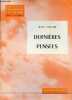
Collection nouvelle bibliothèque scientifique. Classification Dewey : 500-SCIENCES DE LA NATURE ET MATHEMATIQUES
ELECTRICITE ET OPTIQUE: 2ème éd
JACQUES GABAY 1991 3x24x16cm. 1991. Broché.
proche du très bon état intérieur propre bonne tenue dos légèrement creusé comporte une ride
Figures d'équilibre d'une masse fluide
Paris, Gauthier-Villars et Cie, éditeurs, 1902, in-8, 210 pp, Broché, couverture imprimée, Édition originale des leçons professées par Poincaré à la Sorbonne en 1900, rédigées par L Dreyfus. Couverture un peu défraîchie. Couverture rigide
Bon 210 pp.
La Méthode de Neumann et le Probleme de Dirichlet.
(Berlin, Uppsala & Stockholm, Paris, 1895). 4to. Without wrappers as extracted from ""Acta Mathematica. Hrsg. von G. Mittag-Leffler"", Bd. 20, pp. 59-142.
First edition. In this paper Poincaré succeeded in converting differential equations into integral equations. ""It became a major technique for solving initial-and boundary-value problems of ordinary and partial differential equations and was the strongest impetus for the study of integral equations."" (Morris Kline).
La méthode de Neumann et le problème de Dirichlet.
[Berlin, Stockholm, Paris, Beijer, 1897]. 4to. Without wrappers as extracted from ""Acta Mathematica. Hrdg. von G. Mittag-Leffler."", Bd. 20, pp. 59-142.
First printing of Poincaré's paper in which he succeeded in converting differential equations into integral equations. ""It became a major technique for solving initial-and boundary-value problems of ordinary and partial differential equations and was the strongest impetus for the study of integral equations."" (Morris Kline).
L'analyse et la recherche - Collection savoir : sciences.
Hermann. 1991. In-8. Broché. Bon état, Couv. convenable, Dos satisfaisant, Intérieur frais. 241 pages.. . . . Classification Dewey : 500-SCIENCES DE LA NATURE ET MATHEMATIQUES
Collection savoir : sciences - Choix de textes et introduction de Girolamo Ramunni. Classification Dewey : 500-SCIENCES DE LA NATURE ET MATHEMATIQUES
La science et l'hypothèse
Ernest Flammarion. Non daté. In-8. Broché. Etat d'usage, Couv. convenable, Dos plié, Intérieur acceptable. 304 pages. Portrait en noir et blanc en frontispice. Non daté.. . . . Classification Dewey : 190-Philosophie occidentale moderne
Classification Dewey : 190-Philosophie occidentale moderne
LA SCIENCE ET L'HYPOTHÈSE
Paris Ernest Flammarion, Editeur 1960 in 12 (19x13) 1 volume broché, 294 pages [1]. Bibliothèque de philosophie scientifique. Bel exemplaire ( Photographies sur demande / We can send pictures of this book on simple request )
Très bon Broché
La Science et l'hypothèse
Flammarion Science de la nature Dos carré collé 1968 In-12 (10,9 x 17,8 cm), dos carré collé, 252 pages ; volume bruni, taches et mlanque au premier plats, sur les premiers feuillets et sur la tranche, en l'état. Livraison a domicile (La Poste) ou en Mondial Relay sur simple demande.
La science et l'hypothèse - Collection Champs n°56.
Flammarion. 1999. In-12. Broché. Etat d'usage, Couv. convenable, Dos satisfaisant, Intérieur acceptable. 252 pages - nombreuses annotations, phrases soulignées au crayon à papier à l'intérieur du livre ne gênant pas la lecture.. . . . Classification Dewey : 500-SCIENCES DE LA NATURE ET MATHEMATIQUES
Collection Champs n°56. Classification Dewey : 500-SCIENCES DE LA NATURE ET MATHEMATIQUES
La valeur de la science
Flammarion 1929, in-12 relié demi-cuir, 278pp; frottements d’usage à la reliure, papier jauni d’époque - bon état
La Valeur de la science
Flammarion, coll. « Bibliothèque de Philosophie Scientifique » 1955 Quarante-huitième mille. In-12 broché. 278 pages. Bon état d’occasion.
Bon état d’occasion
La valeur de la science
Paris Flammarion Paris, Éditions Flammarion, 1948. Collection : Bibliothèque de philosophie scientifique, dirigée par Paul Gaultier. In-12 broché de 278 pages. Pages non coupées en tranche de tête. Bel exemplaire.
Toutes les expéditions sont faites en suivi au-dessus de 25 euros. Expédition quotidienne pour les envois simples, suivis, recommandés ou Colissimo.
"Les sciences et les humanités - ""Ligue pour la culture française"""
Arthème Fayard. Non daté. In-12. Broché. Etat d'usage, Couv. légèrement passée, Dos frotté, Quelques rousseurs. 32 pages. Non daté.. . . . Classification Dewey : 300-SCIENCES SOCIALES
Classification Dewey : 300-SCIENCES SOCIALES
Leçons sur les hypothèses cosmogoniques
Paris, A. Hermann et fils, 1911, in-8, XXV-294-[1] pp, Broché, couverture imprimée de l'éditeur, Première édition de ce recueil des leçons professées par Henri Poincaré (1854-1912) à la Sorbonne. Cet ouvrage critique et historique a été rédigé par Henri Vergne. Sans le papillon d'errata. Cette édition a été publiée sans le portrait (il sera inséré dans la seconde édition de 1913). Petits accrocs au dos, brochage fragile. Sinon bon exemplaire, tel que paru. Poggendorff V, 990. Couverture rigide
Bon XXV-294-[1] pp.
Leçons sur les hypothèses cosmogoniques / professées à la Sorbonne par Henri Poincaré,... ; rédigées par Henri Vergne,.... avec... une notice sur Henri Poincaré / par Ernest Lebon
Paris, A. Hermann et fils 1913 In-8 24,5 x 16 cm. Reliure demi-basane verte, dos lisse, couvertures conservées, portrait de Henri Poncaré en frontispice, LXX-294 pp., 43 figures, index alphabétique, table des matières. Exemplaire en bon état.
Bon état d’occasion
Mémoire sur les Fonctions fuchsiennes.
[Berlin, Stockholm, Paris, F. & G. Beijer, 1882]. Large4to. As extracted from ""Acta Mathematica"", In ""Acta Mathematica"", volume 1. Clean and fine. Pp. 193-294.
First printing of Poincaré's famous paper which conjectured the uniformization theorem for (the Riemann surfaces of) algebraic curves. It also constitute the second paper in Poincaré's exceedingly important series of six paper's which together represent the discovery of Automorphic Functions. ""Before he was thirty years of age, Poincaré became world famous with his epoch-making discovery of the ""automorphic functions"" of one complex variable (or, as he called them, the ""fuchsian"" and ""kleinean"" functions)."" (DSB).These manuscripts, written between 28 June and 20 December 1880, show in detail how Poincaré exploited a series of insights to arrive at his first major contribution to mathematics: the discovery of the automorphic functions. In particular, the manuscripts corroborate Poincaré's introspective account of this discovery (1908), in which the real key to his discovery is given to be the recognition that the transformations he had used to define Fuchsian functions are identical with those of non-Euclidean geometry.The idea was to come in an indirect way from the work of his doctoral thesis on differential equations. His results applied only to restricted classes of functions and Poincaré wanted to generalize these results but, as a route towards this, he looked for a class functions where solutions did not exist. This led him to functions he named Fuchsian functions after Lazarus Fuchs but were later named automorphic functions. First editions and first publications of these epochmaking papers representing the discovery of ""automorphic functions"", or as Poincaré himself called them, the ""Fuchsian"" and ""Kleinian"" functions.""By 1884 Poincaré published five major papers on automorphic functions in the first five volumes of the new Acta Mathematica. When the first of these was published in the first volume of the new Acta Mathematica, Kronecker warned the editor, Mittag-Leffler, that this immature and obscure article would kill the journal. Guided by the theory of elliptic functions, Poincarë invented a new class of automorphic functions. This class was obtained by considering the inverse function of the ratio of two linear independent solutions of an equation. Thus this entire class of linear diffrential equations is solved by the use of these new transcendental functions of Poincaré."" (Morris Kline).Poincaré explains how he discovered the Automorphic Functions: ""For fifteen days I strove to prove that there could not be any functions like those I have since called Fuchsian functions, I was then very ignorant" every day I seated myself at my work table, stayed an hour or two, tried a great number of combinations and reached no results. One evening, contrary to my custom, I drank black coffee and could not sleep. Ideas rose in crowds I felt them collide until pairs interlocked, so to speak, making a stable combination. By the next morning I had established the existence of a Class of Fuchsian functions, those which come from hypergeometric series" i had only to write out the results, which took but a few hours...the transformations that I had used to define the Fuchsian functions were identical with those of Non-Euclidean geometry...""

