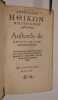
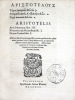
Aristote Laurentius Minio-Paluello Erse Valgimigli Aetius Franceschini
Reference : 100102792
(2026)
Desclée de Brouwer / Bruges-Paris 2026 in8. 2026. Broché.
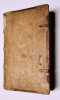
dos recollé bords frottés couverture défraîchie intérieur propre
2021 Paris, Villegagnons-Plaisance éditions, 2021. Deux grands in-8 brochés de 235 et 370 pp. avec bibliographies in fine. Très bon état, comme neuf.
2021 Paris, Villegagnons-Plaisance éditions, 2021. Grand in-8 broché de 235 pp., bibliographie in fine. Très bon état, comme neuf.
2021 Paris, Villegagnons-Plaisance éditions, 2021. Grand in-8 broché de 370 pp. avec index et bibliographie in fine. Très bon état, comme neuf.
Leiden (Lugduni Batavorum), Ex Officina Plantiniana, Apud Franciscum Raphelengium, 1591.
8vo. 2 parts in 1: (XVI),297,(7 index); 23,(1 blank) p. Modern half calf. 16 cm (Ref: STCN ppn 840465076; Cranz (Bibliotheca Bibliographica Aureliana) 108.713; Schwab 1520; Hoffmann 1,285; Schweiger 1,53; Brunet 1,464; Graesse 1,213; Ebert 1137) (Details: Restored half calf antique style, with some gilding on the back, and a red shield. Marbled boards. Plantin's woodcut printer's mark on the title, motto: 'Labore et Constantia'. The first part (p. 1-297) contains 'De Mundo'; the Greek text is divided in paragraphs, and each paragraph is followed by 2 Latin translations, of Apuleius and of Guillaume Budé, and by explanatory notes (scholia) of Vulcanius. The second part, which is often lacking in other copies, has a title page of its own; it contains the 'editio princeps' of the Greek text of Gregorius Cyprius' 'Praise of the Sea', and reissue of Paulus Silentiarius' poem on the hotsprings (Therma) in Bithynia) (Condition: Paper yellowing. 2 names on the title. Right edge of the first leaves slightly thumbed, the right lower corner of the first leaves somewhat dog-eared) (Note: The Greek scholar/philosopher Aristotle, 384-322 B.C., is one of the foremost names in the history of thought, and perhaps the most influential of all who have ever written. His influence on Western science and culture is immense. His boundless industry extended to most branches of higher learning. 74 treatises, genuine and spurious, have come down to us under his name. One such work that has no claim to be genuine is the once popular philosophic treatise 'De Mundo', or 'On the Universe'. (Edition Bekker 391-401) In it cosmological and meterological subjects are treated. The work was once ascribed to Aristotle, but ever since the German scholar Wilhelm Capelle traced most of its doctrines to the Greek Stoic philosopher Posidonius of Apameia, ca. 135 - ca. 51 B.C., the author is known as Pseudo-Aristotle. (Neue Jahrbücher, XV (1905) p. 529/68) Capelle dates the treatise in the first half of the second century A.D. It was translated into Latin in the second century A.D. by the Roman rhetorician and platonic philosopher Apuleius Madaurensis, who is best known for his famous picaresque novel 'Metamorphoses', also known as 'The Golden Ass'. In 1533, the French classical scholar Guillaume Budé (Guilielmus Budaeus) published in Basel an edition of 'De Mundo' with a Latin translation of his own. This translation and the one of Apuleius was adopted in this Leiden edition of 1591 edited by the Flemish scholar Bonaventura Vulcanius (De Smet in Flemish), 1539-1614, from 1581 professor of Greek and Latin Letters at the recently founded University of Leiden. It is Vulcanius second edition of 'De Mundo', for in 1587 he had published the first edition. In the short preface Vulcanius observes that he has restored 'De Mundo' to its original splendor, emendating the manuscript and editions he used (e.g. 'vetus codex meus habet' and 'In Aldina legitur') at quite a number of places, and that he has cleansed Apuleius' translation from many horrific mistakes. ('In Aristotele itaque emendavi non pauca, ab Apuleio innumera mendarum portenta profligavi, totamque hanc Aristotelici pariter & Apuleiani Mundi fabricam pristinae suae, quoad eius fieri potuit, integritati restitui', p. *3 verso) Vulcanius elucidated ('illustravi') 'De Mundo' also with a load of annotations that, he hoped, were useful for future philologists and even philosophers. In his annotations he examined how faithful to the Greek the Latin versions of Apuleius and Budaeus were, and the 'emendations Vulcanius supplied were nearly all accepted by later editors of 'De Mundo', notably Bekker (1831) and Lorimer (1938)'. (H. Cazes (ed.), 'Bonaventura Vulcanius, Works and Networks: Bruges 1538 - Leiden 1614', Leiden 2010, p. 346) 3 years after this edition of 'De Mundo' Vulcanius produced for the same publisher an 'Opera Omnia' edition of Apuleius. After 'De Mundo' Vulcanius has added in this edition of 1591 a separate volume containing 2 short Greek texts, the 'editio princeps' of a prose work of Gregorius Cyprius, 1241-1290, Patriarch of Constantinople, the 'Encomium Maris', or the 'Praise of the Sea', (p. 3/12) and a iambic poem of 189 verses composed by Paulus Silentiarius during the reign of Justinian, 'Eis ta en Pythois Therma', on the hotsprings in Bithynia in Asia Minor (p. 13/23, including Vulcanius' notes). It was, Vulcanius explains in the 1 page introduction to this poem, shoddily presented in the 'Anthologia Epigrammatum Graecorum' of Henri Estienne of 1566. He therefore decided to deliver a correct and sound text, with his annotations. (p. 13) These 2 small works were probably added by Vulcanius because they go well with, and illustrate the passages in 'De Mundo' on the element water, i.e. rivers, seas, oceans etc. (p. 44/62)) (Provenance: On the title the name of 'Henricus Gesselius'. This might be the Dutchman Henricus Gesselius, a 'Medicinae Doctor', who published in 1640 a 'Disputationum medicarum quinta, de febre hectica & malignis' and 'Disputationum medicarum de febribus septima'. If this is correct the other name 'Ioan. Cor. Gess.' might well be Johannes Cornelius Gesselius, ca. 1550-1627, who was from 1574 rector of the Gymnasium of Amersfoort. He was fired in 1619 because he refused to renounce his catholic faith. (NNBW 6, p. 579/80) (Collation: *8, A-T8; a8, b4 (leaf b4 verso blank)) (Photographs on request)
Hamburg, Felix Meiner, 1985.
LXII,450 p. Paperback. 19 cm (PhB 5)
Brussel, KAWLsK, 1963.
183 p. Wrs. 26 cm (Verh. KAWLsK)(Saec. XIII)
Budel, Damon, 2001.
175 p. Hardb. 21 cm (OiN Suppl. 31; includ. Greek text; dustjacket)
Berlin, Walter De Gruyter 1960 Volume 2 only (out of 5): xvii + [673] pp. (i.e. pages 790 to 1462), photomechanical reprint of the 1851-edition, 28cm., publisher's hardcover in brown cloth (gilt lettering on spine, spine bit sunfaded), text in Greek, text printed in 2 columns, text and interior are clean and bright, good condition, weight: 2.4kg., F107703
Berlin, Walter De Gruyter 1960 Volume 1 only (out of 5): xxiii + 789pp., photomechanical reprint of the 1851-edition, 28cm., publisher's hardcover in brown cloth (gilt lettering on spine, spine bit sunfaded), text in Greek, text printed in 2 columns, text and interior are clean and bright, good condition, weight: 2.8kg., F107704
Basle (Basileae), Eusebii Episcopii opera ac impensa, 1582.
Folio. (XX),623,(12 index),(1 printer's mark) p. Modern calf 35.5 cm (Details: Nice copy, bound in modern full (red)brown calf, with 5 raised bands on the back. Spine short title in gilt: 'ARISTOTELIS / DE REPVBLICA'. Text in three columns, with the Greek in the centre flanked by the Latin translations of Piero Vettori and Denys Lambin respectively on each side. Large printer's woodcut device to the title and last page, depicting a bust of 'Hermes triceps' (three-headed Hermes) on a pillar; each of the heads wears a winged helmet; the middle Hermes holds in his right hand a caduceus, and in his left a bishop's staff (Episcopius!); from the pillar seems to hang a chopped off head. Large historiated woodcut letter on leaf a2, woodcut letters of various sizes throughout the text. Wide margins) (Condition: First and last leaf dust-soiled. Small and faint name on the title. Paper yellowing. Small bookplate on the front pastedown. 2 bookplates on the lower pastedown) (Note: The Greek scholar/philosopher Aristotle, 384-322 B.C., is one of the foremost names in the history of thought, and perhaps the most influential of all who have ever written. His influence on Werstern science and culture is immense. His boundless industry extended to most branches of higher learning. 74 treatises, genuine and spurious, have come down to us under his name. His 'Politics', literally 'the things concerning the polis', is among his best known and most widely read works. It embraces in 8 books the historical, theoretical and practical aspect of politics. To Aristotle 'politics were the very crown of philosophical study (...) and the ultimate end of the State to provide an environment in which those capable of the highest mental and moral development might attain thereto. (...) The important sections of this great work are the sketch of the ideal state, (...) the account of the various forms of government (...) the discussions of sovranty and responsibility and of kingship'. (H.J. Rose, 'A handbook of Greek literature', Oxford, 1965, p. 276) This Basle edition of 1582 of the Politics adopts the Greek text, Latin translation and the famous commentary, earlier published by the Italian scholar Piero Vettori (Petrus Victorius), 1499-1585, at Florence in 1576. Vettori, professor of Greek and Latin in the 'Studio Fiorentino' at Florence, was the greatest Italian Greek scholar of his time. His best known works in the field of Greek philology are his commentaries on Aristotle's Rhetoric (1548), Poetics (1560), Politics (1576) and Nicomachean Ethics (1584). Every chapter (caput) in this Politics edition of 1582 is printed separately, followed by Vettori's very extensive and rich commentary. The Greek text is flanked by 2 Latin translations, one of Vettori, and one which the French scholar and Royal Reader in Greek, Denys Lambin (Dionysius Lambinus), 1520-1572, had published in Paris in 1567. Added to the chapters are, hot from the press, the notes and diagrams of the Basle professor of Greek and Moral philosophy Theodor Zwinger, (Theodorus Zuingerus), 1533-1588. He is best known for his editions of the Nicomachean Ethics (Basle 1566) and the Politica of Aristotle (Basle 1582), in which he transformed these works in a series of diagrams, analysing and showing their structures in systematic tables. Appended are the 'Pythagoreorum fragmenta politica' in the edition of the French scholar Jean de Sponde, or Johannes Spondanus, 1557-1595) (Provenance: Bookplates of: 'United Presbyterian Church. 'Brown library'. Glasgow, 66 Virginia St.' and of 'United Presbyterian College. Brown-Lindsay Library. Shelfmark 3C1.1 No. 5154'. Small bookplate 'Bibliotheca Classica Stephaniana' of the Swedish classical scholar Staffan Fogelmark on the front pastedown. Fogelmark was Reader in Greek, 1972-85 at Lund University; Lecturer in Greek, 1985-96. University of Gothenburg: Professor of Greek, 1997-2004) (Ref: VD16 A 3582 & VD16 P 5468. Bibliotheca Bibliographica Aureliana 38, no. 108.655; Hoffmann 1,294. Griechischer Geist aus Basler Pressen no, 129. Ebert 1166; Graesse 1,214. Adams A 1914. Moss 1,129; Not in Brunet) (Collation: alpha6, beta4, a-z6, A-2G6) (Photographs on request) (Heavy book, may require extra shipping costs)
Cambridge (Cantabrigiae), Apud Johannem Hayes, Celeberrimae Academiae Typographum, Sumptibus Thomae Dawson Bibliopolae Cantabrigensis, 1696.
8vo. 2 parts in 1: (XX),101,(3),104,(12 index, errata) p., folding table. Half vellum. 17 cm (Ref: Hoffmann 1,283; Cooper/Gudeman 44 & 174; Schrier p. 36; Brunet 1,477; Moss 1,122; Graesse 1,214; Ebert 1191; ESTC R14743) (Details: The work consists of two parts, each with its own title page; the first contains the Greek text and commentary, the second the Latin translation and analytical notes. Short title in ink on the back. The folding plate shows a 'Synopsis libri Poeticae' ) (Condition: Binding somewhat used. Vellum age-tanned. Vellum on the back slightly soiled. Front flyleaf removed) (Note: 'The influence of Aristotle, 384-322 BC, on Western intellectual life is immense, so much so that once one begins to track it, no field of inquiry can be identified that it would be safe to overlook. Aristotle laid the foundations for not one but two sciences, logic and biology, an achievement unmatched by any thinker before or since'. (The Classical Tradition, Cambr. Mass. 2010, p. 70) For centuries his authority guided the further development of some of the sciences. From the 16th century to the age of Romanticism Aristotle's views, developped in his 'De arte poetica', played a dominant role in the theory and practice of European literature, especially of drama. And with Jacob Bernay's 'Grundzüge der verlorenen Abhandlung des Aristoteles über Wirkung der Tragödie' (1857), who rejected the moral (Lessing) and aesthetic (Goethe) tradition of 'catharsis', and who introduced the concept of the intentional arousal and discharge of emotions, to the discussion, Aristotle's description of the effect of tragedy as a 'catharsis', (cleansing, or purgation) of tragic emotions (pity and fear) 'became the focus of a debate on the purposes of literature which attracts contributors up to the present day'. (O.J. Schrier, 'The Poetics of Aristotle and the Tractatus Coislinianus, a Bibliography from about 900 till 1996', Leiden, 1998, p. 1) (Nietzsche, Freud, Wagner, Wilamowitz-Moellendorff et 'multi alii' followed). Aristotle's 'De poetica liber' is 'the only piece of technical writing from antiquity that still plays a role in scholarly discourse. If Aristotle had confined himself to discussing Greek poetry from the viewpoint of its formal aspects or its historical development, his work would still have been of eminent importance, but only for classicists and historians of literature. He did more, however, laying bare what in his view are the fundamentals of poetry, giving his criteria for distinguishing literary genres, and pointing out along which lines he thought these and the works of individual poets should be evaluated. In pursuing these targets, he formulated insights that have been thought to be applicable even to modern narrative genres like the detective story and the film. These aspects of the Poetics make it an interesting starting-point for discussions in wide areas of modern literary theory'. (Idem, Ibidem) This edition of 1696 is a revision of Goulston's 'De Poetica' edition of 1623. It was edited in 1696 by the English schoolmaster James Upton, 1670-1749, once a fellow of King's College at Cambridge. Upton udated the work of 1623, making better use of the 'De Poetica' edition of the Dutch scholar Daniel Heinsius (Leiden 1610/11, and 1643), and of the Aristotle edition of the German scholar Friedrich Sylburg, who provided not only notes, but also the Greek text for this edition (Frankfurt 1584/87, volume 2). Upton added, he tells in the preface, also material he found in various authors, among whom Samuel Petit's 'Leges Atticae' (Paris 1635) and Daniel Heinsius' 'De tragoediae constitutione' (Leiden 1611), and André Dacier's French translation of the Poetics (Paris 1692). Upton also consulted Du Val's Aristotle edition (Paris 1619, 1639). He also revised Goulstons Latin translation) Theodor Goulston, 1576-1632, studied in Oxford, and was a medical doctor in London. His Poetics edition was reissued in 1696, 1728, 1731, 1745 and 1780. In 1619 Goulston had already published in London 'Versio Latina et Paraphrasis in Aristotelis Rhetoricam' (See his Wikipedia article) (Collation: Ad 1: *2, A-O8, P4, Q2. (Folding table after leaf before A1)) (Photographs on request)
Frankfurt (Francofurti), Apud heredes Andreae Wecheli, Claudium Marnium & Iohannem Aubrium, 1596.
8vo. (XXIV),992 (recte 984) p. Vellum. 17 cm. <Important edition of the Physics, one of Aristotle's principal works> (Ref: VD16 A 3554; Hoffmann 1,286: 'Durch d. Vergleich v. Heidelb. Mss. hat d. Ausg. krit. Werth'; Cranz, 'A bibliography of Aristotle editions, 1501-1600', no. 108.745'; cf. Neue Pauly, Supplementband 2, p. 73 where Pacius' edition of the complete Aristotle, Geneva 1597, is mentioned) (Details: The Greek text and the opposing Latin translation are printed in 2 columns on the first 336 pages. Woodcut printer's mark on the title, depicting the winged horse Pegasus gracefully arched over a caduceus and 2 intertwined cornucopiae. Edges dyed gray/blue) (Condition: Vellum scuffed, spotted and worn to the extremes. Upper joint split for the greater part. Back somewhat damaged. Occasional contemporary ink underlinings & annotations.(Note: 'The influence of Aristotle, 384-322 BC, on Western intellectual life is immense, so much so that once one begins to track it, no field of inquiry can be identified that it would be safe to overlook. Aristotle laid the foundations for not one but two sciences, logic and biology, an achievement unmatched by any thinker before or since'. (The Classical Tradition, Cambr. Mass. 2010, p. 70) For centuries his authority was so great that it prevented the further development of some of the sciences, e.g. astronomy. A.E. Taylor, who thought that the qualifications of Aristotle as a man of science have been much overrated, argues that Aristotle's ascendancy over thought in certain areas, biology, astronomy, is to be regretted, on account of his physical doctrines. The early 17th century English philosopher Francis Bacon found the veneration for Aristotle one of the chief hindrances to the free development of natural science. (A.E. Taylor, 'Aristotle', N.Y. 1955, p. 61/62) Nevertheless, the Phusikês akroaseôs, or Naturalis auscultatio, nowadays known as the Physics, or Physica, is one of the most important works of Aristotle. The title Physics is misleading to a modern reader, 'as a matter of fact the ancient name for it is phusikês akrôasis', i.e. Lectures (literally 'hearing') on Nature. It discusses, not such laws as are generally studied by a modern physicist, but rather the fundamental ideas of matter, motion and so forth, leading up to the famous conception of God as the ummoved mover of the whole'. (H.J. Rose, 'A History of Greek Literature, London, 1965, p. 274/75) This 1596 edition of Aristotle's Physics was produced by the Italian Aristotelian scholar Julius Pacius a Berige, or in Italian Giulio Pace de Beriga, 1550-1635. He had protestant sympathies and had to flee to Geneva. He was an itinerant scholar, he was professor in Geneva from 1575 to 1585. He taught law at the University of Heidelberg from 1585 to 1595. Later we find him teaching Greek and law at the Academy of Sedan, the Universities of Nimes, Leiden, Grenoble, Montpelliere, Valence and finally at Padua. Pacius showed a humanist's concern for the accurate establishment of the Greek texts and their accurate translation into Latin. He was the editor, translator and commentator of Aristotle's Organon, (1584, 1585, 1591, 1597 (Wechel at Frankfurt), 1598, 1605, 1617, 1682) one of the most widely used editions of his time. His edition of the Phusikês akroaseôs of 1596 was repeated in 1608 and in 1629. Pacius, who was a jurist too, edited also the Corpus Juris, which was reissued several times. (J. Berriat-Saint-Prix, 'Notice sur Julius Pacius a Beriga, jurisconsulte et philosophe des XVIe et XVIIe siècles', Paris, 1840; easier, but much shorter, Pacius' lemma in Wikipedia) (Provenance: Two bookplates and a small inscription on the front pastedown, which belong together. The first is an armorial bookplate: 'Ex libris Hans Schless'. The second bookplate: 'Ex libris D.F.' It depicts some pharmacist's paraphanalia. The inscription on the pastedown below these two bookplates explains it all: 'Skaenket Dansk Farmaceutforening, Bibliotek af Hans Schlesch, 8 III 1955'. This book was donated to the Library of the Danish Union of Pharmacists (D.F.) by Hans Schlesch in March 1955. Dr. Hans Schlesch, 1891-1962, was a Danish malacologist and shell-collector of worldfame. He wrote numerous articles. On the front flyleaf the name: 'G.L. Buhrke, 1828'. (?) On the title the ownership inscription: 'Joannes Stille, comparavi Brunsvigae anno 1644'. Not much is known about this Johannes Stille. The most substantial is perhaps the mentioning of him, if it is him, in a history of the University of Rindeln. Here it is told that he died in 1660 and that he was a member of 'philosophische Fakultät, welche als eine Vorschule der Theologie mit Recht betrachtet wurde'. (F.K.Th. Piderit, 'Geschichte der Hessisch-Schaumburgischen Universität Rinteln', Marburg 1842) Perhaps the same Stille produced in 1646 in Helmstedt this dissertation: 'Disputatio philosophica continens quaestiones miscellaneas, quam dirigente divino numine sub prae-sidio viri clarissimi & excellentissimi Dn. M. Johannis à Felden math. P. P. examinandam proponit Johannes Stille Hannoveranus'. One Johannes Stille studied some time in Leiden; in the Album Studiosorum of that University it is recorded that he was born in 1622) (Collation: *4, )(8, A-2P8, 2Q4) (Photographs on request)
Heidelberg (Heidelbergae), 1560. (Colophon: 'Heidelbergae, Excudebat Lodovicus Lucius, Universitatis typographus, Anno salutis humanae 1560, Mense Septembri)
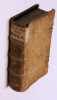
8vo. (VIII),567(recte 571),(1 colophon),(4 blank) p. Contemporary blind-tooled pigskin over wooden boards. 17.5 cm (Ref: VD16 A 3403; Hoffmann 1,291; Schweiger 1,52; cf. Dibdin 1,326 & Moss 1,126 for the edition of 1555; cf. Graesse 1,212; Cranz, A bibliography of Aristotle editions, 1501-1600, no. 108.398; J. Lewis, 'Adrien Turnèbe (1512-1565), a humanist observed', Genève, 1998, p. 127/28) (Details: Nice contemporary pigskin over wooden boards. Back with 3 raised bands. Boards decorated with a row of blind-tooled rolls, comprising floral motives and heads in medallions. The central panel is adorned with floral motives and palmets. The blind-stamped year 1565 or 1563 is vaguely visible at the bottom of the central panel on the upper board. Greek text with facing Latin translation, printed in 2 columns) (Condition: Pigskin age-tanned, worn and scuffed. Paper label at the head of the spine with a short title on it. Small damages to the pigskin. The clasps and catches are gone. Three small ownership inscriptions on the front endpapers. Two old initials in the lower margin of the title page. Small stamp on the verso of the title. A strip of the blank uppermargin of the title torn off, without affecting the text. Some contemporary ink marginalia) (Note: The Greek scholar Aristotle, 384-322 B.C., is one of the foremost names in the history of thought, and perhaps the most influential of all who have ever written. His influence on Western science and culture is immense. Aristotle's treatise 'Nicomachean Ethics' is perhaps 'the greatest and most famous of all works on morals, certainly the most notable exposition of Greek ethics. The title is derived from the name on Aristotle's son Nikomachos (...). It falls into ten books, and its fundamental principle is the doctrine of the Mean, according to which every virtue is a proper blend of two opposed and non-moral tendencies (as courage, of fear and daring), and lies between two vices, resulting from the exaggeration of one tendency or the other'. (H.J. Rose, 'A history of Greek literature', London, 1965, p. 275/76) This Heidelberg edition of 1560 is a reissue of an edition with the same title, which was published in Paris in 1555 and edited by the French scholar Adrianus Turnebus (Adrien Tournèbe), 1512-1565, professor of Greek in that city, and a specialist in Greek textual criticism. In the preface (Adrianus Turnebus lectori) to the 1555 edition, repeated in this 1560 edition, Turnebus declares that he edited the Nicomachean Ethics with the help of Pier Vettori's observations (ex Petri Victorii observationibus) and some very old manuscripts (ex vetustis aliquot exemplaribus). He also realized that this Greek text should also be accessible to students of philosophy who knew only Latin. It was necessary therefore to correct and emend the Latin text. Because translators from Greek into Latin added always something of their own ideas to a translation (de suo quaedam addentes), or made the Latin text much longer by explaning paraphrases (paraphrasibus Graeca explicantes), it is not possible to bring the Latin translation into line with the original Greek text (ut singula singulis responderent). To avoid an uneven division of the text and translation, he thought it necessary to make a translation that connected the Latin translation to the Greek text (Graeca & Latina coniungerentur). (Adrianus Turnebus lectori, page a2 recto & verso) The Greek text of the edition of 1555 of Turnebus was based on the edition of 1547, which was published by the Italian scholar Pier Vettori in Florence) (Provenance: On the front pastedown a small name: 'Nagel'. On the front flyleaf the ownership entry of: 'Daniel Walasser, Giengensis'. Who this Daniel Walasser of Gien (a French city in the department of Loiret) was, we could not find out. On the same leaf also: 'Ex libris Jacobi Zenetti, 1821'. The German 'Privatgelehrte und Schriftsteller' Jakob Zenetti, 1801-1844, received his doctor's degree in 1829 at the University Ingolstadt-Landshut-München. He lived in Augsburg, and seems to have been a philanthropist. The Zenettistreet in Augsburg is called after him. He wrote 'Einfluss der Philosophie auf das Leben', second edition, Augsburg 1842, and some poetry, e.g. 'Der ägyptische Joseph: in vier Gesängen', Augsburg, 1843. On the title, below the imprint, the initials D.W. On the verso of the title a small and round stamp: 'Sammlung des Dr. Hans Hasso v. Veltheim'. In the centre of the stamp a coat of arms. Hans-Hasso Freiherr von Ludolf Martin Veltheim Ostrau, 1885-1956, was a German Indologist, anthroposophist, Far East traveler, occultist, and author. He was of old Saxon nobility. He published several books about his travels through East Asia. (See Wikipedia: 'Hans Hasso von Veltheim') Hasso was the owner of the barock castle 'Schloss Ostrau' in Ostrau near Halle (Saale), which he turned it into a meeting point of Anthroposophists from all over the world. After the Second World War he was expropriated. Part of his library and art collection was brought to the Martin-Luther-Universität Halle-Wittenberg, the remaining was confiscated by the occupying forces of the Russians. (See for this library Wikipedia: 'Schloss Ostrau') See for Hasso's portrait and death mask 'Google Images') (Collation: *4, a-z8, A-M8, N4, O4 (last 2 leaves blank) (the leaves d1 & d2 the page numbering is double) (Photographs on request)
Cambr., CUP, 1968.
94 p. Pb.
Grinnell, Peripatetic Press, (1991).
723 p. Pb. 23 cm
N.Y., Scribner's sons, n.d.
(after 1955). XXXIII,359 p. Pb. (tr.)
Oxf., Clarendon Press, 1982.
XII,234 p. Cl. 21 cm
Grinnell, Peripatetic Press, (1979).
13,498 p. Cl. 24 cm
Cambr., CUP, 1882.
CXXVII,327 p. Cl. 23 cm (Cover sl. worn at extremes)
Francfort, Héritiers de André Wechel, 1584 ; in-4 ; plein vélin ivoire de l'époque, titre manuscrit au dos ; 341 pp., (1) p. corrigenda, (1) f. blanc. Texte grec jusqu'à la page 258 puis Annotations en latin sur deux colonnes et Index.
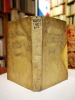
Mentions manuscrites anciennes sur les plats, premier plat restauré au centre extérieur, cachet d'un ancien Séminaire ; bon exemplaire dans l'ensemble.
Phone number : 06 60 22 21 35
Paris, Librairie Garnier Frères, 1944.
XIV,572 p. Wrappers 19 cm (Cover somewhat worn) (Greek text with facing translation, notes)
Oxford, Clarendon Press, 1976.
Cloth. 19 cm (OCT)
Lpz., Tbn., 1928.
XVI,128 p. Cloth. (BT maior)
Paris, Les Belles Lettres, 1972.
Wrs. 19 cm (Budé)(Margins trimmed; ex libris)