 Write to the booksellers
ARISTOTELES.
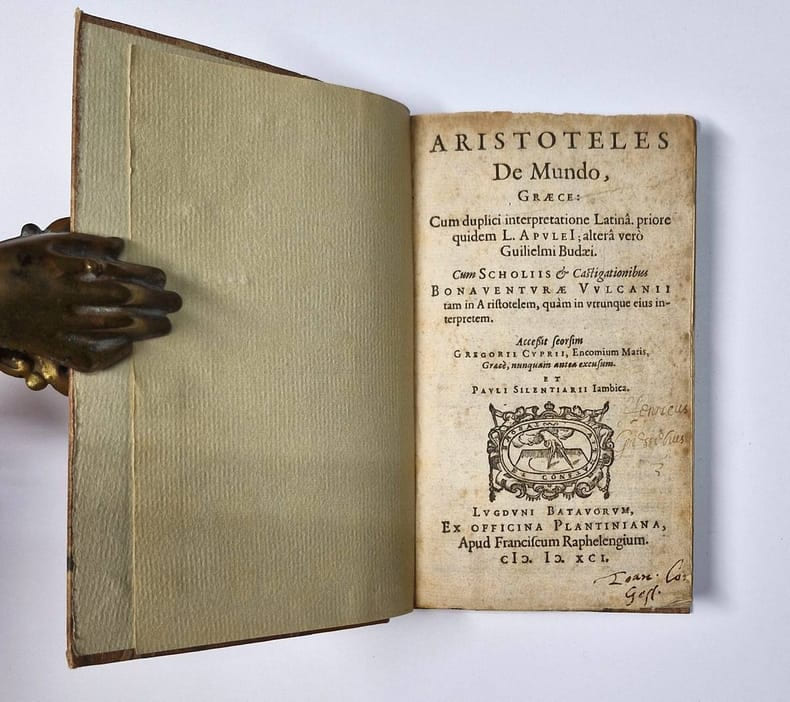
Aristoteles. De mundo, Graece: Cum duplici interpretatione Latinâ, priore quidem L. Apuleii; alterâ verò Guilielmi Budaei. Cum scholiis & castigionibus Bonaventurae Vulcanii tam in Aristotelem, quam in utrunque eius interpretem. Accessit seorsim Gregorii Cyprii, Encomium Maris, Graece, numquam antea excusum. Et Pauli Silentiarii Iambica.
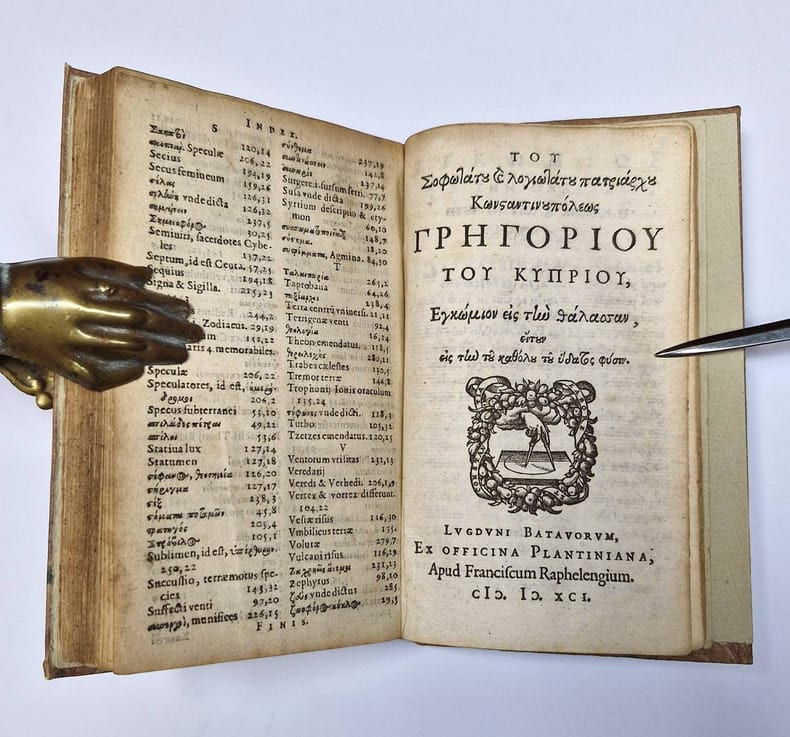
Leiden (Lugduni Batavorum), Ex Officina Plantiniana, Apud Franciscum Raphelengium, 1591.
Reference : 153420
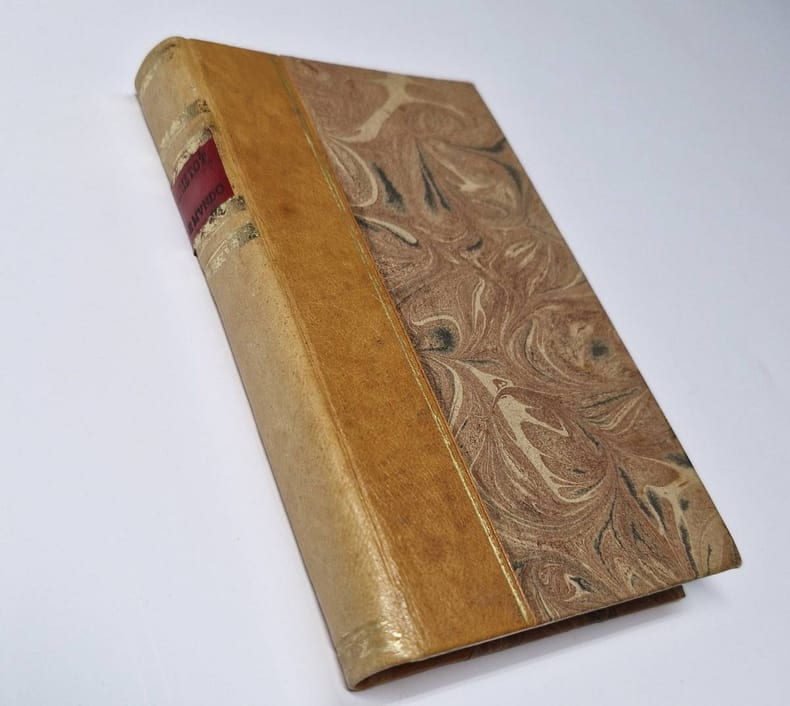
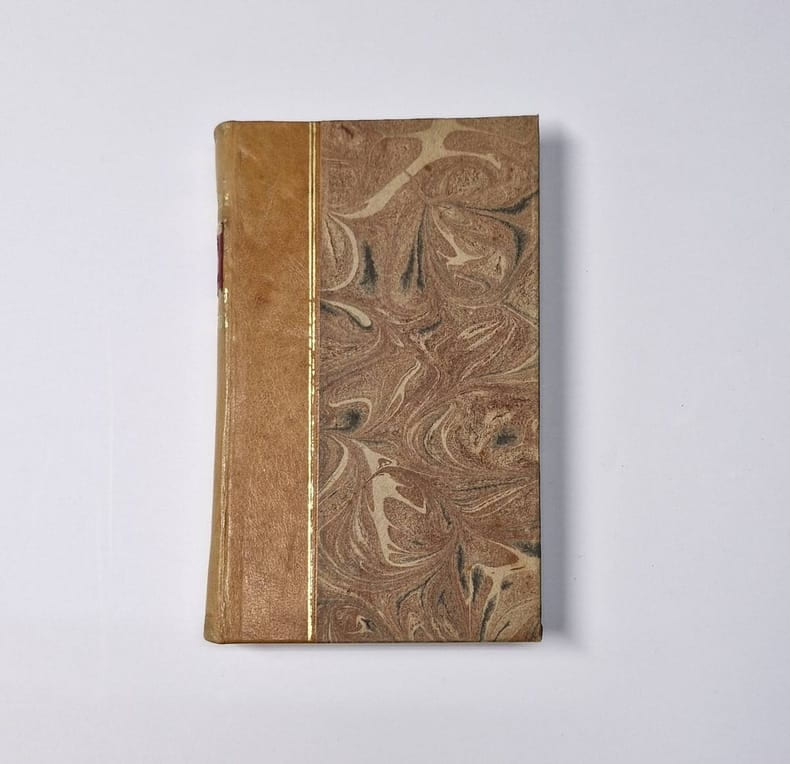
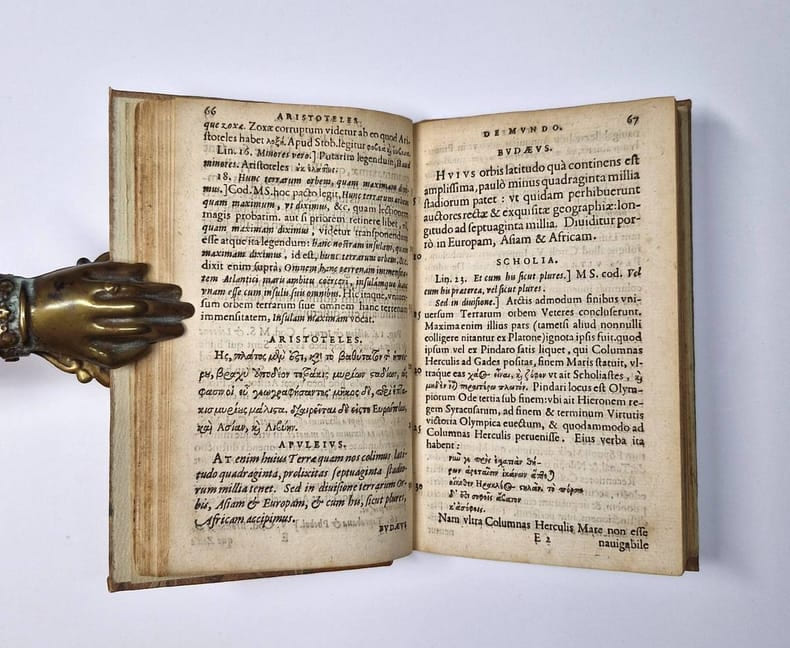
8vo. 2 parts in 1: (XVI),297,(7 index); 23,(1 blank) p. Modern half calf. 16 cm (Ref: STCN ppn 840465076; Cranz (Bibliotheca Bibliographica Aureliana) 108.713; Schwab 1520; Hoffmann 1,285; Schweiger 1,53; Brunet 1,464; Graesse 1,213; Ebert 1137) (Details: Restored half calf antique style, with some gilding on the back, and a red shield. Marbled boards. Plantin's woodcut printer's mark on the title, motto: 'Labore et Constantia'. The first part (p. 1-297) contains 'De Mundo'; the Greek text is divided in paragraphs, and each paragraph is followed by 2 Latin translations, of Apuleius and of Guillaume Budé, and by explanatory notes (scholia) of Vulcanius. The second part, which is often lacking in other copies, has a title page of its own; it contains the 'editio princeps' of the Greek text of Gregorius Cyprius' 'Praise of the Sea', and reissue of Paulus Silentiarius' poem on the hotsprings (Therma) in Bithynia) (Condition: Paper yellowing. 2 names on the title. Right edge of the first leaves slightly thumbed, the right lower corner of the first leaves somewhat dog-eared) (Note: The Greek scholar/philosopher Aristotle, 384-322 B.C., is one of the foremost names in the history of thought, and perhaps the most influential of all who have ever written. His influence on Western science and culture is immense. His boundless industry extended to most branches of higher learning. 74 treatises, genuine and spurious, have come down to us under his name. One such work that has no claim to be genuine is the once popular philosophic treatise 'De Mundo', or 'On the Universe'. (Edition Bekker 391-401) In it cosmological and meterological subjects are treated. The work was once ascribed to Aristotle, but ever since the German scholar Wilhelm Capelle traced most of its doctrines to the Greek Stoic philosopher Posidonius of Apameia, ca. 135 - ca. 51 B.C., the author is known as Pseudo-Aristotle. (Neue Jahrbücher, XV (1905) p. 529/68) Capelle dates the treatise in the first half of the second century A.D. It was translated into Latin in the second century A.D. by the Roman rhetorician and platonic philosopher Apuleius Madaurensis, who is best known for his famous picaresque novel 'Metamorphoses', also known as 'The Golden Ass'. In 1533, the French classical scholar Guillaume Budé (Guilielmus Budaeus) published in Basel an edition of 'De Mundo' with a Latin translation of his own. This translation and the one of Apuleius was adopted in this Leiden edition of 1591 edited by the Flemish scholar Bonaventura Vulcanius (De Smet in Flemish), 1539-1614, from 1581 professor of Greek and Latin Letters at the recently founded University of Leiden. It is Vulcanius second edition of 'De Mundo', for in 1587 he had published the first edition. In the short preface Vulcanius observes that he has restored 'De Mundo' to its original splendor, emendating the manuscript and editions he used (e.g. 'vetus codex meus habet' and 'In Aldina legitur') at quite a number of places, and that he has cleansed Apuleius' translation from many horrific mistakes. ('In Aristotele itaque emendavi non pauca, ab Apuleio innumera mendarum portenta profligavi, totamque hanc Aristotelici pariter & Apuleiani Mundi fabricam pristinae suae, quoad eius fieri potuit, integritati restitui', p. *3 verso) Vulcanius elucidated ('illustravi') 'De Mundo' also with a load of annotations that, he hoped, were useful for future philologists and even philosophers. In his annotations he examined how faithful to the Greek the Latin versions of Apuleius and Budaeus were, and the 'emendations Vulcanius supplied were nearly all accepted by later editors of 'De Mundo', notably Bekker (1831) and Lorimer (1938)'. (H. Cazes (ed.), 'Bonaventura Vulcanius, Works and Networks: Bruges 1538 - Leiden 1614', Leiden 2010, p. 346) 3 years after this edition of 'De Mundo' Vulcanius produced for the same publisher an 'Opera Omnia' edition of Apuleius. After 'De Mundo' Vulcanius has added in this edition of 1591 a separate volume containing 2 short Greek texts, the 'editio princeps' of a prose work of Gregorius Cyprius, 1241-1290, Patriarch of Constantinople, the 'Encomium Maris', or the 'Praise of the Sea', (p. 3/12) and a iambic poem of 189 verses composed by Paulus Silentiarius during the reign of Justinian, 'Eis ta en Pythois Therma', on the hotsprings in Bithynia in Asia Minor (p. 13/23, including Vulcanius' notes). It was, Vulcanius explains in the 1 page introduction to this poem, shoddily presented in the 'Anthologia Epigrammatum Graecorum' of Henri Estienne of 1566. He therefore decided to deliver a correct and sound text, with his annotations. (p. 13) These 2 small works were probably added by Vulcanius because they go well with, and illustrate the passages in 'De Mundo' on the element water, i.e. rivers, seas, oceans etc. (p. 44/62)) (Provenance: On the title the name of 'Henricus Gesselius'. This might be the Dutchman Henricus Gesselius, a 'Medicinae Doctor', who published in 1640 a 'Disputationum medicarum quinta, de febre hectica & malignis' and 'Disputationum medicarum de febribus septima'. If this is correct the other name 'Ioan. Cor. Gess.' might well be Johannes Cornelius Gesselius, ca. 1550-1627, who was from 1574 rector of the Gymnasium of Amersfoort. He was fired in 1619 because he refused to renounce his catholic faith. (NNBW 6, p. 579/80) (Collation: *8, A-T8; a8, b4 (leaf b4 verso blank)) (Photographs on request)
Bookseller's contact details
Antiquariaat Fragmenta Selecta
+31 20 418 55 65
Payment mode

Sale conditions
Terms of Sale All items offered are subject to prior sale. Your order will be final after you have received our confirmation, with a specification of the availability of the items and the shipping costs. All books are complete and in good antiquarian condition, unless otherwise described. Prices are in EURO. Postage and insurance are not included. Postage will be calculated at cost (no extra charges). Returns Books may be returned within 14 days of receipt, if returned in the same condition as sent, and packed, shipped and insured as received (please always notify us). We will refund the shipping costs of a return shipment only if our descriptions were not correct. How to pay Pre-payment is necessary for new customers. Our order confirmation will provide detailed information and a specification of the shipping costs. Customers who are known to us and libraries will be invoiced as usual. We accept Visa and Mastercard. You can submit your card information through our SECURE PAYMENT FORM. PayPal: we will send you a personal link to the PayPal website. Banktransfers: payment can be made into our bank account in The Netherlands.

