 Write to the booksellers
-
Type
Book (1165)
Magazine (4)
-
Latest
Last 24h (3)
Last month (33)
Last week (5)
-
Language
English (2)
French (1162)
Greek (2)
Italian (1)
Latin (1)
Russian (1)
-
Century
16th (8)
17th (5)
18th (12)
19th (61)
20th (566)
21st (79)
-
Countries
Belgium (430)
Canada (4)
Côte d'Ivoire (1)
Denmark (6)
France (497)
Germany (2)
Greece (3)
Netherlands (162)
Switzerland (63)
United States of America (1)
-
Syndicate
ALAC (4)
CLAM (2)
ILAB (217)
NVVA (4)
SLACES (4)
SLAM (196)
Poétique. Texte établi et traduit par J. Hardy. Deuxième édition. Collection des Universités de France publiée sous le patronage de l’Association Guillaume Budé.
Paris, Les Belles Lettres 1952, 200x130mm, 99pages, broché. Bel exemplaire.
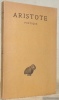
édition bilingue: français - grec ancien, Pour un paiement via PayPal, veuillez nous en faire la demande et nous vous enverrons une facture PayPal
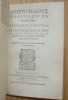
Fragmenta Aristotelis collegit disposuit illustravit Aemilius Heitz in Gymnasio Argentoratensi Litt. Ant. Professor
Paris, Ambrosio Firmin Didot, 1869 – in-quarto, 360 pp – broché, une gravure n. et b. sur la couverture
Bel ouvrage bilingue latin-grec qui réunit par les soins de Aemilius Heitz des fragments retrouvés d' Aristote. Int. très frais, excellent ex.
Les Quatre Poëtiques : d'Aristote, d'Horace, de Vida, de Despréaux, Avec les Traductions & des Remarques par M. l'Abbé Batteux
Paris Saillant & Nyon, Desaint 1771
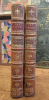
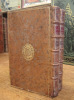
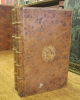
Quatre parties en deux volumes in-8 (202 x 135 mm), veau havane moucheté, dos à cinq nerfs orné, pièce de maroquin rouge, alérions entre les nerfs, triple filet entourant les plats, armes au centre, filet sur les coupes, tranches mouchetées rouges (reliure d'époque). Frontispice de Cochin fils gravé par Aug. de Saint-Aubin. Texte grec de "La Poëtique" d'Aristote, texte latin de "L'Art poétique" d'Horace et de la "Poétique" de Vida, en regard des traductions respectives. Exemplaire aux armes de Anne-Léon II de Montmorency, marquis de Fosseux (ou Fosseuse), puis duc de Montmorency, fils unique d'Anne-Léon Ier, baron de Montmorency, lieutenant général, et d'Anne-Marie-Barbe de Ville, sa première femme, appelé d'abord le marquis de Fosseuse, naquit le 11 août 1731 ; d'abord menin du Dauphin et capitaine-lieutenant des gendarmes de la reine, en mai 1745, il fut fait chevalier de Saint-Louis, le 3 avril 1758, et promu brigadier de cavalerie en décembre 1761, et maréchal de camp en juin 1753. Il émigra à Munster lors de la Révolution et mourut dans cette ville le 1er septembre 1799. Il avait épousé en premières noces, le 27 janvier 1761, Marie-Judith de Champagne et en secondes noces Anne-Françoise-Charlotte de Montmorency-Luxembourg, qui lui apporta en dot le duché de Montmorency. (OLIVIER, planche 810, 2). Ex-libris La Rochefoucauld duc de Bisaccia. (quelques défauts, petits manques de cuir au bas des plats et sur la coiffe inférieure tome 2, quelques légères piqûres). // Four parts in two octavo volumes (202 x 135 mm), havana speckled calf, spine tooled raised on five bands, red morocco label, piece of arms between the bands ("alérions"), triple fillet border on covers, central coat of arms, fillet on turns-in, red sprinkled edges (contemporary binding). Frontispiece by Cochin fils engraved by Aug. de Saint-Aubin. Greek text of "La Poëtique" by Aristote, latin text of "L'Art poétique" by Horace and of "La Poétique" by Vida, respectively facing french translation. Copy bearing the arms of Anne-Léon II de Montmorency, marquis de Fosseux (or Fosseuse), "puis duc de Montmorency, fils unique d'Anne-Léon Ier, baron de Montmorency, lieutenant général, et d'Anne-Marie-Barbe de Ville, sa première femme, appelé d'abord le marquis de Fosseuse, naquit le 11 août 1731 ; d'abord menin du Dauphin et capitaine-lieutenant des gendarmes de la reine, en mai 1745, il fut fait chevalier de Saint-Louis, le 3 avril 1758, et promu brigadier de cavalerie en décembre 1761, et maréchal de camp en juin 1753. Il émigra à Munster lors de la Révolution et mourut dans cette ville le 1er septembre 1799. Il avait épousé en premières noces, le 27 janvier 1761, Marie-Judith de Champagne et en secondes noces Anne-Françoise-Charlotte de Montmorency-Luxembourg, qui lui apporta en dot le duché de Montmorency". (OLIVIER, plate 810, 2). Bookplate La Rochefoucauld duc de Bisaccia. (some defects, small lack of leather on bottom of covers and on bottom of spine vol. 2, some light spots).
La Métaphysique d 'Aristote - Introduction, notes et index de J. Tricot
1970 Paris, Librairie Philosophique J. Vrin, 1970 - Complet en 2 volumes in-8 brochés - LVIII- 877 pages, pagination continue - rousseurs sur les coupes, sinonbon exemplaire- Réf. 49918
Cnformément à nos conditions générales de vente :Les frais de port sont affichés à titre indicatif. Il se peut que nous devions vous contacter pour vous informer du coût de laffranchissement supplémentaire en fonction du poids et du nombre de livres, surtout pour les envois internationaux Cependant vu l'augmentation des tarifs postaux à l'internationale, nous pouvons expédier les ouvrages en point relais MONDIAL RELAY pour les pays suivants : Allemagne, Autriche, Belgique, Espagne, Italie, Luxembourg, Pays-Bas, Pologne, et Portugal. Merci de nous indiquer en retour le point relais choisi ainsi que votre numéro de téléphone mobile & adresse Courriel pour assurer le suivi du colis.N'hésitez pas à nous interroger.In accordance with our general terms and conditions of sale:Shipping costs are displayed for informational purposes only. We may need to contact you to inform you of the additional postage costs depending on the weight and number of books, especially for international shipments.However, given the increase in international postal rates, we can ship books via Mondial Relay to the following countries: Germany, Austria, Belgium, Spain, Italy, Luxembourg, Netherlands, Poland, and Portugal. Please provide us with your chosen Mondial Relay point, as well as your mobile phone number and email address to ensure package tracking.Please feel free to contact us with any questions
ARISTOTE (introduction, traduction, notes par Olivier Bloch et Antoine Leandri)
Reference : 14475
Aristotelis Metaphysica. Recognouit brevique adnotatione critica instruxit W. Jaeger.
Oxonii - Oxford, E Typographeo Clarendoniano 1963, 190x125mm, XXII - 312pages, reliure d'éditeur. Très bel exemplaire.
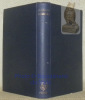
préface en latin, texte en grec ancien, Nom de possesseur. Pour un paiement via PayPal, veuillez nous en faire la demande et nous vous enverrons une facture PayPal
Aristotelis Metaphysica. Recognouit brevique adnotatione critica instruxit W. Jaeger.
Oxonii - Oxford, E Typographeo Clarendoniano 1963, 190x130mm, XXII - 312pages, reliure d'éditeur sous jaquette. Dos de la jaquette insolé et etiquette de cotation sur le bas de la page de garde supérieure, autrement bel exemplaire.
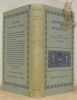
préface en latin, texte en grec ancien, Pour un paiement via PayPal, veuillez nous en faire la demande et nous vous enverrons une facture PayPal
"De l'âme : Texte établi par A. Jannone, texte traduit et annoté par E. Barbotin; De la génération et de la corruption : Texte établi et traduit par Charles Meugler. Collection : Les portiques, N° 96."
Paris, Le Club Français du Livre, 1970 14 x 22, 245 pp., reliure d'édition skivertex bleu + rhodoïd, très bon état.
"N° 8803 sur 23000 exemplaires numérotés; ""De l'âme"" : texte établi par A. Jannone, traduit et annoté par E. Barbotin; ""De la génération et de La corruption"" : texte établi et traduit par Charles Mugler."
"Aristote; De l'âme, De la génération, De la corruption. Collection : Les portiques, N° 96."
Paris, Le Club Français du Livre, 1969. 14 x 22, 245 pp., reliure d'édition skivertex vert + rhodoïd, très bon état.
N° 1176 sur 23000 exemplaires numérotés.
Les Politiques by Aristote (2008-07-21) [Hardcover]
Relié. Sous étui.
Merci de nous contacter à l'avance si vous souhaitez consulter une référence dans notre boutique à Authon-du-Perche.
De Reip[ublicae] bene administrandae ratione libri octo, a Dionys. Lambino (...) olim Latina facti : nuper av auctore recogniti, & notis ad oram libri adscriptis aucti.
Paris, Jacques du Puys, 1580. 1 vol. in-4°, veau fauve, dos à nerfs orné de fleurons dorés, encadrement d'un filet doré sur les plats, couronne d'olivier accompagnée de fleurettes dorée au centre. Reliure de l'époque restaurée. Bon exemplaire. Ex-libris ms. sur la garde blanche et sur le titre d'un médecin du XIXe s. Impression en caractères italiques, (8) ff., 158 ff. Signatures :l at4 et4 [A-Z]4 [Aa-Qq]4 Rr2. Petites rousseurs à qq. ff.
Seconde édition peu commune de la traduction latine de la Politique d'Aristote par l'humaniste français Denis Lambin. Elle avait été publiée pour la première fois en 1567. Cette nouvelle édition (posthume) a été revue par l'auteur avant son décès (1572) et accompagnée d'annotations dans les manchettes. Cranz-Schmitt, 108.647; FVB, 54706; USTC, 170545.


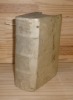
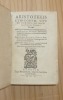
Aristotelis Aristotelis Ethicorvm, sive De Moribvs, ad Nicomachvm, libri decem. Adiecta ad contextum Græcum interpretatione latina Dionysii LAMBINI [---]. Studio & opera Matthiae BERGII. Hanoviae. Claudii Marnii. 1601. Suivi de : Aristotelis politica a Petro Ramo regio professore latina facta et dialecticis summis breviter exposita & illustrata (---) Francofvrti. Claudium Marnium & heredes. 1601.
1 volume in-8° relié plein vélin d'époque, taches sur le vélin ce dernier en très bon état. 496 p. + 537 p. + 49 f. (index), petite galerie de vers en page de garde.
Phone number : 06.31.29.75.65
Aristote Laurentius Minio-Paluello Erse Valgimigli Aetius Franceschini
Reference : 100102792
(1953)
Aristoteles latinus XXXIII - De Arte Poetica / Union académique internationale - corpus philosophorum medii aevi academiarum consociatarum auspiciis et consilio editum
Desclée de Brouwer / Bruges-Paris 1953 in8. 1953. Broché.
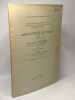
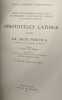
dos recollé bords frottés couverture défraîchie intérieur propre
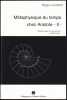
MÉTAPHYSIQUE DU TEMPS CHEZ ARISTOTE. Complet en 2 volumes : 1. Recherches historiques sur les conceptions mythologiques et astromomiques précédant la philosophie aristotélicienne. 2. Métabiologie du mouvement entéléchique.
2021 Paris, Villegagnons-Plaisance éditions, 2021. Deux grands in-8 brochés de 235 et 370 pp. avec bibliographies in fine. Très bon état, comme neuf.
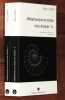
MÉTAPHYSIQUE DU TEMPS CHEZ ARISTOTE. Volume 1 : Recherches historiques sur les conceptions mythologiques et astromomiques précédant la philosophie aristotélicienne.
2021 Paris, Villegagnons-Plaisance éditions, 2021. Grand in-8 broché de 235 pp., bibliographie in fine. Très bon état, comme neuf.
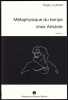
MÉTAPHYSIQUE DU TEMPS CHEZ ARISTOTE. Volume 2 : Métabiologie du mouvement entéléchique.
2021 Paris, Villegagnons-Plaisance éditions, 2021. Grand in-8 broché de 370 pp. avec index et bibliographie in fine. Très bon état, comme neuf.
Aristoteles. De mundo, Graece: Cum duplici interpretatione Latinâ, priore quidem L. Apuleii; alterâ verò Guilielmi Budaei. Cum scholiis & castigionibus Bonaventurae Vulcanii tam in Aristotelem, quam in utrunque eius interpretem. Accessit seorsim Gregorii Cyprii, Encomium Maris, Graece, numquam antea excusum. Et Pauli Silentiarii Iambica.
Leiden (Lugduni Batavorum), Ex Officina Plantiniana, Apud Franciscum Raphelengium, 1591.
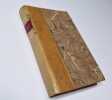
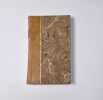
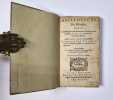
8vo. 2 parts in 1: (XVI),297,(7 index); 23,(1 blank) p. Modern half calf. 16 cm (Ref: STCN ppn 840465076; Cranz (Bibliotheca Bibliographica Aureliana) 108.713; Schwab 1520; Hoffmann 1,285; Schweiger 1,53; Brunet 1,464; Graesse 1,213; Ebert 1137) (Details: Restored half calf antique style, with some gilding on the back, and a red shield. Marbled boards. Plantin's woodcut printer's mark on the title, motto: 'Labore et Constantia'. The first part (p. 1-297) contains 'De Mundo'; the Greek text is divided in paragraphs, and each paragraph is followed by 2 Latin translations, of Apuleius and of Guillaume Budé, and by explanatory notes (scholia) of Vulcanius. The second part, which is often lacking in other copies, has a title page of its own; it contains the 'editio princeps' of the Greek text of Gregorius Cyprius' 'Praise of the Sea', and reissue of Paulus Silentiarius' poem on the hotsprings (Therma) in Bithynia) (Condition: Paper yellowing. 2 names on the title. Right edge of the first leaves slightly thumbed, the right lower corner of the first leaves somewhat dog-eared) (Note: The Greek scholar/philosopher Aristotle, 384-322 B.C., is one of the foremost names in the history of thought, and perhaps the most influential of all who have ever written. His influence on Western science and culture is immense. His boundless industry extended to most branches of higher learning. 74 treatises, genuine and spurious, have come down to us under his name. One such work that has no claim to be genuine is the once popular philosophic treatise 'De Mundo', or 'On the Universe'. (Edition Bekker 391-401) In it cosmological and meterological subjects are treated. The work was once ascribed to Aristotle, but ever since the German scholar Wilhelm Capelle traced most of its doctrines to the Greek Stoic philosopher Posidonius of Apameia, ca. 135 - ca. 51 B.C., the author is known as Pseudo-Aristotle. (Neue Jahrbücher, XV (1905) p. 529/68) Capelle dates the treatise in the first half of the second century A.D. It was translated into Latin in the second century A.D. by the Roman rhetorician and platonic philosopher Apuleius Madaurensis, who is best known for his famous picaresque novel 'Metamorphoses', also known as 'The Golden Ass'. In 1533, the French classical scholar Guillaume Budé (Guilielmus Budaeus) published in Basel an edition of 'De Mundo' with a Latin translation of his own. This translation and the one of Apuleius was adopted in this Leiden edition of 1591 edited by the Flemish scholar Bonaventura Vulcanius (De Smet in Flemish), 1539-1614, from 1581 professor of Greek and Latin Letters at the recently founded University of Leiden. It is Vulcanius second edition of 'De Mundo', for in 1587 he had published the first edition. In the short preface Vulcanius observes that he has restored 'De Mundo' to its original splendor, emendating the manuscript and editions he used (e.g. 'vetus codex meus habet' and 'In Aldina legitur') at quite a number of places, and that he has cleansed Apuleius' translation from many horrific mistakes. ('In Aristotele itaque emendavi non pauca, ab Apuleio innumera mendarum portenta profligavi, totamque hanc Aristotelici pariter & Apuleiani Mundi fabricam pristinae suae, quoad eius fieri potuit, integritati restitui', p. *3 verso) Vulcanius elucidated ('illustravi') 'De Mundo' also with a load of annotations that, he hoped, were useful for future philologists and even philosophers. In his annotations he examined how faithful to the Greek the Latin versions of Apuleius and Budaeus were, and the 'emendations Vulcanius supplied were nearly all accepted by later editors of 'De Mundo', notably Bekker (1831) and Lorimer (1938)'. (H. Cazes (ed.), 'Bonaventura Vulcanius, Works and Networks: Bruges 1538 - Leiden 1614', Leiden 2010, p. 346) 3 years after this edition of 'De Mundo' Vulcanius produced for the same publisher an 'Opera Omnia' edition of Apuleius. After 'De Mundo' Vulcanius has added in this edition of 1591 a separate volume containing 2 short Greek texts, the 'editio princeps' of a prose work of Gregorius Cyprius, 1241-1290, Patriarch of Constantinople, the 'Encomium Maris', or the 'Praise of the Sea', (p. 3/12) and a iambic poem of 189 verses composed by Paulus Silentiarius during the reign of Justinian, 'Eis ta en Pythois Therma', on the hotsprings in Bithynia in Asia Minor (p. 13/23, including Vulcanius' notes). It was, Vulcanius explains in the 1 page introduction to this poem, shoddily presented in the 'Anthologia Epigrammatum Graecorum' of Henri Estienne of 1566. He therefore decided to deliver a correct and sound text, with his annotations. (p. 13) These 2 small works were probably added by Vulcanius because they go well with, and illustrate the passages in 'De Mundo' on the element water, i.e. rivers, seas, oceans etc. (p. 44/62)) (Provenance: On the title the name of 'Henricus Gesselius'. This might be the Dutchman Henricus Gesselius, a 'Medicinae Doctor', who published in 1640 a 'Disputationum medicarum quinta, de febre hectica & malignis' and 'Disputationum medicarum de febribus septima'. If this is correct the other name 'Ioan. Cor. Gess.' might well be Johannes Cornelius Gesselius, ca. 1550-1627, who was from 1574 rector of the Gymnasium of Amersfoort. He was fired in 1619 because he refused to renounce his catholic faith. (NNBW 6, p. 579/80) (Collation: *8, A-T8; a8, b4 (leaf b4 verso blank)) (Photographs on request)
Aristoteles. Nikomachische Ethik. Auf der Grundlage der Übersetzung von Eugen Rolfes herausgegeben von Günther Bien. Vierte durchgesehene Auflage, erweitert um einen Nachtrag zu den Literaturhinweisen.
Hamburg, Felix Meiner, 1985.
LXII,450 p. Paperback. 19 cm (PhB 5)
Aristoteles over de vriendschap. Boeken VIII & IX van de Nicomachische Ethiek met de comm. van Aspasius en Michaël in de Latijnse vert. van Grosseteste, door W. STINISSEN.
Brussel, KAWLsK, 1963.
183 p. Wrs. 26 cm (Verh. KAWLsK)(Saec. XIII)
'Aristoteles' over kleuren. Ingeleid, vertaald en geannoteerd door R. FERWERDA. Essay (by) P. STRUYCKEN.
Budel, Damon, 2001.
175 p. Hardb. 21 cm (OiN Suppl. 31; includ. Greek text; dustjacket)
Aristotelis Opera, ex recensione Immanuelis Bekkeri, edidit Academia Regia Borussica. Volumen alterum [Volume 2]
Berlin, Walter De Gruyter 1960 Volume 2 only (out of 5): xvii + [673] pp. (i.e. pages 790 to 1462), photomechanical reprint of the 1851-edition, 28cm., publisher's hardcover in brown cloth (gilt lettering on spine, spine bit sunfaded), text in Greek, text printed in 2 columns, text and interior are clean and bright, good condition, weight: 2.4kg., F107703
Aristotelis Opera, ex recensione Immanuelis Bekkeri, edidit Academia Regia Borussica. Volumen primum [Volume 1]
Berlin, Walter De Gruyter 1960 Volume 1 only (out of 5): xxiii + 789pp., photomechanical reprint of the 1851-edition, 28cm., publisher's hardcover in brown cloth (gilt lettering on spine, spine bit sunfaded), text in Greek, text printed in 2 columns, text and interior are clean and bright, good condition, weight: 2.8kg., F107704
Aristotelis Politicorum libri octo ex Dion. Lambini & Pet. Victorii interpretationibus puriss. graecolatini, Theod. Zvingeri Argumentis atque Scholiis, Tabulis quinetiam in tres priores libros illustrati, Victorii commentariis perpetuis declarati, Pythagoreorum veterum Fragmenta politica, a Io. Spondano conversa & emendata. Index rerum & verborum pleniss.
Basle (Basileae), Eusebii Episcopii opera ac impensa, 1582.
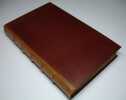
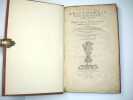
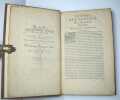
Folio. (XX),623,(12 index),(1 printer's mark) p. Modern calf 35.5 cm (Details: Nice copy, bound in modern full (red)brown calf, with 5 raised bands on the back. Spine short title in gilt: 'ARISTOTELIS / DE REPVBLICA'. Text in three columns, with the Greek in the centre flanked by the Latin translations of Piero Vettori and Denys Lambin respectively on each side. Large printer's woodcut device to the title and last page, depicting a bust of 'Hermes triceps' (three-headed Hermes) on a pillar; each of the heads wears a winged helmet; the middle Hermes holds in his right hand a caduceus, and in his left a bishop's staff (Episcopius!); from the pillar seems to hang a chopped off head. Large historiated woodcut letter on leaf a2, woodcut letters of various sizes throughout the text. Wide margins) (Condition: First and last leaf dust-soiled. Small and faint name on the title. Paper yellowing. Small bookplate on the front pastedown. 2 bookplates on the lower pastedown) (Note: The Greek scholar/philosopher Aristotle, 384-322 B.C., is one of the foremost names in the history of thought, and perhaps the most influential of all who have ever written. His influence on Werstern science and culture is immense. His boundless industry extended to most branches of higher learning. 74 treatises, genuine and spurious, have come down to us under his name. His 'Politics', literally 'the things concerning the polis', is among his best known and most widely read works. It embraces in 8 books the historical, theoretical and practical aspect of politics. To Aristotle 'politics were the very crown of philosophical study (...) and the ultimate end of the State to provide an environment in which those capable of the highest mental and moral development might attain thereto. (...) The important sections of this great work are the sketch of the ideal state, (...) the account of the various forms of government (...) the discussions of sovranty and responsibility and of kingship'. (H.J. Rose, 'A handbook of Greek literature', Oxford, 1965, p. 276) This Basle edition of 1582 of the Politics adopts the Greek text, Latin translation and the famous commentary, earlier published by the Italian scholar Piero Vettori (Petrus Victorius), 1499-1585, at Florence in 1576. Vettori, professor of Greek and Latin in the 'Studio Fiorentino' at Florence, was the greatest Italian Greek scholar of his time. His best known works in the field of Greek philology are his commentaries on Aristotle's Rhetoric (1548), Poetics (1560), Politics (1576) and Nicomachean Ethics (1584). Every chapter (caput) in this Politics edition of 1582 is printed separately, followed by Vettori's very extensive and rich commentary. The Greek text is flanked by 2 Latin translations, one of Vettori, and one which the French scholar and Royal Reader in Greek, Denys Lambin (Dionysius Lambinus), 1520-1572, had published in Paris in 1567. Added to the chapters are, hot from the press, the notes and diagrams of the Basle professor of Greek and Moral philosophy Theodor Zwinger, (Theodorus Zuingerus), 1533-1588. He is best known for his editions of the Nicomachean Ethics (Basle 1566) and the Politica of Aristotle (Basle 1582), in which he transformed these works in a series of diagrams, analysing and showing their structures in systematic tables. Appended are the 'Pythagoreorum fragmenta politica' in the edition of the French scholar Jean de Sponde, or Johannes Spondanus, 1557-1595) (Provenance: Bookplates of: 'United Presbyterian Church. 'Brown library'. Glasgow, 66 Virginia St.' and of 'United Presbyterian College. Brown-Lindsay Library. Shelfmark 3C1.1 No. 5154'. Small bookplate 'Bibliotheca Classica Stephaniana' of the Swedish classical scholar Staffan Fogelmark on the front pastedown. Fogelmark was Reader in Greek, 1972-85 at Lund University; Lecturer in Greek, 1985-96. University of Gothenburg: Professor of Greek, 1997-2004) (Ref: VD16 A 3582 & VD16 P 5468. Bibliotheca Bibliographica Aureliana 38, no. 108.655; Hoffmann 1,294. Griechischer Geist aus Basler Pressen no, 129. Ebert 1166; Graesse 1,214. Adams A 1914. Moss 1,129; Not in Brunet) (Collation: alpha6, beta4, a-z6, A-2G6) (Photographs on request) (Heavy book, may require extra shipping costs)
ARISTOTELOUS PERI POIÊTIKÊS. Aristotelis De poetica liber. Ex versione Theodori Goulstoni perpetuis notis analyticis illustrata. Accedunt integrae notae Frid. Sylburgii & Dan. Heinsii, necnon selectae aliorum. (And:) Aristotelis De poetica liber, latine conversus, et analytica methodo illustratus, per Theodorum Goulstonum.
Cambridge (Cantabrigiae), Apud Johannem Hayes, Celeberrimae Academiae Typographum, Sumptibus Thomae Dawson Bibliopolae Cantabrigensis, 1696.
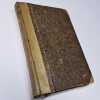

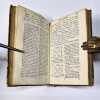
8vo. 2 parts in 1: (XX),101,(3),104,(12 index, errata) p., folding table. Half vellum. 17 cm (Ref: Hoffmann 1,283; Cooper/Gudeman 44 & 174; Schrier p. 36; Brunet 1,477; Moss 1,122; Graesse 1,214; Ebert 1191; ESTC R14743) (Details: The work consists of two parts, each with its own title page; the first contains the Greek text and commentary, the second the Latin translation and analytical notes. Short title in ink on the back. The folding plate shows a 'Synopsis libri Poeticae' ) (Condition: Binding somewhat used. Vellum age-tanned. Vellum on the back slightly soiled. Front flyleaf removed) (Note: 'The influence of Aristotle, 384-322 BC, on Western intellectual life is immense, so much so that once one begins to track it, no field of inquiry can be identified that it would be safe to overlook. Aristotle laid the foundations for not one but two sciences, logic and biology, an achievement unmatched by any thinker before or since'. (The Classical Tradition, Cambr. Mass. 2010, p. 70) For centuries his authority guided the further development of some of the sciences. From the 16th century to the age of Romanticism Aristotle's views, developped in his 'De arte poetica', played a dominant role in the theory and practice of European literature, especially of drama. And with Jacob Bernay's 'Grundzüge der verlorenen Abhandlung des Aristoteles über Wirkung der Tragödie' (1857), who rejected the moral (Lessing) and aesthetic (Goethe) tradition of 'catharsis', and who introduced the concept of the intentional arousal and discharge of emotions, to the discussion, Aristotle's description of the effect of tragedy as a 'catharsis', (cleansing, or purgation) of tragic emotions (pity and fear) 'became the focus of a debate on the purposes of literature which attracts contributors up to the present day'. (O.J. Schrier, 'The Poetics of Aristotle and the Tractatus Coislinianus, a Bibliography from about 900 till 1996', Leiden, 1998, p. 1) (Nietzsche, Freud, Wagner, Wilamowitz-Moellendorff et 'multi alii' followed). Aristotle's 'De poetica liber' is 'the only piece of technical writing from antiquity that still plays a role in scholarly discourse. If Aristotle had confined himself to discussing Greek poetry from the viewpoint of its formal aspects or its historical development, his work would still have been of eminent importance, but only for classicists and historians of literature. He did more, however, laying bare what in his view are the fundamentals of poetry, giving his criteria for distinguishing literary genres, and pointing out along which lines he thought these and the works of individual poets should be evaluated. In pursuing these targets, he formulated insights that have been thought to be applicable even to modern narrative genres like the detective story and the film. These aspects of the Poetics make it an interesting starting-point for discussions in wide areas of modern literary theory'. (Idem, Ibidem) This edition of 1696 is a revision of Goulston's 'De Poetica' edition of 1623. It was edited in 1696 by the English schoolmaster James Upton, 1670-1749, once a fellow of King's College at Cambridge. Upton udated the work of 1623, making better use of the 'De Poetica' edition of the Dutch scholar Daniel Heinsius (Leiden 1610/11, and 1643), and of the Aristotle edition of the German scholar Friedrich Sylburg, who provided not only notes, but also the Greek text for this edition (Frankfurt 1584/87, volume 2). Upton added, he tells in the preface, also material he found in various authors, among whom Samuel Petit's 'Leges Atticae' (Paris 1635) and Daniel Heinsius' 'De tragoediae constitutione' (Leiden 1611), and André Dacier's French translation of the Poetics (Paris 1692). Upton also consulted Du Val's Aristotle edition (Paris 1619, 1639). He also revised Goulstons Latin translation) Theodor Goulston, 1576-1632, studied in Oxford, and was a medical doctor in London. His Poetics edition was reissued in 1696, 1728, 1731, 1745 and 1780. In 1619 Goulston had already published in London 'Versio Latina et Paraphrasis in Aristotelis Rhetoricam' (See his Wikipedia article) (Collation: Ad 1: *2, A-O8, P4, Q2. (Folding table after leaf before A1)) (Photographs on request)
ARISTOTELOUS PHUSIKÊS AKROASEÔS BIBLIA TH'. Aristotelis Stagiritae, Peripateticorum Principis, Naturalis auscultationis libri VIII. Jul. Pacius a Beriga cum Graecis excusis quam scriptis codicibus accurate contulit, Latina interpretatione auxit, & commentariis analyticis illustravit. Adiectus est geminus index: alter librorum, tractatuum & capitum: alter rerum & verborum in toto opere memorabilium.
Frankfurt (Francofurti), Apud heredes Andreae Wecheli, Claudium Marnium & Iohannem Aubrium, 1596.
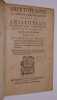
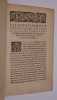
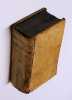
8vo. (XXIV),992 (recte 984) p. Vellum. 17 cm. <Important edition of the Physics, one of Aristotle's principal works> (Ref: VD16 A 3554; Hoffmann 1,286: 'Durch d. Vergleich v. Heidelb. Mss. hat d. Ausg. krit. Werth'; Cranz, 'A bibliography of Aristotle editions, 1501-1600', no. 108.745'; cf. Neue Pauly, Supplementband 2, p. 73 where Pacius' edition of the complete Aristotle, Geneva 1597, is mentioned) (Details: The Greek text and the opposing Latin translation are printed in 2 columns on the first 336 pages. Woodcut printer's mark on the title, depicting the winged horse Pegasus gracefully arched over a caduceus and 2 intertwined cornucopiae. Edges dyed gray/blue) (Condition: Vellum scuffed, spotted and worn to the extremes. Upper joint split for the greater part. Back somewhat damaged. Occasional contemporary ink underlinings & annotations.(Note: 'The influence of Aristotle, 384-322 BC, on Western intellectual life is immense, so much so that once one begins to track it, no field of inquiry can be identified that it would be safe to overlook. Aristotle laid the foundations for not one but two sciences, logic and biology, an achievement unmatched by any thinker before or since'. (The Classical Tradition, Cambr. Mass. 2010, p. 70) For centuries his authority was so great that it prevented the further development of some of the sciences, e.g. astronomy. A.E. Taylor, who thought that the qualifications of Aristotle as a man of science have been much overrated, argues that Aristotle's ascendancy over thought in certain areas, biology, astronomy, is to be regretted, on account of his physical doctrines. The early 17th century English philosopher Francis Bacon found the veneration for Aristotle one of the chief hindrances to the free development of natural science. (A.E. Taylor, 'Aristotle', N.Y. 1955, p. 61/62) Nevertheless, the Phusikês akroaseôs, or Naturalis auscultatio, nowadays known as the Physics, or Physica, is one of the most important works of Aristotle. The title Physics is misleading to a modern reader, 'as a matter of fact the ancient name for it is phusikês akrôasis', i.e. Lectures (literally 'hearing') on Nature. It discusses, not such laws as are generally studied by a modern physicist, but rather the fundamental ideas of matter, motion and so forth, leading up to the famous conception of God as the ummoved mover of the whole'. (H.J. Rose, 'A History of Greek Literature, London, 1965, p. 274/75) This 1596 edition of Aristotle's Physics was produced by the Italian Aristotelian scholar Julius Pacius a Berige, or in Italian Giulio Pace de Beriga, 1550-1635. He had protestant sympathies and had to flee to Geneva. He was an itinerant scholar, he was professor in Geneva from 1575 to 1585. He taught law at the University of Heidelberg from 1585 to 1595. Later we find him teaching Greek and law at the Academy of Sedan, the Universities of Nimes, Leiden, Grenoble, Montpelliere, Valence and finally at Padua. Pacius showed a humanist's concern for the accurate establishment of the Greek texts and their accurate translation into Latin. He was the editor, translator and commentator of Aristotle's Organon, (1584, 1585, 1591, 1597 (Wechel at Frankfurt), 1598, 1605, 1617, 1682) one of the most widely used editions of his time. His edition of the Phusikês akroaseôs of 1596 was repeated in 1608 and in 1629. Pacius, who was a jurist too, edited also the Corpus Juris, which was reissued several times. (J. Berriat-Saint-Prix, 'Notice sur Julius Pacius a Beriga, jurisconsulte et philosophe des XVIe et XVIIe siècles', Paris, 1840; easier, but much shorter, Pacius' lemma in Wikipedia) (Provenance: Two bookplates and a small inscription on the front pastedown, which belong together. The first is an armorial bookplate: 'Ex libris Hans Schless'. The second bookplate: 'Ex libris D.F.' It depicts some pharmacist's paraphanalia. The inscription on the pastedown below these two bookplates explains it all: 'Skaenket Dansk Farmaceutforening, Bibliotek af Hans Schlesch, 8 III 1955'. This book was donated to the Library of the Danish Union of Pharmacists (D.F.) by Hans Schlesch in March 1955. Dr. Hans Schlesch, 1891-1962, was a Danish malacologist and shell-collector of worldfame. He wrote numerous articles. On the front flyleaf the name: 'G.L. Buhrke, 1828'. (?) On the title the ownership inscription: 'Joannes Stille, comparavi Brunsvigae anno 1644'. Not much is known about this Johannes Stille. The most substantial is perhaps the mentioning of him, if it is him, in a history of the University of Rindeln. Here it is told that he died in 1660 and that he was a member of 'philosophische Fakultät, welche als eine Vorschule der Theologie mit Recht betrachtet wurde'. (F.K.Th. Piderit, 'Geschichte der Hessisch-Schaumburgischen Universität Rinteln', Marburg 1842) Perhaps the same Stille produced in 1646 in Helmstedt this dissertation: 'Disputatio philosophica continens quaestiones miscellaneas, quam dirigente divino numine sub prae-sidio viri clarissimi & excellentissimi Dn. M. Johannis à Felden math. P. P. examinandam proponit Johannes Stille Hannoveranus'. One Johannes Stille studied some time in Leiden; in the Album Studiosorum of that University it is recorded that he was born in 1622) (Collation: *4, )(8, A-2P8, 2Q4) (Photographs on request)

