 Write to the booksellers
ARISTOTELES.
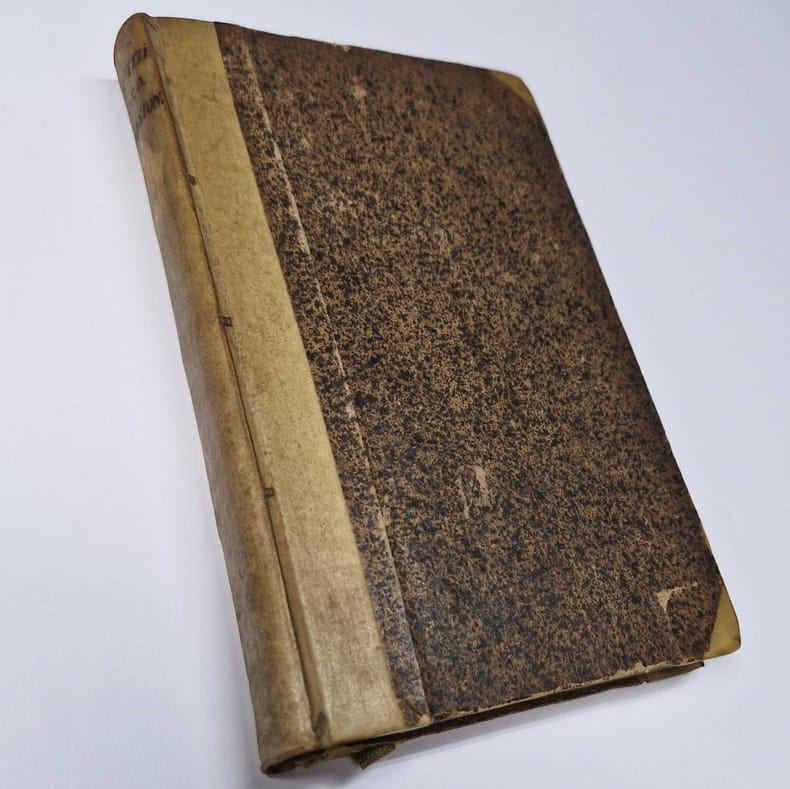
ARISTOTELOUS PERI POIÊTIKÊS. Aristotelis De poetica liber. Ex versione Theodori Goulstoni perpetuis notis analyticis illustrata. Accedunt integrae notae Frid. Sylburgii & Dan. Heinsii, necnon selectae aliorum. (And:) Aristotelis De poetica liber, latine conversus, et analytica methodo illustratus, per Theodorum Goulstonum.
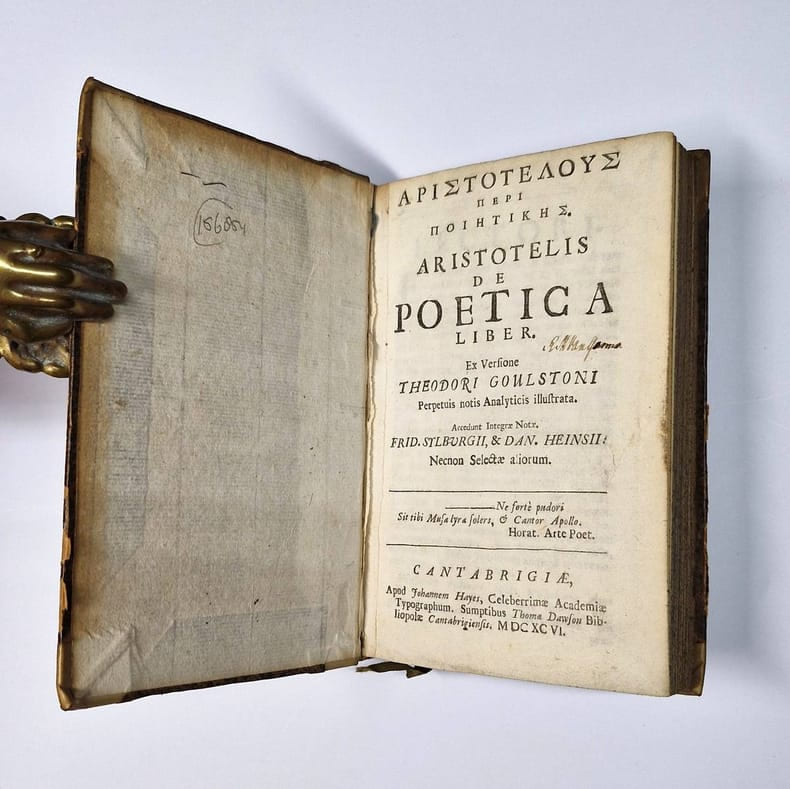
Cambridge (Cantabrigiae), Apud Johannem Hayes, Celeberrimae Academiae Typographum, Sumptibus Thomae Dawson Bibliopolae Cantabrigensis, 1696.
Reference : 156854
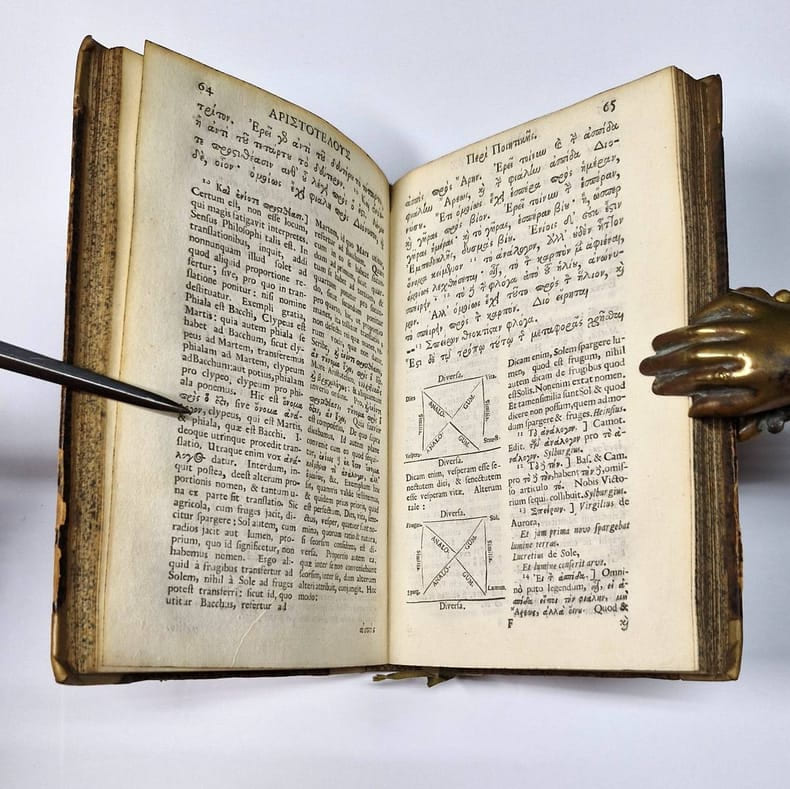
8vo. 2 parts in 1: (XX),101,(3),104,(12 index, errata) p., folding table. Half vellum. 17 cm (Ref: Hoffmann 1,283; Cooper/Gudeman 44 & 174; Schrier p. 36; Brunet 1,477; Moss 1,122; Graesse 1,214; Ebert 1191; ESTC R14743) (Details: The work consists of two parts, each with its own title page; the first contains the Greek text and commentary, the second the Latin translation and analytical notes. Short title in ink on the back. The folding plate shows a 'Synopsis libri Poeticae' ) (Condition: Binding somewhat used. Vellum age-tanned. Vellum on the back slightly soiled. Front flyleaf removed) (Note: 'The influence of Aristotle, 384-322 BC, on Western intellectual life is immense, so much so that once one begins to track it, no field of inquiry can be identified that it would be safe to overlook. Aristotle laid the foundations for not one but two sciences, logic and biology, an achievement unmatched by any thinker before or since'. (The Classical Tradition, Cambr. Mass. 2010, p. 70) For centuries his authority guided the further development of some of the sciences. From the 16th century to the age of Romanticism Aristotle's views, developped in his 'De arte poetica', played a dominant role in the theory and practice of European literature, especially of drama. And with Jacob Bernay's 'Grundzüge der verlorenen Abhandlung des Aristoteles über Wirkung der Tragödie' (1857), who rejected the moral (Lessing) and aesthetic (Goethe) tradition of 'catharsis', and who introduced the concept of the intentional arousal and discharge of emotions, to the discussion, Aristotle's description of the effect of tragedy as a 'catharsis', (cleansing, or purgation) of tragic emotions (pity and fear) 'became the focus of a debate on the purposes of literature which attracts contributors up to the present day'. (O.J. Schrier, 'The Poetics of Aristotle and the Tractatus Coislinianus, a Bibliography from about 900 till 1996', Leiden, 1998, p. 1) (Nietzsche, Freud, Wagner, Wilamowitz-Moellendorff et 'multi alii' followed). Aristotle's 'De poetica liber' is 'the only piece of technical writing from antiquity that still plays a role in scholarly discourse. If Aristotle had confined himself to discussing Greek poetry from the viewpoint of its formal aspects or its historical development, his work would still have been of eminent importance, but only for classicists and historians of literature. He did more, however, laying bare what in his view are the fundamentals of poetry, giving his criteria for distinguishing literary genres, and pointing out along which lines he thought these and the works of individual poets should be evaluated. In pursuing these targets, he formulated insights that have been thought to be applicable even to modern narrative genres like the detective story and the film. These aspects of the Poetics make it an interesting starting-point for discussions in wide areas of modern literary theory'. (Idem, Ibidem) This edition of 1696 is a revision of Goulston's 'De Poetica' edition of 1623. It was edited in 1696 by the English schoolmaster James Upton, 1670-1749, once a fellow of King's College at Cambridge. Upton udated the work of 1623, making better use of the 'De Poetica' edition of the Dutch scholar Daniel Heinsius (Leiden 1610/11, and 1643), and of the Aristotle edition of the German scholar Friedrich Sylburg, who provided not only notes, but also the Greek text for this edition (Frankfurt 1584/87, volume 2). Upton added, he tells in the preface, also material he found in various authors, among whom Samuel Petit's 'Leges Atticae' (Paris 1635) and Daniel Heinsius' 'De tragoediae constitutione' (Leiden 1611), and André Dacier's French translation of the Poetics (Paris 1692). Upton also consulted Du Val's Aristotle edition (Paris 1619, 1639). He also revised Goulstons Latin translation) Theodor Goulston, 1576-1632, studied in Oxford, and was a medical doctor in London. His Poetics edition was reissued in 1696, 1728, 1731, 1745 and 1780. In 1619 Goulston had already published in London 'Versio Latina et Paraphrasis in Aristotelis Rhetoricam' (See his Wikipedia article) (Collation: Ad 1: *2, A-O8, P4, Q2. (Folding table after leaf before A1)) (Photographs on request)
Bookseller's contact details
Antiquariaat Fragmenta Selecta
+31 20 418 55 65
Payment mode

Sale conditions
Terms of Sale All items offered are subject to prior sale. Your order will be final after you have received our confirmation, with a specification of the availability of the items and the shipping costs. All books are complete and in good antiquarian condition, unless otherwise described. Prices are in EURO. Postage and insurance are not included. Postage will be calculated at cost (no extra charges). Returns Books may be returned within 14 days of receipt, if returned in the same condition as sent, and packed, shipped and insured as received (please always notify us). We will refund the shipping costs of a return shipment only if our descriptions were not correct. How to pay Pre-payment is necessary for new customers. Our order confirmation will provide detailed information and a specification of the shipping costs. Customers who are known to us and libraries will be invoiced as usual. We accept Visa and Mastercard. You can submit your card information through our SECURE PAYMENT FORM. PayPal: we will send you a personal link to the PayPal website. Banktransfers: payment can be made into our bank account in The Netherlands.

