 Write to the booksellers
-
Type
Book (975)
Magazine (5)
-
Latest
Last month (39)
Last week (3)
-
Language
English (2)
French (978)
-
Century
16th (20)
17th (52)
18th (181)
19th (306)
20th (146)
21st (75)
-
Countries
Belgium (125)
Denmark (670)
France (185)
-
Syndicate
CLAM (1)
ILAB (679)
SLAM (8)
Histoires de Russie, de Pologne, de Suède et de Danemark depuis les temps les plus reculés jusqu'à nos jours.
Paris, Adolphe Delahays/Librairie Universelle, 1846. "14 x 23, 486 pp., 31 planches, broché, mauvais état (couverture défraîchie, 1 déchirure sans manque à l'arrière; papier de mauvaise qualité avec des rousseurs)."
För Högre och Lägre Tjenstemän vid Landt-Regeringen i Sverige och Finland.
Stockh., 1852. Orig.bogtrykt foromsl. 479 pp.

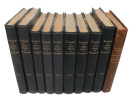
Udgivne af Fyens Stifts litterære Selskab. 10 Bd. (alt som udkom).
Odense, 1861-90. Bd. 1-9 indbundet i meget smukke private hldrbd. af blå oaseged (Axel Jensen), bd. 10 i samt. hldrbd.
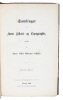
Die Staatserbefolge der Herzogthümer Schleswig=Holstein und zugehörige Lande. Ein staatsrechtlicher Versuch.
Hamburg, Perthes=Besser & Mauke, 1844. lex8vo. Cont. hcalf. Richly gilt back. (8),XX,319,(4) pp., 1 folded lithographed cold. map and 2 folded plates.
First edition.
Skulptören Anders Zorn
Zornsamlingarna, Mora, 1999. In-8, cartonnage éditeur illustré en couleurs, 135 pp. Introduktion - Ungdomsalstren - Kvinnoporträtten - Emma Zorn - Mona - Mormor - Madame May - Solfjädar - Papperskniv med Emma Zorns porträtt - Monas gravrelief - Faun och nymf - Frihetsthjältarna - Gustav Vasa - Engelbrekt - Sankt Göran ...
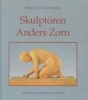
Avec 138 illustrations en noir et en couleurs.Texte en suédois. --- Plus d'informations sur le site archivesdunord.com
Materiality and Religious Practice in Medieval Denmark
, Brepols, 2021 Hardback, 296 pages, Size:156 x 234 mm, Illustrations:11 b/w, 32 col., Language: English. ISBN 9782503594163.
Summary From bread and wine to holy water, and from oils and incense to the relics of saints, the material objects of religion stood at the heart of medieval Christian practice, bridging the gap between the profane and the divine. While theoretical debates around the importance of physicality and materiality have animated scholarship in recent years, however, little attention has been paid to finding solid, empirical evidence upon which to base such discussions. Taking medieval Denmark as its case study, this volume draws on a wide range of different fields to explore and investigate material objects, spaces, and bodies that were employed to make the sacred tangible in the religious experience and practice of medieval people. The contributions gathered here explore subjects as diverse as saints' relics, sculptures, liturgical vessels and implements, items used for personal devotion, gospel books, and the materiality of Christian burials to explore the significance of objects that moved the souls, bodies, hearts, and minds of the faithful. In doing so, they also open new insights into religion and belief in medieval Denmark. TABLE OF CONTENTS List of Illustrations Introduction: Materiality and Religious Practice in Medieval Denmark - MADS VEDEL HEILSKOV AND SARAH CROIX Research History - Materiality and Medieval Religious Practice in Danish Research - MORTEN LARSEN Materiality in Medieval Episcopal Rites: Some Examples - BERTIL NILSSON The Liturgical Use of the Gospel Book in the Middle Ages and Notions of Sacramentality? - NILS HOLGER PETERSEN Making the Liturgy Manifest: Objects and Materials in Late Medieval Church Rites - MARTIN WANGSGAARD J RGENSEN Holy Heads: Pope Lucius's Skull in Roskilde and the Role of Relics in Medieval Spirituality - LENA LIEPE Living Matter in Medieval Denmark - MADS VEDEL HEILSKOV Objects of Personal Devotion - Outer Markers and Inner Meanings - METTE H JMARK S VS AND MARIA KNUDSEN Materiality of Memory: The Use and Significance of Wax in Late Medieval Devotion - LAURA KATRINE SKINNEBACH Materiality in Medieval Burials - JAKOB TUE CHRISTENSEN AND MIKAEL MAN E BJERREGAARD Future Perspectives: An Epilogue from the Views of an Archaeologist and Art Historian - METTE SVART KRISTIANSEN AND MERCEDES P REZ VIDAL
Danmarks Krønike af Saxo Grammaticus fordansket ved Nik. Fred. Sev. Grundtvig. 3 bd.
Kbh., 1818-22. 4to. 3 lidt senere halvlæderbind. Rygge med brugsspor. XLIV, 302, (6), 338, (10), 460 pp.
Førsteudgaven af Grundtvigs oversættelse.
Danmarks Krønike. Fordansket ved N.F.S.Grundtvig. 3 Bd.
København., Schultziske Officin, 1818-22. 4to. Indbundet i tre velbevarede samtidige hldrbd. med rygforgyldning.. XLIV,302,(6),338,(10),460 pp. Indvendig rent, frisk eksemplar.
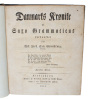
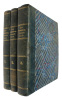
Førsteudgaven af Grundtvigs oversættelse.
Den Danske Krønicke som Saxo Grammaticus screff, hallfierde hundrede Aar forleden: Nu først aff Latinen udsæt, flittelige offuerseet oc forbedret, Aff Anders Søffrinssøn Vedel. - [FIRST DANISH TRANSLATION OF THE NARRATIVE OF HAMLET, PRINCE OF DENMARK]
Kiøbenhaffn, Hans Støckelman oc Andreas Gutterwitz, 1575. Folio. Bound in a very nice mid 19th century brown half calf with five raised bands and gilt ornamentations to spine. Title-page printed in red and black and with large woodcut, verso with full-page woodcut portrait of King Frederik II. Small repaired cut-out to top of title-page and an old owner's annotation. Neat marginal annotations to some leaves and early annotations to back fly-leaf. Occasional light brownspotting, but overall an unusually well kept and fresh copy, printed on good paper. (36), 547, (33) pp.
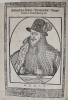
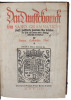
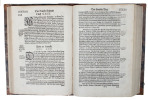
The very rare first translation into any language, being the seminal first Danish translation, of the first preserved full history of Denmark - to this day the most important of all Danish historical publications and a main work of European Medieval literature. This magnificent work furthermore contains the first known written narrative of the legend of Hamlet and served as the basis for Shakespeare's play. """"Hamlet"" is based on a Norse legend composed by Saxo Grammaticus in Latin around 1200 AD. The sixteen books that comprise Saxo Grammaticus' ""Gesta Danorum"", or ""History of the Danes"", tell of the rise and fall of the great rulers of Denmark, and the tale of Amleth, Saxo's Hamlet, is recounted in books three and four. In Saxo's version, King Rorik of the Danes places his trust in two brothers, Orvendil and Fengi. The brothers are appointed to rule over Jutland, and Orvendil weds the king's beautiful daughter, Geruth. They have a son, Amleth. But Fengi, lusting after Orvendil's new bride and longing to become the sole ruler of Jutland, kills his brother, marries Geruth, and declares himself king over the land. Amleth is desperately afraid, and feigns madness to keep from getting murdered. He plans revenge against his uncle and becomes the new and rightful king of Jutland."" (""Shakespeare's Sources for ""Hamlet"" "" - Shakespeare-on-line). The patriotic ""Danish Chronicle"" (i.e. Gesta Danorum) by Saxo Grammaticus is without comparison the most ambitious literary production of medieval Denmark and the most important source for the early history of the nation, also being one of the oldest known written documents about the history of Estonia and Latvia. Its sixteen books describe the history of Denmark and the Danes as well as Scandinavian history in general, from prehistory until Saxo's own time (12th century). It offers crucial reflections on European affairs of the High Middle Ages, from a unique Scandinavian perspective, and constitutes a significant supplement to other Western and Southern European sources. Saxo Grammaticus (ab. 1150-1220) was probably a secular clerk or secretary to Absalon, Archbishop of Lund, the great Danish churchman, statesman and warrior. Saxo is remembered today as the author of the first full history of Denmark, in which he modelled himself upon the classical authors (e.g. Virgil, Plato, Cicero) in order to glorify his fatherland. The work dates from the end of the 12th century and was first printed, in Latin, in Paris in 1514 with 16th century re-issues following in 1534 (Basel) and 1576 (Frankfurt). In 1575, the very first translation of the work appeared, that into Danish, which came to play a significant role in the history of both the legends presented in the work and in Danish language and culture. This groundbreaking first printed translation of Saxo's chronicle was prepared by the Danish historian and philologist Anders Sørensen Vedel (1542-1616). Vedel was also the tutor of Tycho Brahe and his companion on Brahe's grand tour of Europe, where the two formed a lasting bond of friendship. Previous attempts had been made at translating Saxo's magnificent work (one by Christiern Pedersen, one by Jon Tursen), but none of them were printed and the manuscripts have also not survived"" Vedel's translation is the only one that was finished and made it to print. Prompted by Absalon, Vedel began his translation in 1570, and it took him five years to finish the task of both translating and rewriting the original Latin text. While working on this grandiose production, he was given the income of a canon at Ribe Cathedral. Vedel's translation is one of tone of the most important Renaissance contributions to Danish literature and to the development of the Danish language. Vedel's work is not merely a translation, but a magnificent rewriting that should be considered a literary masterpiece in its own right. After Vedel's translation, Saxo remained the indispensable classic that overshadowed all other historical works, both as a source to the earliest history of Denmark and the Danes and as a source of the Nordic myths. Vedel's seminal translation predates the first English translation by more than 300 years and remained the only vernacular version of the text for centuries. The work consists of sixteen books that cover the time from the founders of the Danish people (Dan I of Denmark) till Saxo's own time, ending around 1185 (with the submission of Pomerania), when the last part is supposedly written. The work thus covers the entire history of Denmark until Saxo's own time, seen under a somewhat glorified perspective, from heathen times with tales of Odin and the gods of Valhalla to the times of Absalon, who probably directly influenced the sections on the history of his own time, working closely with Saxo himself. The work also contains the first known written narrative of the legend of Hamlet (Amleth, the son who took revenge for his murdered father). It is this narrative of Saxo's, which he based on an oral tale, that forms the basis for Shakespeare's ""Hamlet"", which takes place in Helsinore in Denmark. There is fairly certain evidence that Shakespeare knew Saxo's work on the History of Denmark and thus the legend of Amleth. ""This is the old, Norse folk-tale of Amleth, a literary ancestor of Shakespeare's ""Hamlet"". The Scandinavian legend was recorded in Latin around 1200 by the Danish historian Saxo Grammaticus and first printed in Paris in this beautiful 1514 edition. It is part of the collection of tales known as Gesta Danorum - a partly mythical history of the Danes. Saxo's Amleth story - a summaryKing Rørik of Denmark appoints two brothers, Horwendil and Fengo, as the rulers of Jutland. Horwendil slays the King of Norway, marries King Rørik's daughter Gerutha, and they have a son named Amleth. Consumed by envy of his brother, Fengo murders Horwendil and marries his wife Gerutha. Amleth then feigns madness, clothing himself in rags and spouting nonsense, to shield himself from his uncle's violence. In fact, the name 'Amleth' itself means 'stupid'.Yet Amleth's behaviour attracts suspicion, and the King attempts to trap him into admitting he has plans for revenge. First, a beautiful woman is used to lure him into betraying himself, but she proves loyal to Amleth. Then a spy is planted to eavesdrop on Amleth's conversation with his mother, in which she repents and he confesses his plans for revenge. Amleth detects the spy, kills him in a mad frenzy, throws his mutilated body in a sewer, and leaves it to be eaten by pigs. Fengo then deports Amleth to England with two escorts carrying a letter directing the King there to execute him. Amleth switches the letter with another one, which orders the death of the escorts and asks for the hand of the English Princess in marriage.Returning to Denmark, Amleth arrives disguised, in the midst of his own funeral, burns down the hall and hunts down his sleeping uncle. Because Amleth had wounded himself on his sword, attendants had made it harmless by nailing it to the scabbard (the sheath used to hold it). Amleth swaps this useless sword with Fengo's, succeeds in killing his uncle and next day is hailed as the King....Saxo's account has many of the defining features of Shakespeare's drama: a villain who kills his brother, takes over the throne and then marries his brother's wifea cunning young hero, the King's son, who pretends to be mad to shield himself from his unclethree plots used by the King to uncover the young man's secrets: a young woman, a spy planted in the Queen's bedroom (who is uncovered and killed), and two escorts who take the prince to England (also outwitted and killed)a hero who returns home during a funeral and finally achieves his revenge through an exchange of swords. There are equivalents for Shakespeare's central characters - old and young Hamlet, old and young Fortinbras, Claudius and Gertrude, Polonius, Ophelia, Rosencrantz and Guildenstern. But Saxo has no ghost demanding vengeance, and the identity of the murderous uncle is known from the start. There is no Osric, no gravediggers or play within a play. The legend lacks a Laertes character and the young woman does not go mad or kill herself. Perhaps most crucially, Amleth lacks Hamlet's melancholy disposition and long self-reflexive soliloquies, and he survives after becoming king."" (""Saxo's legend of Amleth in the Gesta Danorum"" - The British Library.mht). ""Saxo Grammaticus, (flourished 12th century-early 13th century), historian whose Gesta Danorum (""Story of the Danes"") is the first important work on the history of Denmark and the first Danish contribution to world literature.Little is known of Saxo's life except that he was a Zealander belonging to a family of warriors and was probably a clerk in the service of Absalon, archbishop of Lund from 1178 to 1201. Saxo is first mentioned in Svend Aggesen's Historia Regum Danicae compendiosa (1185"" ""Short History of the Danish Kings"") as writing the history of Svend Estridsen (d. 1076).The Gesta Danorum was written at the suggestion of Archbishop Absalon: its 16 volumes begin with the legendary King Dan and end with the conquest of Pomerania by Canute IV in 1185. The work is written in a brilliant, ornate Latin. It was his Latin eloquence that early in the 14th century caused Saxo to be called ""Grammaticus."" The first nine books of the Gesta Danorum give an account of about 60 legendary Danish kings. For this part Saxo depended on ancient lays, romantic sagas, and the accounts of Icelanders. His legend of Amleth is thought to be the source of William Shakespeare's Hamlet" his Toke, the archer, the prototype of William Tell. Saxo incorporated also myths of national gods whom tradition claimed as Danish kings, as well as myths of foreign heroes. Three heroic poems are especially noteworthy, translated by Saxo into Latin hexameters. These oldest-known Danish poems are Bjarkemaalet, a battle hymn designed to arouse warlike feelings Ingjaldskvadet, a poem stressing the corruptive danger of luxury upon the old Viking spirit" and Hagbard and Signe, a tragedy of love and family feuds. The last seven books contain Saxo's account of the historical period, but he achieves independent authority only when writing of events close to his own time. His work is noteworthy for its sense of patriotic purpose based on a belief in the unifying influence of the monarchy. By presenting a 2,000-year-long panorama of Danish history, he aimed to show his country's antiquity and traditions. Saxo's work became a source of inspiration to many of the 19th-century Danish Romantic poets."" (Encycl. Britt.) Laur.Nielsen 240. - Thesaurus 190.
Den Danske Krønike som Saxo Grammaticus skreff, Halffierde hundrede Aar forleden. Først Aff Latinen udsæt, flittelige offuerseet oc forbedret, Aar MDLXXV. Aff Anders Søffrenssøn Vedel. Oc nu, effter Kongelig Mayestats Privilegium i 10. Aar icke maa ef...
Kiøbenhaffn, Henrich Waldkirch, 1610. Folio. (30 x 20 cm.). Indbundet i et noget senere (omkr. 1740), velbevaret helldrbd. 4 ophøjede bind på ryggen. 2 intakte lukkestroppe af støbt messing. (32),DXLVII (=547),(29) pp. Titelbladet trykt i rød/sort, Der er to varianter af titelbladet, det ene med Vedels portræt på bagsiden, det andet uden, som her. Indvendig et stort udmærket og ganske rent eksemplar med kun lettere brugsspor. Gl. ejernamvne på titelbladet. På forsatse er indklæbet 29 små kobberstukne portrætter af danske konger taget fra et andet værk.
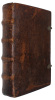
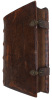
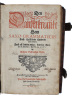
2. udgaven af den første dansk-sprogede Saxo-Udgave - et monumentalværk i dansk sprog og litteratur, idet værket først med Vedels oversættelse nåede frem til den almene læser, ""skrevet på et rent og frodigt dansk... langt senere blev den en sproglig inspirationskilde for romantikkens danske digtere...(DBL).Thesaurus 205.
Historiæ Danicæ Libri XVI. Stephanus Iohannis Stephanius summo Studio recognovit, Notis uberioribus illustravit. 1.-2.
Soræ, Joachim Moltkeog (Henrik Kruse),1644- (45). Folio. Velbevaret samt.helpergamentsbd. m.rig. rygforgyldn. (forgyldningen noget svag). Grønne bindebånd, som antageligt er fornyet. Kobberst.titelbl. (6), 384, (20), 252, (22) pp. samt talrige træsnitillustr. i kommentaren. Her og der med lidt brunpletter, men i øvrigt stort og godt ekspl.
Originaludgaven af den berømte ""Sorø-udgave"" som skulle afløse Chr. Pedersen's ""Pariserudgave"". Stephanius' tekst er filologisk set fremragende.
Saxoni Grammatici Historia Danica. Recensuit et Commentariis illustravit Petrus Erasmus Müller, Opus morte Milleri interruptum absolvit Joannes Matthias Velschow. Vol. I-II. (I. Textum et Notas breviores complectentis. II. Prolegomena et Notas uberior...
Havniæ, 1839-58. Lex8vo. 2 hldrbd. med rygforgyldning. Rygge med lidt brugsspor. Stålstukket portræt af Müller. XII,1033,XCIX,388 pp. samt 6 stålstukne plancher med runesten m.v. Lettere brunplettet.
Saxoni Grammatici Historia Danica. Recensuit et Commentariis illustravit Petrus Erasmus Müller, Opus morte Milleri interruptum absolvit Joannes Matthias Velschow. Vol. I-II. (I. Textum et Notas breviores complectentis. II. Prolegomena et Notas uberior...
Havniæ, 1839-58. Lex8vo. 3 samtidige velbevarede hldrbd. med rygforgyldning. XII,1033,XCIX,388 pp.
Saxonis Gesta Danorum. Primum a C. Knabe & P. Hermann recensita. Recognoverunt et ediderunt J. Olrik & H. Ræder. 2 vols. (I. Textus continens. II. Indicem Verborum Conficiendum curavit Franz Blatt).
Hauniæ, 1931-57. Folio. 2 orig. hlærredsbd. LI, 609, XXVII, 890 pp.
Saxonis Gesta Danorum. Primum a C. Knabe & P. Hermann recensita. Recognoverunt et ediderunt J. Olrik & H. Ræder. 2 vols. (I. Textus continens. II. Indicem Verborum Conficiendum curavit Franz Blatt).
Hauniæ, 1931-57. Folio. Ubeskåret i 2 orig. hlærredsbd. LI, 609, XXVII, 890 pp.
Saxonis Gesta Danorum. Primum a C. Knabe & P. Herrman recensita. Recognoverunt et edidirunt J. Olrik & H. Ræder. Tomus I. Textum Continens.
Hauniæ, 1931. 4to. Orig. hlærredsbind. LI,609 pp.
Saxonis Grammatici Danorum Historiae libri XVI, tre centis abhinc annis conscripta, tanta dictionis elegantia, rerung. gestarum varietate, ut cum omni vetustate contendere optimo iure videri possint. Accessit rerum memorabilium Index locupletissimus. ...
Basel, Io. Bebelium, 1534. Folio. Smukt nyere helldrbd. i flammet kalv, ophøjede bind på ryg udført i gl. stil. (16),189 blade. Titelbladet opsat med lidt skjolder og reparationer. Fra fol 127 starter en svag skjold i indre margin som gennem siderne breder sig i teksten. Fol 187-89 repareret med tab af lidt tekst i nederste hjørner. Lidt brunpletter og svage skjolder, mest i marginer. Første tekstside med bred træskåren ramme efter forlæg af Hans Holbein. Iøvrigt en del træskårne initialer.Folio. Beautiful recent full mottled calf binding in old style w. raised bands on back. Title-page mounted w. a few restorations and a bit of waterstaining. From f. 127 and throughout weak foxing to inner margin, which further on streches out into the text. Ff. 187-189 repaired w. a bit of loss of text to lower corners. A few brownspots and weak waterstaining, mostly marginal. First leaf of text w. a broad woodcut frame, made after Holbein. Many woodcut initials. (16), 189 ff.

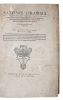
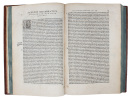
The rare Basel-edition of Saxo. It is the second Saxo-edition, but it is rarer than the first. Ther present work constitute the first full history of Denmark for posterity and to this day the most important of all Danish historical publications. This magnificent work contains the first known written narrative of the legend of Hamlet and served as the basis for Shakespeare's play. Denne såkaldte Basel-udgave er anden trykte Saxo-udgave og regnes for den mest sjældne.Adams S,631. - Lauritz Nielsen, 241.
Saxonis Grammatici Danorum Historiae libri XVI, tre centis abhinc annis conscripta, tanta dictionis elegantia, rerung. gestarum varietate, ut cum omni vetustate contendere optimo iure videri possint. Accessit rerum memorabilium Index locupletissimus. ... - [THE FIRST NARRATIVE OF HAMLET]
Basel, Io. Bebelium, 1534. Folio. Later full vellum. (18th cent.). Some minor cracks to hinge. A few brownspots to title-page and last leaf. Title-label with gilt lettering. Fol. (16),189, (1, verso with printers woodcut device) . First leaf of text with a broad woodcut frame, made after Holbein. Many woodcut initials. Small stamp on titlepage and in one margin. A large exceptionally clean copy.

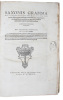
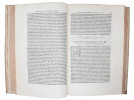
Second edition, also often referred to as the Basel-edition, of this monumental landmark work constituting the first full history of Denmark for posterity and to this day the most important of all Danish historical publications. This magnificent work preserves a wealth of Nordic legends, royal genealogies and mythic material otherwise lost - among them the earliest written account of the legend of Amleth, which later inspired Shakespeare to write Hamlet. This second edition (known as the Basel-edition) is considered even scarcer than the editio princeps printed in Paris in 1514. """"Hamlet"" is based on a Norse legend composed by Saxo Grammaticus in Latin around 1200 AD. The sixteen books that comprise Saxo Grammaticus' ""Gesta Danorum"", or ""History of the Danes"", tell of the rise and fall of the great rulers of Denmark, and the tale of Amleth, Saxo's Hamlet, is recounted in books three and four. In Saxo's version, King Rorik of the Danes places his trust in two brothers, Orvendil and Fengi. The brothers are appointed to rule over Jutland, and Orvendil weds the king's beautiful daughter, Geruth. They have a son, Amleth. But Fengi, lusting after Orvendil's new bride and longing to become the sole ruler of Jutland, kills his brother, marries Geruth, and declares himself king over the land. Amleth is desperately afraid, and feigns madness to keep from getting murdered. He plans revenge against his uncle and becomes the new and rightful king of Jutland. ([own translation] Carl S. Petersen). No complete manuscript of Saxo's work has survived, merely a few loose leaves have been preserved. Saxo Grammaticus (ab. 1150-1220) was probably a secular clerk or secretary to Absalon, Archbishop of Lund, the great Danish churchman, statesman and warrior. Saxo is remembered today as the author of the first full history of Denmark, in which he modelled himself on the classical authors (e.g. Virgil, Plato, Cicero) in order to glorify his fatherland. The work dates from the end of the 12th century and was edited by Christiern Pedersen, a Canon of Lund, and printed by Jodocus Badius Ascendius in Paris in 1514 (the present copy) with 16th century re-issues following in 1534 (Basel) and 1576 (Frankfurt). Only with the first printing of this seminal work did the work become known throughout academic circles. The work soon received international fame and is to this day renowned as not only being immensely important historically, but also being extremely well written (Saxo is praised by Erasmus, for instance, for possessing great power of eloquence). The work consists of sixteen books that cover the time from the founders of the Danish people (Dan I of Denmark) till Saxo's own time, ending around 1185 (with the submission of Pomerania), when the last part is supposedly written. The work thus covers the entire history of Denmark until Saxo's own time, seen under a somewhat glorified perspective, from heathen times with tales of Odin and the gods of Valhalla to the times of Absalon, who probably directly influenced the sections on the history of his own time, working closely with Saxo himself. The work also contains the first known written narration of the legend of Hamlet (Amleth, the son who took revenge for his murdered father). It is this narrative of Saxo's, which he based on an oral tale, that forms the basis for Shakespeare's ""Hamlet"", which takes place in Helsinore in Denmark. There is fairly certain evidence that Shakespeare knew Saxo's work on the History of Denmark and thus the legend of Amleth. ""This is the old, Norse folk-tale of Amleth, a literary ancestor of Shakespeare's ""Hamlet"". The Scandinavian legend was recorded in Latin around 1200 by the Danish historian Saxo Grammaticus (…). It is part of the collection of tales known as Gesta Danorum - a partly mythical history of the Danes. Saxo's Amleth story - a summary King Rørik of Denmark appoints two brothers, Horwendil and Fengo, as the rulers of Jutland. Horwendil slays the King of Norway, marries King Rørik's daughter Gerutha, and they have a son named Amleth. Consumed by envy of his brother, Fengo murders Horwendil and marries his wife Gerutha. Amleth then feigns madness, clothing himself in rags and spouting nonsense, to shield himself from his uncle's violence. In fact, the name 'Amleth' itself means 'stupid'. Yet Amleth's behaviour attracts suspicion, and the King attempts to trap him into admitting he has plans for revenge. First, a beautiful woman is used to lure him into betraying himself, but she proves loyal to Amleth. Then a spy is planted to eavesdrop on Amleth's conversation with his mother, in which she repents and he confesses his plans for revenge. Amleth detects the spy, kills him in a mad frenzy, throws his mutilated body in a sewer, and leaves it to be eaten by pigs. Fengo then deports Amleth to England with two escorts carrying a letter directing the King there to execute him. Amleth switches the letter with another one, which orders the death of the escorts and asks for the hand of the English Princess in marriage. Returning to Denmark, Amleth arrives disguised, in the midst of his own funeral, burns down the hall and hunts down his sleeping uncle. Because Amleth had wounded himself on his sword, attendants had made it harmless by nailing it to the scabbard (the sheath used to hold it). Amleth swaps this useless sword with Fengo's, succeeds in killing his uncle and next day is hailed as the King. ... Saxo's account has many of the defining features of Shakespeare's drama: a villain who kills his brother, takes over the throne and then marries his brother's wife a cunning young hero, the King's son, who pretends to be mad to shield himself from his uncle three plots used by the King to uncover the young man's secrets: a young woman, a spy planted in the Queen's bedroom (who is uncovered and killed), and two escorts who take the prince to England (also outwitted and killed) a hero who returns home during a funeral and finally achieves his revenge through an exchange of swords. There are equivalents for Shakespeare's central characters - old and young Hamlet, old and young Fortinbras, Claudius and Gertrude, Polonius, Ophelia, Rosencrantz and Guildenstern. But Saxo has no ghost demanding vengeance, and the identity of the murderous uncle is known from the start. There is no Osric, no gravediggers or play within a play. The legend lacks a Laertes character and the young woman does not go mad or kill herself. Perhaps most crucially, Amleth lacks Hamlet's melancholy disposition and long self-reflexive soliloquies, and he survives after becoming king."" (""Saxo's legend of Amleth in the Gesta Danorum"" - The British Library.mht). Adams S,631. Lauritz Nielsen, 241.
Den Danske Krønicke som Saxo Grammaticus screff, hallfierde hundrede Aar forleden: Nu først aff Latinen udsæt, flittelige offuerseet oc forbedret, Aff Anders Søffrinssøn Vedel.
Kiøbenhaffn, Hans Støckelman oc Andreas Gutterwitz, 1575. Folio. Velbevaret, nær samtidigt hellæderbind over træ med ophøjede bind på ryggen. Rygfelter med blindtrykte stempler. Med begge originale messinghængsler. Ryg med svage krakeleringer og lidt overfladeslid langs ryggens kanter. Titelblad itrykt i rødt/sort. Titelbladet omkantet, men uden tab. Fr. II's træskårne portræt trykt på bagsiden af titelbladet. (36),547,(33) pp. Trykt på godt svært papir og ualmindelig ren med kun få svage marginale brunpletter. Et blad i Fortalen omkantet og nogle få små bladhjørner restaurerede.
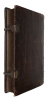
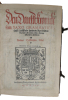
Originaludgaven af den første dansk-sprogede Saxo-Udgave - et monumentalværk i dansk litteratur, idet værket først med Vedels oversættelse nåede frem til den almene læser. The first printed Danish translation of Saxo Grammaticus ""Danorum Regum heroumque Historie"".Laur. Nielsen 1451 - Thesaurus 205 (Ed. A).
Den Danske Krønicke som Saxo Grammaticus screff, hallfierde hundrede Aar forleden: Nu først aff Latinen udsæt, flittelige offuerseet oc forbedret, Aff Anders Søffrinssøn Vedel.
Kiøbenhaffn, Hans Støckelman oc Andreas Gutterwitz, 1575. Folio. Nær samtidigt hellæderbind med ophøjede bind på ryggen, rig rygforgyldning. Skindtitel senere fornyet. Permer helt intakte, men med krakeleringer i skindets overflade. Titelblad i rødt/sort. Nederste højre hjørne af titelbladet bortrevet, men fint udbedret i faksimile. Fr. II's træskårne portræt trykt på bagsiden af titelbladet. (36),547,(33) pp. Trykt på godt svært papir. Mindre skjolder i nogle marginer til slut, få spredte brunpletter, enkelte tilskrifter.
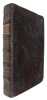
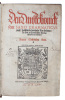
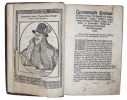
Originaludgaven af den første dansk-sprogede Saxo-Udgave - et monumentalværk i dansk litteratur, idet værket først med Vedels oversættelse nåede frem til den almene læser. The first printed Danish translation of Saxo Grammaticus ""Danorum Regum heroumque Historie"".Laur. Nielsen 1451 - Thesaurus 205 (Ed. B).
Den Danske Krønicke som Saxo Grammaticus screff, hallfierde hundrede Aar forleden: Nu først aff Latinen udsæt, flittelige offuerseet oc forbedret, Aff Anders Søffrinssøn Vedel.
Kiøbenhaffn, Hans Støckelman oc Andreas Gutterwitz, 1575. Folio. Spejlbindspastiche fra midten af 1800-tallet. Blindtrykte rammer. Rammer i 2 farver og med blindtrykte hjørnestempler. Ryggen med ophøjede bind og rigt forgyldt. Forgyldt rygtitel. Krakeleringer i skindet på permerne. (34) af 36 (A6 mangler),547,(33) pp. Fr. II's træskårne portræt trykt på bagsiden af titelbladet. Titelbladet trykt i rødt/sort men stærkt repareret i marginer med tab af papir og kun ganske lidt tab af en lille del af to bogstaver. Ligeledes er de første 11 blade stærkt kantreparerede, her og der med tab af nogle bogstaver i de trykte marginalier. Kolofonbladet er indbundet efter titelbladet. Brugssporene er markante på de første 12 blade, ellers nogenlunde bevaret med nogle omkantninger. Talrige gl. ikke tydelige ejernavne. Dog er et navn tydbart ""Baltzer Knutzon Bleiteckereiser"" (Baltzer blytækker, virksom 1603-19 i København) og om hvem der er skrevet en lang historie på de sidste friblade.
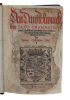
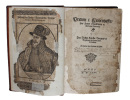
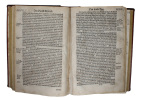
Originaludgaven af den første dansk-sprogede Saxo-Udgave - et monumentalværk i dansk litteratur, idet værket først med Vedels oversættelse nåede frem til den almene læser. The first printed Danish translation of Saxo Grammaticus ""Danorum Regum heroumque Historie"".Laur. Nielsen, 1451 - Thesaurus 205.
Historiæ Danicæ Libri XVI. Stephanus Iohannis Stephanius summo Studio recognovit, Notis uberioribus illustravit. 2 Dele.
Soræ, Joachim Moltke, Henrik Kruse,1644-45. Folio. (31,2 x 21 cm.). Samtidigt helpergamentsbind med håndskreven rygtitel. Bindet med lidt ældre blækpletter. Kobberstukket titelblad med Chr. IV, Valdemar I, Absalon og Saxo. (6), 384, (20), 252, (22) pp. samt talrige træsnitillustrationer i kommentardelen. Stephanius' kommentar har selvstændigt titelblad. Stort, rent og velbevaret eksemplar. Med Jonas Skougaards stilige kollationering i blyant på indersiden af forpermen, hvor han også bemærker, at dette eksemplar er større end normalen.
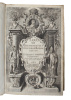
Originaludgaven af den berømte ""Sorø-udgave"" som skulle afløse Chr. Pedersen's ""Pariserudgave"". Stephanius' tekst er filologisk set fremragende og udgaven er banebrydende for Saxo-forskningen.Bibl. Danica III,9. - Thesaurus II, 668. - Birkelund, 48. - Skougaard III,p.138.
Historiæ Danicæ Libri XVI. Stephanus Iohannis Stephanius summo Studio recognovit, Notis uberioribus illustravit. 2 Dele.
Soræ, Joachim Moltke, Henrik Kruse,1644-45. Folio. (31,5 x 20,5 cm.). Samtidigt helpergamentsbind med håndskreven rygtitel. Kobberstukket titelblad med Chr. IV, Valdemar I, Absalon og Saxo. (6), 384, (20), 252, (22) pp. samt talrige træsnitillustrationer i kommentardelen. Stephanius' kommentar har selvstændigt titelblad. Stort, rent og velbevaret eksemplar. Luxdorphs elefant på forpermen, hans egenhændige navnetræk på indersiden af fribladet og 5 blade (friblade m.v.) fyldt med - sandsynligvis i egen hånd - sirligt skrevne optegnelser med sidehenvisninger, et slags register til bogen. Hertil er yderligere indsat på forpermens inderside Luxdorphs, i sort trykte, våbenskjold. Brugt som exlibris udtaler Elberling ""som Ex-Libris er det saare hæsligt, og det er vist kun meget sjældent benyttet paa denne Maade (af Luxdorph)"" (Breve fra en Bogelsker, p. 112-13).

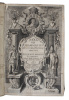
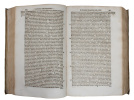
Originaludgaven af den berømte ""Sorø-udgave"" som skulle afløse Chr. Pedersen's ""Pariserudgave"". Stephanius' tekst er filologisk set fremragende og udgaven er banebrydende for Saxo-forskningen.Bibl. Danica III,9. - Thesaurus II, 668. - Birkelund, 48.
Den Danske Krønike som Saxo Grammaticus skreff, Halffierde hundrede Aar forleden. Først Aff Latinen udsæt, flittelige offuerseet oc forbedret, Aar MDLXXV. Aff Anders Søffrenssøn Vedel. Oc nu, effter Kongelig Mayestats Privilegium i 10. Aar icke maa ef...
Kiøbenhaffn, Henrich Waldkirch, 1610. Folio. (32 x 20 cm.). Indbundet i et samtidigt pragtfuldt renaissancebind i hellæder over træ med 4 ægte bind på ryggen, rigt udstyret med blindtryykte sammensatte rammer på begge permer og blindtrykt ornamentik i de centrale rektangulære felter. En del af ryg og hjørner restaureret, her er det gl. skind erstattet med nyt (uden blidtryk). Med 1 af 2 messinglukker. (32),DXLVII (=547),(29) pp. Forsatse fornyet. Titelbladet trykt i rød/sort, opklæbet og med lidt tab af blankt papir øverst (gl. navn bortklippet ?). Ydre margin af titelblad restaureret uden tab. Der er to varianter af titelbladet, det ene med Vedels portræt på bagsiden, det andet uden, som her. Indvendig et stort udmærket og ganske rent eksemplar, kun lettere bruning af marginer.
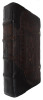
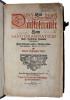
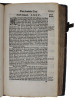
2. udgaven af den første dansk-sprogede Saxo-Udgave - et monumentalværk i dansk sprog og litteratur, idet værket først med Vedels oversættelse nåede frem til den almene læser, ""skrevet på et rent og frodigt dansk...langt senere blev den en sproglig inspirationskilde for romantikkens danske digtere...(DBL).Thesaurus 205.
Danica historia libris XVI, annis ab hinc trecentis qvinqvaginta summa verborum elegantia, magna sententiarum grauitate, rerum denique admiranda varietate, intermixtis aliarum quoque Gentium historijs, conscripta. [Bound with:] Germanicarum Rerum Quat... - [THIRD AND LAST 16TH CENTURY LATIN EDITION]
Frankfurt am Main, And. Wechel, 1576. Folio. Bound in contemporary blindstamped pigskin over wooden boards with the two original brass clasps. Hinges with grey coloured repair. Lower part of spine with traces after having been coloured red and blue. A very fine and clean copy. [Saxo:] (8), 342, (24) pp + 1 blank leaf + [Germanicarum Rerum Quatuor... :] (10), 224, (10) ff.].
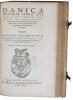
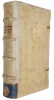
Third and last 16th century Latin edition of Saxo's ""History of Denmark"", edited by Philip Loncier, rector of the Frankfurt Gymnasium.Saxo Grammaticus (ab. 1150-1220) was probably a secular clerk or secretary to Absalon, Archbishop of Lund, the great Danish churchman, statesman and warrior. Saxo is remembered today as the author of the first full history of Denmark, in which he modeled himself on the classical authors (e.g. Virgil, Plato, Cicero) in order to glorify his fatherland. The work dates from the end of the 12th century and was edited by Christiern Pedersen, a Canon of Lund, and printed by Jodocus Badius Ascendius in Paris in 1514 (the editio princeps) with 16th century re-issues following in 1534 (Basel) and 1576 (the present). Only with the first printing of this seminal work did the work become known throughout academic circles. The work soon received international fame and is to this day renowned as not only being immensely important historically, but also being extremely well written (Saxo is praised by Erasmus, for instance, for possessing great power of eloquence). The work consists of sixteen books that cover the time from the founders of the Danish people (Dan I of Denmark) till Saxo's own time, ending around 1185 (with the submission of Pomerania), when the last part is supposedly written. The work thus covers the entire history of Denmark until Saxo's own time, seen under a somewhat glorified perspective, from heathen times with tales of Odin and the gods of Valhalla to the times of Absalon, who probably directly influenced the sections on the history of his own time, working closely with Saxo himself. Apart from that, the work contains the first known written narration of the legend of Hamlet (Amleth, the son who took revenge for his murdered father). It is most likely this narrative of Saxo's, which he based on an oral tale, that forms the basis for Shakespeare's ""Hamlet"", which takes place in Helsinore in Denmark. There is fairly certain evidence that Shakespeare knew Saxo's work on the History of Denmark and thus, from that, the legend of Amleth.The editio princeps was printed in Paris in 1514, the second edition being printed in Basel in 1534.LN 1450Thesaurus 190.GERMANICARUM RERUM QUATUOR...Bound with Saxo is German Simon Schard's (1535-1573), History of Germany from the time Augustus till Henry IV.Adams G 488

