 Write to the booksellers
-
Type
Book (1241)
Magazine (1)
-
Language
French (1240)
Italian (2)
-
Century
18th (2)
19th (44)
20th (116)
21st (16)
-
Countries
Belgium (266)
France (366)
Netherlands (329)
Switzerland (281)
-
Syndicate
ILAB (321)
NVVA (15)
SLACES (15)
SLAM (306)
SNCAO (1)
Inscriptions de l'Ethiopie antique.
Leiden, Brill, 1962. In-8 rel. pleine toile d'éd., titre doré, 111 pp., 24 planches dont 16 pl. photogr. (une dépliante).
Bonne condition. - Frais de port : -France 5,7 € -U.E. 8 € -Monde (z B : 12 €) (z C : 22 €)


Sammlung der carthagischen Inschriften. Band I : Tafeln 1-202 und Anhang, Tafel 1-6.
Strassburg, Trübner, 1883. Petit in-folio rel. édit. bradel demi-toile brune à petits coins, [2] ff., 208 planches de fac-similés d'inscriptions au trait.
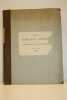
Rare et importante publication sur l'épigraphie punique. Herausgegeben mit Unterstützung der K. Akademie der Wissenschaften zu Berlin. Coins et coupes frottés, bonne condition. - Frais de port : -France 9,65 € -U.E. 11 € -Monde (z B : 17 €) (z C : 42 €)
11. Mit Beiträgen von M. Clauss, W. Eck, W. Kuhoff, L. Schumacher, R. Duthoy & P.R.C. Weaver.
Düsseldorf, Rheinland Verlag, 1976.
5,227 p., 21 pls. Cloth. 27 cm
13. Mit Beiträgen von B. & H. Galsterer, N. Gudea, Ph. Leveau, H.P. Roschinski, C.B. Rüger & B. Beyer, H.-O. Schnepper, M.P. Speidel, R. Wiegels.
Köln, Rheinland Verlag, 1983.
5,221 p., ills. Cl. 27 cm
5. Mit Beiträgen von G. Alföldy, L. Balla, C. Fernández-Chicarro, R.P. Duncan-Jones, S. Dusanic, H.-G. Kolbe, M. Mirkovic & R. Noll.
Düsseldorf, Rheinland Verlag, 1968.
5,190 p., 18 pls. Cl. 27 cm
8. Mit Beiträgen von G. Alföldy, L. Balla, T. Bechert, E. Birley, R.W. Davies, B. Dobson, & D.J. Breeze & R. Syme.
Düsseldorf, Rheinland Verlag, 1969.
5,133 p., 4 pls. Cl. 27 cm
9. Mit Beiträgen von R.W. Davies, R.P. Duncan-Jones, W. Eck, H. Galsterer, B. Galsterer-Kröll, M.G. Jarrett, J.C. Mann, V.A. Maxfield, M.M. Roxan & C.B. Rüger.
Düsseldorf, Rheinland Verlag, 1972.
5,260 p., 3 fold. tables. Cl. 27 cm
Medicine at Monte Cassino. Constantine the African and the Oldest Manuscript of his Pantegni
, Brepols, 2019 Hardback, xxxvi + 255 pages, Size:156 x 234 mm, Illustrations:46 b/w, 16 col., 6 tables b/w., Language: English. ISBN 9782503579214.
Summary Fleeing his North-African homeland for Italy, Constantine the African arrived in Salerno and then joined the abbey of Monte Cassino south of Rome in c. 1077. He dedicated his life to the translation of more than two dozen medical texts from Arabic into Latin. These great efforts produced the first substantial written body of medical theory and practice in medieval Europe. His most important contribution, an encyclopedia he called the Pantegni (The Complete Art), was translated and adapted from the Complete Book of the Medical Art by the Persian physician 'Ali ibn al-'Abb?s al-Ma??s? (d. 982). This monograph focuses on the oldest manuscript of the Pantegni,Theorica, which represents a work-in-progress with numerous unusual features. This study, for the first time, identifies Monte Cassino as the origin of this oldest Pantegni manuscript, and asserts that it was made during Constantine's lifetime. It further demonstrates how a skilled team of scribes and scholars assisted the translator in the complex process of producing this Latin version of the Arabic text. Several members of this production team are identified, both in the Pantegni manuscript and in other copies of Cassinese manuscripts. The book breaks new ground by identifying a range of manuscripts produced at Monte Cassino under Constantine's direct supervision, as evidenced by their material features, script, and contents. In rare detail, this study explores some of the challenges met by 'Team Constantine' as they sought to reveal new knowledge to the West, which in turn revolutionized medical understanding throughout medieval Europe. This is really a quite remarkable study, utterly transformative of our understanding of one of the turning points in the history of Western civilization, the moment when Greco-Arabic medicine was introduced into the Latin European world. Michael McVaugh TABLE OF CONTENTS Preface Acknowledgements List of Abbreviations Introduction. Constantine the African and the Pantegni in Context (by Eliza Glaze) Chapter 1. The Dossier of the Scribe Chapter 2. Producing the Manuscript Chapter 3. Team Constantine Chapter 4. Using the Manuscript Chapter 5. Implications and Complications Appendices Appendix A. The Hague, Koninklijke Bibliotheek, MS 73 J 6 Appendix B. The Biographies of Constantine the African Appendix C. Latin Text and English Translation of the Prologue of the Pantegni Appendix D. English Translation of the Theodemar Chapter of Ortus et vita Appendix E. Holster Books Copied Prior to 1200 Appendix F. Glossary of Scribes Bibliography Manuscript Index General Index
Estelle Ingrand-Varenne, Elisa Pallotini, Janneke Raaijmakers ? (eds)
Reference : 64418
Writing Names in Medieval Sacred Spaces. Inscriptions in the West, from Late Antiquity to the Early Middle Ages
, Brepols, 2023 Hardback, xx + 386 pages, Size:156 x 234 mm, Illustrations:94 b/w, 26 col., 4 tables b/w., 3 maps color, Language(s):English, French. ISBN 9782503602363.
Summary This volume proposes a framework for reflection on practices of writing personal names in medieval sacred spaces, uniting historians, art historians, and specialists in written culture (both epigraphers and palaeographers). It traces the forms and functions of names that can be found within the space of early medieval churches and cemeteries, focusing mainly, but not solely, on inscriptions. By examining names written in various kinds of media, from liturgical books to graffiti and more formal inscriptions, the contributors investigate the intentions and effects of the act of writing one's own name or having one's name written down. Their interest resides less in the name itself than the interactions it had with its spatial, iconographic, linguistic, ritual, and cultural context, and what this indicates about medieval graphical practices. What is a name from a graphic point of view? What are the specificities of the epigraphic manifestations of names? By whom were names written, and for whom were they intended (if they were even meant to be accessed)? Addressing these and other questions, this volume shows the importance of inscriptions as historical sources and the contribution they give to the study of medieval societies at the intersection of history, anthropology, archaeology, linguistics, and semiology. TABLE OF CONTENTS Introduction ? VINCENT DEBIAIS Le nom et l' tre: De la th orie aux mises en forme pigraphiques ? ESTELLE INGRAND-VARENNE Graver son nom dans la pierre: Aspects techniques et culturels ? THIERRY GREGOR Topographie du nom du saint dans l' glise: L'exemple des inscriptions br ves de d dicace ? ANNICK GAGN Le nom, marque dans l'image et marqueur de l'objet ? VINCENT DEBIAIS Le nom l'oeuvre: Les signatures pigraphiques d'artistes et de commanditaires entre qu te de gloire et perspectives eschatologiques ? EMILIE MINEO Hic fuit: Scratching Names on Sacred Walls ? CARLO TEDESCHI Saints' Names and Relics: The Evidence of Church Inscriptions ? ELISA PALLOTTINI Ces morts dont on inscrit le nom dans la pierre ... ? C CILE TREFFORT Et breve in exigo marmore nomen ero: Un seul nom pour pitaphe (Gaule, Aquitaine, VIe-VIIIe s.) ? MORGANE UBERTI The Memory of a Person's Name ? JANNEKE RAAIJMAKERS The Social Meaning of Names ? JANNEKE RAAIJMAKERS Naming as a Liturgical Act ? ELS ROSE Beyond the Pale? Those Who Were Not Worthy to Be Named ? MARCO MOSTERT Conclusions ? ESTELLE INGRAND-VARENNE, ELISA PALLOTTINI, and JANNEKE RAAIJMAKERS Bibliography Indices
Die Handschriften der Sammlung Ludwig. Band I.
Köln, Schnütgen-Museum der Stadt Köln, 1979.
335 p., 64 tipped in col. pls.; 123 b/w pls. Cl. 34 cm (Heavy book, may require extra shipping costs)
Notam superponere studui. The Use of Annotation Symbols in the Early Middle Ages
, Brepols, 2019 Paperback, 301 pages, Size:216 x 280 mm, Illustrations:15 tables b/w., Language: English. ISBN 9782503581705.
Summary Early medieval manuscripts were commonly annotated not only by glosses but also by annotation symbols. These graphic signs inserted in manuscript margins provided manuscript text with layers of additional meaning and functionality. From the most common signs marking biblical quotations and passages of interest to the sophisticated systems of signs used by some of the early medieval scholars, annotation symbols represent perhaps the most common form of marginalia encountered in early medieval books. Yet, their non-verbal character proved a serious obstacle to their understanding and appreciation. This book represents the first systematic study of annotation symbols used in the Latin West between c. 400 and c. 900. Combining paleographic evidence with the evidence of written sources such as late antique and early medieval lists of signs, this book identifies the most important communities of sign users and conventions in use in the early Middle Ages. It explores some of the notable differences between regions, periods, linguistic communities and classes of users and reconstructs a fascinating history of the practice of using signs, rather than words, to annotate text. Those who work with early medieval manuscripts will, furthermore, find this book to be a practical handbook of the most common annotation symbols attested in early medieval Western manuscripts or discussed in ancient and medieval sources. TABLE OF CONTENTS Introduction Chapter 1. The use of annotation symbols in Antiquity Chapter 2. The 21-sign treatise: inherited classical doxa in the early medieval Latin West Chapter 3. Transmission of other doxa with ancient roots in the Early Middle Ages Chapter 4. The revival of scholarly sign use in the Carolingian period Chapter 5. Annotation symbols in the Carolingian classroom Chapter 6. Signs used by Western scribes from Late Antiquity until the ninth century Conclusion Appendix I: Overview of the most important annotation symbols Appendix II: Latin sign treatises from the eighth to fifteenth century Appendix III: Annotation symbols in Bavarian manuscripts Bibliography Index of manuscripts Index of authors and texts annotated with signs Index of notable sign users
Catalogue des manuscrits conservés à Namur (Musée archéologique, Evêché, Grand Séminaire, Museum Artium S.J., etc.)
Gembloux, Duculot 1934 585pp., dans la série "Catalogue général des manuscrits des bibliothèques de Belgique" volume I, 25cm., jolie reliure solide en demi-toilme rouge, plats marbrés, titre doré au dos, brochure originale conservée et reliée, texte et intérieur sont frais, avec ex-libris héraldique, très bon état, poids: 1.4 kg., B115538
Daily, Sabbath, & Festival Prayers in the Dead Sea Scrolls.
Leiden, Brill, 1998. In-8, rel. éd. pleine-toile noire sous jaquette, X-302 pp., 3 planches de reprod. photogr. de fragments en n/b., texte en anglais, appendice, bibliographie, index.
Collection : Studies on the texts of the desert of Judah edited by F. Garcia Martinez, A.S. Van der Woude. Volume XXVII. Comme neuf. - Frais de port : -France 7,15 € -U.E. 9 € -Monde (z B : 14 €) (z C : 24 €)
Téboursouk. Stèles anépigraphes et stèles à inscriptions néopuniques.
P., Imprimerie nationale et C. Klincksieck, 1974. In-4 broché, 53 pp., 12 planches d'ill. photogr. en noir.
Plat sup. déchiré sur 15 cm au niveau du dos, très bon ex. par ailleurs. - Frais de port : -France 5,7 € -U.E. 8 € -Monde (z B : 12 €) (z C : 22 €)
The Papyrus Bremner-Rhind (British Museum No.10188).
Bruxelles, Fondation Egyptologique Reine Elisabeth, 1933. In-4, en feuilles sous chemise imprimée, X-94 pp., texte autographe en caractères hiéroglyphiques, non coupé.
Bibliotheca Aegyptiaca III. Dos passé, pp. de titre piquée en marge, bon ex. par ailleurs. - Frais de port : -France 5,7 € -U.E. 8 € -Monde (z B : 12 €) (z C : 22 €)
Etudes d'épigraphie médiévale. Texte, Index + planches. [2 vol.].
Limoges, Pulim, 1995. 2 vol. in-8 br., 621 et 108pp., 35 planches d'ill. en noir et blanc.
Recueil d'articles de Robert Favreau rassemblés à l'occasion de son départ à la retraite. Très bonne condition. - Frais de port : -France 7,15 € -U.E. 9 € -Monde (z B : 14 €) (z C : 24 €)
Les inscriptions médiévales [dans: Typologie des sources du moyen age occidental, TYP 35]
Turnhout, Brepols 1979 126pp., 24cm., brochure originale, dans la série "Typologie des sources du moyen age occidental" fasc.35 (B-I.D.7), très bon état, G102980
Der Habgierige und die Maat in der Lehre des Ptahhotep (5. und 19. Maxime).
Glückstadt, J.J. Augustin, 1958. In-4 br., 51 pp.
Bonne condition. - Frais de port : -France 4,9 € -U.E. 7 € -Monde (z B : 11 €) (z C : 21 €)
Des saints et des livres. Christianisme flamboyant et manuscrits hagiographiques du Nord la fin du Moyen ge (XIIIe-XVIe si cle)
, Brepols, 2021 Hardback, 521 pages, Size:156 x 234 mm, Illustrations:34 col., Language: French. ISBN 9782503595856.
Summary la fin du Moyen ge, la production hagiographique manuscrite se transforme et conna t son dernier ge d'or entre le succ s ditorial de la L gende dor e et l'arriv e de l'imprimerie. De nombreux textes anciens sont abr g s pour int grer de nouvelles collections. Ce ph nom ne est en partie responsable du relatif d sint r t des historiens leur gard : quoi bon s'int resser ces abr g s alors qu'il reste tant d couvrir dans les grands l gendiers du Moyen ge central, et qu'on commence peine mieux conna tre les tout premiers manuscrits conserv s ? L'objectif de ce livre est de mieux saisir la fonction sociale du manuscrit hagiographique, une p riode, celle du christianisme flamboyant , caract ris e par l'accumulation et la multiplication des d votions. En se focalisant sur les Pays-Bas m ridionaux et une large France septentrionale, une r gion travers e par la devotio moderna et d'intenses dynamiques religieuses, son objectif est aussi de comprendre ensemble les l gendiers latins et vernaculaires, en moyen n erlandais comme dans les parlers d'o l. Il s'agit de saisir les conditions mat rielles de la circulation des textes hagiographiques, mais aussi l'usage de ces manuscrits, dans le cadre de la pastorale et des pratiques cultuelles collectives comme dans celui de l'affirmation de l'individu la fin du Moyen ge. TABLE OF CONTENTS Fernand PELOUX, Introduction. Une culture hagiographique flamboyante au prisme de ses manuscrits (XIVe- XVIe si cle) Premi re partie. L'hagiographie vernaculaire du nord de la France : usages et r ception des manuscrits Catherine VINCENT, Pourquoi r crire des Vies de saints en fran ais la fin du Moyen ge ? Quelques pistes Ariane PINCHE, Li Seint Confessor de Wauchier de Denain, une ?uvre s rielle et son contexte manuscrit Anne-Fran oise LEURQUIN-LABIE, Composition, usage et diffusion du l gendier picard Esther DEHOUX, Marc GIL, Mathieu VIVAS, Un l gendier picard illustr de la fin du XVe si cle (Lille, BM, ms. 795). Originalit et tradition d'un cycle iconographique unique Florent COSTE, Du local l'universel. Modulations septentrionales de la L gende dor e dans quelques l gendiers vernaculaires Marie-Genevi ve GROSSEL, Les traductions en prose des Vies des P res apr s le XIIIe si cle : reprise, volution, transformation aux XIVe et XVe si cles Deuxi me partie. Un terrain propice. Manuscrits et spiritualit dans l'espace belge et les anciens Pays-Bas Werner VERBEKE, Prol gom nes pour une Bibliotheca Hagiographica Neerlandica Barbara FLEITH, Fabrication, fonctions et usages de quelques manuscrits contenant des chapitres des traductions n erlandaises de la Legenda aurea Chlo Clovis MAILLET, Singularit et s rialit d'un tr s rare manuscrit latin enlumin de la L gende Dor e au XVe si cle (Glasgow UL 1111) V ronique HAZEBROUCK-SOUCHE, La figure de l' v que dans l'oeuvre de Jean Gielemans : de la collection de Vies abr g es une chorographie sacr e du Brabant ? Xavier HERMAND, Composer, compiler, copier des textes hagiographiques la fin du Moyen ge : le cas des maisons religieuses du Namurois Troisi me partie. De Brest Tr ves, approche typologique de la diversit des manuscrits hagiographiques. Marjolaine LEMEILLAT, Manuscrits hagiographiques et saints bretons en Bretagne la fin du Moyen ge (XIVe-d but XVIe si cle) Fernand PELOUX et Laura VANGONE, Un l gendier m connu, commandit par le cardinal Georges d'Amboise vers 1500 (BM Rouen, A 40 [1412]) Sarah OLIVIER, R crire la saintet . Autour du ms. BNF Lat. 917, libellus de sainte Clotilde au XIVe si cle : entre pratiques d votionnelles et chos politiques Micka l WILMART, Un placard hagiographique : les miracles de sainte Foy enregistr s Coulommiers au XVe si cle Sara PRETTO, Entre d votion et outil de travail : le Repertorium singulorum sanctorum per annum de l'abbaye du Saint-S pulcre de Cambrai (Cambrai, BM, 116) Bastien DUBUISSON, Les transformations d'un recueil hagiographique monumental. Le grand l gendier de Saint-Maximin de Tr ves aux XVe- XVIe si cles Andr VAUCHEZ, Conclusions Bibliographie R sum s
Rene d'Anjou L'iconographie du Livre du C'ur d'amour epris de Rene d'Anjou
, Brepols - Harvey Miller, 2018 softcover, 145 p., 70 colour ill., 156 x 234 mm,Languages: French, Middle French. NEUF ISBN 9782503580029.
Le cycle iconographique quasiment complet du Livre du C'eur d'amour epris est ici envisage de concert avec le texte, en revelant ainsi toute sa richesse et sa singularite. Ce volume est consacre a l?une des ?uvres majeures de Rene d?Anjou conservee aujourd?hui dans le manuscrit francais 24399 de la Bibliotheque nationale de France. En un songe allegorique qui est aussi quete chevaleresque, le C'ur personnifie veut rejoindre l'aimee. Les enluminures, par une mise en image efficace et dynamique du texte, rendent surtout la profonde melancolie, en cette fin du Moyen Age, d'un sentiment amoureux qui affronte de multiples epreuves. Comme dans le Mortifiement de Vaine Plaisance, compose deux ans plus tot et premier volet de ce diptyque litteraire, le c?ur (organe supplicie pour le Mortifiement ou Chevalier depite dans le roman de 1457) n'aura d'autre choix que le renoncement final et la douleur. A cet egard, anime d'un vrai souci spirituel, Rene d'Anjou fait edifier a la meme epoque, aux Cordeliers d?Angers, une chapelle dediee a saint Bernardin de Sienne (1453), pensee comme tombeau pour son c?ur. Les sujets evoques dans le traite de theologie morale ou dans les peripeties sentimentales du chevalier C?ur ne sont pas ainsi sans rappeler les sujets exprimes et representes dans le petit sanctuaire, echos d?une reflexion sur la Passion du Christ, la redemption, la Vaine Gloire et le salut de l?ame. Rose-Marie Ferre est Maitre de Conferences en Histoire de l'art medieval a l'Universite Paris-Sorbonne (Paris IV). Ses recherches portent sur les parametres de la commande artistique, les questions d'iconographie et de transmission culturelle a la fin du Moyen Age. Table of Contents Une mise en scene allegorique de la quete amoureuse Rene d'Anjou, du prince a l'ecrivain Le personnage politique L'homme de religion et de spiritualite Le grand commanditaire L'ecrivain Les ?uvres attribuees Le Mortifiement de Vaine Plaisance Le Livre du C?ur d'Amour epris : epopee et courtoisie Un c?ur pluriel Une ecriture metaphorique Un texte enlumine : donnees historiques sur le manuscrit et comparaison avec le manuscrit de Vienne. Le cycle iconographique Bibliographie Glossaire
Une notazione neumatica della Germania del nord-ovest. Nuovi frammenti di Missale Lucchese.
Santa Rufina di Cittaducale (RI), RiStampa srl 2021, 240x170mm, frontispizio, 95pagine, in brossura. Buono stato.
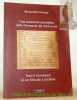
illustrato, Pour un paiement via PayPal, veuillez nous en faire la demande et nous vous enverrons une facture PayPal
Catalogue des manuscrits hagiographiques de la Bibliotheque nationale d'Athenes
, Brepols - Harvey Miller, 1984 Hardcover. 206 p., 160 x 250 mm, Languages: Greek, Including an index. Fine copy. ISBN 17010660200.
Manuscrits grecs de Paris, Inventaire hagiographique.
, Brepols - Harvey Miller, 1968 Hardcover. 380 p., 160 x 250 mm, Languages: Greek, Including an index. Fine copy. ISBN 17010440200.
Mittelalterliche Handschriften der Kölner Dombibliothek. Erstes Symposion der Diözesan- und Dombilbiothek Köln zu den Dom-Manuskripten, 26. bis 27 November 2004. Libelli Rhenani, Band 12.
Köln, Erzbischöfliche Diözesan- und Dombibliothek 2005, 240x175mm, 338Seiten, broschiert. Sehr schönes Exemplar.
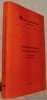
28 S/W Photographien, Pour un paiement via PayPal, veuillez nous en faire la demande et nous vous enverrons une facture PayPal

