 Write to the booksellers
152 books for « plutarchus »Edit
-
Century
16th (2)
18th (1)
19th (2)
20th (5)
-
Topics
Dryden (1)
Early printed books (2)
English (1)
Greek (119)
History (7)
Latin (111)
Literature (1)
Philosophy (3)
Religions (1)
Sciences (3)
-
Countries
Belgium (12)
Denmark (1)
France (4)
Germany (2)
Greece (1)
Netherlands (130)
Switzerland (2)
-
Syndicate
ILAB (4)
NVVA (1)
SLACES (1)
SLAM (1)
T'Leven der doorluchtige Griecken ende Romeynen, tegen elck anderen vergeleken door Plutarchus van Chaeronea. Wt de Griecsche sprake overgeset door M. Iaques Amyot, Abt van Bellozane, ende Raedt des Coninckx van Franckrijck, by hem overzien ende verbetert. Mitsgaders het leven van Hannibal, Scipio den Africaen, uyt het Latyn verfranscht by Carolus Clusius. Voorder het Leven van Epaminondas, Philippus van Macedonien, Dionysius den Ouden (Tyran van Sicilien), Augustus Cesar, Plutarchus ende Seneca, ende noch het Leven vande negen treffelijcke krijgs-oversten beschreven door Aemylius Probus. Met een cort begrijp op elcx leven, Leeringen op de kant, Chronijck ende Leer-registers, alles versamelt ende uytgegeven by S(imon) G(oulart) S(enlisien). Tesamen van nieus tot gemeen nut verduyscht door A. V(an) Z(uylen) V(an) N(ieuvelt) ende ten deele by eenen anderen beminder.
Delft (Tot Delft), Utrecht, (Tot Wtrecht), By Adriaen Gerritsen van Beyeren ende Felix van Sambrix (sic), & By David van Hoogenhuysen, 1644.
Folio. VI,548,(4) leaves. Calf 32 cm (Ref: STCN 141469102; Geerebaert 69,3, records this second edition of the first complete Dutch translation of 1603; OiN 310; Hoffmann 3,227; Graesse 5,365/66; Ebert 17507) (Details: Back gilt & with 6 raised bands. Unsigned engraved architectural frontispiece, depicting a chapel in a temple, in the niches of which stand 4 statues, one of them is Mercurius. The chapel is flanked by Romulus and Theseus, the founders of Rome and Athens; in the dome of the chapel is a portrait of Plutarchus. Woodcut printer's mark on the title, depicting a three-master on a rough sea, motto: 'Durate'. Woodcut initials at the beginning of a 'vita'. To some copies has been added after the title page 1 leaf with a dedication 'Aende Hoogh-Moghende Heeren, de Staten Generael' to the States General of the Dutch Republic. This copy doesnot have that dedication) (Condition: Head & foot of the spine partly worn away. Old leather repairs to the upper part of both joints. Upper joint and hinge cracking, but still strong. Leather repairs to 3 corners. 1 bumped corner grazed. Small hole in the leather of the lower board. Front endpapers renewed. Original front flyleaf preserved, but worn & with a fold. Margins of the frontispiece thumbed & slightly frayed. Some faint & small waterstains on the lower margin of ca. hundred leaves) (Note: This translation of 1644 is reissue of the first complete Dutch translation, originally published in 1603. The Greek philosophic stylist Plutarchus of Chaeroneia, ca. 46-120 A.D., wrote numerous short treatises on ethics and philosophy. He is however best known as historian and biographer. Plutarch composed with his famous 'Vitae' (or Parallel Lives), written ca. 100-120 A.D., a work of timeless quality. His aim was not writing history, but biography, so his chief interest was in the characters of the heroes and villains he portrayed, never avoiding a good story. Plutarch exercised a very profound influence on Western civilisation. His 'Vitae' has been one of the most frequently and continuously read books of the Western tradition. (The Classical Tradition, Cambr. Mass. 2010, p. 747.) Treacherous to the historian, Plutarch has won however since the Renaissance the affection of the many generations to whom he has been a main source of understanding of the ancient world, that is, early modern Europe discovered the ancient world for a great part through Plutarch's eyes. The Lives could gain an enormous impact by providing later biographers and literary authors an outstanding model. It is very well known for example that authors like Montaigne, Corneille, Racine, Rousseau, Schiller and Shakespeare heavily drew upon the Lives. Until the 19th century the Lives were invoked as models of totalitarism, anticlericalism by supporters and opponents. 'The founders of American democracy were avid readers of Plutarch as well, and some laced their prose with evidence of that fact. Franklin and Hamilton, in particular, proclaimed their admiration for the Lives' (Idem, p. 749) On the continent the 'Lives' were widely read in the French translation of the French humanist Jacques Amyot, 1513-1593, who was one of the most famous and influential translators of the Renaissance. Although the son of poor parents he was appointed professor of Greek and Latin at the University of Bourges. He even became bishop of Auxerre. From 1559 till 1565 he worked on his famous translation of the 'Vies Parallèles des Hommes Illustres'. For his translations he visited the 'Bibliotheca Vaticana' and the libraries of Venice to study Greek codices. His translation was considered by some to be so excellent that it even excelled the original Greek. 'Maer sal tot besluyt ghenoech sijn, alleen aen te roere, hoe dat M. Iacques Amyot s'conincx Raedt in dit groote werck sijnen swaren arbeyt zoo heeft besteedt, ende de oversettinge zoo wel getroffen, dat veele cloecke mannen meenen dat deselve den Griecxen text in cierlijckheydt overtreffet.' (Leaf 3* verso of the preface) This Dutch translation was based on the French text which was reedited by the French calvinist minister, author and translator S.G.S., i.e. Simon Goulard Silvanectinus (from Senlis), 1547-1628. Goulard published an expanded edition of Amyot's French translation in 1587. He added translations of the 'vitae' of Hannibal and Scipio Africanus, in the 16th century believed to be the work of Plutarch himself, but written by the 15th century imitator of Plutarch Donato Acciaiuoli (1470), and translated into French by the Dutch botanist Carolus Clusius, in French Charles de l'Écluse, (1561). Goulard also 'produced comparisons where these were missing in Plutarch as well as new Lives of Epaminondas and Philip, Dionysius and Augustus Caesar and Plutarch and Seneca'. (F. Manzini, 'Stendhal's Parallel Lives', Oxford etc. 2004, p. 37/38) The title of this Dutch translation is more or less an adaptation of the French title page of the edition Paris 1592. The Dutch translation was made, the preface reveals, by A.V.Z.V. Nieuvelt, that is Adam van Zuylen van Nieuvelt, and was first published., posthumely, in 1603. This edition of 1644 is a line for line reedition of that translation. Van Zuylen van Nieuvelt also translated the 'Cyropaedia' of Xenophon, published in 1592. He is a fine example of the Renaissance soldier. He fought in the Eighty Years' War, the Dutch war of Independence, 1568-1648, against the Spaniards. In 1583 he was for a year baljuw (bailiff) of Schoonhoven, a small city just east of Rotterdam. Later he was captain of an infantery regiment of the son in law of William of Orange, Philips of Hohenlohe, fighting against the Spaniards in the East of the Netherlands. In 1580 Adam van Zuylen was wounded in the lost and forgotten battle of Hardenberg, where the troops of the young republic lost 1500 man. (See: members.home.nl/m.tettero/Watergeuzen/Hardenberg.htm) Later Van Zuylen campaigned in the province of Friesland, and in 1596 he took part in the defence of Hulst, a fortified city in Zeeland. There he was taken prisoner by the Spaniards. He died that same year. Still this soldier found time to translate 'Vies Parallèles des Hommes Illustres' of Amyot, and Machiavelli's 'Discorsi' and 'Il Principe' (also from the French). After his death the manuscript with the translation of Amyot's Plutarch came into the possession of the Leiden publishers Paedts and Bouwens, who decided to enlarge this work, and to adopt it to the highly successfull French Amyot edition, produced by Simon Goulart, which contained not only useful notes and some commentary, but also a kind of continuation, consisting of the biographies of a number of ancient generals and kings. These new additions were translated by an anonymous man of letters. 'Maer alle de voorverhaelde nieuwe byvoegselen van Simon Goulart, sijn ten jongsten verduytscht, zoo in gedicht als anders, by eenen anderen, wesende een liefhebber sijner moeder tale'. (Leaf. *3 verso of the preface) (Van der Aa, 13,393)) (Collation: *6, A-4Z6 (leaf 4Z6 verso blank) (Photographs on request) (Heavy book, may require extra shipping costs)
Plutarchi Chaeronensis peri PAIDÔN AGÔGÊS, seu De puerorum educatione libellus. Analysi grammatica, interpretatione simplici ad textum graecum & paraphrasi perspicua ad modum Iohannis Minellii, illustratus studio M. Christiani Iunckeri, Dresd. Ill. Gymnas. Sax. Henneb. quod Schleusingae est, Conr. (Bound with:) Isocratis Attici rhetoris Orationes tres. I. ad Demonicum. II. ad Nicoclem. III. quae inscribitur Nicocles. Analysi grammatica, interpretatione simplici ad textum graecum & paraphrasi perspicua ad modum Iohannis Minellii, illustratae studio M. Christiani Iunckeri, Dresd. Ill. Gymnas. Sax. Henneb. quod Schleusingae est, Conr.
Leipzig (Lipsiae), Apud Maurit. Georg. Weidmannum, 1719.
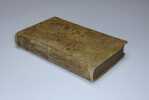
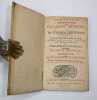
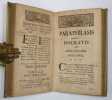
8vo. Two parts in 1 volume: (XIV),381,(3, stocklist) p. Vellum 17 cm (Ref: VD18 10402462; Ad 1: Hoffmann 3,185; Ad 2: Hoffmann 2,478) (Details: Two title-pages, both printed in red & black. On the left pages, printed in two columns, the Greek text and a parallel literal word for word translation into Latin; on the right page a polished translation, on the lower half of the right pages notes in Latin) (Condition: Vellum soiled and spotted. Paper foxed and browning) (Note: The Greek philosopher, historian and educator Plutarchus of Chaeroneia was born before 50 A.D. and died after A.D. 120. He is our most important witness of the spiritual climate of the first and second century A.D. He wrote numerous short treatises of popular moral philosophy, which go under the general name of Moralia. They include debating themes, works in the form of question and answer, and serious discussions of philosophical topics. 'It is no exaggeration to say that Renaissance and early modern Europe discovered Greece and Rome through Plutarch's eyes'. (The Classical Tradition, Cambr. Mass., 2010, p. 748) The treatise 'de puerorum educatione' is the first treatise of the 'Moralia' (No. 1, 1a-14c). Since Wyttenbach's 'Moralia' edition (1795-1810, Animadvers. I, 29-156) it is generally assumed, on stylistic and grammatical grounds, that this treatise cannot have been written by Plutarchus. Therefore it is very remarkable that a not genuine essay has such a strong influence on European intellectual and cultural life. 'The essay, however, is interesting in itself, since it reflect in many ways the educational conditions of its time. Frankly recognizing the difference in natural endowments, the author insists on the great benefits which inevitably come from training. Physical training is of course required, and military training is held to be most important for preparing men to win in battle. A knowledge of philosophy is the final goal of education'. (Plutarch, 'Moralia', with English translation by F.C. Babbitt, LCL 197, p. 3) In the first half of the 18th century alone German scholars published editions in 1705, 1719, 1738, 1744, 1745, 1749, 1750. In 1738 and 1754 German translations appeared. There was evidently much demand for Plutarchus' treatise on the education of children in Germany in the 18th century. The German historian and schoolmaster Christian Juncker, born 1668, became Conrector in 1695 of the 'Hennebergisches Gymnasium Schleusingen'. In 1713 he was appointed Rector of the Gymnasium of Altenburg, where he died in 1714. Juncker produced for the Leipzig publisher Weidmann a whole series of Latin school editions in the same manner as this Plutarch/ Isocrates edition, of Sallustius, Terentius, Florus, Horatius, Vergilius & Suetonius. Weidmann reissued them for decades. They were made in the manner of the popular 'Latin made easy method' of the Dutch schoolmaster Johannes Minellius. The Greek ones, first published in 1704, Juncker made as a next step for schoolboys who had already mastered the Greek of the New Testament. (p. *2 verso) ) (Provenance: On front flyleaf in ink 'Weidlich 1793') (Collation: *8 (minus leaf *8); A - 2A-8) (Photographs on request)
Eenige morale of zedige werken van Plutarchus. Vertaalt door R. T.
Amsterdam, Voor Hendrik Maneke, 1634.
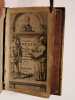
12mo. (VIII),477,(3 blank) p., frontispiece. Vellum 12.5 cm (Ref: Geerebaert 69,8; Geerebaert gives as date 1644; OiN 307) (Details: 5 thongs laced through the joints. Engraved frontispiece, depicting a writer/philosopher and the Greek god Hermes standing beneath a bust (of Plutarch?) The frontispiece bears the impressum 'Amsterdam, 1643') (Condition: Vellum slightly soiled and spotted. Front hinge cracking, frontispiece loosening. Right margin of first gatherings somewhat thumbed. Very tiny and almost invisible pinpoint wormholes in the left lower corner, never coming near any text) (Note: This is a translation into Dutch of 10 treatises of Plutarch's Moralia: 'Van d'opvoedingh der Kinderen. Hoe, en met wat inzicht, de Ionghelinghen de Poeeten leezen moeten. Hoe men hooren moet. Van de zeedelijkcke duechd. Van de zonde, en van de duechd. Dat men de duechd kan leeren. Hoe men de vleider, en pluim-strijcker van de vriend onderscheiden kan. Van de langhmoedichheyd. Van de Nieus-gierichheydt. Van de veelheit der Vrienden'. The Greek philosopher, historian and educator Plutarchus of Chaeroneia was born before 50 A.D., and died after A.D. 120. He is our most important witness of the spiritual climate of the first and second century A.D. He wrote numerous short treatises of popular moral philosophy, which go under the general name of the Moralia. They include debating themes, works in the form of question and answer, and serious discussions of philosophical topics. His warm and sympathetic personality can be traced in many treatises, which contain also a great deal of antiquarian knowledge picked up by Plutarchus in the course of his wide reading. (H.J. Rose, A Handbook of Greek literature, London 1965, p. 408). The Moralia were very influential in the Renaissance. 'It is no exaggeration to say that Renaissance and early modern Europe discovered Greece and Rome through Plutarch's eyes'. (The Classical Tradition, Cambr. Mass., 2010, p. 748). The 10 treatises were translated by one 'R.T.' Van Doorninck and STCN declare that this is Reinier Telle, 1558/59-1618. He was rector of the Schola Latina of Zierikzee, his hometown, from 1604-1610. He translated several works from Latin and Italian. According to De la Fontaine Verwey he was also a worthy satirical poet. Interesting as this may be, this cannot be correct, for the translation is preceded by a dedication to 'Franciscus Heermans', signed by R.T. The writer of this dedication tells that the publication of the 'gulde spreuken' of Heermans inspired him to translate a number of golden treatises of Plutarch as well. Now, Franciscus Heermans, or Franciscus Heerman, who lived from 1610 till after 1670, published his 'Toneel der deughdt, ofte guldene annotatien' only in 1631, 13 years after the death of Reinier Telle. Heermans was only 10 when Telle died. Heermans book was very successful, about 30 editions appeared during the next hundred years. (See for Heermans or Heerman Van der Aa 8,382/83; see for Telle preferably 'Biografisch lexicon voor de geschiedenis van het Nederlands Protestantisme' volume 1,375/6) (Provenance: On the front pastedown a nice small paper label 'M.M. Couvée, Lange Pooten 41, La Haye'. M.M. Couvée ran a posh bookshop and publishing firm in The Hague from 1859 till 1885. Members of the Royal family were among his clients) (Collation: A-8, A - V-8 (V7 verso & V8 blank) (Photographs on request)
Plutarchus' leven van Pericles en enkele gestalten uit Pericles' omgeving
Nijmegen, Berkhout 1948 [vi +] 141pp., in de reeks "Indagationes Noviomagenses ad res antiquas spectantes" vol.I, [inleiding & commentaren in het Nederlands, tekst van Plutarchus tweetalig : Grieks/Nederlands], stempeltje
Opuscula Plutarchi Chaeronei sedulo undequaque collecta, & diligenter recognita, ac in unam faciem bellatule coimpressa, quorum ante praefationem patebit & numerus & series, praemisso quam amplissimo & rerum & verborum indice. Addita autem sunt nuper opuscula haec duo, De cohibenda iracundia & curiositate.
N.pl. (Paris), Vaenundantur in Officina Ascensiana, (1526). (Colophon at the end: 'Sub prelo Ascensiano ad Nonas Febru. 1526')
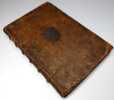
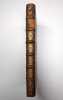
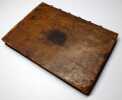
Small folio. (XIV),191 leaves. Contemporary leather. 31 cm (Ref: BP16_104378; Renouard, Badius Ascensius 3, p. 175, no. 9; Hoffmann 3,198/99; cf Schweiger 1,264, ed. Paris, Asc. 1521; Graesse 5,362, Graesse forgot to mention the year 1526; Pettegree/Walsby 83345) (Details: Spine with 6 raised bands. Gilt floral motives in the compartments. Ascensius's woodcut printer's device with the date 1520 on the title-page, surrounded by broad woodcut borders with some allegorical scenes. The short preface of Iodocus Badius Ascensius' is dated 1521. Ca. 60 big woodcut initials) (Condition: Cover grazed, scuffed & soiled. Foot of the spine chafed. Red morocco shield in the second compartment partly gone. Gilt stamp in the centre of both boards erased and made unrecognizable, probably with sandpaper. Two old and faint ownership entries on the title. Below the printer's mark a small name has been erased, resulting in a tiny hole in the paper. Lower margin of the second half waterstained. Big stain on one leaf. Foxing near the end. Lacking the last blank leaf. Some old ink underlinings and notes) (Note: The Greek philosopher, historian and educator Plutarchus of Chaeroneia was born before 50 A.D. and died after A.D. 120. He is our most important witness of the spiritual climate of the first and second century A.D. He wrote numerous short treatises of popular moral philosophy, which go under the general name of 'Moralia'. They include debating themes, works in the form of question and answer, and serious discussions of philosophical topics. His warm and sympathetic personality can be traced in many treatises, which contain also a great deal of antiquarian knowledge picked up by Plutarchus in the course of his wide reading. (H.J. Rose, A Handbook of Greek literature, London 1965, p. 408) The Moralia were very influential in the Renaissance. 'It is no exaggeration to say that Renaissance and early modern Europe discovered Greece and Rome through Plutarch's eyes'. (The Classical Tradition, Cambr. Mass., 2010, p. 748). Hoffmann mentions a great number of Greek, Greek/Latin editions, and Latin translations of (part of) the Moralia which were produced during the first half of the 16th century. The French publisher of Flemish origin Badius Ascensius (1462-1535), who was himself an accomplished Greek scholar, produced between 1503 and 1526 9 different editions of treatises of the Moralia, with translations of Erasmus and Guillaume Budé. The last one, this edition of 1526, has Latin translations made by Erasmus, Budaeus, Melanchthon, et alii. It copies the preceding edition of 1521, but adds at the end 8 leaves with 2 new treatises, 'De cohibenda iracundia' & 'De curiositate', both translated by Erasmus. The edition contains also short introductions to several treatises written by the leading scholars of that period) (Provenance: 2 faint and illegible names on the title, one word recognizable as 'Anthonii')) (Collation: â8, ê6, a-z8, A8 (minus A8, a blank leaf)) (Photographs on request)
Traitté de la superstition, composé par Plutarque, & traduit par Mr. Le Fevre. Avec un Entretien sur la vie de Romulus.
Saumur, Par Jean Lesnier Marchand Libraire, 1666.
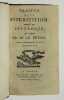
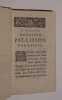
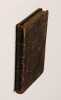
12mo. 52,117,(3) p. Calf 15 cm (Ref: Hoffmann 3,217; Graesse 5,369) (Details: Back with 4 raised bands; back and borders of the boards ruled blind. Woodcut printer's mark on the title of Jean Lesnier, it depicts an eagle that soars above a city; in its beak a banner with the motto 'movendo'. Woodcut headpieces and initials. Paper of excellent quality) (Condition: Binding a bit chafed, and slightly worn at the extremities. Tear in leaf A4) (Note: The Greek philosopher, historian and educator Plutarchus of Chaeroneia was born before 50 A.D., and died after A.D. 120. He is our most important witness of the spiritual climate of the first and second century A.D. He wrote numerous short treatises of popular moral philosophy, which go under the general name of the Moralia. They include debating themes, works in the form of question and answer, and serious discussions of philosophical topics. His warm and sympathetic personality can be traced in many treatises, which contain also a great deal of antiquarian knowledge picked up by Plutarchus in the course of his wide reading. (H.J. Rose, A Handbook of Greek literature, London 1965, p. 408). The Moralia were very influential in the Renaissance. 'It is no exaggeration to say that Renaissance and early modern Europe discovered Greece and Rome through Plutarch's eyes'. (The Classical Tradition, Cambr. Mass., 2010, p. 748). Since the Plutarch edition of 1572 of Henri Estienne (Henricus Stephanus) the 76 treatises of the Moralia are divided into 14 books, and the Latin titles he gave to the treatises are still in use today. Our book is a translation into French of the 14th treatise, Plutarch's essay on Superstition, 'De Superstitione', '?e?? de?s?da?µ???a?' (Moralia, Book 2, 164E-171F). It is an attempt to prove that superstition is a dangerous venom, and far worse than atheism. Plutarch argues that the 'atheist, when he is ill, takes into account and calls to mind the times when he has eaten too much or drunk too much wine, also irregularities in his daily life, or instances of over-fatigue or unaccustomed changes of air or locality; and again when he has given offence in administering office, and has encountered disrepute with the masses or calumny with a ruler, he looks to find the reason in himself and his own surroundings: Where did I err, and what have I done? What duty of mine was neglected? But in the estimation of the superstitious man, every indisposition of his body, loss of property, deaths of children, or mishaps and failures in public life are classed as 'afflictions of God' or 'attacks of an evil spirit'. For this reason he has no heart to relieve the situation or undo its effects, or to find some remedy for it or to take a strong stand against it, lest he seem to fight against God and to rebel at his punishment; but when he is ill the physician is ejected from the house, and when he is in grief the door is shut on the philosopher who would advise and comfort him'. (Babbit's translation of 168B-C in the Loeb Classical Library edition of the Moralia, 1928) The treatise, which Faber calls 'un des plus excellens traittés qui'ait iamais fait Plutarque', (Préface p. 22) was translated by the French scholar Tanneguy Le Fèvre, latinized as Tanaquil Faber, 1615-1672, who was from 1665 'professeur de grec de l'Académie protestante de Saumur'. Faber was a diligent editor of Greek and Latin texts. He opposed contemporary superstition, which he calls 'une maladie de l'ame'. (Préface p. 19) He considered atheists 'irreligieux' (...) gens sans religion'. (Idem p. 35). Faber is famous because of his daughter Anne, who married in 1664 the learned printer Jean (de) Lesnier, 1639-1675, when she was seventeen years old. So De Lesnier, who was printer for the protestant academy of Saumur, printed and published this translation for his father in law. After the publisher's early death in 1675, Anne, widowed at the age of 28, married in 1683 André Dacier, pupil of her father, and became a respected classical philologist herself under the name of 'Madame Dacier'. The work seems to be rare; we found in KVK only a few copies) (Collation: *-2*12, 3*2, A-E12) (Photographs on request)
Plutarchus 'De audiendis poetis'. Introduction, translation, commentary (by) Leo Johannes Rudolf Heirman.
's-Gravenhage, 1972.
VIII,198 p. Wrappers. 24 cm (Dissertation, Leiden) (Signature of the author on the title. Title written on the back with black feltpen)
Plutarchus' leven van Agesilaus. Inleiding, tekst, commentaar door I. BOS.
Groningen, Batavia, Wolters, 1949.
41,41 p. H.cl. 22 cm (Some pencil)
Plutarchus' leven van Agesilaus. Inleiding, tekst, commentaar.
Groningen, Batavia, Wolters, 1947.
XXX,226 p. Wrappers. 23 cm (Dissertation)
Plutarchus' leven van Pericles en enkele gestalten uit Pericles' omgeving.
Nijmegen, 1948.
VI,141 p. Wrs. (OiN 312; Diss., Nijmegen; introduction, text, translation & historical commentary)
Plutarchus' leven van Pericles en enkele gestalten uit Pericles' omgeving.
Nijmegen, 1948.
VI,141 p. Wrappers. (OiN 312; Dissertation; introduction, text, translation & historical commentary)
Plutarchus' leven van Pericles en enkele gestalten uit Pericles' omgeving.
Nijmegen, 1948.
VI,141 p. Cl. 25 cm (Diss.)(Rebound. Intr., t., tr. & hist. comm.)
Plutarchus' leven van Pyrrhus. Historische commentaar.
Amsterdam, H.J. Paris, 1940.
X,247 p. Stiff wrappers 24 cm (Dissertation) (Greek text & commentary) (Tear of 5 cm frontcover)
Plutarchus' leven van Pyrrhus. Historische commentaar.
Amsterdam, H.J. Paris, 1940.
X,247 p. Stiff wrappers. 24 cm (Dissertation, University Leiden) (Greek text & commentary) (Cover plasticized)
Plutarchus' leven van Pyrrhus. Historische commentaar.
Amsterdam, H.J. Paris, 1940.
X,247 p. Stiff wrappers 24 cm (Dissertation) (Greek text & commentary)
Plutarchus' leven van Lysander. Inl., tekst, commentaar.
Amst., Paris, 1939.
(VIII),275 p. Wrs. (Diss.)(Cover sl. worn)
Plutarchus' leven van Lysander. Inleiding, tekst, commentaar.
Amsterdam, H.J. Paris, 1939.
(VIII),275 p. Boards. 22 cm (Dissertation, VU Amsterdam) (Rebound)
Plutarchus en de Griekse muziek. De mentaliteit van de intellectueel in de tweede eeuw na Christus.
Bilthoven, Creyghton, 1970.
(VII),140 p. Cloth 26 cm (Dissertation, trade edition)
Plutarchus en de Griekse muziek. De mentaliteit van de intellectueel in de tweede eeuw na Christus.
Bilthoven, Creyghton, 1970.
(VII),140 p. Stiff wrappers 25 cm (Dissertation, University of Utrecht)
Plutarchi Cheronaei Philosophi et Historici Vitae comparatae illustrium virorum graecorum & romanorum, ita digestae, ut temporum ordo seriesque constet. Hermanno Cruserio I.C. interprete. Cum indice verborum & rerum locupletissimo & fidelissimo. Tomus Secundus.
Lyon (Lugduni), Apud Antonium Gryphium, 1566.
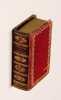
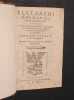
16mo. 876,(60 index) p. 18th century red morocco. 12 cm Volume 2 (of 3) only (Ref: Hoffmann 3,198; Brunet 4,737; Graesse 5,361) (Details: Back gilt with floral motives, boards with gilt wavelike borders. Marbled endpapers. Woodcut printer's mark on the title, depicting a griffin, which mythological animal symbolizes courage, diligence, watchfulness, and rapidity of execution, used as a pun of the family name Gryph or Greif (of German origin). The motto is 'Virtute duce / comite fortuna', 'Virtue thy leader, fortune thy comrade', a quote from a letter of Cicero to Plancus. (Ep. ad Familiares, liber X,3) This second volume contains the Lives of Aristides/Cato Maior, Agis & Cleomenes/Tiber. & C. Gracchi, Pyrrhus/Marius, Lysander/Sulla, Eumenes/Sertorius, Cimon/Lucullus, Nicias/Crassus, Agesilaus/Pompeius, Phocion/Cato Minor) (Condition: Binding scuffed, especially at the extremities. Corners bumped. Superficial damage to both boards. The turn-in of the upper board partly and of the lower board almost completely gone. Edges partly faintly stained. Faint name on the title. The words 'Tomus Secundus' have been erased, resulting in a small hole in the title) (Note: The Greek philosophic stylist Plutarchus of Chaeroneia, ca. 46-120 A.D., wrote numerous short treatises on ethics and philosophy. He is however best known as historian and biographer. Plutarch composed with his famous 'Vitae' (or Parallel Lives), written ca. 100-120 A.D., a work of timeless quality. His aim was not writing history, but biography, so his chief interest was in the characters of the heroes and villains he portrayed, never avoiding a good story. Plutarch exercised a very profound influence on Western civilisation. His 'Vitae' has been one of the most frequently and continuously read books of the Werstern tradition. (The Classical Tradition, Cambr. Mass. 2010, p. 747.) Treacherous to the historian, Plutarch has won however since the Renaissance the affection of the many generations to whom he has been a main source of understanding of the ancient world, that is, early modern Europe discovered the ancient world through Plutarch's eyes. The Lives could gain an enormous impact by providing later biographers and literary authors an outstanding model. It is very well known for example that authors like Montaigne, Corneille, Racine, Rousseau, Schiller and Shakespeare heavily drew upon the Lives. Until the 19th century the Lives were invoked as models of totalitarism, anticlericalism by supporters and opponents. 'The founders of American democracy were avid readers of Plutarch as well, and some laced their prose with evidence of that fact. Franklin and Hamilton, in particular, proclaimed their admiration for the Lives' (The Classical Tradition, Cambr. Mass., 2010, p. 749) This Latin translation of 1566 was made by the Dutch humanist Herman Cruyser (or Crüser), in Latin Cruserius, born in 1510 in the Dutch city of Kampen. He was a jurist and diplomat for the duchess of Guelderland and for the duchess of Cleve, Jülich & Berg. In his sparetime he translated some treatises of Galenus and the 'Vitae' of Plutarch. His translation of the 'Vitae' was first published in Basel in 1564 in folio. On the title of that edition he is described as 'Ducis Clivensis & Iuliaensis consilarius, interpres elegantissimus ac fidelissimus'. Our edition of Gryphius of 1566, in smaller format and cheaper, is a reissue of that expensive folio edition of 1564. Hoffmann writes that the translation of Cruyser first appeared in 1561, but it seems that no one has ever seen a copy of that edition. Cruyser died in 1575. 'Als Wilhelms (Wilhelm, duke of Cleve and Jülich) älteste Tochter Maria Eleonore 1573 den geisteskranken Herzog Albrecht Friedrich von Preußen heiratete, begleitete Crüser sie als Gesandter und persönlicher Ratgeber und blieb bis zu seinem Tode bei ihr in Königsberg'. (NDB 3 (1957), p. 430) (Provenance: On the title the name of 'François Lamb') (Collation: Aa8, B-3M8, 3N4) (Photographs on request)
Ploutarchou tou Chairôneôs Parallêla, ê Bioi parallêloi. Plutarchi Chaeronensis Parallela, seu Vitae parallelae, id est Vitae illustrium virorum, quos binos quasi paria composuit.
(Geneve, Henricus Stephanus, 1572)
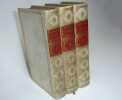
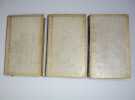
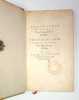
8vo. 3 volumes: vol. 1: (II),579,(1 blank); vol. 2: (2, = p. 581/82), p. 583-1213,(3 blank = p. 1214/16); vol. 3: p. (2 = p. 1217/18),1219-1923,(1 blank). 19th century vellum. 18 cm (Ref: GLN-2438; Renouard 134/35; Brunet 4,733; Hoffmann 3,171; Schweiger 2,258/9; Dibdin 2,336/7; Moss 2,507; Ebert 17406; Not in Graesse) (Details: These three volumes are the volumes 4, 5 & 6 of the 13 volume set 'Plutarchi Chaeronensis quae extant opera', which is the first edition of the complete works of Plutarch published by Henri Estienne in Geneva in 1572. The 3 volumes contain the complete Greek text of 'Ploutarchou tou Chairôneôs Parallêla, ê bioi parallêloi. Plutarchi Chaeronensis Parallela, seu vitae parallela', being tomus primus, secundus and tertius. Backs gilt with floral motives in 4 compartments. Red morocco shield on the backs. Boards with gilt borders that consist of a long floral wreath of wine leaves. Board edges decoratively gilt with complementary inside (inner) dentelles. Edges gilt. Marbled endpapers) (Condition: Bindings slightly soiled and very slightly scratched. Bookplate on the front endpaper of the first volume. Faint and small library stamp on the titles) (Note: The Greek philosophic stylist Plutarchus of Chaeroneia, ca. 46-120 A.D., wrote numerous short treatises on ethics and philosophy. He is however best known as historian and biographer. Plutarch composed with his famous 'Vitae' (or Parallel Lives), written ca. 100-120 A.D., a work of timeless quality. His aim was not writing history, but biography, so his chief interest was in the characters of the heroes and villains he portrayed, never avoiding a good story. Plutarch exercised a very profound influence on Western civilisation. His collection of 'Vitae' has been one of the most frequently and continuously read books of the Western tradition. Treacherous to the historian, Plutarch has won however since the Renaissance the affection of the many generations to whom he has been a main source of understanding of the ancient world, that is, early modern Europe discovered the ancient world through Plutarch's eyes. The Lives could gain an enormous impact by providing later biographers and literary authors an outstanding model. Authors like Montaigne, Corneille, Racine, Rousseau, Schiller and Shakespeare heavily drew upon the Lives. Until the 19th century the Lives were invoked as models of totalitarism, anticlericalism by supporters and opponents. 'The founders of American democracy were avid readers of Plutarch as well, and some laced their prose with evidence of that fact. Franklin and Hamilton, in particular, proclaimed their admiration for the Lives'. (The Classical Tradition, Cambr. Mass., 2010, p. 749) The first complete edition of Plutarch was published by the French humanist scholar/printer Henri Estienne (Henricus Stephanus), 1531-1598, who contributed greatly in the field of classical philology. He produced 58 Latin and 74 Greek editions of ancient authors, of which 18 were 'editiones principes'. He is still famous for his huge 'Thesaurus Graecae Linguae' of 1572, his Plutarch edition of the same year, and his 3 volume Plato edition of 1578. Scholars today still refer to the works of Plato and Plutarch by their Stephanus pagination) (Provenance: Bookplate of 'docteur Paul Lecène'. It depicts a faun who is sitting on a book, while playing a flute. Around him a motto in Greek: 'GÊRASKÔ D'AEI POLLA DIDASKOMENOS'. A famous text of the Greek philosopher Solon, one of the Seven Wise. It means 'I grow old forever learning many things'. Monsieur Lecène, 1878-1929, was a wellknown French surgeon. He has his own street, 'La rue du Docteur-Lecène' in the 13th arrondissement of Paris. The round stamp on the title is rather vague, it seems to read: 'BIBLIOTHECA DUACENA'. This set must once have belonged to the University (Library) of Douai, in the North of France. In 1793, during the French Revolution, this Catholic bulwark against protestantism, which was founded in 1560 by the Spanish king Philipp II, was closed down, and its library was incorporated in the 'Bibliothèque Municipale'. This library numbered 115000 works, when it burned down by a bombardment on the 11th of August 1944. Nine tenth of the books were destroyed, but the core of the collection, manuscripts and 8 000 old books, among which 450 incunables were saved. How this set of Plutarch escaped the confiscation and fire, we do not know. (See Wikipedia French: 'Universités de Douai') (Collation: 1: pi1, a-z8, A-M8, N10 (N10 verso blank). 2: pi1, a6, b8, Cc-Zz8, aA-rR8 (leaf rR7 verso and rR8 blank). 3: Aa-Zz8, Aaa-Vvv8, Xxx10 (leaf Xxx10 verso blank)) (Photographs on request) (Heavy set, may require extra shipping costs)
Plutarchi Fragmenta et Spuria (Plutarchi operum vol. 5)
Parisiis [Paris], Firmin-Didot 1876 xiv + 438pp., text printed in 2 columns, softcover, 27cm., pages uncut, G, [bilingual edition: Greek-Latin, with index on all of Plutarch's works]
Plutarch's lives of illustrious men, to which is prefixed 'A life of Plutarch' [3 volumes]
Boston, Dana Estes & company s.d. Complete in 3 volumes: xxiv,597 + 584 + 522pp. illustrated with some bl/w plates out of text, uniform hardcover bindings in half-leather (corners slightly bumped), gilt title and decorations on spines, marbled boards, upper edges gilt, marbled endpapers, title in red and black, text in English, in the series "Illustrated Sterling Edition", very good condition, weight: 2.7kg., K96363

