 Write to the booksellers
PLUTARCHUS.
Eenige morale of zedige werken van Plutarchus. Vertaalt door R. T.
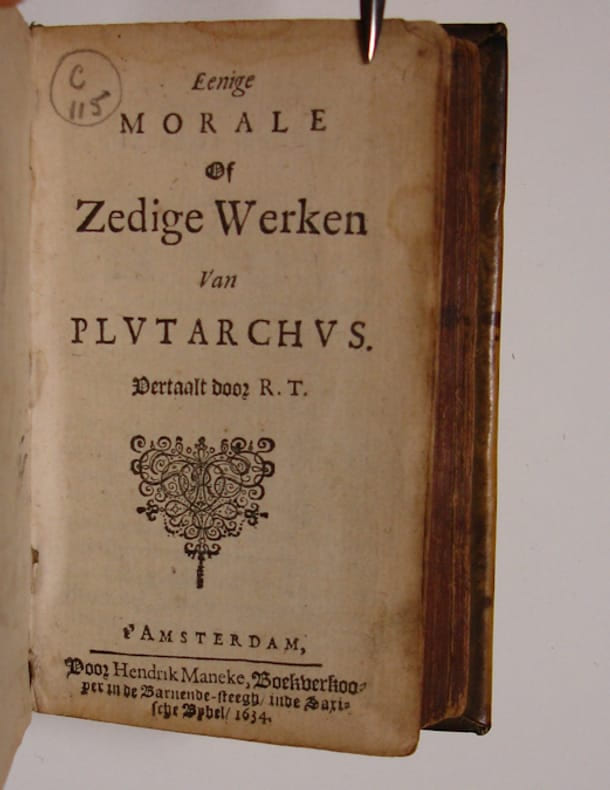
Amsterdam, Voor Hendrik Maneke, 1634.
Reference : 120155
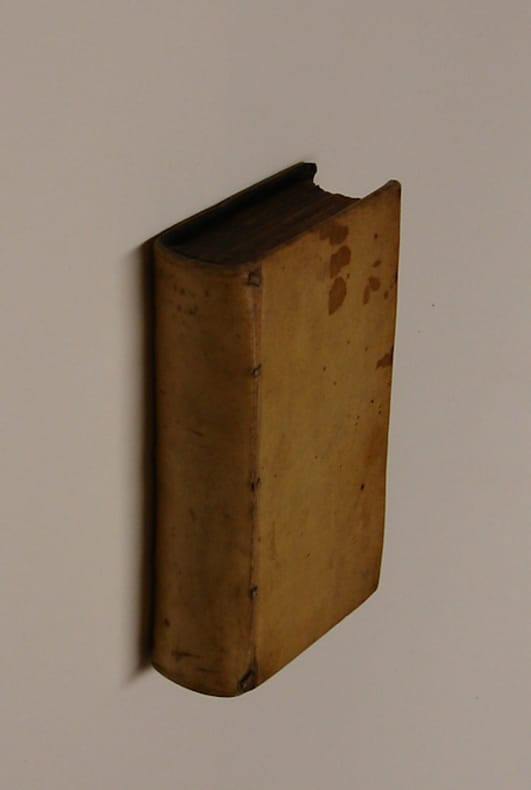
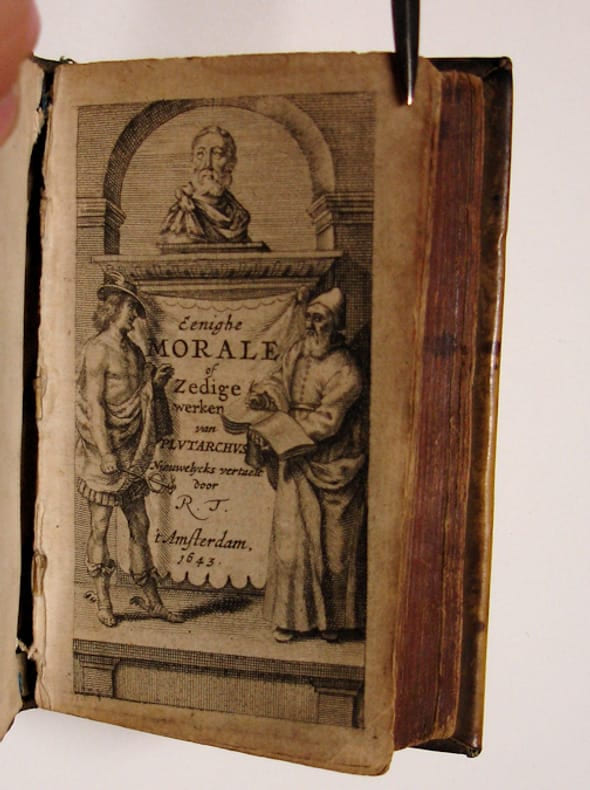
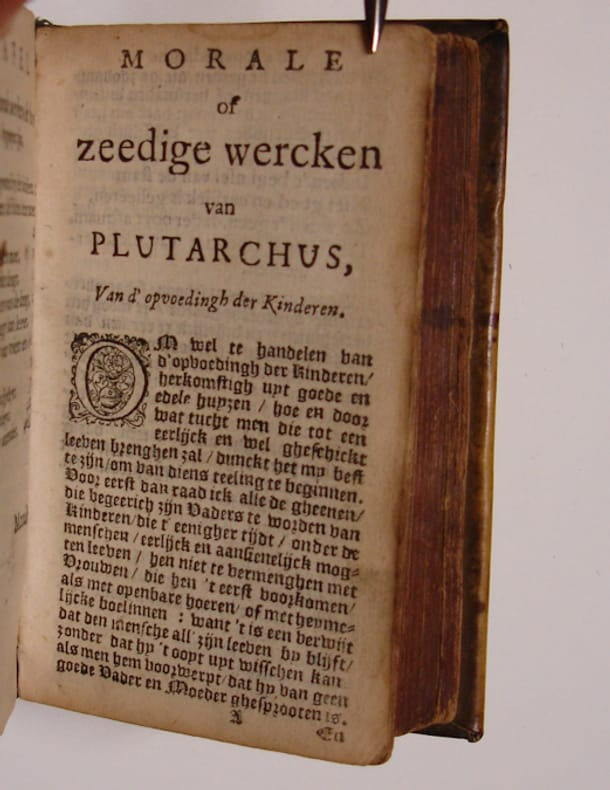
12mo. (VIII),477,(3 blank) p., frontispiece. Vellum 12.5 cm (Ref: Geerebaert 69,8; Geerebaert gives as date 1644; OiN 307) (Details: 5 thongs laced through the joints. Engraved frontispiece, depicting a writer/philosopher and the Greek god Hermes standing beneath a bust (of Plutarch?) The frontispiece bears the impressum 'Amsterdam, 1643') (Condition: Vellum slightly soiled and spotted. Front hinge cracking, frontispiece loosening. Right margin of first gatherings somewhat thumbed. Very tiny and almost invisible pinpoint wormholes in the left lower corner, never coming near any text) (Note: This is a translation into Dutch of 10 treatises of Plutarch's Moralia: 'Van d'opvoedingh der Kinderen. Hoe, en met wat inzicht, de Ionghelinghen de Poeeten leezen moeten. Hoe men hooren moet. Van de zeedelijkcke duechd. Van de zonde, en van de duechd. Dat men de duechd kan leeren. Hoe men de vleider, en pluim-strijcker van de vriend onderscheiden kan. Van de langhmoedichheyd. Van de Nieus-gierichheydt. Van de veelheit der Vrienden'. The Greek philosopher, historian and educator Plutarchus of Chaeroneia was born before 50 A.D., and died after A.D. 120. He is our most important witness of the spiritual climate of the first and second century A.D. He wrote numerous short treatises of popular moral philosophy, which go under the general name of the Moralia. They include debating themes, works in the form of question and answer, and serious discussions of philosophical topics. His warm and sympathetic personality can be traced in many treatises, which contain also a great deal of antiquarian knowledge picked up by Plutarchus in the course of his wide reading. (H.J. Rose, A Handbook of Greek literature, London 1965, p. 408). The Moralia were very influential in the Renaissance. 'It is no exaggeration to say that Renaissance and early modern Europe discovered Greece and Rome through Plutarch's eyes'. (The Classical Tradition, Cambr. Mass., 2010, p. 748). The 10 treatises were translated by one 'R.T.' Van Doorninck and STCN declare that this is Reinier Telle, 1558/59-1618. He was rector of the Schola Latina of Zierikzee, his hometown, from 1604-1610. He translated several works from Latin and Italian. According to De la Fontaine Verwey he was also a worthy satirical poet. Interesting as this may be, this cannot be correct, for the translation is preceded by a dedication to 'Franciscus Heermans', signed by R.T. The writer of this dedication tells that the publication of the 'gulde spreuken' of Heermans inspired him to translate a number of golden treatises of Plutarch as well. Now, Franciscus Heermans, or Franciscus Heerman, who lived from 1610 till after 1670, published his 'Toneel der deughdt, ofte guldene annotatien' only in 1631, 13 years after the death of Reinier Telle. Heermans was only 10 when Telle died. Heermans book was very successful, about 30 editions appeared during the next hundred years. (See for Heermans or Heerman Van der Aa 8,382/83; see for Telle preferably 'Biografisch lexicon voor de geschiedenis van het Nederlands Protestantisme' volume 1,375/6) (Provenance: On the front pastedown a nice small paper label 'M.M. Couvée, Lange Pooten 41, La Haye'. M.M. Couvée ran a posh bookshop and publishing firm in The Hague from 1859 till 1885. Members of the Royal family were among his clients) (Collation: A-8, A - V-8 (V7 verso & V8 blank) (Photographs on request)
Bookseller's contact details
Antiquariaat Fragmenta Selecta
+31 20 418 55 65
Payment mode

Sale conditions
Terms of Sale All items offered are subject to prior sale. Your order will be final after you have received our confirmation, with a specification of the availability of the items and the shipping costs. All books are complete and in good antiquarian condition, unless otherwise described. Prices are in EURO. Postage and insurance are not included. Postage will be calculated at cost (no extra charges). Returns Books may be returned within 14 days of receipt, if returned in the same condition as sent, and packed, shipped and insured as received (please always notify us). We will refund the shipping costs of a return shipment only if our descriptions were not correct. How to pay Pre-payment is necessary for new customers. Our order confirmation will provide detailed information and a specification of the shipping costs. Customers who are known to us and libraries will be invoiced as usual. We accept Visa and Mastercard. You can submit your card information through our SECURE PAYMENT FORM. PayPal: we will send you a personal link to the PayPal website. Banktransfers: payment can be made into our bank account in The Netherlands.

