 Write to the booksellers
PLUTARCHUS & ISOCRATES.
Plutarchi Chaeronensis peri PAIDÔN AGÔGÊS, seu De puerorum educatione libellus. Analysi grammatica, interpretatione simplici ad textum graecum & paraphrasi perspicua ad modum Iohannis Minellii, illustratus studio M. Christiani Iunckeri, Dresd. Ill. Gymnas. Sax. Henneb. quod Schleusingae est, Conr. (Bound with:) Isocratis Attici rhetoris Orationes tres. I. ad Demonicum. II. ad Nicoclem. III. quae inscribitur Nicocles. Analysi grammatica, interpretatione simplici ad textum graecum & paraphrasi perspicua ad modum Iohannis Minellii, illustratae studio M. Christiani Iunckeri, Dresd. Ill. Gymnas. Sax. Henneb. quod Schleusingae est, Conr.
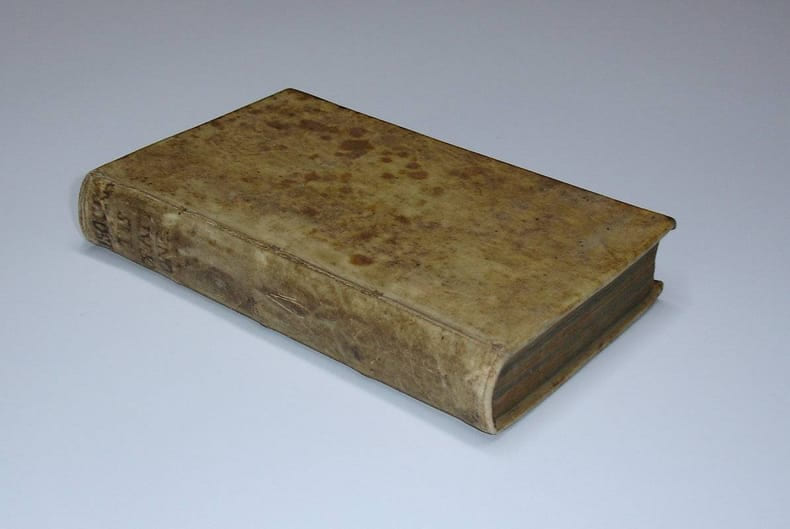
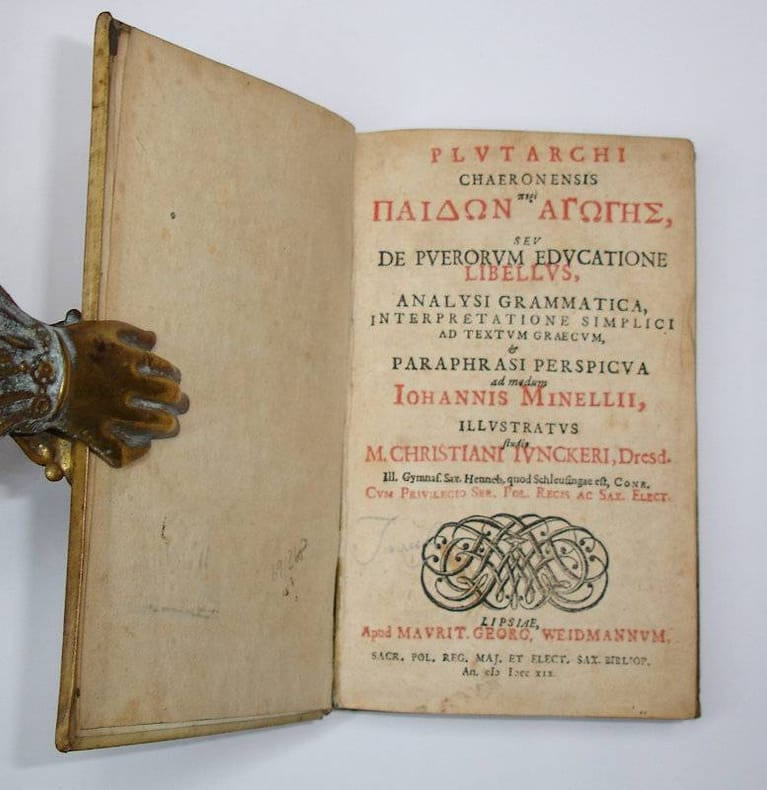
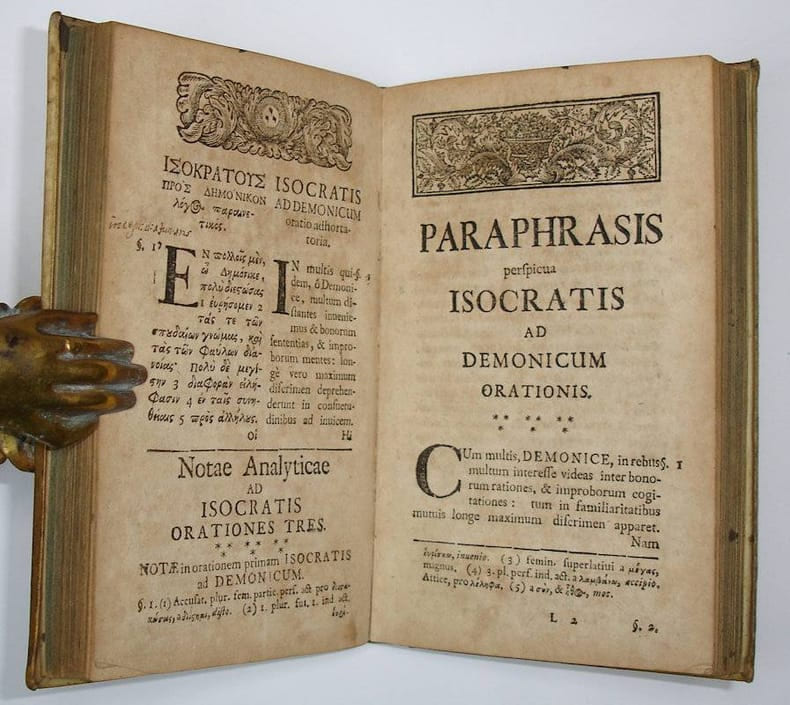
Leipzig (Lipsiae), Apud Maurit. Georg. Weidmannum, 1719.
Reference : 120393
8vo. Two parts in 1 volume: (XIV),381,(3, stocklist) p. Vellum 17 cm (Ref: VD18 10402462; Ad 1: Hoffmann 3,185; Ad 2: Hoffmann 2,478) (Details: Two title-pages, both printed in red & black. On the left pages, printed in two columns, the Greek text and a parallel literal word for word translation into Latin; on the right page a polished translation, on the lower half of the right pages notes in Latin) (Condition: Vellum soiled and spotted. Paper foxed and browning) (Note: The Greek philosopher, historian and educator Plutarchus of Chaeroneia was born before 50 A.D. and died after A.D. 120. He is our most important witness of the spiritual climate of the first and second century A.D. He wrote numerous short treatises of popular moral philosophy, which go under the general name of Moralia. They include debating themes, works in the form of question and answer, and serious discussions of philosophical topics. 'It is no exaggeration to say that Renaissance and early modern Europe discovered Greece and Rome through Plutarch's eyes'. (The Classical Tradition, Cambr. Mass., 2010, p. 748) The treatise 'de puerorum educatione' is the first treatise of the 'Moralia' (No. 1, 1a-14c). Since Wyttenbach's 'Moralia' edition (1795-1810, Animadvers. I, 29-156) it is generally assumed, on stylistic and grammatical grounds, that this treatise cannot have been written by Plutarchus. Therefore it is very remarkable that a not genuine essay has such a strong influence on European intellectual and cultural life. 'The essay, however, is interesting in itself, since it reflect in many ways the educational conditions of its time. Frankly recognizing the difference in natural endowments, the author insists on the great benefits which inevitably come from training. Physical training is of course required, and military training is held to be most important for preparing men to win in battle. A knowledge of philosophy is the final goal of education'. (Plutarch, 'Moralia', with English translation by F.C. Babbitt, LCL 197, p. 3) In the first half of the 18th century alone German scholars published editions in 1705, 1719, 1738, 1744, 1745, 1749, 1750. In 1738 and 1754 German translations appeared. There was evidently much demand for Plutarchus' treatise on the education of children in Germany in the 18th century. The German historian and schoolmaster Christian Juncker, born 1668, became Conrector in 1695 of the 'Hennebergisches Gymnasium Schleusingen'. In 1713 he was appointed Rector of the Gymnasium of Altenburg, where he died in 1714. Juncker produced for the Leipzig publisher Weidmann a whole series of Latin school editions in the same manner as this Plutarch/ Isocrates edition, of Sallustius, Terentius, Florus, Horatius, Vergilius & Suetonius. Weidmann reissued them for decades. They were made in the manner of the popular 'Latin made easy method' of the Dutch schoolmaster Johannes Minellius. The Greek ones, first published in 1704, Juncker made as a next step for schoolboys who had already mastered the Greek of the New Testament. (p. *2 verso) ) (Provenance: On front flyleaf in ink 'Weidlich 1793') (Collation: *8 (minus leaf *8); A - 2A-8) (Photographs on request)
Bookseller's contact details
Antiquariaat Fragmenta Selecta
+31 20 418 55 65
Payment mode

Sale conditions
Terms of Sale All items offered are subject to prior sale. Your order will be final after you have received our confirmation, with a specification of the availability of the items and the shipping costs. All books are complete and in good antiquarian condition, unless otherwise described. Prices are in EURO. Postage and insurance are not included. Postage will be calculated at cost (no extra charges). Returns Books may be returned within 14 days of receipt, if returned in the same condition as sent, and packed, shipped and insured as received (please always notify us). We will refund the shipping costs of a return shipment only if our descriptions were not correct. How to pay Pre-payment is necessary for new customers. Our order confirmation will provide detailed information and a specification of the shipping costs. Customers who are known to us and libraries will be invoiced as usual. We accept Visa and Mastercard. You can submit your card information through our SECURE PAYMENT FORM. PayPal: we will send you a personal link to the PayPal website. Banktransfers: payment can be made into our bank account in The Netherlands.

