 Write to the booksellers
PLUTARCHUS.
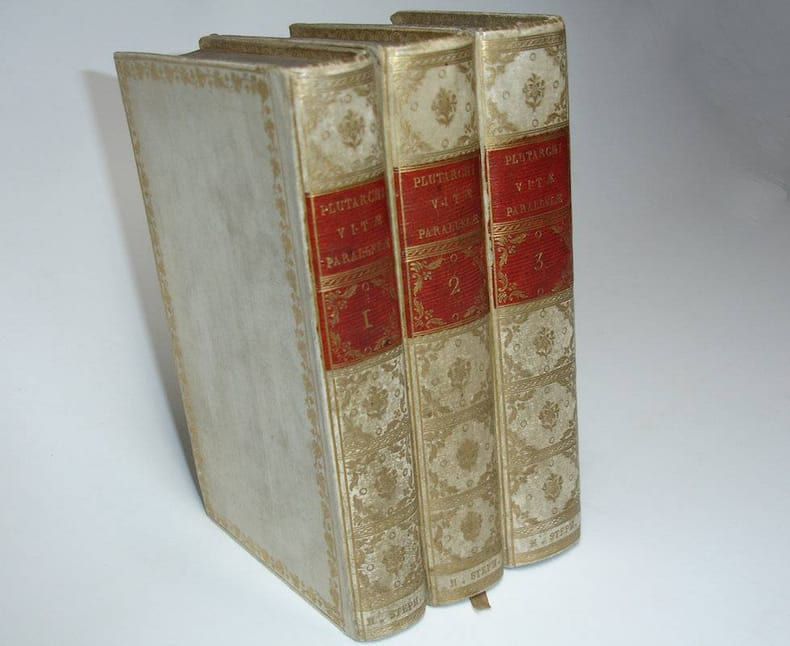
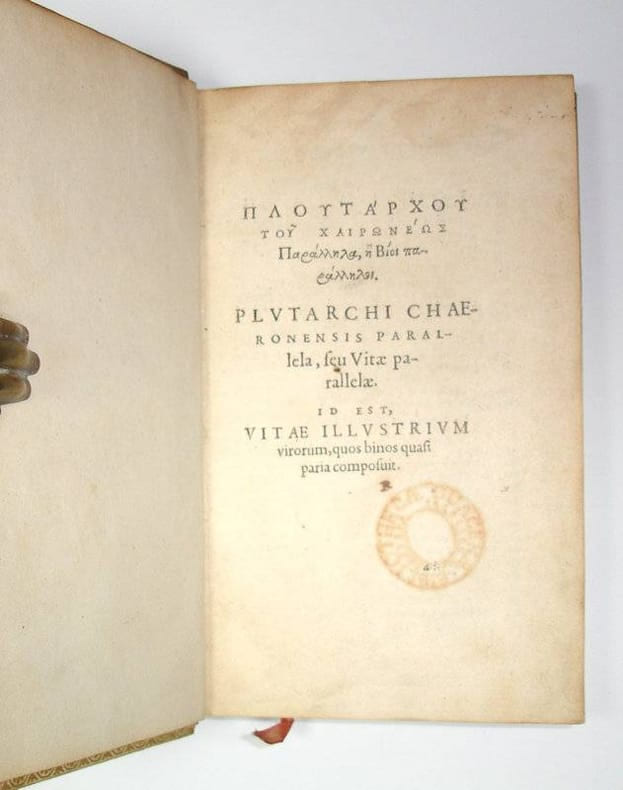
Ploutarchou tou Chairôneôs Parallêla, ê Bioi parallêloi. Plutarchi Chaeronensis Parallela, seu Vitae parallelae, id est Vitae illustrium virorum, quos binos quasi paria composuit.
(Geneve, Henricus Stephanus, 1572)
Reference : 130371
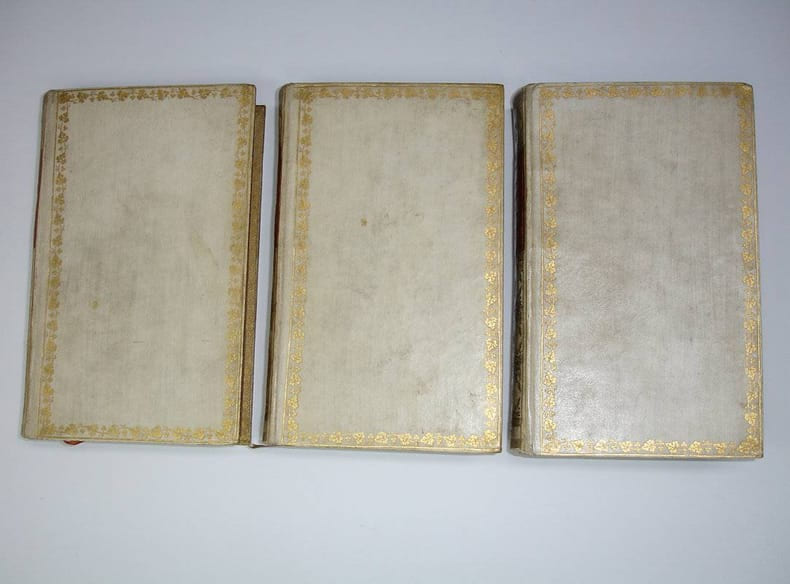
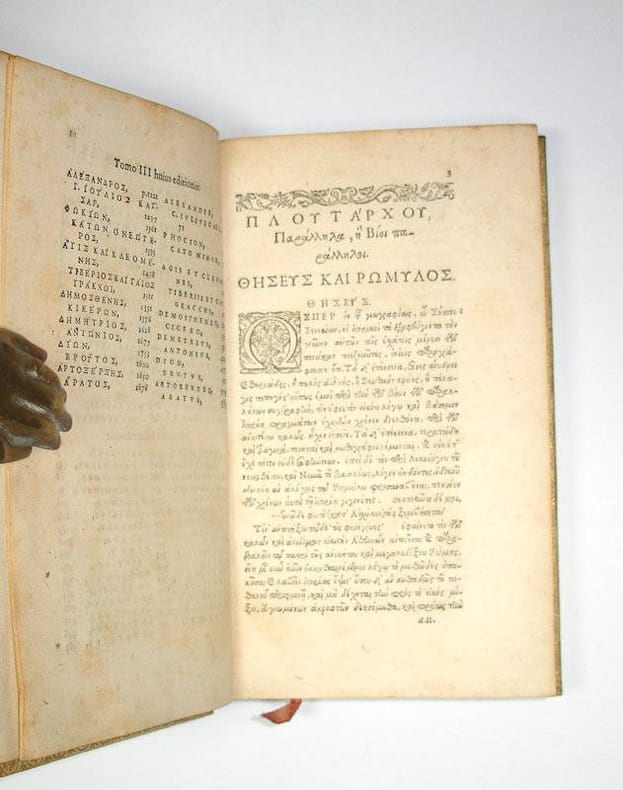
8vo. 3 volumes: vol. 1: (II),579,(1 blank); vol. 2: (2, = p. 581/82), p. 583-1213,(3 blank = p. 1214/16); vol. 3: p. (2 = p. 1217/18),1219-1923,(1 blank). 19th century vellum. 18 cm (Ref: GLN-2438; Renouard 134/35; Brunet 4,733; Hoffmann 3,171; Schweiger 2,258/9; Dibdin 2,336/7; Moss 2,507; Ebert 17406; Not in Graesse) (Details: These three volumes are the volumes 4, 5 & 6 of the 13 volume set 'Plutarchi Chaeronensis quae extant opera', which is the first edition of the complete works of Plutarch published by Henri Estienne in Geneva in 1572. The 3 volumes contain the complete Greek text of 'Ploutarchou tou Chairôneôs Parallêla, ê bioi parallêloi. Plutarchi Chaeronensis Parallela, seu vitae parallela', being tomus primus, secundus and tertius. Backs gilt with floral motives in 4 compartments. Red morocco shield on the backs. Boards with gilt borders that consist of a long floral wreath of wine leaves. Board edges decoratively gilt with complementary inside (inner) dentelles. Edges gilt. Marbled endpapers) (Condition: Bindings slightly soiled and very slightly scratched. Bookplate on the front endpaper of the first volume. Faint and small library stamp on the titles) (Note: The Greek philosophic stylist Plutarchus of Chaeroneia, ca. 46-120 A.D., wrote numerous short treatises on ethics and philosophy. He is however best known as historian and biographer. Plutarch composed with his famous 'Vitae' (or Parallel Lives), written ca. 100-120 A.D., a work of timeless quality. His aim was not writing history, but biography, so his chief interest was in the characters of the heroes and villains he portrayed, never avoiding a good story. Plutarch exercised a very profound influence on Western civilisation. His collection of 'Vitae' has been one of the most frequently and continuously read books of the Western tradition. Treacherous to the historian, Plutarch has won however since the Renaissance the affection of the many generations to whom he has been a main source of understanding of the ancient world, that is, early modern Europe discovered the ancient world through Plutarch's eyes. The Lives could gain an enormous impact by providing later biographers and literary authors an outstanding model. Authors like Montaigne, Corneille, Racine, Rousseau, Schiller and Shakespeare heavily drew upon the Lives. Until the 19th century the Lives were invoked as models of totalitarism, anticlericalism by supporters and opponents. 'The founders of American democracy were avid readers of Plutarch as well, and some laced their prose with evidence of that fact. Franklin and Hamilton, in particular, proclaimed their admiration for the Lives'. (The Classical Tradition, Cambr. Mass., 2010, p. 749) The first complete edition of Plutarch was published by the French humanist scholar/printer Henri Estienne (Henricus Stephanus), 1531-1598, who contributed greatly in the field of classical philology. He produced 58 Latin and 74 Greek editions of ancient authors, of which 18 were 'editiones principes'. He is still famous for his huge 'Thesaurus Graecae Linguae' of 1572, his Plutarch edition of the same year, and his 3 volume Plato edition of 1578. Scholars today still refer to the works of Plato and Plutarch by their Stephanus pagination) (Provenance: Bookplate of 'docteur Paul Lecène'. It depicts a faun who is sitting on a book, while playing a flute. Around him a motto in Greek: 'GÊRASKÔ D'AEI POLLA DIDASKOMENOS'. A famous text of the Greek philosopher Solon, one of the Seven Wise. It means 'I grow old forever learning many things'. Monsieur Lecène, 1878-1929, was a wellknown French surgeon. He has his own street, 'La rue du Docteur-Lecène' in the 13th arrondissement of Paris. The round stamp on the title is rather vague, it seems to read: 'BIBLIOTHECA DUACENA'. This set must once have belonged to the University (Library) of Douai, in the North of France. In 1793, during the French Revolution, this Catholic bulwark against protestantism, which was founded in 1560 by the Spanish king Philipp II, was closed down, and its library was incorporated in the 'Bibliothèque Municipale'. This library numbered 115000 works, when it burned down by a bombardment on the 11th of August 1944. Nine tenth of the books were destroyed, but the core of the collection, manuscripts and 8 000 old books, among which 450 incunables were saved. How this set of Plutarch escaped the confiscation and fire, we do not know. (See Wikipedia French: 'Universités de Douai') (Collation: 1: pi1, a-z8, A-M8, N10 (N10 verso blank). 2: pi1, a6, b8, Cc-Zz8, aA-rR8 (leaf rR7 verso and rR8 blank). 3: Aa-Zz8, Aaa-Vvv8, Xxx10 (leaf Xxx10 verso blank)) (Photographs on request) (Heavy set, may require extra shipping costs)
Bookseller's contact details
Antiquariaat Fragmenta Selecta
+31 20 418 55 65
Payment mode

Sale conditions
Terms of Sale All items offered are subject to prior sale. Your order will be final after you have received our confirmation, with a specification of the availability of the items and the shipping costs. All books are complete and in good antiquarian condition, unless otherwise described. Prices are in EURO. Postage and insurance are not included. Postage will be calculated at cost (no extra charges). Returns Books may be returned within 14 days of receipt, if returned in the same condition as sent, and packed, shipped and insured as received (please always notify us). We will refund the shipping costs of a return shipment only if our descriptions were not correct. How to pay Pre-payment is necessary for new customers. Our order confirmation will provide detailed information and a specification of the shipping costs. Customers who are known to us and libraries will be invoiced as usual. We accept Visa and Mastercard. You can submit your card information through our SECURE PAYMENT FORM. PayPal: we will send you a personal link to the PayPal website. Banktransfers: payment can be made into our bank account in The Netherlands.

