 Write to the booksellers
90 books for « leonhard euler »Edit
-
Century
18th (61)
19th (5)
-
Countries
Belgium (1)
Denmark (61)
France (10)
Germany (1)
Switzerland (17)
-
Syndicate
ILAB (81)
NVVA (17)
SLACES (17)
SLAM (3)
Topics
- Algebra (1)
- Astronomy (6)
- Berlin (1)
- Books from the xviiith (1)
- Cosmology (1)
- Early printed books (1)
- First edition (2)
- Game (1)
- Geometry (1)
- Germanic languages (1)
- Germany (1)
- Helvética (15)
- History (1)
- Lamp (3)
- Mathematics (30)
- Optics (1)
- Philosophy (5)
- Physics (18)
- Prussia (1)
- Religions (1)
- Sciences (16)
- Switzerland (16)
- Tea (15)
- Technology (3)
- Theorem (2)
- Theory (7)
- Turbine (1)
- Wairy louis-constant alias constant (1)
Theoria motuum planetarum et cometarum continens methodum facilem exaliquot observationibus orbitas cum planetarum tum cometarum determinandi. Una cum calculo, quo cometae, qui annis 1680 et 1681 itemque ejus, qui nuper est visus, motus verus investigatur [Une théorie sur les mouvements des planètes et des comètes, contenant une méthode simple pour déterminer les orbites des planètes et des comètes à partir de quelques observations. Accompagnée d'un calcul permettant d'étudier les mouvements réels des comètes de 1680 et 1681, ainsi que celui récemment observé.]
AMBROISE HAUDE | Berlin s. d. [1744] | 19.5 x 23.5 cm | Relié
Édition originale du premier ouvrage de Leonhard Euler entièrement consacré à lastronomie, publiée à Berlin chez Ambrosius Haude en 1744, sans date au titre. In-4, illustré dun frontispice allégorique daprès F. H. Frisch et gravé par Berot, ainsi que de quatre planches dépliantes de figures astronomiques et géométriques. Le frontispice a été imprimé sur le feuillet A4, qui aurait normalement porté les pages 7 et 8, puis placé en regard du titre : la pagination passe ainsi directement de 6 à 9 sans aucune lacune dans le texte. 185 pp. chiffrées jusquà 187. Reliure moderne en demi-vélin ivoire, dos lisse muet, plats de papier peigné, tranches rouges. Quelques petites rousseurs, principalement en fin de volume. Le frontispice, placé dès lorigine à la place dun feuillet de texte, donne au programme scientifique du livre une traduction emblématique. Deux figures ailées y présentent le système solaire sous la devise « Sapientissimi Opus » - luvre du Très-Sage -, image dun ordre céleste dont les mouvements constituent précisément lobjet du calcul qui suit. * La Theoria motuum planetarum et cometarum est le premier livre quEuler consacre entièrement à lastronomie. Son titre en énonce déjà lambition : fournir une méthode permettant, à partir dun petit nombre dobservations, de déterminer les orbites des planètes comme celles des comètes. Louvrage, répertorié Eneström 66, sera considéré comme lun des textes fondamentaux dEuler sur le calcul des orbites. Le problème plonge directement ses racines dans la mécanique newtonienne. Newton avait donné dans les Principia une construction géométrique du mouvement dun corps soumis à lattraction dun autre et avait appliqué sa théorie aux trajectoires cométaires.Euler transpose désormais cette mécanique dans le langage de lanalyse. Dans la Theoria, il donne un traitement mathématique complet du problème à deux corps formé par une planète et le Soleil et élabore des méthodes permettant de remonter des observations à lorbite elle-même. Les historiens des méthodes de détermination des orbites cométaires voient précisément dans ce livre la première méthode pleinement analytique qui ne dépende plus dune construction géométrique. La portée de ce déplacement avait été parfaitement perçue par Jérôme de Lalande. Dans sa Bibliographie astronomique de 1803, il résume la place historique du volume en une phrase : « Ce livre est le premier où l'on ait traité analytiquement les orbites des planètes et des comètes ». Euler ne laisse pas cette méthode dans labstraction. Il lapplique à deux comètes dont le rapprochement est particulièrement significatif. La première est la grande comète de 1680-1681, lun des objets auxquels Newton avait lui-même appliqué sa théorie de la gravitation dans les Principia. Plus de soixante ans après Newton, Euler revient donc sur le même corps céleste, mais avec les instruments du calcul analytique. La seconde est celle que le titre désigne simplement comme « ejus, qui nuper est visus », celle qui vient dêtre observée. Il sagit de la spectaculaire grande comète de 1743-1744, aujourdhui C/1743 X1, dite comète de Klinkenberg-Chéseaux. Découverte à la fin de 1743, elle atteignit son périhélie le 1er mars 1744 et devint lun des phénomènes astronomiques les plus remarqués de son temps. La Theoria confronte ainsi la méthode nouvelle dEuler à la fois à un objet canonique de la mécanique newtonienne et à lactualité astronomique la plus immédiate. Cette double application donne tout son sens au titre de louvrage. Il ne sagit pas seulement dexposer une théorie générale du mouvement céleste, mais de montrer comment un nombre limité dobservations peut être converti en paramètres orbitaux par le calcul.Le passage de la figure géométrique à léquation rend la méthode systématique et ouvre la voie à une astronomie dans laquelle la détermination des trajectoires devient lun des grands domaines de lanalyse mathématique. Une étude historique récente

"EULER, LEONHARD. - EULER'S SECOND LUNAR THEORY AND THE PROBLEM OF THREE BODIES.
Reference : 41682
(1769)
Nouvelle Méthode de Déterminer les Dérangemens dans le Mouvement des Corps Célestes, Causés par leur Action mutuelle. (New Method to determine the pertubations during the motion of heavenly bodies caused by their mutual attraction) - Réflexions sur le...
(Berlin, Haude et Spener, 1769). 4to. No wrappers, as issued in ""Mémoires de l'Academie Royale des Sciences et Belles-Lettres"", tome XIX,. (2 =halftitle Mémoires..),141-220. 1.memoir pp. 141-179 a. 1 enraved plate. - 2. pp. 180-193. - 3. pp. 194-220. - 4. pp. 221-234 a. 1 plate.
First printing of these 4 fundamental papers on the perturbations of the moon, as Euler was the first to use of the Calculus on the motion of the moon in relation to the attractive powers of the Moon, the Earth and the Sun. The theories laid down here is also called Euler's second theory and it is the most interesting. It was of the greatest importtence as a basis for later developments.""He applied his mathematics to astronomy, working out the nature of some perturbations, being in this respect the precursor of Lagrange and Laplace. He began to replace the geometric methods of proof used by Galileo and Newton with the algebraic, a tendency carried to its conclusion by Lagrange. In particular he worked on lunar theory, that is, on the analysis of the exact motion of the moon, the complications of which have been the despair of astronomers and mathematicians since the time of Kepler. - Eneström: 398, 399, 400 a. 401.
Neue Grundsätze der Artillerie enthaltend die Bestimmung der Gewalt des Pulvers nebst einer Untersuchung über den Unterschied des Wiederstands der Luft in schnellen und langsamen Bewegungen aus dem Englischen des Hrn. Benjamin Robin übersetzt und mit ...
Berlin, A. Haude, 1745. Small 8vo. Cont. hcalf. Gilt back. Gilt title-label in red leather on back. Upper compartment of back with a paper-label pasted on. Light scattered browning to leaves, but a good copy. Title-page with 2 rubberstamps. Engraved title-vignette. (16), 720 pp. and 8 folded engraved plates.
First German edition of Robin's famous work ""On Gunnery"" describing the compositions of gun-powders, ballistics and pyrotechnics and it is the first edition of Euler's extensive commentaries and additions. It is called ""Eulers erläuterte Artillerie.""""An inquiry from the King about the best work on artillery moved Euler to translate into German Benjamin Robin's ""New Principles on Gunnery"". Euler added his own supplements on ballistics, which were five times longer than the original text. These supplements occupy an important place in the history of ballistics..."" (DSB). - Poggendorff I:689.
Memoire sur la determination de la Parallaxe de la Lune et de la Coubure de la Terre entreprise au Cap de Bonne Esperence et a Berlin par Ordre de S.M.T. Chret. avec le Observations, faites depuis le 25. Nov. 1751. jusqu'au 20. Avril 1752. à L'Obser...
(Berlin, Haude et Spener, 1752). 4to. Without wrappers extracted from ""Mémoires de l'Academie Royale des Sciences et Belles-Lettres"", tome VI, pp. 236-279 and 1 engraved plate, pp. 379-411 - pp. 280-310 and 1 engraved plate. The plate showing Le Monnier's quadrant.
Both papers first edition. The famous Lalande-paper describing the measurement of the Moon's distance from the earth, which was accomplished by measuring the parallax from the different places of observation, and thus, by using triangulation methods, he found a Moon-Earth distance of about 60 times the earth's radius, and thus provided a more exact value of the estimates known since antiquity. - ""In 1751 Abbé Nicolas de la Caille departed on an expedition to Cape of Good Hope, one of the main purposes of which was to measure the lunar parallax.It was importent that simultaneous measurements be made in Europe at some points on the same meridian.The most advantageous site was Berlin, which unfortunately lacked an adequate instrument, Le Monnier permitted Lalande to go to his place, entrusting him to his quadrant, whic was generally considered to be the best in France. At Berlin, Lalande was admitted to the Prussian cademy, where he enjoied the company of Maupertois, Euler and others...""(DSB).Euler in his paper (Reflexions of the different degrees of sunlight on other celestial bodies"" considers the possibillity of combining distances with degrees of reflected sunlight. - Enestrom: E 178.
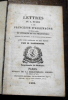
Lettres de L. Euler à Une Princesse d’Allemagne sur divers sujets de Physique et de Philosophie enrichies d’un fac-similé et de plusieurs lettres inédites
Paris, Bureau de la Bibliothèque Choisie, 1829. Relié,9 motifs et pièces de titre dorées, 9 cm x 14 cm, 354 pages. Correspondance de Leonhard Euler avec la princesse d’Anhalt-Dessau, préface et notes de M. Laurentie. Bien complet du fac-similé hors-texte, quelques rousseurs, état d’usage
"EULER, LEONHARD. - SOLVING FOR THE FIRST TIME THE CONTACT PROBLEM OF FRICTION.
Reference : 45497
(1750)
Sur l'atmosphere de la Lune prouvée par la derniere eclipse annulaire du Soleil. (On the atmosphere of the moon as proved by the last ringed eclipse of the sun) + Sur le frottement des corps solides. (On the friction of solid bodies) + Sur la diminu...
(Berlin, Haude et Spener, 1750). 4to. No wrappers, as issued in ""Mémoires de l'Academie Royale des Sciences et Belles-Lettres"", tome IV, pp. 103-121 + pp. 122-132 + pp. 133-148 and 6 engraved plates (on 5).
Three first editions by Euler. Euler's goal in the first paper is to show that certain phenomena that resulted from the eclipse of July 25, 1748 are evidence that the moon has an atmosphere that is almost 200 times less dense than that of the earth. (The phenomena Euler observed are optical effects of light passing close to a sharp edge, and not the refraction of a lunar atmosphere).The other papers on the physics of rigid bodies are groundbreaking as Euler here set forth what is known as ""Euler's dynamical equations of the motion of the mass-center of any solid"", and thus STATING FOR THE FIRST TIME THE LAW OF DRY FRICTION, mathematically. Euler explains his experiments with the inclined plane and discovers the DIFFERENCE BETWEEN KINETIC AND STATIC FRICTION.""Leonhard Euler occupied himself with the mathematical point of view of friction as well as the experimental. He introduced the differentiation between static frictional forces and kinetic frictional forces, and solved the problem of rope friction, probably the first contact problem to be analytically solved in history. (1750, the papers offered). He was the first to lay the foundations of the mathematically way of dealing with the law of dry friction and in this way promoted further development. We have to thank for the symbol as the coefficient of friction. Euler worked with the idea that friction originates from the interlocation, between small triangular irregularities.This understanding survived, in different variations,for a hundred years and is also used today as the ""Tomlinson Model"" in connection with friction on atomic scale.""(L. Popov ""History of the Contact Mechanics and the Physics of Function"", p.3).Eneström: E142, E143, E144.
Recherche sur une nouvelle maniere d'elever de l'eau proposee par M. de Mour. - [EULER ON HOW TO RAISE WATER]
(Berlin, Haude et Spener, 1753). 4to. No wrappers as issued in ""Memoires de l'Academie Royale des Sciences et Belles Lettres"". tome VII, pp. 305-330 + two engraved plates.
First printing of Euler's paper on how to raise water, which was a study written on the background of his - unsuccessful - garden-project in Frederick the Great's large complex of summer palaces, Sanssouci where Euler was asked to design the pumps to the many fountains. ""I wanted to make a fountain in my Garden"", Frederic the Great wrote to Voltaire on 25 January 1778. But the water-art project ended in a fiasco. The fountain design was supposed to be executed according to the latest knowledge in hydraulics and should even surpass Versailles with its splendor. ""Euler calculated the effort of the wheels for raising the water to a basin, from where it should fall down through canals, in order to form a fountain jet at Sans-Souci. My mill was constructed mathematically, and it could not raise one drop of water to a distance of fifty feet from the basin.""Since then the fiasco at Sanssouci stands out as an example for the gulf between theory and practice. And Leonhard Euler, the mathematical genius from Basel, became a target of mockery and malicious joy"". (Michael Eckert: Euler and the Fountains of Sanssouci).See Enetröm E202.
DEFENSE DE LA REVELATION CONTRE LES OBJECTIONS DES ESPRITS-FORTS, par M. Euler, suivie des pensées de cet auteur sur la religion, supprimées dans la dernière édition de ses lettres à une princesse d'Allemagne.
Paris, chez Adrien Le Clere, 1805, 1 broché, sans couverture. in-8 de VIII-72 pages ;
Léonhard Euler, physicien et mathématicien suisse.
"EULER, LEONHARD. - INTRODUCING ""THE EULER CONSTANT"" AND ""THE FUNCTION NOTATION""
Reference : 50926
(1740)
De Linea celerrimi descensus in Medio qvocunqve resistente. (On the curve of fastest descent in whatever resistent medium). (+) De progressionibus harmonicis observationes. (On harmonic progressions). (+) De infinitis curvis iusdem generis seu methodu...
(Petropoli, St. Petersburg, Typis Academiae, 1740). 4to. No wrappers. In: ""Classes Prima continens Mathematica. Commentarii Academiae Scientiarum Imperialis Petropolitanae"", Tomus VII ad Annum 1735, &..... Euler's papers: pp. 135-149, 150-161, 174-183 a. 184-200 and 2 engraved plates. Clean and fine.
First printing of 4 importent early papers by Euler. Enestroem: E42, E43, E44 a. E45.E42: This is Euler's second paper on the ""Brachistochrone problem"".E43. Here Euler introduces THE EULER CONSTANT. ""The Euler-Mascheroni constant (also called Euler's constant) is a mathematical constant recurring in analysis and number theory, usually denoted by the lowercase Greek letter gamma.""E44: ""This is an extensive paper that develops a method for finding a family of curves arising from the constant of integration of dz = Pdx, which is treated as the second variable"" the rudiments of partial differentiation are presented, and there is an extensive survey of homogeneous functions centred around what is now know as Euler's Theorem for such functions. The origins of this paper would seem to be Proposition 15 of Vol. 2 of the Mechanica, relating to families of tautochronous curves, where an integration relying on Euler's Theorem is required."" (Ian Bruce).E45: Here Euler introduces the FUNCTION NOTATION f(x). ""This is an equally extensive paper that continues the development of methods for finding a family of curves arising from the constant of integration of dz = Pdx, which is treated as the second variable. A method is developed for finding the modular equation for the first order equation that is extended to cover a number of cases"" this in turn is extended to second and higher orders. The method involves finding suitable functions to integrate, starting from a part of the modular equation that is integrable, so that the whole equation is of this form. This paper is noteworthy in addition as it seems to be the first in which the function notation, albeit in a slightly different form from the modern meaning, is introduce. I have not been able to check all the equations at this stage.""(Ian Bruce).This section also contains DANIEL BERNOULLI: Demonstrationes theorematum svorum de oscillationibus corporum filo flexili connexorum et catenae verticaliter suspensae. Pp. 162-173.
Lettres d'Euler à une princesse d'Allemagne sur divers sujets de physique et de philosophie
Paris, Charpentier, 1866. 2 vol. in-8, XXVIII404 pp. + 412 pp., demi-basane vert foncé, dos à nerfs orné de filets à froid, tranches mouchetées (petites épidermures).
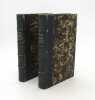
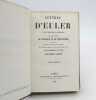
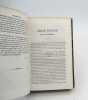
Édition de la correspondance scientifique et philosophique entre le mathématicien suisse Leonhard Euler et la princesse d'Anhalt-Dassau. Elle est illustrée de 215 figures gravées sur bois dans le texte. Il contient aussi l'éloge d'Euler par Condorcet et une introduction ainsi que des notes d'Émile Saisset. * Membre du SLAM et de la LILA / ILAB Member. La librairie est ouverte du lundi au vendredi de 14h à 19h. Merci de nous prévenir avant de passer,certains de nos livres étant entreposés dans une réserve.
Principes de la Trigonometrie Spherique tirés de la Méthode des plus Grands et plus Petits (Principles of spherical Trigonometry deduced from the Method of Maxima and Minima). (And same author:) Élémens de la Trigonometrie spheroidique tirés de la Met... - [EULER'S SPHERICAL GEOMETRY]
(Berlin, Haude et Spener, 1755). 4to. Without wrappers as issued in ""Mémoires de l'Academie Royale des Sciences et Belles-Lettres"", tome IX, pp. 223-257 and 1 folded engraved plate (a tear to plate, no loss), and pp. 258-293 and 1 folded engraved plate.
Both papers first edition. The modern form of trigonometry as well of all trigonometry are due to Euler. Whereas trigonometry before Euler was concerned with trigonomic Lines, Euler's trigonometry deals with trigonomic Function. - ""In the first paper Euler constructs spherical trigonometry as the intrinsic geometry of the surface of the sphere. He expresses the line element ds of the surface in terms of the longitude and latitude of a point, defines the great circles as curves that minimize the integral of the line element, and, in connection with with the determination of the minimum of a side of a spherical triangle, derives 10 equations of spherical geometry.. After the discovery that the shape of the earth is that of a spheroid, Euler, (in the second paper here offered) extended his methods to spheroids. He develops this subject in its entirety...and here deduced very many of the formulas of spherical geometry"" (Rosenfeld & Abramovich). - Enestrom: E:214 a. E: 215. - Another Paper by Euler is withbound: Examen d'une Controverse sur la Loi de Refraction de Rayon de differentes Couleurs par Rapport a la diversité des Milieux transparens par lesquels ils sont transmis."" pp. 294-320. (Enestrom: E 216.
De Superficie Conorum Scalenorum, aliorumqve corporum conicorum. (On the surface of scalene cones and of other conic bodies). (+) Theoremata circa divisores numerorum. (Theorems on divisors of numbers). (2 papers by Euler).
(Petropoli (St. Petersbourg), 1750). 4to. Uncut, without wrappers. Extracted from ""Novi Commentarii Academiae Scientiarum Imperialis Petropolitanae"", Tom. I. ad Annum 1747 et 1748. Pp. 3-19 a. 1 engraved plate., and pp. 20-48.
First printing of both papers. The second is important as it contains Euler'is second proof of the Euler-Fermat theorem, which Euler presents as a consequence of the theorem that (a+b)p = ap+bp (mod p). This paper also includes results about possible divisors of a2n + b2n, and Euler uses this to show again that F5 is not prime. - Enestroem No. 133 a. 134.
Théorie complete de la construction et de la manoeuvre des vaisseaux, mise à la portée de ceux qui s'appliquent à la Navigation. Par M. Léonard Euler. Nouvelle édition revue et corrigée
1776 Paris, Claude-Antoine Jombert, 1776, 3 parties en 1 vol. in-8 de (6)-268-(2) pp., rel. d'ép. de plein veau brun granité, dos à nerfs orné de fers dorés, pièce de titre de maroquin rouge, bon ex.
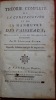

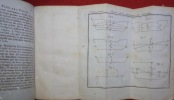
Peu courant. 1re édition française, l'édition originale et la première complète a paru en 1773 en français, à Saint-Pétersbourg, des extraits furent publiés en latin dans la même ville en 1749. Leonhard Euler (1707-1783), d'origine suisse, fut l'un des mathématiciens les plus importants de son temps. Cet ouvrage peu connu, concerne particulèrement la solidité des navires. Les deux additions qui se trouvent à la fin de l'ouvrage sont de son élève Lexell.Complet des 6 planches gravées dépliantes.
Essai d'une Explication physique des Couleurs engendrees sur des Surfaces extrémement minces. (Essay concerning the physical explanation of colors which are issued from extremely thin surfaces). - [EULER'S WAVE-THEORY OF LIGHT]
(Berlin, Haude et Spener, 1754). 4to. Without wrappers as extracted from ""Mémoires de L'Academie Royale des Sciences et belles Lettres"", Tome VIII, pp. 262-282.
First printing of Eulers's importent paper in which he defended the wave-theory of light in opposition to the newtonian corpuscular hypothesis.Most of the scientists and philosophers of the 18th century defended the corpuscular theory of light, but Euler ""being impressed by the notion that the emission of particles would cause a diminuation in the mass of the radiating body, which was not observed, while the emission of waves involved no such consequence...he insisted strongly on the resamblance between light and sound" the whole of the space through which the heavenly bodies move is filled with a subtle matter, the aether, and light consists in vibrations of this aether 'light is the same thing as sound in air'....The chief novelty of Euler's writings on light is his explanation of the manner in which material bodies appear coloured when wieved with white light" and, in particular the way in which colours of thin plates are produced."" (Whittaker,A History of the Theories of Aether and Electricity: pp. 97-98.). - Euler's worg comes here together with a paper by L'Abbe Mazeas on ""Observations sur les Coleurs engendres par le Frottement des Surfaces plane et transparentes."". - Enestrom E:209.
Vollständige Anleitung zur Integralrechnung. Aus dem Lateinischen ind Deutsche übersetz von Joseph Salomon. 4 Bde. - [A LANDMARK TEXTBOOK ON THE INTEGRAL CALCULUS]
Wien, Carl Gerold, 1828-30. 8vo. Bound in 4 contemp. marbled boards, titlelabels with gilt lettering. A few scratches to hinges and spine ends. Very small loos to 2 titlelabels. Light wear to top of spine on volume 4. Corners a bit bumped. 2 small paperlabels pasted to lower part of spines. A small stamp to foot of titlepages. VIII,439IV,424VIII,439"VI,520 pp. and 3 folded engraved plates.
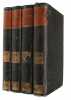
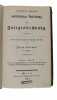
First German edition (a translation from the Latin ""Institutiones Calculi Integralis"", 1768-70) of this landmark work on the integral calculus, being the most complete and accurate work on the subject at the time. It ""contained not only a full summary of everything then known on this subject, but also the Beta and Gamma functions and other original investigations"" (Cajori). The work exhibits Euler's numerous discoveries in the theory of both ordinary and partial differential equations, which were especially useful in mechanics.""(Euler) presents methods of definite and indefinite integration, having invented many of the methods himself, such as the use of an ""Euler substitution"" for rationalizing particular irrational differentials. His treatment is near exhaustive for integrals expressive as elementary functions. He also develops the theory of ordinart and partial differential equations and presents many properties of the beta and gamma function Eulerian integrals introduced by Euler earlier.""(Parkinson ""Breakthroughs"" 1768 M).Enestroem E 342, E 385, E 385 (The Latin edition). - Poggendorff I, 690.
Vollständige Anleitung zur Integralrechnung. Aus dem Lateinischen ind Deutsche übersetz von Joseph Salomon. 4 Bde. - [A LANDMARK TEXTBOOK ON THE INTEGRAL CALCULUS]
Wien, Carl Gerold, 1828-30. 8vo. Bound in 4 contemp. hcalf. Gilt spines with gilt lettering. Very light wear to top of spine on vol. 2. A stamp on title-pages and a previous owners name. A printed paperlabel on all 4 frontcovers. A few corners a bit bumped. VIII,439IV,424VIII,439"VI,520 pp. and 3 folded engraved plates. Internally clean and fine.
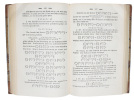
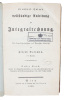
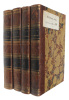
First German edition (a translation from the Latin ""Institutiones Calculi Integralis"", 1768-70) of this landmark work on the integral calculus, being the most complete and accurate work on the subject at the time. It ""contained not only a full summary of everything then known on this subject, but also the Beta and Gamma functions and other original investigations"" (Cajori). The work exhibits Euler's numerous discoveries in the theory of both ordinary and partial differential equations, which were especially useful in mechanics.""(Euler) presents methods of definite and indefinite integration, having invented many of the methods himself, such as the use of an ""Euler substitution"" for rationalizing particular irrational differentials. His treatment is near exhaustive for integrals expressive as elementary functions. He also develops the theory of ordinart and partial differential equations and presents many properties of the beta and gamma function Eulerian integrals introduced by Euler earlier.""(Parkinson ""Breakthroughs"" 1768 M).Enestroem E 342, E 385, E 385 (The Latin edition). - Poggendorff I, 690.
De la Propagation du Son (On the Propagation of Sound). (And same author:) Supplement aux Recherches sur la Propagation du Son (Supplement to the Research on the Propagation of Sound). (And same author:) Continuation des Recherches sur la Propagation ... - [THE WAVE EQUIATION FOR AERIAL ACOUSTICS DISCOVERED]
(Berlin, Haude et Spener, 1766). 4to. Without wrappers as issued in ""Mémoires de L'Academie Royale des Sciences et Belles-Lettres"", tome XV, pp. 185-209 a. 1 engraved plate, pp.210-240 a. 2 engraved plates, pp. 241-264 and 1 engraved plate.
First editions of Eulers three main papers on the theory of sounds in which he formulated the WAVE EQUATION for the propagation of sounds in the air. In the first paper Euler analyzes the forces that act on a slice of air that is in a disturbed state at y but was initially at x. The analysis is customary in the modern elementary works. In the second paper Euler gets a result that is equivalent to the general formula ofinversion for partial differentiations, noting in addition that cylindrical and spherical waves also follow it.""Euler, Lagrange, and others worked on the propagation of sound in air. Euler wrote on the subject of sound frequently from the time he was twenty years old (1727) and established this field as a branch of mathematical physics...Three fine and definitive papers were read to the Berlin Academy in 1759 (the papers offered here). (Morris Kline). - Eneroth: E 305, E 306, E 307.
Reflexions sur un probleme de geometrie traite par quelques geometres et qui es neanmoins impossible (+) Recherches physiques sur la diverse refrangibilite des rayons de lumiere. - [EULER ON LIGHT RAYS]
(Berlin, Haude et Spener, 1756). 4to. No wrappers as issued in ""Memoires de l'Academie Royale des Sciences et Belles Lettres"". tome X, pp. 173-199" pp. 200-226.
First printing of two Euler-papers in which he occupies himself with an unsolvable geometric problem and the physics of the different refrangibilities of light rays, a field Euler made important and original contributions to. Euler's wave theory of light, published in 1746, was based on an analogy between sound and light to a more and more mathematical elaboration on that notion. His wave theory degenerated, and it was not until Fresnel introduced transverse waves and an elaborate notion of interference that the wave theory again progressed. He was the second after Christian Huygens to proposed a wave theory of light, and thereby one of the earliest to argue against Newton's particle theory of light. His 1740s papers on optics helped ensure that the wave theory of light proposed by Christian Huygens would become the dominant mode of thought until the development of the quantum theory of light.See Eneström E220, E221.
Réfléxions sur quelques Loix génerales de la Nature qui s'observent dans les Effets des Forces quelconques. (Reflection on some general laws of nature which are observed in the effects of random forces).
(Berlin, Haude et Spener, 1750). 4to. No wrappers as issued in ""Mémoires de l'Academie Royale des Sciences et Belles-Lettres"" Tome IV, Année 1748. Pp. (189-) 218 and 1 engraved plate.
First appearance of this paper, in which Euler proves that given the static principle, he can derive the equilibrium conditions for a fluid, and from these, he obtains the integrability conditions for a ""Pfaffian"" form in three variables. He also looks at the equilibrium of a weight suspended from three elastic cords by looking, via analogy, to a special case of the problem for fluids.""In his 1748 paper, Euler in ""Reflexions sur quelques loix generales de la nature.."" starts by declaring his commitment to the least-action principle. His expression corresponds to what we would now call potential energy, so that his statement of least action (formulated by Maupertuis in 1746) in statics is equivalent to the principle that a system of bodies at rest will adopt a configuration that minimizes total potential energy. Euler called this quantity ""effort"".""Enestrom: E 146.
"EULER, LEONHARD. - ON MAUPERTUIS' PRINCIPLE OF LEAST ACTION
Reference : 46426
(1752)
Lettre de M. Euler a M. Merian. (+) Expose concernant L'Examen de la Lettre de M. de Leibnitz, alleguée par M. Le Prof. Koenig, dans le Mois de Mars, 1751, des Actes de Leipzig a l'Occassion du Principe de la Moindre Action.
(Berlin, Haude et Spener, 1752). 4to. No wrappers, as issued in ""Mémoires de l'Academie Royale des Sciences et Belles-Lettres"", 1750, tome VI, Titlepage to the section. (3), pp. 520-532 (+) pp. 52-64 (Expose).
In 1751, Maupertuis' priority for the principle of least action was challenged in print (Nova Acta Eruditorum of Leipzig) by an old acquaintance, Johann Samuel Koenig, who quoted a 1707 letter purportedly from Leibniz that described results similar to those derived by Euler in 1744. However, Maupertuis and others demanded that Koenig produce the original of the letter to authenticate its having been written by Leibniz. Koenig only had a copy and no clue as to the whereabouts of the original. Consequently, the Berlin Academy under Euler's direction declared the letter to be a forgery and that its President Maupertuis could continue to claim priority for having invented the principle.Enestroem: 182.
De la Controverse entre Mrs. Leibnitz & Bernouilli sur les Logarithmes des Nombres Negatifs e Imaginaires. (Controversy between Mr Leibniz and Mr Bernouilli on the logarithms of negative and imaginary numbers).
(Berlin, Haude et Spener, 1751). 4to. No wrappers, as issued in ""Mémoires de l'Academie Royale des Sciences et Belles-Lettres"", tome V, pp. 139-179.
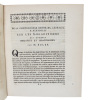
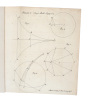
First edition of this importent paper on the logarithms of complex numbers, where Euler clarified such functions. He disagreed with Leibniz that a special function was only applicable for positive numbers, and showed that i was applicable for both negative and positive numbers, only with a difference of a constant. When Euler here (the offered item) came out with the correct form for the logarithm, it was not generally accepted. - Enestrom, Euler Bibliography E 168.
Theorie plus complette des machines qui sont mises en mouvement par la reaction de l'eau (+) De la variation de la latitude des etoiles fixes et de l'obliquite de l'ecliptique.
(Berlin, Haude et Spener, 1756). 4to. No wrappers as issued in ""Memoires de l'Academie Royale des Sciences et Belles Lettres"". tome X, pp. 227-295"" pp. 296-336.
First printing of two influential and important Euler papers. In THEORIE PLUS COMPLETTE (i.e. A more complete theory of machines which are activated by their reaction to water), Euler's seminal and most in-depth paper on hydraulics regarding fluid driven turbines. Euler goes into the entire theory of his main idea of Recherches sur l'effet d'un machine hydraulique proposée par M. Segner, professeur à Goettingue (E179) in greater generality. He then proceeds to calculate the optimum proportions for his proposed turbine. His treament is so complete that an engineer today could use his calculations to design a turbine. He opens the paper with the statement that ""Having already explained in some reports the effect that the machine projected by Mr de Segner is capable of producing, I here propose to develop the same in greater detail"". In DE LA VARIATION DE LA LATITUDE he is concerned about the variation of latitude of fixed stars and the obliquity of the ecliptic).See Eneström E222, E223.
De Minimis oscillationibus Corporum tam rigidorum qvam flexibilium. Methodus nova et facilis. (On the smallest oscillations of rigid and flexible bodies. A new and easy method.)
(Petropoli, St. Petersburg, Typis Academiae, 1740). 4to. No wrappers. In: ""Classes Prima continens Mathematica. Commentarii Academiae Scientiarum Imperialis Petropolitanae"", Tomus VII ad Annum 1735, &..... Euler's paper: pp. 99-122 a. 2 engraved plates. Wide-margined, clean.
First printing of Euler's first paper on vibrating bars. Euler here solves the partial differential equation for a forced harmonic oscillator and notices the resonnance phenomenon. - Enestroem E40.
Die Berliner und die Petersburger Akademie der Wissenschaften im Briefwechsel Leonhard Eulers. I und II. Teil. (2 Bände). Mitw. von P. Hoffmann, Quellen und Studien zur Geschichte Osteuropas, Band III , Teil 1 & 2.
Berlin : Akademie-Verlag, 1959, 1961. gr. in-8vo, (X) + 327 S. + 2 Tafeln / (XII) + 463 S., Original-Leinenband. OU.
1) Der Briefwechsel L. Eulers (Euler) mit G. F. Müller 1735 - 1767. / 2) der Briefwechsel mit Nartov, Razumovskij, Schumacher, Teplov und der Petersburger Akademie 1730-1763.

(SLACES, NVVA)
Phone number : 41 (0)26 3223808
Theoria motus corporum solidorum seu rigidorum exprimis nostrae cognitionis principiis stabilita et ad omnes motus qui in huiusmodi corpora cadere possunt accommodata. Volumen prius edidit Charles Blanc. ‘Leonardi Euleri Opera Omnia’ series secunda. Opera mechanica et astronomica. Volumen tertium (Gesamtausgabe der Werke von Leonhard EULER Band III). Auctoritate et impensis societatis scientiarum naturalium helveticae Bernae MCMXLVIII.
Leipzig, B.G. Teubner, 1948, gr. in-4to, XII + 1 Bl. + 327 S., Original-Pappband. Schönes Exemplar.
(SLACES, NVVA)
Phone number : 41 (0)26 3223808

