 Write to the booksellers
45 books for « heinsius d »Edit
-
Language
French (44)
Greek (1)
-
Century
17th (5)
18th (6)
19th (1)
20th (4)
-
Countries
Belgium (6)
France (24)
Germany (1)
Netherlands (10)
Switzerland (4)
-
Syndicate
ILAB (14)
NVVA (3)
SLACES (3)
SLAM (10)
Topics
- Alsace (3)
- Ampelography - wines (1)
- Amsterdam (2)
- Bibliophilism (1)
- Books from the xviith (1)
- Cavalry (1)
- Early printed books (2)
- Elzevier (2)
- First edition (3)
- German literature (1)
- Germany (1)
- Greek (1)
- Helvética (1)
- History (1)
- Humour anecdotes (1)
- Latin (1)
- Law (1)
- Literature (7)
- Luxembourg (1)
- Printing (1)
- Reptiles (1)
- Switzerland (1)
- Tea (1)
- Theocritus (1)
- Wine (1)
Danielis Heinsii Poemata Latina et Graeca; Editio post plurimas postrema longe auctior.
Amsterdam (Amstelodami), Apud Joannem Janssonium, 1649.
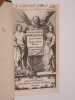
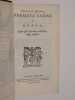
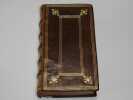
12mo. (XII),666,(2 errata),(4 blank) p., frontispiece. Calf 13.5 cm 'Elegantly printed edition of Heinsius' collective neo-Latin & neo-Greek poetry' (Ref: STCN ppn 850068738; Cf. Willems 1613; Berghman 865; Rahir 2013; Ebert 9380; Brunet 3,84; Graesse 3,232; Ebert 9380) (Details: Back elaborately gilt, with 5 raised bands, and with a red morocco letterpiece in the second compartment. Boards with tripple fillet gilt borders, within which is another tripple fillet rectangle with cornerpieces. Marbled endpapers. Engraved frontispiece, depicting a kind of altar on which rests a shield with text; the altar is flanked by an angel and a girl; the angel tramples on a skeleton; above this scene soars a winged Fama, blowing two horns) (Condition: Joints slightly rubbed. Two small wormholes in the leather at the foot of the spine, and some damage to the lower edge of lower board for ca. one cm. Small hole in the leather of rear cover. On the blank upper margin of the frontispiece an ownership entry) (Note: The Dutch classical scholar of Flemish origin Daniel Heinsius, 1580-1655, who enjoyed international fame as an editor of classical texts, theorist of literary criticism, historian and neolatin poet, was professor of Poetics at the University of Leiden since 1603, extraordinarius Greek since 1605. After the death of J.J. Scaliger, to whose inner circle he belonged, he held the chair of Greek, from 1609 till 1647. He is best known for his edition of Aristotle's treatise on poetry (1611), which he studied in connection with the 'Ars Poetica' of Horace. This edition is 'the only considerable contribution to the criticism and eludication of the work that was ever produced in the Netherlands. (...) In his pamphlet 'De tragoediae Constitutione', published in the same year (1611), he deals with all the essential points in Aristotle's treatise, giving proof that he has thoroughly imbibed the author's spirit. (...) It was through this work that he became a centre of Aristotelian influence in Holland. His influence extended, in France, to Chaplain, and Balzac, to Racine and Corneille; in Germany to Opitz; and in England to Ben Jonson'. (J.E. Sandys, 'A history of classical scholarship, N.Y., 1964, vol. 2, p. 314) Heinsius was a representative of the great age of Neo-Latin in the Low Countries, which encompasses the 16th century, and a good part of the 17th century. Here the Anacreontic-Petrarcan love poetry in Latin was kept alive. (J. IJsewijn, 'Companion to Neo-Latin studies', vol. 1, Leuven 1990, p. 154) This volume of Heinsius' poetry, which was, as the text of the frontispiece tell us, edited by his son Nicolaus Heinsius, opens with early work, the three books of Sylvae, followed by Hipponax, an Ode to Molinus, 3 books of Elegiae, and the Monobiblos. Then comes the 'Herodes Infanticida, tragoedia', followed by Heinsius' last long Latin poem 'De contemptu mortis', a didactic poem in 4 books, wherein arguments, Platonic, Stoic and Christian, are set forth which explain why man should not fear death. Then Heinsius' Epigrams and occasional poetry, the 'Elegiarum iuvenilium libri'. At the end we find Heinsius' literary tour de force, his Greek poems, which were inspired by Theocritus and the Anthologia Graeca. It opens with 'Peplus' (Gown), a series of epigrams which Heinsius composed on Greek authors and philosophers. This part is followed by occasional poetry in Greek which Heinsius wrote for his contemporaries, like Casaubon, and by a section with Heinsius' Latin translations of Greek poetry. The collection closes with the 'Liber adoptivus', which contains occasional poetry addressed to Heinsius by J.J. Scaliger, J. Dousa, H. Grotius et alii. This edition of 1649 is a reissue of an edition of the collected greek and latin poetry of Heinsius, which was published by Heger in Leiden in 1640) (Provenance: 'Ex libris 'Ant. La Bout, 1660', or 'Ant. LaBout') (Collation: *6, A- D12, 2E-2F6 (leaves 2F5 & 2F6 blank)) (Photographs on request)
Dan. Heinsii De tragoediae constitutione liber, in quo inter caetera tota de hac Aristotelis sententia dilucide explicatur. Editio auctior multo, cui & Aristotelis De poëtica libellus, cum ejusdem notis & interpretatione, accedit.
Leiden (Lugd. Batav.), Ex officinâ Elsevirianâ, 1643.
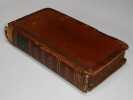
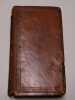
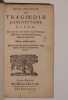
12mo. (XII),368 p. 19th century calf 13.5 cm 'De tragoediae constitutione' established the reputation of Heinsius as an Aristotelian literary critic (Ref: Willems 554; Berghman 964; Rahir 548; Brunet 3,83; Graesse 3,232; Ebert 9377) (Details: Back ruled gilt, with a letterpiece. Boards with blind stamped borders & gilt dentelles on the turn-overs. Marbled endpapers. Elsevier's woodcut printer's mark on the title, featuring an old man who stands in the shade of a vine-entwined elmtree, symbolising the symbiotic relationship between scholar and publisher. The motto is: 'Non solus'. The first part of the book consists of the 'De tragoediae constitutione', the pages 221-321 contain Aristotle's Poetics, edited and translated into Latin by Daniel Heinsius, the pages 322-368 are filled with Heinsius' notes on that text) (Condition: Binding used, and worn at the extremities. Head of the spine gone for 1 cm, foot of the spine chafed. Joint cracked, but strong. Small bookplate on the front pastedown. Paper yellowing) (Note: 'De tragoediae constitutione' established the reputation of the Dutch classical scholar of Flemish origin Daniel Heinsius, 1580-1655, as an Aristotelian critic of reknown. He enjoyed also 'international fame as an editor of classical texts, theorist of literary criticism, historian and neolatin poet, was professor of Poetics at the University of Leiden since 1603, extraordinarius Greek since 1605. After the death of J.J. Scaliger, to whose inner circle he belonged, he held the chair of Greek, from 1609 till 1647. He is best known for his edition of Aristotle's treatise on poetry, (...) which he studied in connection with the 'Ars Poetica' of Horace. This edition is 'the only considerable contribution to the criticism and eludication of the work that was ever produced in the Netherlands. (...) In his pamphlet 'De tragoediae constitutione', (...), he deals with all the essential points in Aristotle's treatise, giving proof that he has thoroughly imbibed the author's spirit. (...) It was through this work that he became a centre of Aristotelian influence in Holland. His influence extended, in France, to Chaplain, and Balzac, to Racine and Corneille; in Germany to Opitz; and in England to Ben Jonson (...)'. (J.E. Sandys, 'A history of classical scholarship, N.Y., 1964, vol. 2, p. 314) Heinsius' edition and Latin translation of Aristotle's 'De poetica liber' was first published by Elsevier in 1610, a year later this was repeated, and expanded with 'De tragoediae constitutione' (1611). Heinsius produced of both works a second and augmented edition, published by Elzevier in 1643. Heinsius' treatise 'De tragoediae constitutione' addresses itself explicitly to the task of presenting a simple and intelligible exposition of tragedy and the tragic plot 'ex mente atque opinione Aristotelis'. Accordingly, the work is based on the Aristotelian definition of tragedy, which is incorporated verbatim in the opening of Heinsius' discussion, and Aristotle's qualitative parts of tragedy (fabula, mores, sententiae, dictio, melodia and apparatus) provide the topics around which the argument is built up. Heinsius' treatise has consequently sometimes been viewed as rendering the 'milk of the Aristotelian word' more or less unwatered'. (P.R. Selin, 'Daniel Heinsius and Stuart England', Leiden/Oxford, 1968, p. 124/25) Nevertheless, 'Heinsius moves away from the Aristotelian concern with the essence of an artistic product to the search for appropriate means of securing what are basically rhetorical effects, ultimately directed to the ethical benefit of the audience'. (Idem p. 145) The treatise did not contribute completely fresh ideas or methods to the Renaissance tradition of the poetic theory. Heinsius' importance lies in the pruning away of complex and elaborate rhetorical Renaissance approaches) (Provenance: Bookplate, probably beginning 20th century: 'Ex libris Emile Brugnon') (Collation: *6, A12-P12, Q4) (Photographs on request)
Satirae duae, Hercules tuam fidem sive Munsterus Hypobolimaeus, et Virgula divina. Cum brevioribus annotatiunculis, quibus nonnulla in rudiorum gratiam illustrantur. Accessit his accurata Burdonum Fabulae confutatio, quibus alia nonnula hac editione accedunt.
Leiden (Lugduni Batavorum), Apud Ludovicum Elzevirium, 1617. (Colophon at the end: 'Lugduni Batavorum, Typis Isaaci Elsevirii, anno 1617')
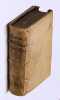
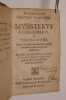
12mo. (XXIV),619 (recte 529),(20),(3 blank) p. Overlapping vellum 13 cm (Ref: STCN ppn 832983446; USTC 1028202; Willems 123; Rahir 99; Berghman 1329 Graesse 6/1, 273/274; Not in Smitskamp's 'The Scaliger Collection', but it does figure in its list of Scaliger editions, p. 120) (Details: 5 thongs laced through the joints. Manuscript title on the back. The first Elzevier edition in small format) (Condition: Vellum age-toned and soiled. Front hinge cracking. Front flyleaf worn and inscribed. Title dustsoiled, and with 2 small ownership entries. Some old marginal notes, occasional ink underlinings) (Note: The French protestant classical scholar J.J. Scaliger, 1540-1609, was a genius, but was also vain and sharp tongued. Consequently he had many enemies. His greatest enemies were among members of the catholic Jesuit order. Scaliger had turned his back on France, and had come in 1592 to Leiden at the request of the authorities of that city and the local University, who desired nothing more than his inspiring presence. There he gathered around him a group of brilliant young man, among whom H. Grotius. In 1599 young Daniel Heinsius, 1580-1655, entered the group, and became 'because of his reputedly attractive personality and remarkable gifts' Scaliger's favorite student. (P.R. Sellin, Daniel Heinsius and Stuart England', Leiden etc., 1968, p. 14) Heinsius rapidly made a name as classical scholar and neolatin poet. In 1609 Scaliger died in his arms. One of Scaliger's foulest adversaries was a former friend, Gaspar Schoppe, or in Latin Scioppius, 1576-1649, who converted to catholicism. He distinguished himself by the virulence of his writings against the Protestants, and he even wanted to incite a war against these heretics. In 1607 this man published a vicious attack upon Scaliger with his 'Scaliger hypololymaeus', in English 'Suppositious Scaliger', or rather 'Basterd Scaliger'. 'Dem tobensten Schimpfen wird hier freier Lauf gelassen; Gifte jeder Art von Verunglimpfung und Verdächtigung werden zusammen gebraut'. (J. Bernays, 'Joseph Justus Scaliger', Berlin, 1855, p. 85) Scioppius wanted to throw discredit on Scaliger, and weaken his authority, so he attacked him at his weakest spot, his supposed noble birth. Scaliger had been raised in the belief that he was a descendent of the royal family Della Scala of Verona, and he let no opportunity pass to mention the splendour of his ancestry. The validity of his pretentions were however dubious. The challenge of Scioppius was accepted by the favourite pupil of Scaliger, Daniel Heinsius, who published one year later, in 1608, anonymously in defence of his master the 'Satirae duae, Hercules tuam fidem, sive Munsterus Hypobolimaeus, et Virgula divina', two mordant Menippean satires that covered Scioppius, who occasionally signed his letters off as 'G.S. a Munster' (hence Munsterus), with much abuse. As Scioppius himself had done with Scaliger, Heinsius smears with the mud of satire his scholarship, his name, the respectability of his parents, and his conversion to catholicism. In the following mockery 'Virgula Divina, sive Lucretii Vespillonis apotheosis', inspired by Seneca's Apocolocyntosis, Heinsius focusses on the humble origins of Scioppius, himself, he tells, a supposititious child. His 'father', called by Heinsius Vespillo, or corpse-bearer/gravedigger (See Martial I,47,1), is sentenced to become assistant of Charon. Scaliger has often admitted in his letters that Heinsius was the author of the satires, and the editor of the book, which opens with a preface dedicated to Scaliger, and a section of Scioppius praise of Scaliger from the time when he was still a friend and a protestant, then a support letter of the French scholar and friend of Scaliger, Isaac Casaubon. Next follow both satires of Heinsius, followed by an attack on Scioppius and his ancestry in a mock-biography: 'Vita et parentes Gasp. Schoppii, a Germano quodam contubernali eius conscripta', composed by Scaliger himself or by Ianus Rutgerus, a friend of Heinsius, and a student of Scaliger. The great man himself contributed, using the initials of his student Rutgerus (auctore I.R. Batavo, Iuris studioso) also to this own defence, a 'accurata Burdonum Fabulae confutatio', 'a precise refutation of the Burdonese story', with the help of charters and documents which should prove his noble origin. Nevertheless, the defence of Heinsius and Scaliger made 'einen sehr kühlen Eindruck auch auf die nähreren Freunde Scaligers'. (Bernays, p. 85). Few wanted to side with him on this matter; the answer of Scaliger was deemed not satisfactory. Scioppius' reputation was damaged too. Heinsius had portrayed him as a parasite and as 'Monster of Münster', labels which he never got rid of. A revised second edition of the 'Satirae duae' was published in the same year in Leiden by Johannes Patius, who had also published the first edition. 1609 he already produced his 4th edition. An eludicating survey of the hard to fathom content of both satires can be found in chapter 5 of 'Menippean Satire and the Republic of Letters, 1581-1655', of A. R. de Smet, Geneva, 1996. 'Hercules tuam fidem' is the title of Varro's 39th Menippean satire) (Provenance: On the title: 'Bern. à Mallinckroth', and also 'Sum J. Niefert'. On the front pastedown a Swedish name 'Henrik Kröijer', and probably one 'R. Berghes') (Collation: *12, A-Z12 (leaf Z11 verso and Z12 blank. Page numbers 513-529 misnumbered 603-619)) (Photographs on request)
Danielis Heinsii De contemptu mortis libri IV. Ad nobilissimum amplissisimumque virum Ianum Rutgersium.
Leiden (Lugduni Batavorum), Ex Officina Elzeviriana, 1621.
4to. (VIII),196,(24 index) p. 19th century hardback. 18.5 cm One of the finest didactic poems of its time. (Ref: STCN ppn 833009389; Willems 186; Berghman 861; Rahir 157; Brunet 3,83: 'la meilleure production poétique de l'auteur'; Ebert 9379; Graesse 3,232) (Details: Dull binding. Title in red & black. Elsevier's printer's mark on the title, depicting an old man standing in the shade of a vine-entwined elmtree, symbolising the symbiotic relationship between scholar and publisher. The motto: 'Non solus', probably indicates the interdependency of publisher and scholar. On the verso of the last leaf of the second volume: 'Lugduni Batavorum, 'Typis Isaaci Elzevirii, Iurati Academiae Typographi, 1621'. Edges dyed red) (Condition: Binding slightly worn. 2 old brownish paper labels on the back. 1 library stamp and 1 small withdrawal 'Doublette' stamp on the title. Paper yellowing) (Note: The Dutch classical scholar of Flemish origin Daniel Heinsius, 1580-1655, who enjoyed international fame as an editor of classical texts, theorist of literary criticism, historian and neolatin poet, was professor of Poetics at the University of Leiden since 1603, and 'extraordinarius' Greek since 1605. After the death of J.J. Scaliger, to whose inner circle he belonged, he held the chair of Greek, from 1609 till 1647. He is best known for his edition of Aristotle's treatise on poetry (1611), which he studied in connexion with the 'Ars Poetica' of Horace. This edition is 'the only considerable contribution to the criticism and elucidation of the work that was ever produced in the Netherlands. (...) In his pamphlet 'De tragoediae Constitutione', published in the same year (1611), he deals with all the essential points in Aristotle's treatise, giving proof that he has thoroughly imbibed the author's spirit. (...) It was through this work that he became a centre of Aristotelian influence in Holland.' (J.E. Sandys, 'A history of classical scholarship, N.Y., 1964, vol. 2, p. 314) Heinsius was an important representative of the great age of Neo-Latin in the Low Countries. The outline of 'De contemptu mortis', a didactic poem in 4 books, is simple: we should not be afraid of death for two reasons, the soul is immortal, and life on earth is full of misery. Platonic, Neoplatonic, Stoic and Christian arguments are set forth which explain why man should not fear death. The form of 'De contemptu' is that of Vergil's Georgica, 4 books of ca. 600 verses. Heinsius confesses his debt to Vergil in the opening lines of his poem, which form a variation of the first verses of the Georgica. The structure of the poem, its style and language are also Vergilian, including the similes. A lucretian element is Heinsius' objective to free humanity, like Lucretius did, from fear of death, but the tenor of the poem is however antilucretian. Heinsius states that the soul doesnot desintegrate after death, but that it continues its existence. Heinsius warns explicitly against epicurism, which is, he thinks, an easy, but misleading philosophy. In book 2 Heinsius answers Lucretius with his own epic catalogue of inspiring famous men. For Lucretius Epicurus was the culmination point, for Heinsius it is the French genius Josephus Justus Scaliger, his much admired master. An important source of inspiration for Heinsius was also the didactic poem 'De animorum immortalitate' of the Italian Aonio Paleario, published in 1535, which is also antilucretian. (Source for 'De contemptu': 'Daniel Heinsius, De verachting van de dood, De contemptu mortis', Vertaling door J. Bloemendaal en W. Steenbeek, Amst., Bert Bakker, 2005, p. 18/23) In the same year 1621 Elsevier published this didactic poem as part of Heinsius' 'Poematum editio nova', but this time in a smaller octavo format. He sold the octavo edition also separately) (Provenance: Round armorial stamp of 'Biblioth. Publ. Reg. Stuttgart'. Small, faint oval stamp on the front pastedown: 'Gerschel's Antiquariat, Stuttgart'. The Kingdom of Württemberg existed in Germany from 1805 to 1918. The kingdom was a continuation of the Duchy of Württemberg, which existed from 1495 to 1805. Its capital was Stuttgart) (Collation: *4, A-2D4, 2E2 ) (Photographs on request)
Danielis Heinsii Poemata auctiora. Editore Nicolao Heinsio Dan. Fil. (I) Danielis Heinsii Poemata graeca, et e graecis latine reddita, diverso tempore ac aetate conscripta. Quibus Adoptivorum liber accedit. (II)HEINSIUS,D.
2 ouvrages en 1 Volume.In-16 - Reliure vélin à rabats de l'époque - dos lisse - Edité par :I - 1640 -Leiden (Lugduni Batavorum), Apud Francis. Hegerum - Titre gravé, représentant 'Severitas', c'est-à-dire 'Sériosité', comme un philosophe/auteur assis et barbu dont la main repose sur un livre ; il regarde 'Lepor', ou 'Plaesantry', représentée comme une jeune femme/Muse jouant du luth, elle a une couronne de laurier sur la tête. Aux pieds de ces deux 'Severitas Leporque' - Lettrines - (18)-575 pages- bon exemplaireII - 1640 - Leiden (Lugd. Bat.), Ex Officina Francisci Hegeri- Le titre porte la marque de l'imprimeur de Hegener : un oiseau nourrissant ses petits de son propre sang, la devise est : « Vivimus ex Uno » ; à la page 15, Gravure sur bois du portrait d'Homère.- 189 pages + 3 Errata - Bon exemplaire - Ré. 49217
Originaire d'une famille gantoise qui se réfugia en 1583 au nord de l'Escaut pour s'établir en Hollande, Daniel Heinsius, 1580-1655, jouissait d'une renommée internationale comme éditeur de textes classiques, théoricien de la critique littéraire, historien et poète néo-latin, Professeur de poétique à l'université de Leyde depuis 1603, Après la mort de J.J. Scaliger, il occupa la chaire de grec, de 1609 à 1647. I -Le premier volume de poésie de s'ouvre avec ses premières uvres, les trois livres de Sylvae, suivis d'Hipponax, d'une Ode à Molinus, de trois livres d'Elegiae et du Monobiblos. Viennent ensuite les Épigrammes de Heinsius et des poèmes occasionnels, dont un « cento vergilianus ». La seconde moitié du premier volume contient « Hérode Infanticida, tragoedia », suivie du dernier long poème latin d'Heinsius, « De contemptu mortis », poème didactique en quatre livres, où sont exposés des arguments platoniciens, stoïciens et chrétiens expliquant pourquoi l'homme ne devrait pas craindre la mort. À la fin de louvrage « Elegiarum iuvenilium reliquiae ». II - Contient le chef-d'uvre littéraire d'Heinsius : ses poèmes grecs, inspirés par Théocrite et l'Anthologia Graeca. Il s'ouvre par « Peplus » (La Robe), une série d'épigrammes composées par Heinsius sur des auteurs et philosophes grecs. Cette partie est suivie de poésies de circonstance en grec qu'Heinsius a écrites pour ses contemporains, comme Casaubon, et d'un extrait de poésie grecque dans sa traduction latine. Il se termine par le « Liber adoptivus », qui contient des poésies occasionnelles adressées à Heinsius par J.J. Scaliger, J. Dousa, H. Grotius et alii. Le bibliographe des Elzeviers, A. Willems, fait l'éloge de cette édition de 1640. Cnformément à nos conditions générales de vente :Les frais de port sont affichés à titre indicatif. Il se peut que nous devions vous contacter pour vous informer du coût de laffranchissement supplémentaire en fonction du poids et du nombre de livres, surtout pour les envois internationaux Cependant vu l'augmentation des tarifs postaux à l'internationale, nous pouvons expédier les ouvrages en point relais MONDIAL RELAY pour les pays suivants : Allemagne, Autriche, Belgique, Espagne, Italie, Luxembourg, Pays-Bas, Pologne, et Portugal. Merci de nous indiquer en retour le point relais choisi ainsi que votre numéro de téléphone mobile & adresse Courriel pour assurer le suivi du colis.N'hésitez pas à nous interroger.In accordance with our general terms and conditions of sale:Shipping costs are displayed for informational purposes only. We may need to contact you to inform you of the additional postage costs depending on the weight and number of books, especially for international shipments.However, given the increase in international postal rates, we can ship books via Mondial Relay to the following countries: Germany, Austria, Belgium, Spain, Italy, Luxembourg, Netherlands, Poland, and Portugal. Please provide us with your chosen Mondial Relay point, as well as your mobile phone number and email address to ensure package tracking.Please feel free to contact us with any questions
(Danielis Heinsii Poematum editio nova. Accedunt praeter alia libri, 'De Contemptu Mortis' antehac una non editi)
Ad 1: (Leiden (Lugduni Batavorum), Sumptibus Elzeviriorum, et Ioannis Mairii, 1621) Ad 2: Leiden (Lugd. Batavorum), Ex Officina Elzeviriana, 1621.
8vo. 2 volumes in 1: (VIII),474 (recte 478),(2 blank); (VI),167 (recte 165),(19 index) p. Red morocco. 14 cm (Ref: STCN ppn 832974838; Willems 187; according to Willems 'on lit sur le dern. f.: Lugduni Batavorum, typis Isaaci Elsevirii, iurati Academiae typographi, 1622; our copy has 1621. A mistake of Willems?; Berghman 862 & 863; Rahir 158 & 159; Breugelmans p. 180, 1621:3; Brunet 3,83; Ebert 9378) (Details: Charming copy. Back with 5 raised bands and ruled gilt. Boards with gilt borders and edges. Inside gilt dentelles. Edges of the bookblock gilt. Marbled endpapers. The title-page of the first volume is lacking and has been replaced by the title-page of the second volume. This title-page is printed in red and black. Elsevier's woodcut printer's mark on the title, depicting an old man standing in the shade of a vine-entwined elmtree, symbolising the symbiotic relationship between scholar and publisher. The motto is: 'Non solus'. Engraved portrait of Homer on p. 264 of the first volume) (Condition: Title-page of the first volume is lacking and has been replaced by the title-page of the second volume. Some wear to the extremes) (Note: The Dutch classical scholar of Flemish origin Daniel Heinsius, 1580-1655, who enjoyed international fame as an editor of classical texts, theorist of literary criticism, historian and neolatin poet, was professor of Poetics at the University of Leiden since 1603, extraordinarius Greek since 1605. After the death of J.J. Scaliger, to whose inner circle he belonged, he held the chair of Greek, from 1609 till 1647. He is best known for his edition of Aristotle's treatise on poetry (1611), which he studied in connexion with the 'Ars Poetica' of Horace. (...). In his pamphlet 'De tragoediae Constitutione', published in the same year (1611), he deals with all the essential points in Aristotle's treatise, giving proof that he has thoroughly imbibed the author's spirit. (...) It was through this work that he became a centre of Aristotelian influence in Holland. His influence extended, in France, to Chaplain and Balzac, to Racine and Corneille; in Germany to Opitz; and in England to Ben Jonson (...)'. (J.E. Sandys, 'A history of classical scholarship, N.Y. 1964, vol. 2, p. 314) Heinsius was a representative of the great age of Neo-Latin in the Low Countries, which encompasses the 16th century, and a good part of the 17th century. Here the Anacreontic-Petrarcan love poetry in Latin was kept alive. (J. IJsewijn, 'Companion to Neo-Latin studies', vol. 1, Leuven 1990, p. 154). The first part of this collection of Heinsius' poetry opens with early work, the 3 books of Sylvae, followed by Hipponax, 3 books of Elegiae, and Monobiblos. Then Heinsius' Epigrams and some occasional poetry; 125 pages with Greek poems, inspired by Theocritus and the Anthologia Graeca. The part with Greek poems starts with 'Peplus' (Gown), a series of epigrams which Heinsius composed on Greek authors and philosophers. This part is followed by 40 p. of Greek poetry in Latin translation, 'Elegiarum iuvenilium reliquiae', and is concluded with the 'Liber adoptivus'. The second volume contains Heinsius' last long Latin poem 'De contemptu mortis' (1621). It is a didactic poem, the finest of its time, in 4 books, wherein arguments, Platonic, Stoic and Christian, are set forth which explain why man should not fear death) (Collation: Pagination sometimes confusing. +1 (title-page of volume 2), *4 (minus leaf *1, the title-page of volume 1), A-2G8 (Gathering P begins with p. 223, in stead of 225, i.e. doubling p. 223 & 224; gathering Q begins with 237 in stead of 239, i.e. doubling 237 & 238). +4 (minus leaf +1, which replaces the title-page of volume 1), A-L8, M4 (In gathering I the pagination 129 & 130 is skipped) (Photographs on request)
L'Avanturier Hollandois, ou la Vie & les Avantures divertissantes & extraordinaires d'un hollandois. Avec figures
Amsterdam Herman Uytwerf 1729
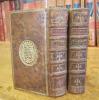
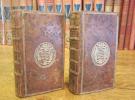
Deux volumes in-12 (134 x 81 mm), veau havane moucheté, dos à cinq nerfs orné, pièce de maroquin rouge, alérions entre les nerfs, triple filet entourant les plats, armes au centre, filet sur les coupes, tranches mouchetées rouges (reliure d'époque). Première traduction française, ornée de 2 frontispices et 12 planches. "Ce roman est traduit du hollandois de Nicolas Heinsius, fils du célèbre littérateur Nicolas Heinsius, et petit-fils de Daniel Heinsius". (Barbier I, 347). L'auteur, qui fut également physcien à la Cour de Christine de Suède, souhaitant pour cet ouvrage les honneurs d'une traduction française, le traduisit lui-même. Il fut réimprimé en 1801 sous le titre "Vie et aventures surprenantes de Mirandor". Exemplaire aux armes de Anne-Léon II de Montmorency, marquis de Fosseux (ou Fosseuse), puis duc de Montmorency, fils unique d'Anne-Léon Ier, baron de Montmorency, lieutenant général, et d'Anne-Marie-Barbe de Ville, sa première femme, appelé d'abord le marquis de Fosseuse, naquit le 11 août 1731 ; d'abord menin du Dauphin et capitaine-lieutenant des gendarmes de la reine, en mai 1745, il fut fait chevalier de Saint-Louis, le 3 avril 1758, et promu brigadier de cavalerie en décembre 1761, et maréchal de camp en juin 1753. Il émigra à Munster lors de la Révolution et mourut dans cette ville le 1er septembre 1799. Il avait épousé en premières noces, le 27 janvier 1761, Marie-Judith de Champagne et en secondes noces Anne-Françoise-Charlotte de Montmorency-Luxembourg, qui lui apporta en dot le duché de Montmorency. (OLIVIER, planche 810, 2). Ex-libris La Rochefoucauld duc de Bisaccia. (frottements sur les dos et plats, coins émoussés, déchirure sur la page de titre tome 2 avec perte de texte). // Two 12o volumes (134 x 81 mm), havana speckled calf, spine tooled raised on five bands, red morocco labels, piece of arms between the bands ("alérions"), triple fillet border on covers, central coat of arms, fillet on turns-in, red sprinkled edges (contemporary binding). First french translation, illustrated with 2 frontispieces and 12 plates. This novel is translated from Dutch from Nicolas Heinsius, son of famous writer Nicolas Heinsius, and grand-son of Daniel Heinsius. (Barbier I, 347). Copy bearing the arms of Anne-Léon II de Montmorency, marquis de Fosseux (or Fosseuse), "puis duc de Montmorency, fils unique d'Anne-Léon Ier, baron de Montmorency, lieutenant général, et d'Anne-Marie-Barbe de Ville, sa première femme, appelé d'abord le marquis de Fosseuse, naquit le 11 août 1731 ; d'abord menin du Dauphin et capitaine-lieutenant des gendarmes de la reine, en mai 1745, il fut fait chevalier de Saint-Louis, le 3 avril 1758, et promu brigadier de cavalerie en décembre 1761, et maréchal de camp en juin 1753. Il émigra à Munster lors de la Révolution et mourut dans cette ville le 1er septembre 1799. Il avait épousé en premières noces, le 27 janvier 1761, Marie-Judith de Champagne et en secondes noces Anne-Françoise-Charlotte de Montmorency-Luxembourg, qui lui apporta en dot le duché de Montmorency". (OLIVIER, plate 810, 2). Bookplate La Rochefoucauld duc de Bisaccia. (rubbings on spine and covers, corners bumped, tear on title page vol. 2 with loss of text).
Danielis Heinsii Orationum editio nova. Tertia parte auctior, caeteris sic recensitis, ut alia videri possit.
Leiden (Lugduni Batavorum), Ex officina Bonaventurae & Abrahami Elzevir, Acad. Typogr.,1627.
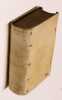
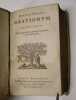
8vo. (XVI),661,(3) p. Overlapping vellum 15.5 cm Oratorical fireworks (Ref: Willems 277; Berghman 770; Rahir 239 or 240) (Details: 5 thongs laced through the joints. Boards with blind double fillet borders. Elsevier's woodcut printer's mark on the title of both volumes, depicting an old man standing in the shade of a vine-entwined elmtree, symbolising the symbiotic relationship between scholar and publisher. The motto is: 'Non solus', probably indicating the interdependency of publisher and scholar. They cannot do it alone, and need each other) (Condition: Vellum age-tanned. Waterstained in the lower margin at the beginning and at the end of the book. All 4 ties gone. Paper yellowing, some faint browning. Old ownership entry on the front pastedown) (Note: The Dutch classical scholar of Flemish origin Daniel Heinsius, 1580-1655, who enjoyed an international reputation as an editor of classical texts, theorist of literary criticism, historian and neolatin poet, was professor of Poetics at the University of Leiden since 1603, extraordinarius Greek since 1605. After the death of J.J. Scaliger, to whose inner circle he belonged, he held the chair of Greek, from 1609 till 1647. His activities have been obscured to later generations by the very bulk and variety of his activities. He is still remembered for his neolatin poetry, and for his edition of Aristotle's treatise on poetry (1611), which he studied in connexion with the 'Ars Poetica' of Horace. This edition is 'the only considerable contribution to the criticism and eludication of the work that was ever produced in the Netherlands. (...) In his pamphlet 'De tragoediae Constitutione', published in the same year (1611), he deals with all the essential points in Aristotle's treatise, giving proof that he has thoroughly imbibed the author's spirit'. (J.E. Sandys, 'A history of classical scholarship, N.Y., 1964, vol. 2, p. 314) Heinsius was an inspiring teacher and a talented speaker. 'His courses in the University were so impressive that his colleagues attended his lectures, (...). As an ornament in which the University took especial pride, his eloquence graced many public functions. Heinsius composed not only the funeral orations for Philip Cluverius, and for Reinerus Bontius, Professor of Medicin, in 1623, but delivered on 19 September 1625 a 'stupenda oratio', on the death of Prince Maurice, for which he received an award of 200 guilders'. (Sellin, P.R., 'Daniel Heinsius and Stuart England', Leiden etc., 1968, p. 36) The first edition of collected orations, 12 of them, was published in 1612. The second augmented edition came in 1615. Demand for more orations arose, and 1620 saw another augmented edition, augmented further in 1627 (this edition). This edition naturally opens with this stupendous oration on the death of Prince Maurice, followed of course by that other oratorical firework, his funeral speech for his beloved master, the French scholar Joseph Justus Scaliger, a still glowing jewel of the University, who died in Leiden in 1609. At the end have been added 27 pages with letters and prefaces that Heinsius wrote for editions of others. Still more augmented editions of the 'Orationes' were published in 1642, 1652 and 1657) (Provenance: Winterthur provenance? On the front pastedown in faint ink: 'And. Bidermanni'. Googling for 'Andr? Bidermann', we found a Gymnasium teacher in Winterthur, born in 1776, appointed in 1819. There were several hits placing a Andr. Bidermann in the Canton Zürich, Winterthur. More indications in that direction, when we searched for 'Andreas Bidermann') (Collation: *8, A-2S8, 2T4; we couldnot find out whether our copy has the cancels of p. 277/8 and 419/20, which Willems mentions, or not) (Photographs on request)
Laus asini. Tertia parte auctior, cum aliis festivis opusculis, quorum seriem pagella sequens indicat.
Leiden (Lugd. Batavorum), Ex Officina Elzeviriana, 1629.
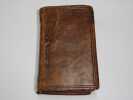
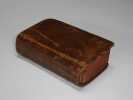
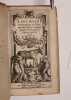
24mo. (XX),438,(2 blank) p. Contemporary calf 10.5 cm (Ref: Willems 315; Berghman 1247; Rahir 286; Brunet 3,84; Graesse 3,233) (Details: Binding ruled blind. Engraved title, depicting 2 learned gentlemen, perhaps Ewaldus Schrevelius, to whom the book is dedicated, and Heinsius' friend Adolph Vorstius, who both doff their hats for an ass) (Condition: Binding scuffed and with a few scratches, corners bumped. Small piece of leather gone at the foot of the spine. Both pastedowns detached) (Note: The 'Laus asini' (ad Senatum Populumque eorum, qui ignari omnium, scientias hoc tempore contemnunt) was published anonymously for the first time in 1623. An augmented edition appeared in 1629. The author is according to all critics the Dutch classical scholar and neolatin poet Daniel Heinsius, 1580-1655. It makes fun of people in an Erasmian spirit, and seems to have lost none of its topicality. The aim is, Heinsius tells in the 'ad lectorem', to vindicate men of letters and those who love to learn, from the contempt of ignorant people, who not only heartily ridicule (liberrime... illudunt) them, but also culture (eruditioni) and the sciences. (leaf *6 recto & verso) This eulogy is a satire on ignorance and voluntary servitude of the ass. It is hard to fathom, because of the complexity of its style, and the overabundance of erudition, (or put more positively, the veritable fireworks of learned allusions) which often obscures matters. The first edition of 1623, which contained the 'Laus Asini' only, is augmented in this second edition with 6 other pieces, 1: an Menippean satire 'Cras credo, hodie nihil', 2: 'Epistola, qua agitur an, & qualis viro literato sit ducenda uxor', 3: 'Laus pediculi, ad Conscriptos Mendicorum Patres', 4: 'Epistola de poetarum ineptiis & saeculi vitio', 5: 'Argumentum Batrachomyomachiae', 6: 'Viro Nobilissimo Ioanni Milandro, Domino de Poederoeye, Principi a Secretis: de Graeculis, quos illi commendaverat'. At the end Heinsius added a short letter to H. Grotius, and a consolation poem for his friend Baudius, on the occasion of the death of his wife) (Collation: *6, 2*4, A-2N6, 2O4 (leaf 2O4 blank) (Photographs on request)
Laus asini. Tertia parte auctior, cum aliis festivis opusculis.
Leiden (Lugd. Batavorum), Ex Officina Elzeviriana, 1629.
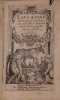
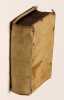
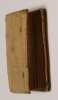
24mo. (XX),438,(2 blank) p. Overlapping vellum 11.5 cm (Ref: STCN ppn 832854379; Willems 315; Berghman 1247; Rahir 286; Brunet 3,84; Graesse 3,233) (Details: 5 thongs laced through the joints. Engraved title, depicting 2 learned gentlemen, perhaps Ewaldus Schrevelius, to whom the book is dedicated, and Heinsius' friend Aldoph Vorstius, who doff their hats for an ass) (Condition: Vellum soiled and scratched. Front board slightly damaged at the upper edge. All four ties gone. Front flyleaf removed. Right edge of the title thumbed, very tiny and almost invisible hole in the title) (Note: The 'Laus asini (ad Senatum Populumque eorum, qui ignari omnium, scientias hoc tempore contemnunt) was published anonymously for the first time in 1623. An augmented edition appeared in 1629. The author is according to all critics the Dutch classical scholar and neolatin poet Daniel Heinsius, 1580-1655. It pokes fun at people in an Erasmian spirit, and seems to have lost none of its topicality. The aim is, Heinsius tells in the 'ad lectorem', to vindicate men of letters and those who love to learn, from the contempt of ignorant people, who not only heartily ridicule (liberrime... illudunt) them, but also culture (eruditioni) and the sciences. (leaf *6 recto & verso) This eulogy is a satire on ignorance and voluntary servitude. It is hard to fathom, because of the complexity of its style, and the overabundance of erudition (or put more positively, the veritable fireworks of learned allusions), which often obscures matters. The first edition of 1623, which contained the 'Laus Asini' only, is augmented in this second edition with 6 other pieces, 1: an Menippean satire 'Cras credo, hodie nihil', 2: 'Epistola, qua agitur an, & qualis viro literato sit ducenda uxor', 3: 'Laus pediculi, ad Conscriptos Mendicorum Patres', 4: 'Epistola de poetarum ineptiis & saeculi vitio', 5: 'Argumentum Batrachomyomachiae', 6: 'Viro Nobilissimo Ioanni Milandro, Domino de Poederoeye, Principi a Secretis: de Graeculis, quos illi commendaverat'. At the end Heinsius added a short letter to H. Grotius, and a consolation poem for his friend Baudius, on the occasion of the death of his wife) (Collation: *6, 2*4, A-2N6, 2O4 (leaf 2O4 blank) (Photographs on request)
Laus Asini tria pars auctior : eum alijs festivis pusculis.
Leyde, ex officina elzeviriana [Bonaventure et Abraham Elzevier], 1629. 1 vol. in-24, veau fauve marbré, dos à nerfs orné de fers à l'oiseau dorés entourés d'une double filet doré, pièce de titre en maroquin rouge, roulette dorée sur les coupes, tranches rouges. Reliure du XVIIIe s. Ex-libris au contreplat de malarienne. Titre-frontispice hors-texte gravé à l'eau-forte, 1 vignette représentant une médaille (revers et avers) gravées sur bois dans le texte, (10) ff. (front. compris), 438 pp.
Seconde édition, la première en petit format de cette célèbre et savoureuse facétie de Daniel Heinsius dans la lignée des éloges paradoxaux de ses prédécesseurs : l'éloge de la folie (Erasme), ou l'Ane d'Or (Apulée). Heinsius dédie son ouvrage au médecin Screvelius à qui il suggère de soigner la fièvre de son siècle pendant que lui, Heinsius le fera rire. L'édition originale publiée en 1623 au format in-4° ne possédait pas de frontispice. Dans cette nouvelle édition, les Elzevier ont fait graver un charmant frontispice représentant un âne juché sur un piédestal devant lequel se prosternent un homme de lettres et un gentilhomme. Cette édition est augmentée de six pièces facétieuses de Daniel Heinsius : Cras credo, hodie nihil, An et qualis viro liberato sit ducenda uxor, Laus pediculi, De poetarum ineptiis et saeculi vitio, Argumentum Batrachomyomachiae, Epistola de commendatione Graeculorum quorundam. Pieters, 100, n°62; Willems, 315,; Rahir, 286.


Der paradiesgarten der Herrad von Landsberg.
Colmar, Alsatia verlag, 1968 ; in-12 oblong, 42 pp., cartonnage de l'éditeur. En superbe état avec sa jaquette - Ein zeugnis mittellterlicher kutur und geistesgeschichte im elsass - ausgewahlt und erlautert von Maria Heinsius ausgewahlt und erlautert von Maria Heinsius.
En superbe état avec sa jaquette - Ein zeugnis mittellterlicher kutur und geistesgeschichte im elsass - ausgewahlt und erlautert von Maria Heinsius ausgewahlt und erlautert von Maria Heinsius.
L'avanturier hollandois, ou La vie et les avantures divertissantes d'un Hollandois
Chez les Westein & Smith | à Amsterdam 1729 | 7.50 x 13.50 cm | 2 volumes reliés
Edition originale française rare, illustrée de 2 frontispices (le même répété) et 12 jolies figures non signées. Traduction de l'auteur lui-même. Le roman ne fut réimprimé qu'en 1801 sous un autre titre. Pages de titre en rouge et noir. Reliures en plein veau brun granité d'époque. Dos à nerfs ornés. Pièces de titre en maroquin rouge et de tomaison en maroquin havane. Manque en tête et au mors supérieur en tête du tome II. 5 coins émoussés. Un léger accroc au dernier caisson en queue du tome II. Trace de mouillure au coin droit haut de plusieurs feuillets en début du tome I. Bon exemplaire. Roman picaresque qui raconte les vicissitudes de l'existence d'un gueux au service de plusieurs maîtres, bourgeois et nobles. La satire n'est jamais loin et l'humour souvent grivois, dressant le portrait mordant de la société du temps. Les aventures rocambolesque du personnage se déroulent entre la Hollande et principalement la France. L'auteur semble avoir lu les romans picaresques espagnols et français du XVIIe, on y reconnaît même l'influence du Don Quichotte dans le fait que le héros ne connaît l'amour et la bravoure qu'au travers de romans de chevalerie, ce qui le conduit à des situations cocasses. Au fur et à mesure que se déroule le roman, les événements s'enchevêtrent et les personnages réapparaissent, créant ainsi un fil narratif. Nicolas Heinsius est le fils d'une illustre lignée de littérateurs, Nicolas heinsius, son père, et Daniel Heinsius, son grand-père. Son roman mérite amplement d'être redécouvert et de prendre place parmi les fleurons de la littérature picaresque. - Photographies et détails sur www.Edition-Originale.com -
[De l'Imprimerie de Honnert] - HEINSIUS, Daniel ; (COUPE, L.)
Reference : 66879
(1796)
Eloge de l'Ane. Traduction libre du Latin de Daniel Heinsius par M. L. Coupé
1 vol. in-18 reliure XIXe demi-chagrin noir, dos à 5 nerfs dorés, De l'Imprimerie de Honnert, Paris, 1796, 213 pp.
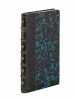
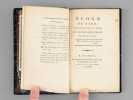
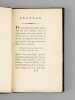
Ainsi que le précise le traducteur de cette facétie, "quatre ânes privilégiés passent cependant glorieusement à la postérité ; celui d'Apulée, celui de Buridan, celui de Buffon, celui de Daniel Heinsius". Daniel Heinsius (1580-1655) fut l'un des plus éminents philologues et intellectuels de son temps. Brunet, III, 84
Hymnus oft Lof-Sanck van Bacchus, waer in' tgebruyck ende misbruyck vande Wijn beschreven wort.
, Leyde, 25 octobre 1615; in-4, vélin ivoire moderne 6 ff., n.ch., 65 pp., 1 p. n.ch. EDITION ORIGINALE de ce grand poème épique hollandais qui célèbre les fastes du dieu de la vigne et retrace les hauts faits de sa vie depuis le jour où il sortit de la cuisse de Jupiter jusqu'à son triomphe. La biographie du grand humaniste Daniel Heinsius ( né à Gand en 1580 et mort à Leyde en 1665) est trop connue pour que nous entrions dans son détail ici. Rappelons simplement que si, dans le monde savant, il passait pour un des plus grands poètes néo-latins de son temps, il aurait également pu briguer les lauriers des Muses flamandes. S'il s'était adonné à la poésie de sa langue nationale, il est probable que ses œuvres figureraient en bonne place à côté de celles de Cats, Vondel et autres Hoofft. Un seul recueil a paru, publié en 1516 par les soins de Pierre Scriverius, sous le titre de Nederduytsche poemata. L'hymne de Bacchus que nous proposons ici en fait partie. C'est la deuxième section du recueil, parue avec une pagination spéciale et un avant-propos de Heinsius adressé à Scriverius. Le volume est orné de 14 superbes illustrations sur cuivre de Simon de PASSE et Cri LE BLON d'après les dessins de J. de GHEYN: naissance de Bacchus, son enfance dans les vignes parmi les satyres, cortèges bachiques, ses amours, ses combats, scènes de beuveries flamandes, etc. Heinsius semble avoir eu une tendresse particulière pour le dieu du vin car, déjà en 1610, il donnait une dissertation sur les Dionysiaques du grand poète grec de la décadence, Nonnos. Il est d'ailleurs probable qu'il ait tiré son hymne de Bacchus de cette colossale épopée. Landwehr Emblem and fable books in the Low countries 292.- Oberlé 1032. Exemplaire un peu taché, 2 déchirures marginales réparées avec un manque à l'angle d'une gravure et à un coin du texte.
Herodes infanticida, tragoedia.
Leyde, [Bonavenure et Abraham] Elzevier, 1632. 1 vol. petit in-8°, basane cailloutée, dos lisse orné de croisillons dorés, pièce de titre et date en pied en maroquin vert, encadrement d'un double filet doré sur les plats, roulette dorée sur les coupes. Reliure du début du XIXe siècle. Cachet ex-libris du Dr Pierre Carteron (Troyes, début du XIXe s.) sur le titre. Mors sup. fendillé. Titre en rouge et noir avec la marque au solitaire, 112 pp. Larges mouillures pâles à qq. ff.
Edition originale de cette tragédie latine de l'humaniste hollandais Daniel Heinsius (1580-1655). L'Hérode infanticide est suivi de l'Hypotyposis infanticidii de St Basile (en grec) et des Poematia aliquot de Daniel Heinsius. Agréable exemplaire. Soleinne, 429; Willems, 369; Rahir, 354.
[Ex Officina Plantiniana Raphelengii] - HESIODUS ; (HEINSIUS, Daniel) ; [ HESIODE ; HESIOD ]
Reference : 65709
(1603)
Hesiodou Askraiou ta heuriskomena. Hesiodi Ascraei quae extant, Cum Graecis Scholiis, Procli, Moschopuli, Tzetzae, in Erga kai Hemeras : Io. Diaconi & incerti in reliqua. Accessit liber singularis, in quo doctrina Ergon kai Hemeron, eiusque institutum, contra opinionem, quae obinuit, ostenditur ; Item Notae, emendationes, observationes & Index copiosissimus in Hesiodum eiusque Interpretes ; Opera & studio Danielis Heinsii [ Suivi de : ] Danielis Heinsii Introductio in doctrinam, quae libris Hesiodi Ergon kai Hemeron continetur [ ...]
1 vol. in-4 (21,8 x 15,6 en marges) reliure XVIIe plein veau marbré, dos à 5 nerfs orné, triple filet doré d'encadrement en plats, coupes et chasses ornées, Ex Officina Plantiniana Raphelengii, s.l. [Leyde - Leiden ], 1603, 22 ff., 329 pp., 1 f. blanc, 159 pp.
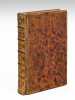
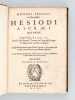
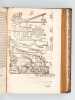
Selon Schweiger, "Heins. folgt der Basler Ausg., weicht aber haufig davon ab" ("Hensius suit l'édition bâloise, mais s'en écarte souvent"). A propos de cette même édition par Heinsius des oeuvres d'Hésiode (né à Ascra en Béotie), et contenant les scholies de Proclus et des commentateurs byzantins Manuel Moschopoulos (élève de Maxime Planude) et Jean Tzetzes, Graesse parle d'une "édition estimée". Bon état pour cette belle édition, ornée d'une belle gravure dans le texte (instruments aratoires). Notre exemplaire est enrichi de quelques annotations manuscrites marginales de l'époque (reliure un peu frottée avec petits mq. en mors, plats et coiffes, bon exemplaire par ailleurs, ex-libris en garde). According to Schweiger, "Heins. folgt der Basler Ausg., weicht aber haufig davon ab" ("Hensius follows the Basel edition, but often deviates from it"). About this same edition by Heinsius of the works of Hesiod (born in Ascra in Boeotia), containing the scholia of Proclus and the Byzantine commentators Manuel Moschopoulos (student of Maxime Planude) and Jean Tzetzès, Graesse speaks of an "esteemed edition ". Good condition for this beautiful edition, decorated with a beautiful engraving in the text (farm implements). Our copy is enriched with some marginal handwritten annotations from the period (slightly rubbed binding with small lacks on joints and cover, good copy otherwise, ex-libris). Graesse, III, 263 ; Schweiger, 143.
LAUS ASINI. " Tertia parte auctior, cum aliis [6] festivis opusculis ".
Lugd. Batavorum [Leyde]. Ex Officina Elzeviriana. 1629. In-24, reliure plein vélin à recouvrement. [2]-438 pages. Page de titre illustrée d'une amusante gravure représentant un âne sur un piédestal, auquel deux gentilshommes font leur révérence. Bel exemplaire, bien relié, sans aucune rousseur.
Cette facétie, publiée anonymement, est l'uvre du philologue et poète néo-latin hollandais Daniel Heinsius (1580-1655). Cette deuxième édition (E.O. en 1623) est augmentée de six autres pièces satiriques ou facétieuses : Cras credo, hodie nihil ; Epistola, qua agitur, An & qualis viro literato sit ducenda uxor ; Laus pediculi ; De poetarum ineptiis, et saeculi vitio ; Argumentum batrachomyomachiae ; Epistola, de commendatione Graeculorum quorundam : cum aliis aliquor.Charles Pieters, Annales de l'imprimerie Elsevirienne, 1851, tome 1, p. 81, n° 9. Brunet, III, 84 (" Petit recueil assez recherché "). Willems, 315. Rahir, 286.
Poematum, editio nova. Accedunt praeter alia libri, De contemptu Mortis antehac una non editi.
Lugduni Batavorum (Leyde), Elzevier, 1621 ; in-12 de [4] ff., 474 pp. ; [4] ff., 167-19 pp., reliure de l'époque, vélin ivoire à recouvrement, titre manuscrit au dos, tranches mouchetées.
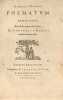
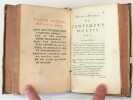
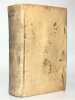
Première édition collective elzévirienne, portant la marque du solitaire. Savant poète néerlandais disciple de Scaliger, Daniel Heinsius fut bibliothécaire de l'Académie de Leyde. La première partie du recueil contient des pièces en édition originale et de nombreux poèmes en grec. La seconde partie est la copie conforme de l'édition originale parue la même année séparément dans un format in-4. Elle possède un titre en rouge et noir. Le Mépris de la Mort est la meilleure production poétique de Daniel Heinsius ; il y expose avec talent la doctrine de Platon. Selon Brunet, « ce poème a joui en son temps d'une très grande vogue ». Portrait d'Homère gravé sur cuivre dans un médaillon.- Willems, 186. Brunet III, 83.Restes de lacets sur les plats, quelques travaux de vers dans le fond de certains cahiers et aux premiers et derniers feuillets, cependant joli exemplaire. - Étiquette grattée d'une Académie de Poitiers et nombreuses notes d'une main de l'époque sur les gardes et les ex-libris manuscrits anciens de Joannis de Meschinet, de Poitiers, Ludovicus Josephus Tagault, et Joannes de Lacosse, de Poitiers.
Der paradiesgarten der Herrad von Landsberg.
Colmar, Alsatia verlag, 1968 ; in-12 oblong, 42 pp., cartonnage de l'éditeur. Ein zeugnis mittellterlicher kutur und geistesgeschichte im elsass - ausgewahlt und erlautert von Maria Heinsius.
Ein zeugnis mittellterlicher kutur und geistesgeschichte im elsass - ausgewahlt und erlautert von Maria Heinsius.
DAS LUSTGARTLEIN DER HERRAD VON LANDSBERG.
Colmar, Alsatia verlag, vers 1940 ; in-12 oblong, 42 pp., cartonnage de l'éditeur. Ein spiegel der hohenstaufenzeit im elsass - ausgewahlt und erlautert von Maria Heinsius.
Ein spiegel der hohenstaufenzeit im elsass - ausgewahlt und erlautert von Maria Heinsius.
Nicolaas Heinsius in dienst van Christina van Zweden.
Delft, Ursulapers, 1949.
340 p. Stiff wrappers. 24 cm (Dissertation, trade edition)
Nicolaas Heinsius in dienst van Christina van Zweden.
Delft, Ursulapers, 1949.
340 p. Stiff wrappers. 24 cm (Dissertation, trade edition)
Ta tou Theokritou sesosmena. Theocriti quae extant. Ex Danielis Heinsii expressa
In aedibus academicis excudebant Robertus et Andreas Foulis | Glasguae (Glascow) 1746 | 9.50 x 16.50 cm | relié
Edition en grec avec la traduction latine en bas de page. Impression soignée. Reliure en plein veau glacé d'époque. Dos à nerfs orné. Pièce de titre en maroquin rouge. Triple filet d'encadrement sur les plats. Tranches dorées. Coiffe de tête élimée. Coins émoussés. Bonne édition, contenant la traduction du célèbre latiniste Daniel Heinsius, qui ocupait la chaire des belles-lettres à Leyde. - Photographies et détails sur www.Edition-Originale.com -
C.Velleii Paterculi que superfunt.
1678 Amstelodami, Elzeviriana, 1678, In seize,(6 f),(3f),(3f), 208 pp, reliure en plein veau d'époque,dos à cinq nerfs,orné de fleurons,légère éraflure sur le plat,
.

