 Write to the booksellers
HEINSIUS,D.
Laus asini. Tertia parte auctior, cum aliis festivis opusculis.
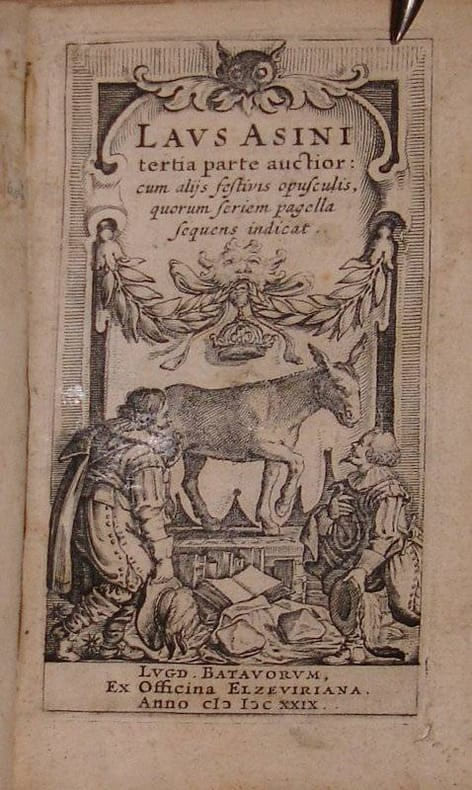
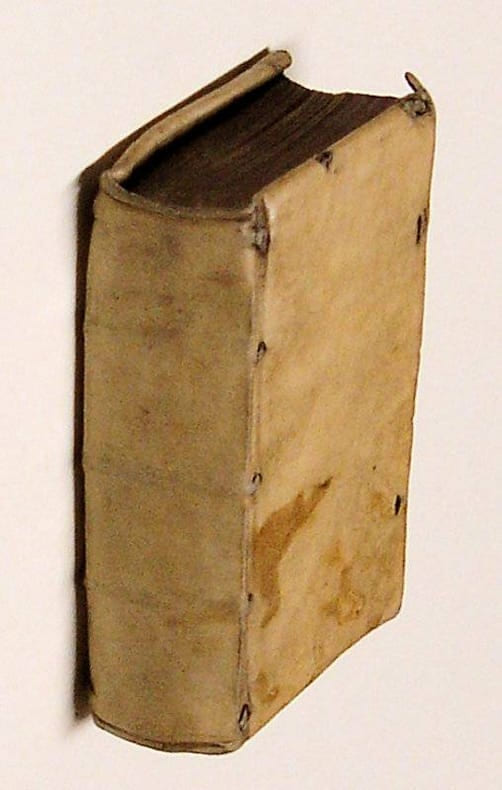
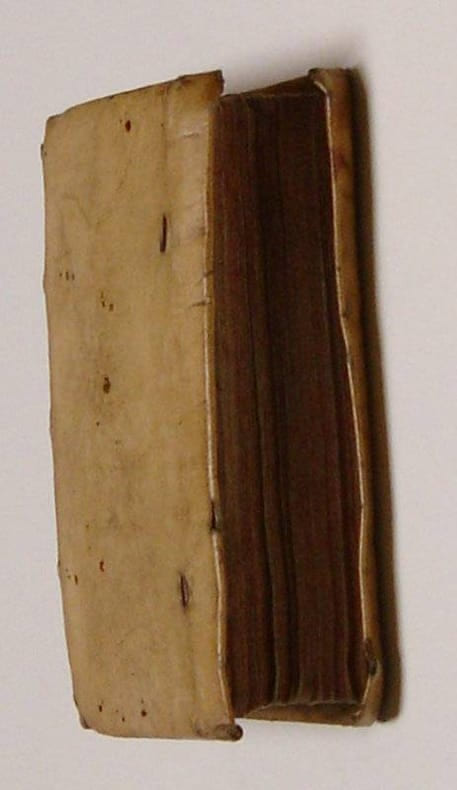
Leiden (Lugd. Batavorum), Ex Officina Elzeviriana, 1629.
Reference : 120077
24mo. (XX),438,(2 blank) p. Overlapping vellum 11.5 cm (Ref: STCN ppn 832854379; Willems 315; Berghman 1247; Rahir 286; Brunet 3,84; Graesse 3,233) (Details: 5 thongs laced through the joints. Engraved title, depicting 2 learned gentlemen, perhaps Ewaldus Schrevelius, to whom the book is dedicated, and Heinsius' friend Aldoph Vorstius, who doff their hats for an ass) (Condition: Vellum soiled and scratched. Front board slightly damaged at the upper edge. All four ties gone. Front flyleaf removed. Right edge of the title thumbed, very tiny and almost invisible hole in the title) (Note: The 'Laus asini (ad Senatum Populumque eorum, qui ignari omnium, scientias hoc tempore contemnunt) was published anonymously for the first time in 1623. An augmented edition appeared in 1629. The author is according to all critics the Dutch classical scholar and neolatin poet Daniel Heinsius, 1580-1655. It pokes fun at people in an Erasmian spirit, and seems to have lost none of its topicality. The aim is, Heinsius tells in the 'ad lectorem', to vindicate men of letters and those who love to learn, from the contempt of ignorant people, who not only heartily ridicule (liberrime... illudunt) them, but also culture (eruditioni) and the sciences. (leaf *6 recto & verso) This eulogy is a satire on ignorance and voluntary servitude. It is hard to fathom, because of the complexity of its style, and the overabundance of erudition (or put more positively, the veritable fireworks of learned allusions), which often obscures matters. The first edition of 1623, which contained the 'Laus Asini' only, is augmented in this second edition with 6 other pieces, 1: an Menippean satire 'Cras credo, hodie nihil', 2: 'Epistola, qua agitur an, & qualis viro literato sit ducenda uxor', 3: 'Laus pediculi, ad Conscriptos Mendicorum Patres', 4: 'Epistola de poetarum ineptiis & saeculi vitio', 5: 'Argumentum Batrachomyomachiae', 6: 'Viro Nobilissimo Ioanni Milandro, Domino de Poederoeye, Principi a Secretis: de Graeculis, quos illi commendaverat'. At the end Heinsius added a short letter to H. Grotius, and a consolation poem for his friend Baudius, on the occasion of the death of his wife) (Collation: *6, 2*4, A-2N6, 2O4 (leaf 2O4 blank) (Photographs on request)
Bookseller's contact details
Antiquariaat Fragmenta Selecta
+31 20 418 55 65
Payment mode

Sale conditions
Terms of Sale All items offered are subject to prior sale. Your order will be final after you have received our confirmation, with a specification of the availability of the items and the shipping costs. All books are complete and in good antiquarian condition, unless otherwise described. Prices are in EURO. Postage and insurance are not included. Postage will be calculated at cost (no extra charges). Returns Books may be returned within 14 days of receipt, if returned in the same condition as sent, and packed, shipped and insured as received (please always notify us). We will refund the shipping costs of a return shipment only if our descriptions were not correct. How to pay Pre-payment is necessary for new customers. Our order confirmation will provide detailed information and a specification of the shipping costs. Customers who are known to us and libraries will be invoiced as usual. We accept Visa and Mastercard. You can submit your card information through our SECURE PAYMENT FORM. PayPal: we will send you a personal link to the PayPal website. Banktransfers: payment can be made into our bank account in The Netherlands.
2 book(s) with the same title
Laus asini. Tertia parte auctior, cum aliis festivis opusculis, quorum seriem pagella sequens indicat.
Leiden (Lugd. Batavorum), Ex Officina Elzeviriana, 1629.
24mo. (XX),438,(2 blank) p. Contemporary calf 10.5 cm (Ref: Willems 315; Berghman 1247; Rahir 286; Brunet 3,84; Graesse 3,233) (Details: Binding ruled blind. Engraved title, depicting 2 learned gentlemen, perhaps Ewaldus Schrevelius, to whom the book is dedicated, and Heinsius' friend Adolph Vorstius, who both doff their hats for an ass) (Condition: Binding scuffed and with a few scratches, corners bumped. Small piece of leather gone at the foot of the spine. Both pastedowns detached) (Note: The 'Laus asini' (ad Senatum Populumque eorum, qui ignari omnium, scientias hoc tempore contemnunt) was published anonymously for the first time in 1623. An augmented edition appeared in 1629. The author is according to all critics the Dutch classical scholar and neolatin poet Daniel Heinsius, 1580-1655. It makes fun of people in an Erasmian spirit, and seems to have lost none of its topicality. The aim is, Heinsius tells in the 'ad lectorem', to vindicate men of letters and those who love to learn, from the contempt of ignorant people, who not only heartily ridicule (liberrime... illudunt) them, but also culture (eruditioni) and the sciences. (leaf *6 recto & verso) This eulogy is a satire on ignorance and voluntary servitude of the ass. It is hard to fathom, because of the complexity of its style, and the overabundance of erudition, (or put more positively, the veritable fireworks of learned allusions) which often obscures matters. The first edition of 1623, which contained the 'Laus Asini' only, is augmented in this second edition with 6 other pieces, 1: an Menippean satire 'Cras credo, hodie nihil', 2: 'Epistola, qua agitur an, & qualis viro literato sit ducenda uxor', 3: 'Laus pediculi, ad Conscriptos Mendicorum Patres', 4: 'Epistola de poetarum ineptiis & saeculi vitio', 5: 'Argumentum Batrachomyomachiae', 6: 'Viro Nobilissimo Ioanni Milandro, Domino de Poederoeye, Principi a Secretis: de Graeculis, quos illi commendaverat'. At the end Heinsius added a short letter to H. Grotius, and a consolation poem for his friend Baudius, on the occasion of the death of his wife) (Collation: *6, 2*4, A-2N6, 2O4 (leaf 2O4 blank) (Photographs on request)
LAUS ASINI. " Tertia parte auctior, cum aliis [6] festivis opusculis ".
Lugd. Batavorum [Leyde]. Ex Officina Elzeviriana. 1629. In-24, reliure plein vélin à recouvrement. [2]-438 pages. Page de titre illustrée d'une amusante gravure représentant un âne sur un piédestal, auquel deux gentilshommes font leur révérence. Bel exemplaire, bien relié, sans aucune rousseur.
Cette facétie, publiée anonymement, est l'uvre du philologue et poète néo-latin hollandais Daniel Heinsius (1580-1655). Cette deuxième édition (E.O. en 1623) est augmentée de six autres pièces satiriques ou facétieuses : Cras credo, hodie nihil ; Epistola, qua agitur, An & qualis viro literato sit ducenda uxor ; Laus pediculi ; De poetarum ineptiis, et saeculi vitio ; Argumentum batrachomyomachiae ; Epistola, de commendatione Graeculorum quorundam : cum aliis aliquor.Charles Pieters, Annales de l'imprimerie Elsevirienne, 1851, tome 1, p. 81, n° 9. Brunet, III, 84 (" Petit recueil assez recherché "). Willems, 315. Rahir, 286.

