 Write to the booksellers
CONDILLAC.
Traité des sensations, à Madame la Comtesse de Vassé.
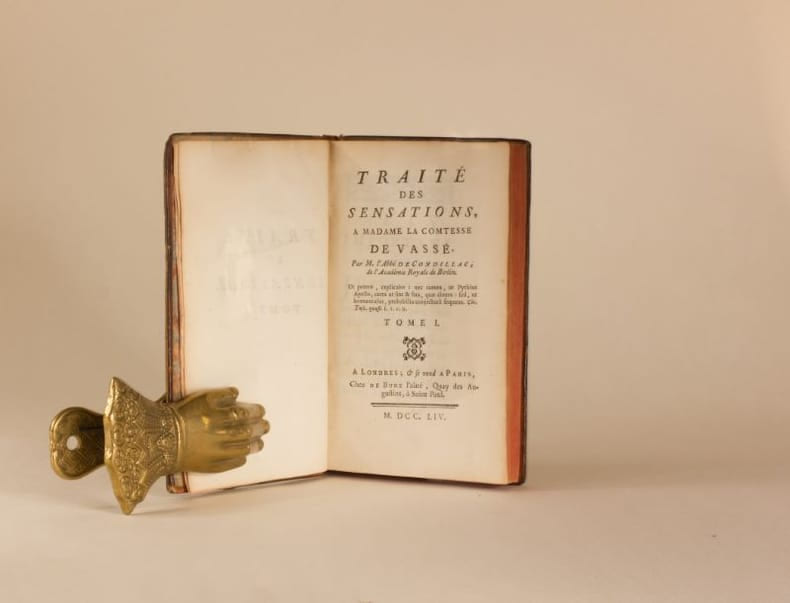
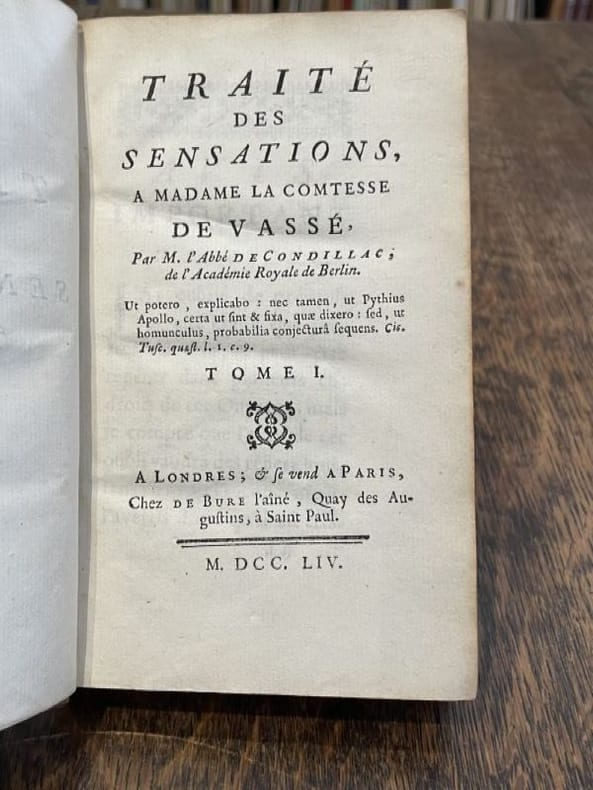
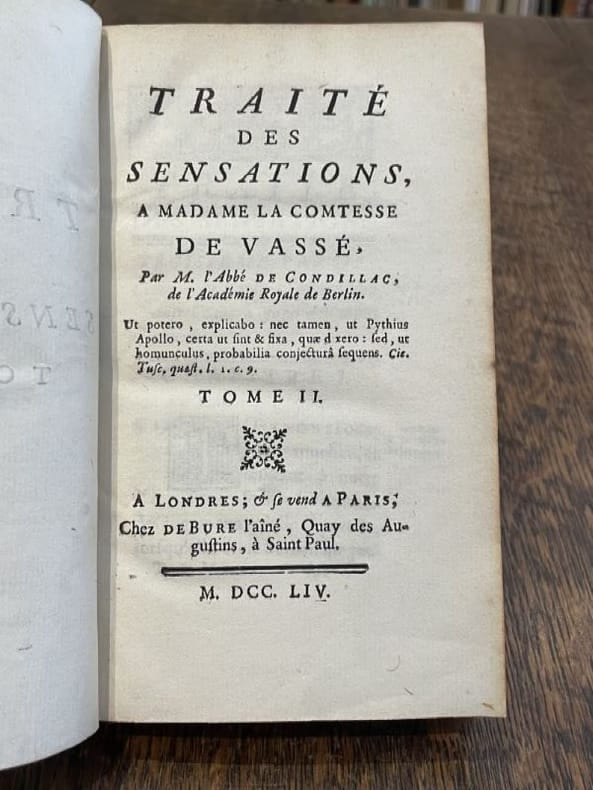
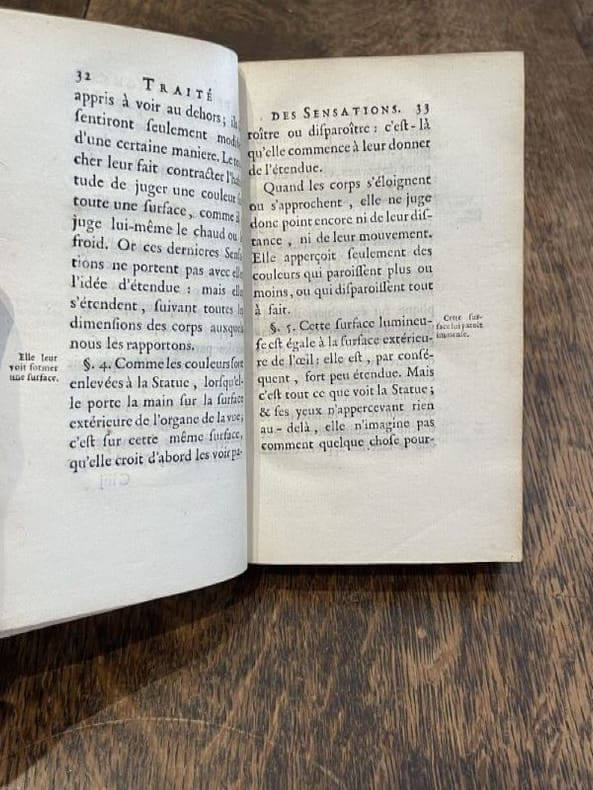
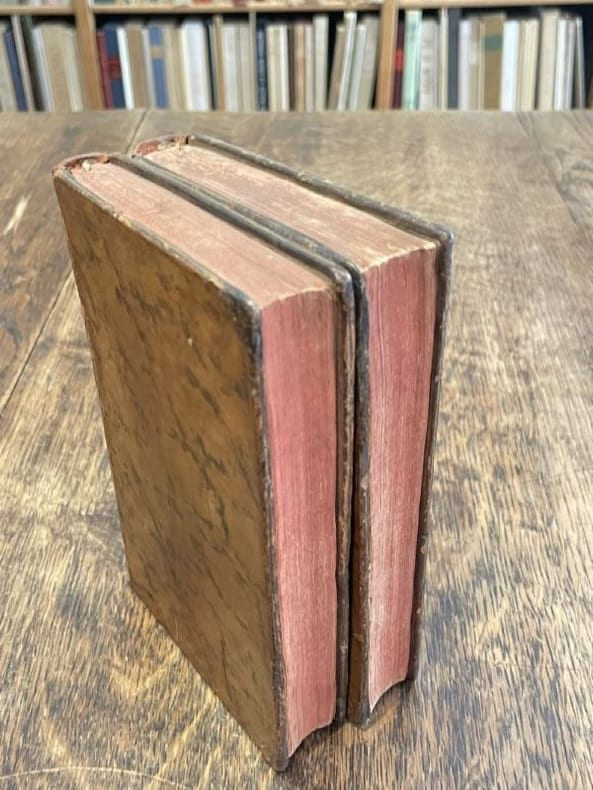
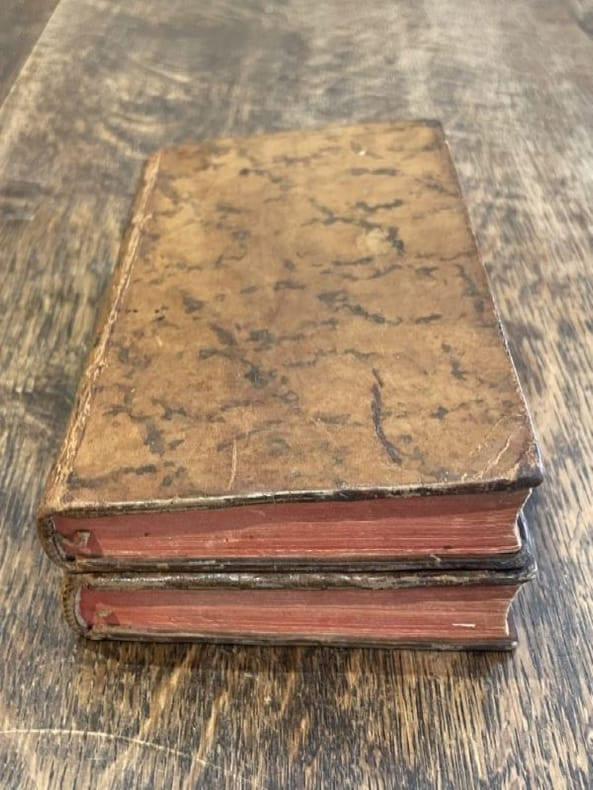
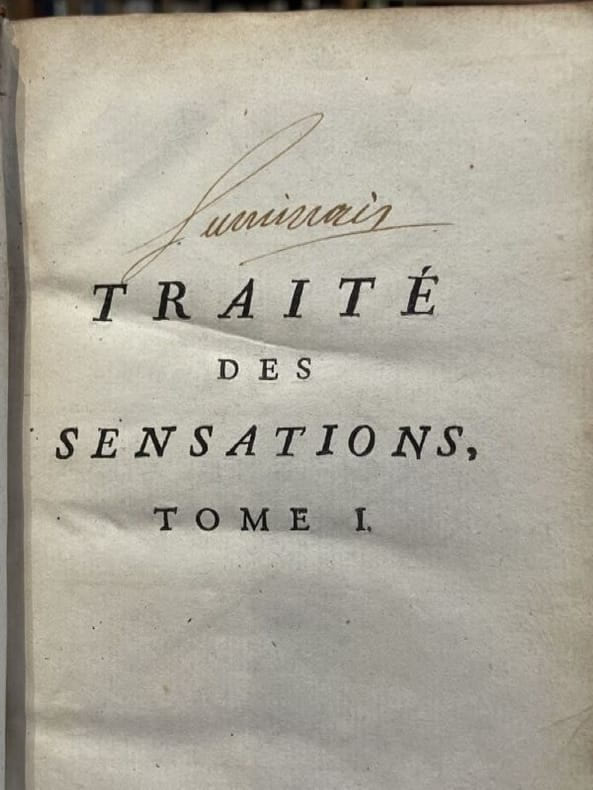
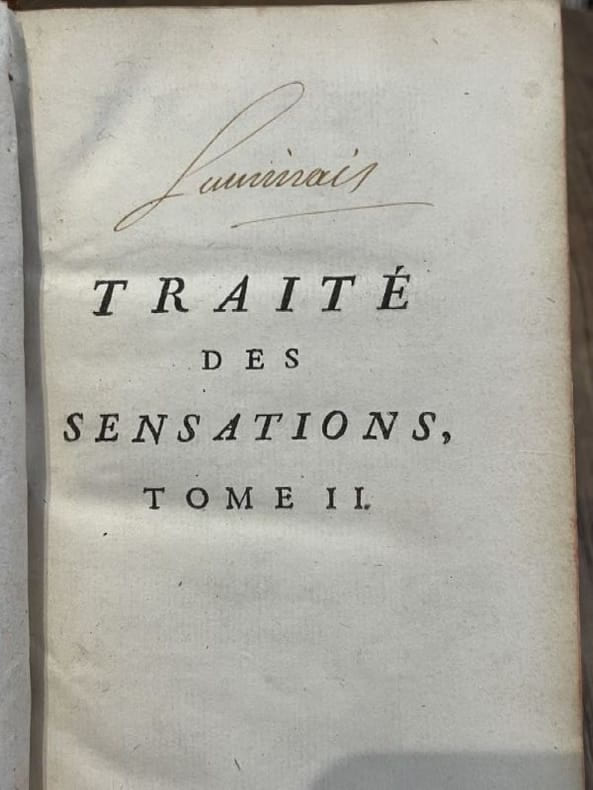
Londres et Paris Chez De Bure l'aîné 1754 2 vol. relié 2 vol. in-12, basane fauve marbrée, dos lisses ornés de fleurons dorés, pièces de titre et de tomaison de maroquin rouge et olive, tranches rouges, VI + 345 et 335 pp. Edition originale de cette oeuvre fondamentale dans la diffusion de l'empirisme en Europe. Etudiant séparément chacun de nos sens grâce à l'hypothèse fameuse de l'homme-statue, le philosophe y démontre que toutes nos facultés intellectuelles et physiques viennent de la seule sensation. Bon exemplaire en reliure d'époque avec ex-libris manuscrit ancien sur les faux-titres, coins et dos légèrement frottés.
Reference : 116463
Bookseller's contact details
Vignes Online
M. Henri Vignes
La Font Macaire
87120 Eymoutiers
France
05 55 14 44 53
Payment mode


Sale conditions
conformes aux usages de la Librairie ancienne et moderne et, pour l'étranger, aux règlements en matière de paiement. Les prix indiqués sont nets, en euros. Frais de port en sus à la charge du destinataire.
4 book(s) with the same title
Traité des sensations, à madame la comtesse de Vassé. Édition originale.
A Londres et se vend à Paris, chez De Bure l'aîné, 1754. 16,5 x 10,5 cm, vj-345 et 335 pp. Deux volumes reliés plein veau raciné d'époque, dos lisse ornés, pièces de titre, tranches rouges. Reliures légèrement usées, tome i coiffe sup. abîmé, traces de frottements, coins émoussés, tome II coiffe sup. arasée, coins émoussés, petit manque à une pièce de titre. Sinon bons exemplaires. Édition originale de « l'oeuvre fondamentale de Condillac ». Dans ce Traité des sensations, Condillac se propose d expliquer par nos sensations la formation de toutes nos idées, et par nos besoins le développement de toutes nos facultés. Il établit que nos pensées et nos connaissances viennent d une seule source : les sensations, processus purement physique. C'est le langage, invention purement humaine, qui permet d'organiser les sensations pour élaborer une pensée consciente.

Traité des sensations à Madame la comtesse de Vassé
De Bure l'aîné | Londres Paris 1754 | 10.5 x 17.1 cm | Relié
Edition originale. Reliures en pleine basane racinée d'époque, dos à cinq nerfs, caissons et fleurons dorés entre les nerfs, pièces de titre en cuir blond, filet doré sur les coupes, contreplats de papier coquille, tranches rouges. Quelques épidermures et manques, coins légèrement émoussés, le coin supérieur du deuxième plat endommagé, défaut de production aux contreplats, infimes piqûres et salissures. L'ouvrage fondamental de la philosophie sensualiste, habillé d'une reliure strictement d'époque. * Dans leTraité des sensations, l'abbé de Condillac mène une expérience de pensée : imaginer comment un être privé de toute idée pourrait néanmoins les acquérir grâce à ses sens. Il recourt pour cela à l'image d'une statue à laquelle il n'accorde d'abord que l'odorat, ce sens devenant le premier vecteur par lequel elle accède à la conscience d'elle-même. En sentant l'odeur d'une rose, la statue ignore qu'elle est une statue qui sent une rose : pour elle-même, elle n'est rien d'autre que cette odeur, puisqu'elle ne connaît rien en dehors de cette seule sentation. En lui présentant tour à tour différentes fleurs, on lui fait acquérir de nouvelles sensations : elle devient ainsi, selon l'objet qui agit sur son organe, odeur de rose, d'illet, de jasmin, de violette, etc. De cette unique modification naissent pourtant déjà l'attention, la mémoire, le jugement par comparaison, et un amour qui n'est encore que l'amour de soi. Toutes les facultés supérieures de l'esprit (jugement, réflexion, désirs, passions) ne sont, selon la formule de Condillac, que « la sensation même qui se transforme différemment », thèse par laquelle il entend se passer de toute faculté innée et fonder l'entendement sur la seule expérience sensible. La réflexion, elle, ne surgit qu'avec le toucher : devenue mobile, la statue découvre par le contact son propre corps puis le monde extérieur, et le toucher instruit alors l'odorat, l'ouïe, la vue et le goût. En 1768, cet ouvrage important offrit à Etienne Bonnot de Condillac, abbé de Mureaux et précepteur du petit-fils de Louis XV, un fauteuil à l'Académie française. Le terme "sensualisme" quant à lui est postérieur à l'ouvrage : il est généralement attribué à Joseph-Marie de Gérando, linguiste et l'un des précurseurs de l'anthropologie. Si le livre est formellement dédié à la comtesse de Vassé, c'est à son amie Elisabeth Ferrand, une autre salonnière et philosophe française, que l'auteur rend longuement hommage dans sa préface - elle serait ainsi l'auteur véritable de la thèse du sensualisme : "Mademoiselle Ferrand m'a éclairé sur les principes, sur le plan & sur les moindres détails & j'en dois être d'autant plus reconnoissant, que son projet n'étoit ni de m'instruire, ni de faire un Livre. Elle ne s'appercevoit pas qu'elle devenoit Auteur, & elle n'avoit d'autre dessein que de s'entretenir avec moi des choses auxquelles je prenois quelque intérêt". Installées toutes les deux dans des appartements dans le faubourg Saint-Germain, Elisabeth Ferrand et la comtesse de Vassé recevèrent une société de savants et de philosophes de premier plan, parmi lesquels Clairaut, Réaumur, Helvétius, Cramer, ainsi que les frères Bonnot de Mably et de Condillac. Ce dernier devena d'ailleurs l'un des principaux bénéficiaires du testament de Mademoiselle Ferrand. Important traité philosophique du XVIIIe siècle, dont le projet doit son inspiration à Mademoiselle Ferrand, une salonnière érudite du Paris des Lumières. - Photographies et détails sur www.Edition-Originale.com -

Traité des Sensations, a Madame la Comtesse de Vassé. 2 vols.
London, Chez de Bure l'aîne, 1754. Small 8vo. 2 cont. full mottled calf, richly gilt backs, tome-and titlelabels in leather, gilt. Very slightly rubbed. Fine. 2 halftitles. (2),VI,345"(4),335,(1) pp. Old owners name on titles, 1 leaf with a tear, repaired without loss. A few minor brownspots, fine and clean.
Rare first edition of Condillac's main work. Condillac's philosophy of science was considered the most authoritative reading of Newtonian methodology. Among many others Lavoicier and other protagonists of the chemical revolution were influenced by his reform of nomenclature, as were and are botanists, zoologists and geometrics by his scientific explanations. His psychological empiricism is now considered the first positivist account of science.Condillac was one of the greatest French philosophers of the Enlightenment. He was friends with Rousseau and Diderot and was a forerunner in the junction between epistemology and philosophy, which was inspired by Locke and Newton, as the two sciences almost merged into one in this period. ""Condillac contibuted to the synthesis more decisively than did any other writer."" (D.S.B. III:380).In this his main and most important work Condillac shows how more complicated functions of the soul arise from the combination and counter-effects of the sensations. According to his highly influential theory, all thought is derived from sense-perception, by placing sensations in a certain order with the help of language and mathematical signs.His ""philosophy of science as language occupies a midpoint in the evolution of scientific epistemology between the empiricism of Locke and the positivism of Comte."" (D.S.B. III:380).Condillac viewed language as the analyst of experience and in this work puts forth his idea that effective knowledge is derived from the mind's ability to invent and manipulate symbols of uniform and determinate significance. He approached all problems genetically and adduced the acquisition of language by regarding a baby. ""(I)n the most comprehensive of his works, the ""Traité des sensations"", he sets out, faithful to his genetic approach, to trace in principle the process by which a being organized with the capacity of becoming human learns to avail itself of the several senses with which it is provided."" (D.S.B. III:381).
Traité des sensations, à Madame la Comtesse de Vassé
Reliure plein veau raciné d'époque. Dos à nerfs ornés de caissons dorés, pièces de titre et de tomaison rouges. Filets d'encadrements dorés sur les plats. Trois tranches mouchetées. Intérieur d'une parfaite fraîcheur et d'une parfaite blancheur.Petite déchirure sur le premier plat du tome 1. Étiquette sur page de garde "M. DUPLEIX de Bacquencourt, Intendant d'Amiens".
Londres, Se vend à Paris De Bure L'ainé 1754 Tome 1: 345 pp.Tome 2: 335 pp. In-8 Reliés Très bel ensemble, d'une parfaite fraicheur. 2 volumes ÉDITION ORIGINALE.

