 Write to the booksellers
GONZAGUE FRICK Louis de.
Poetica.
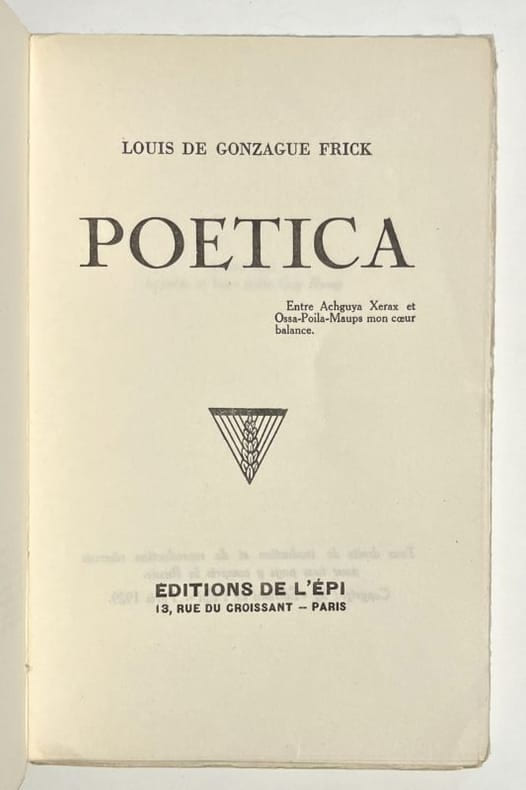
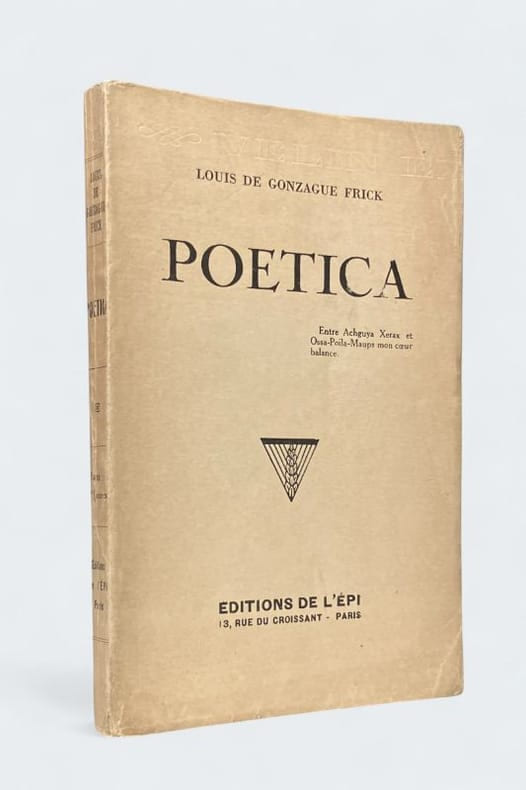
1922 Paris, Éditions de l'Épi, 1922 ; in-12 de 143 pp., broché.
Reference : 456
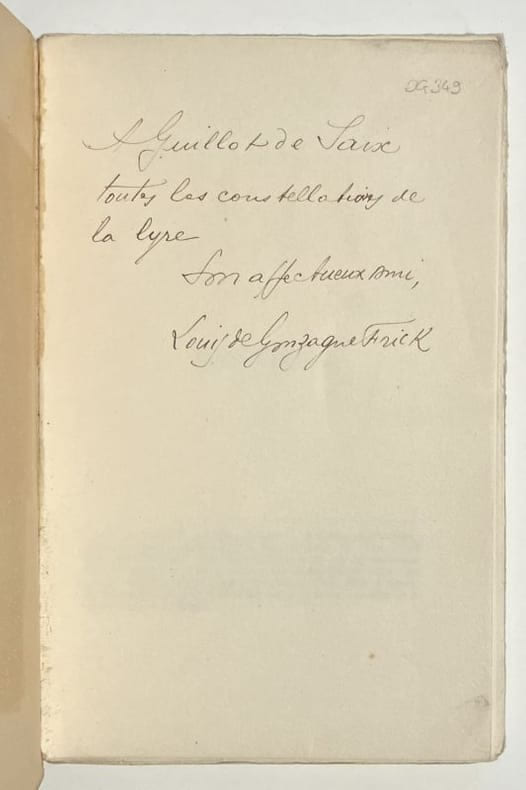
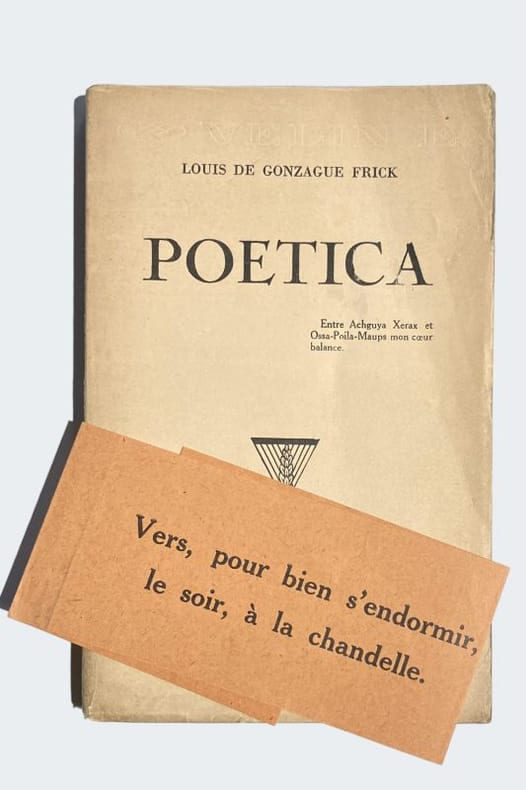
Édition originale. Bel exemplaire, bel envoi : « à Guillot de Saix, toutes les constellations de la lyre, son affectueux ami ». Le bandeau portant : « Vers, pour bien s'endormir le soir, à la chandelle » a été conservé dans le volume.
Bookseller's contact details
Librairie L'Ancre Aldine
M. Guillaume Clément
62 rue Auguste Comte
69002 Lyon
France
04 78 42 07 60
Payment mode


Sale conditions
Nous acceptons les règlements par : CB, chèques, virements, espèces... Conditions de vente conformes aux usages de la profession. Tous les livres sont garantis conformes à la description. Les prix sont nets, en euros, port en sus le cas échéant. Emballage gratuit.
5 book(s) with the same title
Poetica, volumen I : Praecepta poetica. De perfecta poesi.
Vilnius, Lietuviu loiteraturos ir tautosakos institutas, 2009. Grand in-8 cartonnage éditeur, XVI-521 pp., index.
Bonne condition. - Frais de port : -France 8,4 € -U.E. 10 € -Monde (z B : 15 €) (z C : 33 €)


ARISTOTELOUS PERI POIÊTIKÊS. Aristotelis De poetica liber. Ex versione Theodori Goulstoni perpetuis notis analyticis illustrata. Accedunt integrae notae Frid. Sylburgii & Dan. Heinsii, necnon selectae aliorum. (And:) Aristotelis De poetica liber, latine conversus, et analytica methodo illustratus, per Theodorum Goulstonum.
Cambridge (Cantabrigiae), Apud Johannem Hayes, Celeberrimae Academiae Typographum, Sumptibus Thomae Dawson Bibliopolae Cantabrigensis, 1696.
8vo. 2 parts in 1: (XX),101,(3),104,(12 index, errata) p., folding table. Half vellum. 17 cm (Ref: Hoffmann 1,283; Cooper/Gudeman 44 & 174; Schrier p. 36; Brunet 1,477; Moss 1,122; Graesse 1,214; Ebert 1191; ESTC R14743) (Details: The work consists of two parts, each with its own title page; the first contains the Greek text and commentary, the second the Latin translation and analytical notes. Short title in ink on the back. The folding plate shows a 'Synopsis libri Poeticae' ) (Condition: Binding somewhat used. Vellum age-tanned. Vellum on the back slightly soiled. Front flyleaf removed) (Note: 'The influence of Aristotle, 384-322 BC, on Western intellectual life is immense, so much so that once one begins to track it, no field of inquiry can be identified that it would be safe to overlook. Aristotle laid the foundations for not one but two sciences, logic and biology, an achievement unmatched by any thinker before or since'. (The Classical Tradition, Cambr. Mass. 2010, p. 70) For centuries his authority guided the further development of some of the sciences. From the 16th century to the age of Romanticism Aristotle's views, developped in his 'De arte poetica', played a dominant role in the theory and practice of European literature, especially of drama. And with Jacob Bernay's 'Grundzüge der verlorenen Abhandlung des Aristoteles über Wirkung der Tragödie' (1857), who rejected the moral (Lessing) and aesthetic (Goethe) tradition of 'catharsis', and who introduced the concept of the intentional arousal and discharge of emotions, to the discussion, Aristotle's description of the effect of tragedy as a 'catharsis', (cleansing, or purgation) of tragic emotions (pity and fear) 'became the focus of a debate on the purposes of literature which attracts contributors up to the present day'. (O.J. Schrier, 'The Poetics of Aristotle and the Tractatus Coislinianus, a Bibliography from about 900 till 1996', Leiden, 1998, p. 1) (Nietzsche, Freud, Wagner, Wilamowitz-Moellendorff et 'multi alii' followed). Aristotle's 'De poetica liber' is 'the only piece of technical writing from antiquity that still plays a role in scholarly discourse. If Aristotle had confined himself to discussing Greek poetry from the viewpoint of its formal aspects or its historical development, his work would still have been of eminent importance, but only for classicists and historians of literature. He did more, however, laying bare what in his view are the fundamentals of poetry, giving his criteria for distinguishing literary genres, and pointing out along which lines he thought these and the works of individual poets should be evaluated. In pursuing these targets, he formulated insights that have been thought to be applicable even to modern narrative genres like the detective story and the film. These aspects of the Poetics make it an interesting starting-point for discussions in wide areas of modern literary theory'. (Idem, Ibidem) This edition of 1696 is a revision of Goulston's 'De Poetica' edition of 1623. It was edited in 1696 by the English schoolmaster James Upton, 1670-1749, once a fellow of King's College at Cambridge. Upton udated the work of 1623, making better use of the 'De Poetica' edition of the Dutch scholar Daniel Heinsius (Leiden 1610/11, and 1643), and of the Aristotle edition of the German scholar Friedrich Sylburg, who provided not only notes, but also the Greek text for this edition (Frankfurt 1584/87, volume 2). Upton added, he tells in the preface, also material he found in various authors, among whom Samuel Petit's 'Leges Atticae' (Paris 1635) and Daniel Heinsius' 'De tragoediae constitutione' (Leiden 1611), and André Dacier's French translation of the Poetics (Paris 1692). Upton also consulted Du Val's Aristotle edition (Paris 1619, 1639). He also revised Goulstons Latin translation) Theodor Goulston, 1576-1632, studied in Oxford, and was a medical doctor in London. His Poetics edition was reissued in 1696, 1728, 1731, 1745 and 1780. In 1619 Goulston had already published in London 'Versio Latina et Paraphrasis in Aristotelis Rhetoricam' (See his Wikipedia article) (Collation: Ad 1: *2, A-O8, P4, Q2. (Folding table after leaf before A1)) (Photographs on request)
Reference : alb3ef382a56139408a
Studio metrica et poetica. Compilation of articles in memory of Pyotr Alexandro
Studio metrica et poetica. Compilation of articles in memory of Pyotr Alexandrovich Rudnev In Russian /Studia metrica et poetica. Sbornik statey pamyati Petra Aleksandrovicha Rudneva A.K. Baybulin, A.F. Belousov St. Petersburg Academic Project 1999 330 You are welcome to reach out to us for a detailed description of the copies currently available. Delivery of this book may take longer than usual including extended processing and pre-shipping time, no expedited shipping is available. Please advise us if you have a set date or a deadline to receive your order.SKUalb3ef382a56139408a
Dan. Heinsii De tragoediae constitutione liber, in quo inter caetera tota de hac Aristotelis sententia dilucide explicatur. Editio auctior multo, cui & Aristotelis De poëtica libellus, cum ejusdem notis & interpretatione, accedit.
Leiden (Lugd. Batav.), Ex officinâ Elsevirianâ, 1643.
12mo. (XII),368 p. 19th century calf 13.5 cm 'De tragoediae constitutione' established the reputation of Heinsius as an Aristotelian literary critic (Ref: Willems 554; Berghman 964; Rahir 548; Brunet 3,83; Graesse 3,232; Ebert 9377) (Details: Back ruled gilt, with a letterpiece. Boards with blind stamped borders & gilt dentelles on the turn-overs. Marbled endpapers. Elsevier's woodcut printer's mark on the title, featuring an old man who stands in the shade of a vine-entwined elmtree, symbolising the symbiotic relationship between scholar and publisher. The motto is: 'Non solus'. The first part of the book consists of the 'De tragoediae constitutione', the pages 221-321 contain Aristotle's Poetics, edited and translated into Latin by Daniel Heinsius, the pages 322-368 are filled with Heinsius' notes on that text) (Condition: Binding used, and worn at the extremities. Head of the spine gone for 1 cm, foot of the spine chafed. Joint cracked, but strong. Small bookplate on the front pastedown. Paper yellowing) (Note: 'De tragoediae constitutione' established the reputation of the Dutch classical scholar of Flemish origin Daniel Heinsius, 1580-1655, as an Aristotelian critic of reknown. He enjoyed also 'international fame as an editor of classical texts, theorist of literary criticism, historian and neolatin poet, was professor of Poetics at the University of Leiden since 1603, extraordinarius Greek since 1605. After the death of J.J. Scaliger, to whose inner circle he belonged, he held the chair of Greek, from 1609 till 1647. He is best known for his edition of Aristotle's treatise on poetry, (...) which he studied in connection with the 'Ars Poetica' of Horace. This edition is 'the only considerable contribution to the criticism and eludication of the work that was ever produced in the Netherlands. (...) In his pamphlet 'De tragoediae constitutione', (...), he deals with all the essential points in Aristotle's treatise, giving proof that he has thoroughly imbibed the author's spirit. (...) It was through this work that he became a centre of Aristotelian influence in Holland. His influence extended, in France, to Chaplain, and Balzac, to Racine and Corneille; in Germany to Opitz; and in England to Ben Jonson (...)'. (J.E. Sandys, 'A history of classical scholarship, N.Y., 1964, vol. 2, p. 314) Heinsius' edition and Latin translation of Aristotle's 'De poetica liber' was first published by Elsevier in 1610, a year later this was repeated, and expanded with 'De tragoediae constitutione' (1611). Heinsius produced of both works a second and augmented edition, published by Elzevier in 1643. Heinsius' treatise 'De tragoediae constitutione' addresses itself explicitly to the task of presenting a simple and intelligible exposition of tragedy and the tragic plot 'ex mente atque opinione Aristotelis'. Accordingly, the work is based on the Aristotelian definition of tragedy, which is incorporated verbatim in the opening of Heinsius' discussion, and Aristotle's qualitative parts of tragedy (fabula, mores, sententiae, dictio, melodia and apparatus) provide the topics around which the argument is built up. Heinsius' treatise has consequently sometimes been viewed as rendering the 'milk of the Aristotelian word' more or less unwatered'. (P.R. Selin, 'Daniel Heinsius and Stuart England', Leiden/Oxford, 1968, p. 124/25) Nevertheless, 'Heinsius moves away from the Aristotelian concern with the essence of an artistic product to the search for appropriate means of securing what are basically rhetorical effects, ultimately directed to the ethical benefit of the audience'. (Idem p. 145) The treatise did not contribute completely fresh ideas or methods to the Renaissance tradition of the poetic theory. Heinsius' importance lies in the pruning away of complex and elaborate rhetorical Renaissance approaches) (Provenance: Bookplate, probably beginning 20th century: 'Ex libris Emile Brugnon') (Collation: *6, A12-P12, Q4) (Photographs on request)
Poetica I, Hay que ser absolutamente moderno. Poetica II, Borde de los oficios. Poetica III, América, Américas mias.
Valparaiso Ediciones e[ad], Escuela de Arquitectura y Diseno, Universitad Catolica de Valparaiso 2016-2018 3 vol. broché 3 vol. in-8, brochés, couvertures illustrées à rabats, 125, 208 et 228 pp. Réunion des 3 premiers volumes de l'oeuvre poétique de Godofredo Iommi. Edition originale collective. Tirage limité à 500 exemplaires. Texte en espagnol. Excellent état.

