 Write to the booksellers
AULU-GELLE
Noctes Atticae
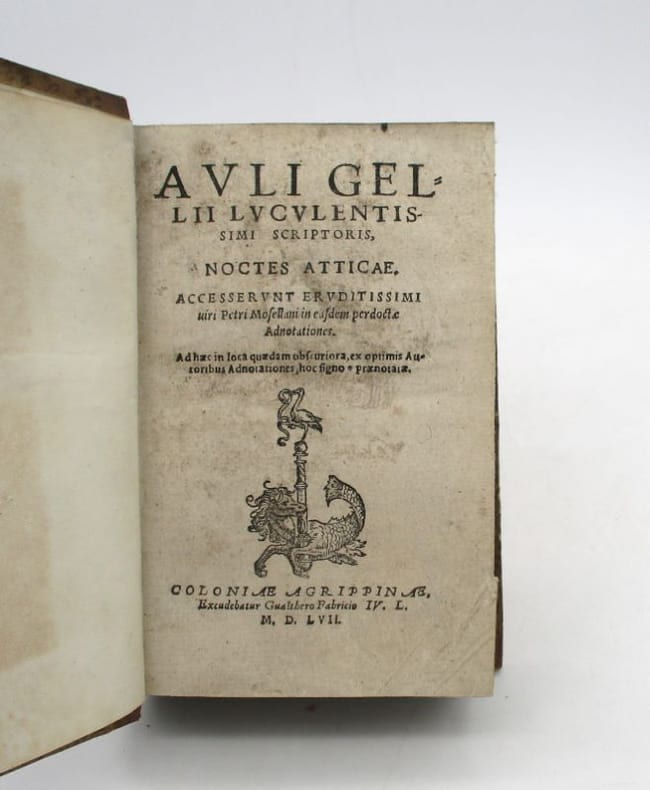
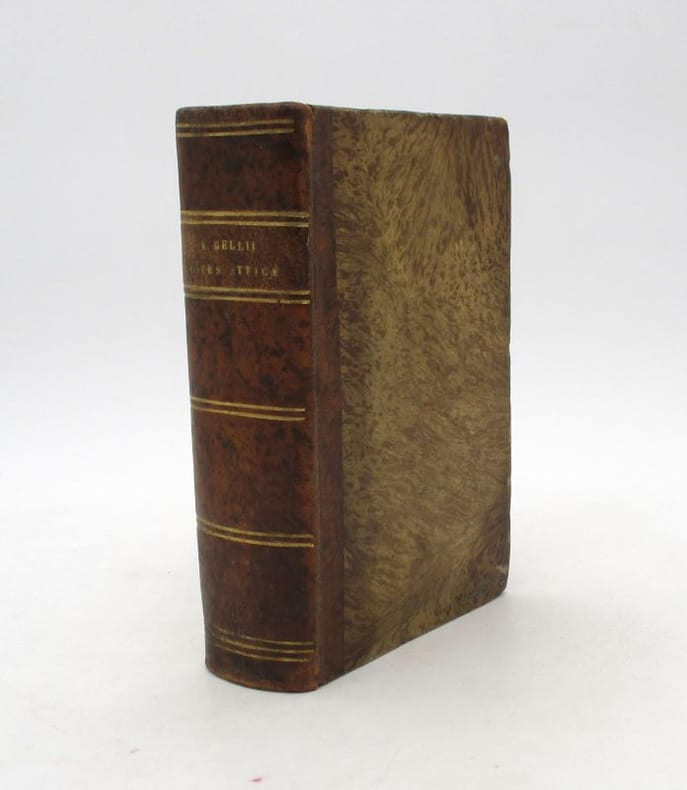
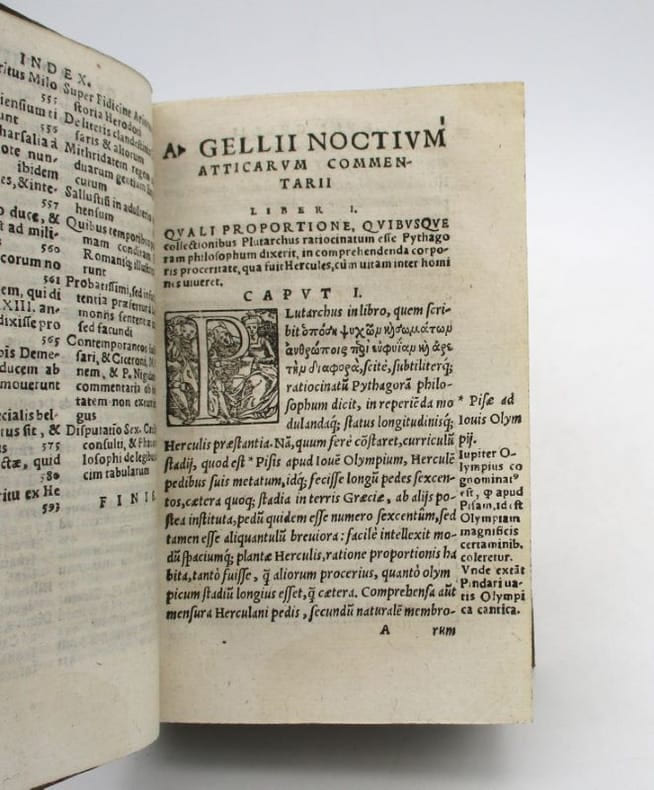
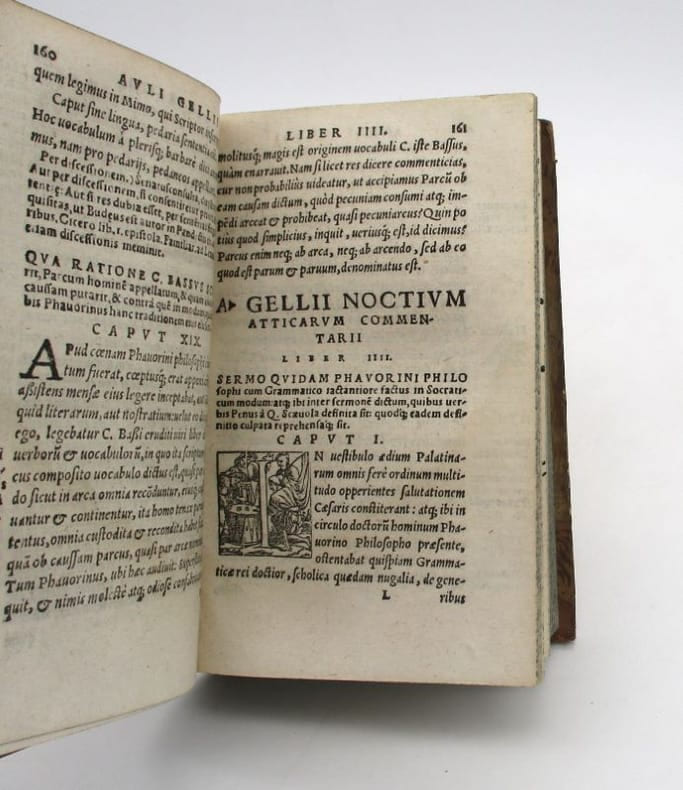
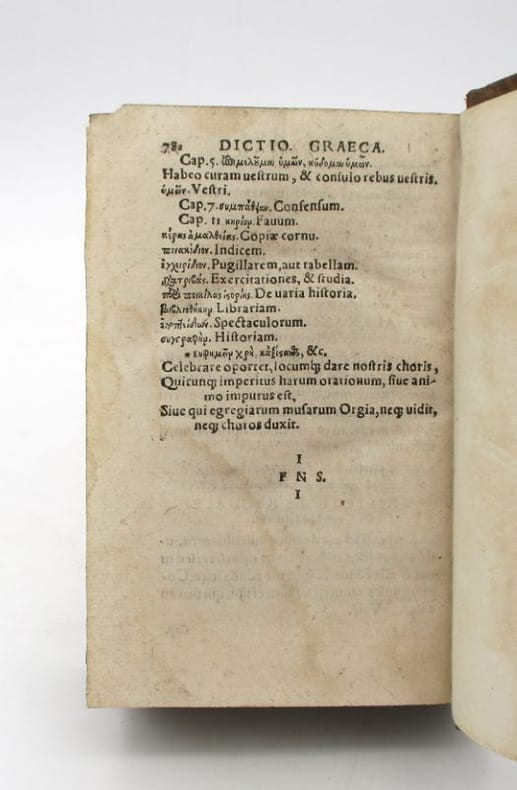
Cologne, Gualthero Fabricio, 1557. In-16, [48]-782 pp., demi-basane à coins marbrée havane postérieure, dos lisse ornée de filets dorés, tranches mouchetées de bleu (1 mors fendu, petites épidermures, quelques taches).
Reference : 19216
Nouvelle édition de cette compilation de textes antiques rassemblés vers le 2e siècle par Aulu-Gelle. Elle est composée de 20 livres dont le 8e est perdu, contenant de courts chapitres mettant en scènes des personnages illustres discutant de sujets des plus divers tels la littérature, les sciences, le droit ou encore l'histoire. En fin de volume se trouve un petit dictionnaire grec-latin. Voir photographie(s) / See picture(s) * Membre du SLAM et de la LILA / ILAB Member. La librairie est ouverte du lundi au vendredi de 14h à 19h. Merci de nous prévenir avant de passer,certains de nos livres étant entreposés dans une réserve.
Bookseller's contact details
L'Ancienne Librairie
M. Alban Caussé
3 Rue Pierre l'Ermite
75018 Paris
France
librairie.ancienne.paris@gmail.com
09 78 81 38 22
Payment mode


Sale conditions
conforme aux règles du SLAM
5 book(s) with the same title
Auli Gellii Noctes Atticae, seu Vigiliae Atticae, quas nunc primum a magno mendorum numero magnus veterum exemplarium numerus repurgavit. Henrici Stephani Noctes aliquot Parisinae, Atticis A. Gellii Noctibus seu Vigiliis invigilatae. Eiusdem H. Stephani annotationes in alios Gellii locos prodibunt cum notis Lud. Carrionis (qui vet. exemplaria contulit) prelo iam traditis.
Paris (Parisiis), (H. Stephanus), 1585. Cum privilegio Caesaris, et Gallorum regis in decennium.
8vo. (VI),23,(1 blank),587,(1 blank);(74 index),(2 blank),205,(3 blank) p. Vellum 18 cm (Ref: Renouard p. 450/51, 1585,2: 'édition rare et estimable', Schweiger 2,378; Brunet 1523/24; Graesse 3,46; Ebert 8284) (Details: 5 thongs laced through both joints. Short title on the back) (Condition: Vellum soiled and spotted, big red stain on the lower board. Occasional old ink underlinings & marginalia. Small and old inscription on the verso of the front flyleaf. A small reference written on the title. On the verso of the title a round red stamp. Upper corner of the last gatherings slightly waterstained. Paper somewhat yellowing) (Note: The Roman author Aulus Gellius, ca. 125-180 AD, was never counted as a major author in antiquity, nor later. His only work 'Noctes Atticae' or 'Attic Nights', is a miscellany that 'ranges from literature to law, from wondrous tales to moral philosophy; one of his favorite topics is the Latin language'. (...) The exposition, in a mildly archaizing but never difficult Latin, often takes the form of dialogues with or between culturally eminent persons whom Gellius had known'. It derives its name from the fact of its having been written during the long nights of a winter which the author spent in Attica as a young itinerant student. The Noctes Atticae were exploited by pagans and Christians alike in late antiquity. In medieval florilegia he is much quoted for piquant tales and moral sentiments. 'From Petrarch onward Gellius became a favorite author of the Renaissance'. 'More than 100 manuscripts were copied'. He was used as a valuable source of information on the Latin language, and had preserved numerous quotations from lost authors, which were presented with grace and elegance. Gellius became a model for the 'Miscellanea' of the Italian humanist Angelo Poliziano. 'In the 18th century, however, new canons of elegance caused his style to seem less attractive, and compilation sank to minor merit' (Quotations from 'The Classical Tradition', Cambr. Mass., 2010, p. 386/7) The notes of Louis Carrion, latinized as Ludovicus Carrio (Brugensis), ca. 1547-1595, which are promised on the title page, are lacking in this edition. Carrion had promised the Parisian scholar/publisher Henri Estienne II, ca. 1530-1598, to manufacture notes for his Gellius edition. Estienne printed the text of Gellius, and waited eight months. In the meantime Carrion delivered material for only 7 leaves. Tired of waiting Estienne published his Gellius, replacing Carrion's notes with work of his own: 'Noctes aliquot Parisinae'. Ultimately Carrion sent Estienne notes concerning the first 24 chapters of the first book only, together 120 pages. These notes Estienne thereupon published separately in the same year. Most copies are like ours, in only a few copies both works have been bound together. The 'Noctes Parisinae' are 27 in number, 7 of which are dedicated to Estienne's friend, the historian, politician and bookcollector Jacques Auguste de Thou, 1553-1617, who was in 1585 'maître des requêtes au parlement de Paris'. Estienne extols his friend 'for his erudition, and his extraordinary zeal for the collection of books: noticing the exquisite literary treasures in which his library abounds, his judgment in the selection of editions, his liberal disbursement in purchasing, and his profuse expenditure on binding and decoration'. (William Parr Greswell, 'A View of the Early Parisian Greek Press', London 1833, volume 2, p. 350) The 'Noctes Parisinae' opens with a defence of Gellius against attacks of the Spanish scholar Juan Luis Vives, who mentioned Gellius e.g. 'loquaculus sine eruditione'; and 'quae de significatu vocum disserit, sunt frivola, et plerumque imperita ac falsa'. (Opera, Basel 1555, Tom. I, p. 480/81)) (Provenance: In pencil on the front flyleaf: '15 sept. 1965', written by the Flemish linguist Walter Couvreur, 1914-1996, who was an Orientalist, and professor of Indoeuropean linguistics at the University of Gent. It indicates the date of aquisition. On the pastedown in the rear he wrote the place where he bought it: 'Leipzig, Zentralantiquariat, DDR'. On the verso of the title a red stamp: 'Ex Biblioth. Regia Berolinensi') (Collation: A-B8 (minus blank leaf B8), a-z8, A-R8, S4 (leaf S4 blank), A-N8 (a leaf signed A2 inserted as a kind of half title between leaf C1 and C2; leaf N7 verso and N8 blank) (Photographs on request)
Auli Gellii Noctes Atticae. Editio nova et prioribus omnibus docti hominis cura multo castigatior.
Amsterdam (Amstelodami), Apud Ludovicum Elzevirium, 1651.
12mo. (XLVIII),498,(122 index) p. 19th cent. marbled boards. 13 cm (Ref: Neue Pauly, Suppl. 2, p. 261; Willems 1127: 'Édition fort jolie et qui passe pour très correcte'; Berghman 2065 ; Rahir 1145; Graesse 3,46; Ebert 8287; Dibdin 1,340/41; Fabricius/Ernesti 3,10: 'emendatissima editio'; Schweiger 2,378: 'Neue, werthvolle Recens. nach Handschr. von Jo.Frd. Gronovius'; Brunet 2,1524: 'Jolie édition') (Details: 5 thongs laced through the joints; engraved title, depicting a learned writer at work under the light of an oil lamp) (Condition: Cover worn at the extremities; marbled paper on the back scuffed; lower corner of a few leaves vaguely waterstained; without the last two blank leaves. Paper somewhat yellowing) (Note: A favorite author of the Renaissance. The Latin author Aulus Gellius, ca. 125-180 AD, was never counted as a major author in antiquity, nor later. His only work 'Noctes Atticae' or 'Attic Nights', is a miscellany that 'ranges from literature to law, from wondrous tales to moral philosophy; one of his favorite topics is the Latin language'. (...) The exposition, in a mildly archaizing but never difficult Latin, often takes the form of dialogues with or between culturally eminent persons whom Gellius had known'. It derives its name from the fact of its having been written during the long nights of a winter which the author spent in Attica as a young itinerant student. The Noctes Atticae were exploited by pagans and Christians alike in late antiquity. In medieval florilegia he is much quoted for piquant tales and moral sentiments. 'From Petrarch onward Gellius became a favorite author of the Renaissance'. 'More than 100 manuscripts were copied'. He was used as a valuable source of information on the Latin language, and had preserved numerous quotations from lost authors, which were presented with grace and elegance. Gellius became a model for the 'Miscellanea' of the Italian humanist Angelo Poliziano. 'In the 18th century, however, new canons of elegance caused his style to seem less attractive, and compilation sank to minor merit' (Quotations from 'The Classical Tradition', Cambr. Mass., 2010, p. 386/7) The 20 books of the Noctes Atticae were ably edited 'cura docti hominis'. This learned editor was the Dutch classicist of German origin Johann Friedrich Gronov, or Gronovius, 1611-1671, He was the successor of Heinsius at the University of Leiden, and he was influenced by Vossius, Grotius, Heinsius & Scriverius. His editions mark an epoch in the study of Livy, of Seneca, Tacitus & Gellius. (Sandys, History of Classical Scholarship, 2,321) (Provenance: On the front pastedown in ink the name of 'Berend van Marle' or 'Barend van Marle', and in pencil the name of a collector of Elzeviers 'J. van Dijck') (Collation: * - 2*-12; A - 2C-12 (lacking the blanks 2C11 & 2C12) (Photographs on request)
Auli Gellii luculentissimi scriptoris Noctes Atticae.
Lyon (Lugduni), Apud Haered. Seb. Gryphii, 1560.
(LXIII)(I blank),533,(3 blank) p. Limp vellum 17 cm (Ref: Schweiger 378; Dibdin 1,340: 'beautiful and accurate edition, (..) deserving of the student's notice'; Moss 1,203; Graesse 3,46; Ebert 8283) (Details: Gryphius' woodcut printer's mark on the title, depicting a griffin, which mythological animal symbolizes courage, diligence, watchfulness, and rapidity of execution, used as a pun of his family name Gryph or Greif. From the claws of this creature hangs a big rectangular stone, beneath which is a winged orb. The motto is 'Virtute duce / comite fortuna', 'Virtue thy leader, fortune thy comrade', a quote from a letter of Cicero to Plancus (Epistulae ad Familiares, liber X,3). At the end a woodcut griffin. The text is printed completely in italics, except for the title) (Condition: Vellum shabby, wrinkled and showing some old repairs. Corners somewhat dog-eared at the end and beginning. Two old ownership inscriptions on the title, one on the front pastedown. Upper margin of the first gatherings and a number of gatherings halfway slightly waterstained. Front flyleaf removed. Paper yellowing. A few small ink stains on the edge of the bookblock) (Note: The Latin author Aulus Gellius, ca. 125-180 AD, was never counted as a major author in antiquity, nor later. His only work 'Noctes Atticae' or 'Attic Nights', is a miscellany that 'ranges from literature to law, from wondrous tales to moral philosophy; one of his favorite topics is the Latin language'. (...) The exposition, in a mildly archaizing but never difficult Latin, often takes the form of dialogues with or between culturally eminent persons whom Gellius had known'. It derives its name from the fact of its having been written during the long nights of a winter which the author spent in Attica as a young itinerant student. The Noctes Atticae were exploited by pagans and Christians alike in late antiquity. In medieval florilegia he is much quoted for piquant tales and moral sentiments. 'From Petrarch onward Gellius became a favorite author of the Renaissance'. 'More than 100 manuscripts were copied'. He was used as a valuable source of information on the Latin language, and had preserved numerous quotations from lost authors, which were presented with grace and elegance. Gellius became a model for the 'Miscellanea' of the Italian humanist Angelo Poliziano. 'In the 18th century, however, new canons of elegance caused his style to seem less attractive, and compilation sank to minor merit' (Quotations from 'The Classical Tradition', Cambr. Mass., 2010, p. 386/7) According to Graesse this 1560 edition of Gellius is a reissue of the edition of Badius Ascensius of 1532. If this is correct, than it was reissued without the preliminaries and the notes. Sebastianus Gryphius was an excellent Latin scholar himself, and the printer of a host of handy and relatively cheap editions of Latin authors. Gellius was for him a moneyspinner, for he published Gellius editions in 1537, 1539, 1546, 1559, 1560 & 1566) (Provenance: Provenance the Tuscan city Gallicano. The first ownership inscription below the imprint is very legible: 'Bartholomaei Landi Gallicanensis', probably a Bartolomeo Landi from Gallicano. The second name on the title is crossed out: '.... Johannis Mamanti Gallicanensis'. 'Johannis' and Gallicanensis' bear a contraction sign. The first name is illegible, it is also contracted and ends probably on '-bri' The inscription on the front pastedown is a problem: 'Di Prese (?) Gio. Mamanti da Gallicano'. Gallicano is a comune (municipality) in the Province of Lucca in the Italian region Tuscany, located about 70 kilometres northwest of Florence) (Collation: A-D8 (gathering C bound before B); a-z8, A-K8, L4 (leaf L3 verso printer's mark, leaf L4 blank) (Photographs on request)
Noctes Atticae. Preterea Petri Mosellani in easdem annotiationes.
Basel, Heinrich Petri, (1565). Kl.-8vo (150 x 120 mm). Mit Holzschnitt-Druckermarke auf Titel und Schlussblatt verso. 850 [recte 852] S., [22] Bl. Lederband des 18. Jhs. ber 5 erhabenen B nden (stark berieben, R cken stellenweise besch digt).
Basler Druck dieses usserst beliebten und viel gelesenen antiken Sammel- und Exzerptenwerks. Nach griechischem Vorbild im zweiten Jahrhundert von Aulus Gellius in langen Wintern chten auf dem Lande nahe bei Athen begonnen und daher Noctes Atticae genannt, ist es eine buntgemischte Sammlung von reizvollen Essays aus den verschiedensten Wissensgebieten, wie der Philosophie und Rechtsgelehrsamkeit, Medizin und Geographie, Geschichte und Literatur, ganz besonders aber auch aus der Grammatik. Der besondere Wert liegt darin, dass es manches kostbare St ck aus verlorenen Originalwerken der lteren r mischen Literatur beinhaltet. Mit der Widmung von Heinrich Petris Sohn Adam an seinen Lehrer in Nozeroi, Claude Frontin. - Durchgehend etwas gebr unt. VD 16 G-1044; Adams G-363; Schweiger II/1, 378; Hieronymus, Petri-Schwabe, 439.
Auli Gellii luculentissimi scriptoris Noctes Atticae
1565 Lugduni [Lyon] ; Haered Seb. Gryphii, 1565 - 1 volume petit In-12° 523 pages - Reliure d'epoque , velin , Dos à cnq nerfs , titre et date manuscrits au dos, parfait état . " Nuits Antiques "

