 Write to the booksellers
GELLIUS.
Auli Gellii luculentissimi scriptoris Noctes Atticae.
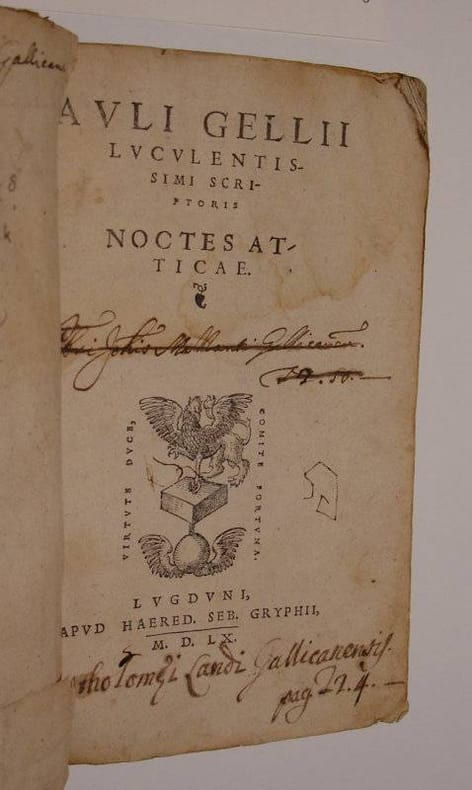
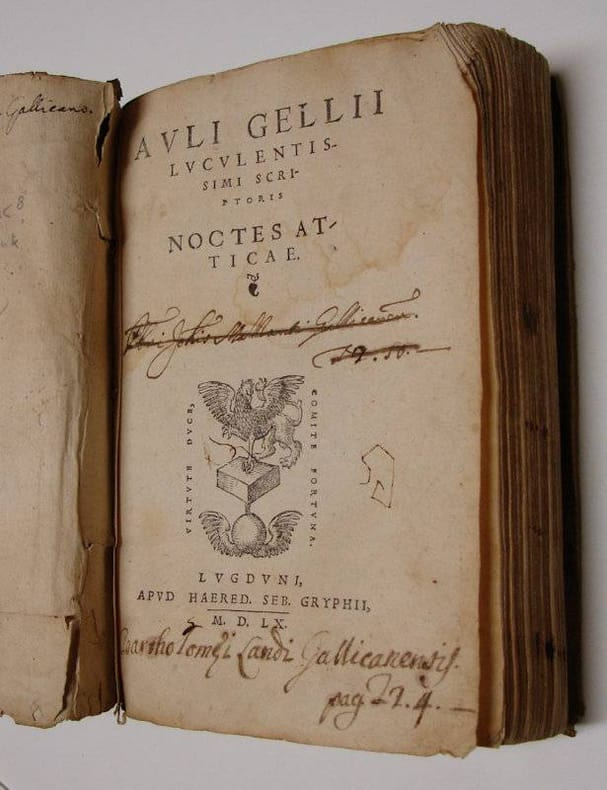
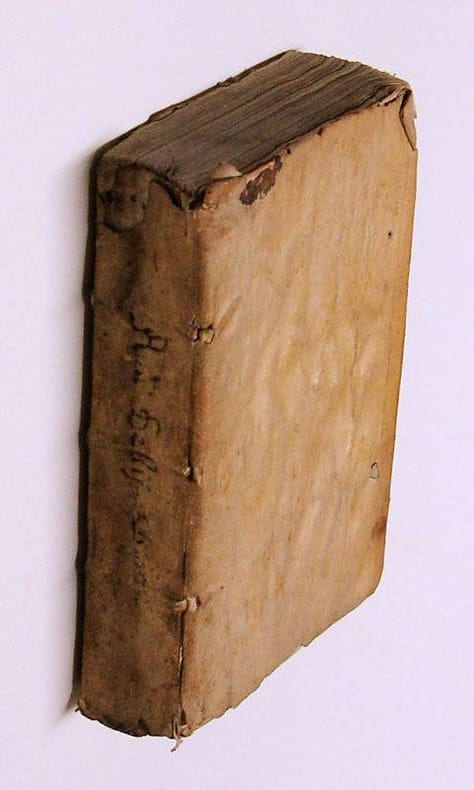
Lyon (Lugduni), Apud Haered. Seb. Gryphii, 1560.
Reference : 120130
(LXIII)(I blank),533,(3 blank) p. Limp vellum 17 cm (Ref: Schweiger 378; Dibdin 1,340: 'beautiful and accurate edition, (..) deserving of the student's notice'; Moss 1,203; Graesse 3,46; Ebert 8283) (Details: Gryphius' woodcut printer's mark on the title, depicting a griffin, which mythological animal symbolizes courage, diligence, watchfulness, and rapidity of execution, used as a pun of his family name Gryph or Greif. From the claws of this creature hangs a big rectangular stone, beneath which is a winged orb. The motto is 'Virtute duce / comite fortuna', 'Virtue thy leader, fortune thy comrade', a quote from a letter of Cicero to Plancus (Epistulae ad Familiares, liber X,3). At the end a woodcut griffin. The text is printed completely in italics, except for the title) (Condition: Vellum shabby, wrinkled and showing some old repairs. Corners somewhat dog-eared at the end and beginning. Two old ownership inscriptions on the title, one on the front pastedown. Upper margin of the first gatherings and a number of gatherings halfway slightly waterstained. Front flyleaf removed. Paper yellowing. A few small ink stains on the edge of the bookblock) (Note: The Latin author Aulus Gellius, ca. 125-180 AD, was never counted as a major author in antiquity, nor later. His only work 'Noctes Atticae' or 'Attic Nights', is a miscellany that 'ranges from literature to law, from wondrous tales to moral philosophy; one of his favorite topics is the Latin language'. (...) The exposition, in a mildly archaizing but never difficult Latin, often takes the form of dialogues with or between culturally eminent persons whom Gellius had known'. It derives its name from the fact of its having been written during the long nights of a winter which the author spent in Attica as a young itinerant student. The Noctes Atticae were exploited by pagans and Christians alike in late antiquity. In medieval florilegia he is much quoted for piquant tales and moral sentiments. 'From Petrarch onward Gellius became a favorite author of the Renaissance'. 'More than 100 manuscripts were copied'. He was used as a valuable source of information on the Latin language, and had preserved numerous quotations from lost authors, which were presented with grace and elegance. Gellius became a model for the 'Miscellanea' of the Italian humanist Angelo Poliziano. 'In the 18th century, however, new canons of elegance caused his style to seem less attractive, and compilation sank to minor merit' (Quotations from 'The Classical Tradition', Cambr. Mass., 2010, p. 386/7) According to Graesse this 1560 edition of Gellius is a reissue of the edition of Badius Ascensius of 1532. If this is correct, than it was reissued without the preliminaries and the notes. Sebastianus Gryphius was an excellent Latin scholar himself, and the printer of a host of handy and relatively cheap editions of Latin authors. Gellius was for him a moneyspinner, for he published Gellius editions in 1537, 1539, 1546, 1559, 1560 & 1566) (Provenance: Provenance the Tuscan city Gallicano. The first ownership inscription below the imprint is very legible: 'Bartholomaei Landi Gallicanensis', probably a Bartolomeo Landi from Gallicano. The second name on the title is crossed out: '.... Johannis Mamanti Gallicanensis'. 'Johannis' and Gallicanensis' bear a contraction sign. The first name is illegible, it is also contracted and ends probably on '-bri' The inscription on the front pastedown is a problem: 'Di Prese (?) Gio. Mamanti da Gallicano'. Gallicano is a comune (municipality) in the Province of Lucca in the Italian region Tuscany, located about 70 kilometres northwest of Florence) (Collation: A-D8 (gathering C bound before B); a-z8, A-K8, L4 (leaf L3 verso printer's mark, leaf L4 blank) (Photographs on request)
Bookseller's contact details
Antiquariaat Fragmenta Selecta
+31 20 418 55 65
Payment mode

Sale conditions
Terms of Sale All items offered are subject to prior sale. Your order will be final after you have received our confirmation, with a specification of the availability of the items and the shipping costs. All books are complete and in good antiquarian condition, unless otherwise described. Prices are in EURO. Postage and insurance are not included. Postage will be calculated at cost (no extra charges). Returns Books may be returned within 14 days of receipt, if returned in the same condition as sent, and packed, shipped and insured as received (please always notify us). We will refund the shipping costs of a return shipment only if our descriptions were not correct. How to pay Pre-payment is necessary for new customers. Our order confirmation will provide detailed information and a specification of the shipping costs. Customers who are known to us and libraries will be invoiced as usual. We accept Visa and Mastercard. You can submit your card information through our SECURE PAYMENT FORM. PayPal: we will send you a personal link to the PayPal website. Banktransfers: payment can be made into our bank account in The Netherlands.
1 book(s) with the same title
Auli Gellii luculentissimi scriptoris Noctes Atticae
1565 Lugduni [Lyon] ; Haered Seb. Gryphii, 1565 - 1 volume petit In-12° 523 pages - Reliure d'epoque , velin , Dos à cnq nerfs , titre et date manuscrits au dos, parfait état . " Nuits Antiques "

