 Write to the booksellers
-
Latest
Last month (126)
Last week (9)
-
Century
16th (1)
17th (9)
18th (55)
19th (100)
20th (630)
21st (143)
-
Countries
Belgium (260)
Brazil (2)
Denmark (229)
France (481)
Netherlands (145)
Switzerland (16)
-
Syndicate
ILAB (408)
NVVA (145)
SLAM (168)
The Reconstruction of Western Europe 1945-51 (University Paperbacks)
Routledge 1987 550 pages 15 4x3x22 8cm. 1987. Broché. 550 pages.



proche du très bon état intérieur propre tranche légèrement ternie
Theories of Organizational Structure and Process
Thomson Learning 1982 480 pages 16 69x23 19x2 82cm. 1982. Cartonné. 480 pages.


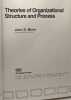
bon état bonne tenue quelques rousseurs sur la tranche intérieur propre
Fragmented Societies: A Sociology of Economic Life Beyond the Market Paradigm (Studies in Urban and Social Change Vol. 1)
Blackwell Publishers 1991 432 pages 4x23x16cm. 1991. Cartonné jaquette. 432 pages.

Très bon état
Stabilizing an Unstable Economy
McGraw hill 2008 432 pages 15 9x23 5x2 9cm. 2008. Cartonné jaquette. 432 pages.
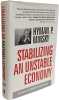
Très bon état
CAN IT HAPPEN AGAIN: Essays on Instability and Finance
M E SHARPE INC 1982 301 pages 22 606x2 286x14 732cm. 1982. Broché. 301 pages. Ce recueil d'essais présente les théories économiques de Hyman Minsky sur l'instabilité financière endogène du capitalisme. L'auteur analyse la crise de 1933 et la quasi-crise de 2008 en examinant si de tels effondrements peuvent se reproduire et en soulignant le rôle de la politique fiscale pour les prévenir

proche du neuf
The Debate Over Stabilization Policy (Raffaele Mattioli Lectures)
Cambridge University Press 1986 284 pages in8. 1986. Cartonné jaquette. 284 pages.


Comme neuf avec sa jaquette intérieur propre bonne tenue
The Gifts of Athena: Historical Origins of the Knowledge Economy
University Press Group 2004 378 pages 15 8x23 6x3cm. 2004. Broché. 378 pages. Derek Bok examine de manière approfondie la commercialisation croissante des universités en analysant comment les établissements d'enseignement supérieur cherchent à tirer profit financièrement non seulement des programmes sportifs mais aussi de l'enseignement et de la recherche. L'ouvrage explore les limites éthiques de cette tendance et questionne où commence la pente glissante de la marchandisation


proche du neuf
Florentine Public Finance in the Early Renaissance 1400-1433 (Harvard Historical Monographs 65)
Harvard university press 1971 256 pages 14 55x2 77x20 37cm. 1971. Cartonné jaquette. 256 pages.
Très Bon état dos insolé intérieur propre bonne tenue
Considérations sur l'organisation sociale, appliquées à l'état civil, politique et militaire de la France et de l'Angleterre; à leurs moeurs, leur agriculture, leur commerce et leurs finances, à l'époque de la paix d'Amiens.
Paris, Chez Migneret, 1802. 3 volumes. x (misnumbered xii), 349, (1) pp.; (4), 322, (2) pp.; (4), 335, (1) pp. 8vo. Contemporary tree calf, spines gilt in compartments, red label and gilt lettering, gilt ornamental border on sides. Kress B.4568; INED 3230bis; not in Goldsmiths; not in Einaudi. First edition. The first volume deals with political science; volume two with population and economics, the colonies and slavery, agriculture and commerce; the third volume deals with finances, mendicity and prisons. The work was published on the occassion of the peace of Amiens with the hope of establishing a rapprochement between France and England. It is interesting to note that the absence of a commercial agreement with the peace of Amiens is considered to be one of the causes of its failure within little more than a year and that Mondénard deals with the subject of economics and commerce in relation to the peace of Amiens (see: Coquelin & Guillaumin, vol. 2, p. 199, and the Historical Dictionary of Napoleonic France, 1799-1815, p. 16).'Ouvrage principal de Mondénard. Celui-ci, émigré en Angleterre, le publia anonymement à son retour. Conservateur, farouche défenseur de la propriété et de la grande culture, il s'en prend aux excès de la Révolution mais accepte quelques-uns de ses principes. Idées justes, notamment sur les rapports entre la machine et l'emploi' (INED). - Some scribbling on half-title of first volume, handwritten name and date on title of first volume.


(NVVA, )
Phone number : 31 20 698 13 75
Histoire du Libre-échange en Angleterre
in 12 broché,titre,188 pages 4 pages de catalogue Germer-Baillière & Cie (1883) édition originale de la traduction française par GRAVEZ.Bibliothèque utile LXXIX.rousseurs sinon très bon état

Rapport fait à l'Assemblée nationale au nom du comité des finances. Le 18 novembre 1789. Paris, Baudouin, 1789. With 7 tables (nrs 5-7 on 8 separate pages) - (Bound with:) MONTESQUIOU-(FEZENSAC, A.P.) de. Rapport fait au nom du comité des finances, à la séance du 12 mars 1790, sur le Mémoire de M. le premier ministre des finances, du 6 du même mois. (Drop-head title). Paris, Imprimerie nationale, (1790). - (Bound with:) MONTESQUIOU-(FEZENSAC, A.P.) de. Rapport sur la dette publique, fait à l'Assemblée nationale au nom du comité des finances. Le 27 août 1790.
Paris, Imprimerie nationale, 1790. Together 3 pieces bound in 1 volume. (2), 63, (1) pp.; 28 pp.; (2), 20 pp. 4to. Modern boards. First work: Not in Kress (cf.: B.1606); not in Goldsmiths; not in Einaudi; not in INED; Martin & Walter 24968; Stourm, p. 162: 'Grand rapport souvent cité. Exposé général de la situation. Enumération des dettes du pays, spécialement des dettes 'criarde'. Recettes et dépenses annuelles. Nouvelle contribution des privillégies évaluée à 30 millions. Gestion des biens du clergé. Besoins extraordinaires'. - First pages with a few spots.Second work: Not in Kress; not in Goldsmiths; not in Einaudi; not in INED; Martin & Walter 24971; Stourm, p. 163: 'Important étude de la situation financière'. Stourm knows an 8vo edition only. Third work: Not in Kress; not in Goldsmiths; not in Einaudi; not in INED; Martin & Walter 24972; Stourm, p. 163: 'Les origines de la dette actuelle sont entachées de faillites. Tableaux des capitaux exigibles et de leurs intérêts'. All first editions. Anne-Pierre, Marquis de Montesquiou-Fezensac (1739-1798), writer and general. In April 1792 he was promoted to lieutenant-general and a month later was dispatched to the marquis de Lafayette's army. A year later Dumouriez selected him as commander for the Armée du Midi. With this army he crossed the Italian frontier to Savoy. A dispute with the Convention led to the accusation of compromising the Republic's dignity, and choosing not to face a trial, Montesquiou withdrew to the canton of Zürich where he remained until after 9 Thermidor. In 1797 he returned to France a became a member of the Constitutional Circle, which opposed the Clichyens, a right-wing political grouping (Historical Dictionary of the French Revolution, 1789-1799, ii, pp. 676-677.)
(NVVA, )
Phone number : 31 20 698 13 75
L'économie du Brésil
Bréal 2019 141 pages 11 8x17 8x1 2cm. 2019. Broché. 141 pages.

Très bon état
MORET (Marie). Documents pour une biographie de Jean-Baptiste André Godin 1910
MORET (Marie). Documents pour une biographie complète de Jean-Baptiste André Godin rassemblés par sa veuve, née Marie Moret. Troisième volume précédé d'une biographie de l'auteur par sa sœur, Mme E. Dallet. Suite du travail dont les chapitres antérieurs, constituant deux volumes, en tirage à part, ont été publiés dans la revue mensuelle Le Devoir, de février 1897 à decembre 1906. Familistère de Guise (1910). 1 volume in-8 de XXIII+574 pages, frontispice, reliure en demi-basane, dos à nerfs (dos légèrement frotté, pages jaunies). Ce troisième volume, complet en lui-même, présente un essai de représentation du travail dans le gouvernement de l'industrie, de l'habitation unitaire et des service collectifs 1877-1879. On trouvera en appendices : Relevé par ordre chronologique de 73 propositions industrielles au sein des Groupes, Unions ou Conseils - Le Testament de J.-B. A. Godin, ainsi qu'une liste des principaux ouvrages de Godin, de sa femme et sur le Familistère. Rare. [1]



Suivre le courant et découvrir l'essentiel de la vie
Dauphin blanc 2012 262 pages 15x23x2cm. 2012. Broché. 262 pages.

Très bon état - livre issu de destockage - pouvant présenter d'infimes traces de stockage - Expédié soigneusement dans emballage adapté
The Economic Theory of Modern Society
Cambridge University Press 2010 360 pages 15 2x2 6x23cm. 2010. Broché. 360 pages.


Très bon état
Tables for Renewing and Purchasing of Leases. As also for Renewing and Purchasing of Lives. With other Necessary Tables for Computing of Interest, either Simple or Compound + Tables of Simple Interest, Exactly Computed For 1 to 12 Months, and For 1 Da... - [AGE-RELATED RENT AND LEASING]
London, J. Brotherton, 1735. 12mo. Bound in one beautiful contemporary full mottled calf binding with four raised bands and red title-label with gilt lettering to spine. Single gilt line-border to boards, inside which a lovely blindstamped ornamental border to one side. All edges of boards with blindstamped ornamentations. P. 1 has a contemporary neat inscription reading: ""Exam.d Morris"" - in the author's own hand? Macclesfield copy, with the armorial bookplate of Earls of Macclesfield to pasted down front end-paper and Shirburn Castle (seat of the Earls of Macclesfield) armorial blindstamp to first four leaves Ex-libris. A lovely, clean, and crisp copy. IV, 48 + (2), 92 pp.
Exceedingly scarce first edition of Morris' book of tables for renewing and purchasing leases in relation to age, being the most accurate and comprehensive list of tables published at the time. The work was considered controversial due to the proposed fall in rent in relation to age, which was seen as a discrimination against young people"" a concept which today has been implemented in virtually all aspects of banking and insurance. ""As late as 1735, Gael Morris, a writer of commercial manuals on annuities and leases, explained that annuities could frequently be purchased cheaper on lives aged between 30 and 40 than on lives under 25 because 'the Hazards of Persons between 15 and 25 are so many' - a conclusion making some intuitive sense but strictly at odds with the lessons taught by Halley's table. There seems to have existed, in short, a deep reluctance to embrace the discovery that the value of annuities and land leases made for the duration of a life (or lives) varied predictably with the age(s) of the lessee(s)."" (Clark, Betting On Lives: The Culture of Life Insurance in England, 1695-1775, p. 116).Gael Morris worked as a mathematician and astronomer and was the assistant of British astronomer James Bradley for several years, where he helped to compute tables of planetary orbits.The work is of the utmost scarcity, with only five copies listed on OCLC (two in the US) and merely one copy listed at auction within the last 40 years (being this copy). Goldsmith: 7269.Hanson: 4767Macclesfield: 1455
Joseph A. Schumpeter, historian of Economics. Perspectives on the History of Economic Thought
London-New York, Routledge 1996 xi + 324pp., 24cm., publisher's hardcover, handwritten publishing date on title page, else in very good condition, ISBN 0-415-13353-X, E100947
Perspectives on Public Choice: A Handbook
Cambridge University Press 1997 692 pages 22 8x4 4x14 6cm. 1997. Broché. 692 pages. Ce manuel édité par Dennis C. Mueller présente une synthèse des principales idées et contributions du champ de la 'public choice' (choix public) une approche de l'étude du comportement politique qui s'appuie sur des modèles où des individus rationnels cherchent à faire avancer leurs propres intérêts. L'ouvrage est structuré en cinq parties et couvre notamment l'analyse formelle du vote et de l'agrégation des préférences

Très bon état
Public Choice II: A Revised Edition of Public Choice (Cambridge Surveys of Economic Literature)
Cambridge University Press 1989 544 pages 15 19x2 64x22 68cm. 1989. Broché. 544 pages. Public Choice III est une édition révisée et considérablement élargie de Public Choice II (1989). Six nouveaux chapitres ont été ajoutés et plusieurs chapitres de l'édition précédente ont été largement révisés avec une expansion significative de la discussion sur les travaux empiriques en choix public. L'ouvrage couvre tous les principaux thèmes du choix public et se veut plus accessible que les éditions précédentes

Très bon état
La politique corporative - Essais d'organisation corporative
s.l., Rex 1935 223pp., br.orig., dans la série "Collection d'"études de doctrine politique catholique", cachet, bon état, G41121
Notes d'économie politique [2 tomes] 1e série: Production, répartition, problèmes sociaux & 2e série: La circulation et la distribution des biens
Anvers/ Paris, Institut supérieur de Commerce St.Ignace/ Spes 1938 519 + 504pp., br.orig., 1e éd.(vol.2) & 3e éd.(vol.I), pour la plupart non coupé, 26cm., bon état
Accountability and Accounting: An Introduction to the Study of Accountancy
Nelson Thornes Ltd 1971 128 pages in8. 1971. Broché. 128 pages.


Bon état bonne tenue intérieur propre très rares notes au stylo noir au début du livre
Initiation à la théorie économique
Paris, P.U.F. 1943 xvi + 300pp., dans la série "Theoria. Etudes sur la théorie moderne de l'économie", br.orig., 23cm., bon état
An American Dilemma. The Negro Problem and Modern Democracy. With the Assistance of Richard Sterner and Arnold Rose. 2 Vols. - [LANDMARK WORK ON RACIAL DISCRIMINATION]
New York & London, Harper & Brothers Publishers, (1944). Royal 8vo. Both volumes in the orig. full cloth bindings. Some wear to capitals and spines a bit soiled. Magazine pictures of Gunnar and Alva Myrdal pasted on to front free end-paper. Internally nice and clean, apart from traces of old paper-clipsto front free end-paper and title-page of volume one. LV, (1), 705, (1) pp" XII pp. pp. (706) - 1483.
First edition of this epoch-making study of race-relations in America.In the early 1940'ies the Swedish Nobel Prize winner for Economics (1974), Gunnar Myrdal (1898-1987) was funded by the Carnegie Foundation to map out the problems that African-Americans had to face in order to fully participate in the American society at the time. This resulted in an enormous and very detailed work, for which Myrdal is famous today. It immediately became very popular, and it sold more than 100.000 copies (25 printings of the first edition appeared) before the second edition appeared in 1965. Several other editions and extracts in other publications appeared before 1965. Nine issues of the work appeared within the first year.The work had an enormous direct effect on the general view on racial issues in America, and it must be said to have paved the way for what we now consider natural policies of racial integration and affirmative action. The view that underlies this landmark work is that democracy will triumph over racism. The effects of this work are difficult to underestimate, and it not only changed the view on racial issues in America, it also directly influenced the US Supreme Court in 1954 to outlaw racial segregation in public schools (Brown versus Board of Education). In 1950 Myrdal was a signatory of the UNESCO statement ""The Race Question"".Assarsson-Rizzi and Bohrn: Gunnar Myrdal. A Bibliography, 1919-1981: No. 127a.
An American Dilemma. The Negro Problem and Modern Democracy. With the Assistance of Richard Sterner and Arnold Rose. - [DEMOCRACY WILL TRIUMPH OVER RACISM]
New York & London, Harper & Brothers Publishers, (1944). Royal 8vo. Orig. full green cloth w. gilt lettering to spine. Some soiling and wear to binding. Internally fine. LIX, (1), 1483 pp.
First edition of this epoch-making study of race-relations in America. The first edition appeared in both one volume and in two volumes. This is the one-volume edition. In the early 1940'ies the Swedish Nobel Prize winner for Economics (1974), Gunnar Myrdal (1898-1987) was funded by the Carnegie Foundation to map out the problems that African-Americans had to face in order to fully participate in the American society at the time. This resulted in an enormous and very detailed work, for which Myrdal is famous today. It immediately became very popular, and it sold more than 100.000 copies (25 printings of the first edition appeared) before the second edition appeared in 1965. Several other editions and extracts in other publications appeared before 1965. Nine issues of the work appeard within the first year.The work had an enormous direct effect on the general view on racial issues in America, and it must be said to have paved the way for what we now consider natural policies of racial integration and affirmative action. The view that underlies this landmark work is that democracy will triumph over racism. The effects of this work are difficult to underestimate, and it not only changed the view on racial issues in America, it also directly influenced the US Supreme Court in 1954 to outlaw racial segregation in public schools (Brown versus Board of Education). In 1950 Myrdal was a signatory of the UNESCO statement ""The Race Question"".Assarsson-Rizzi and Bohrn: Gunnar Myrdal. A Bibliography, 1919-1981: No. 127a.

