 Write to the booksellers
-
Type
Art print (2)
Autograph (4)
Book (33660)
Magazine (146)
Manuscript (3)
Maps (1)
Photographs (8)
-
Latest
Last 24h (1)
Last 3 days (14)
Last month (191)
Last week (111)
-
Language
Chinese (1)
Dutch (3)
English (108)
French (33572)
German (9)
Greek (1)
Italian (112)
Japanese (1)
Latin (5)
Polish (1)
Portuguese (4)
Russian (3)
Spanish (3)
Swedish (1)
-
Century
16th (32)
17th (77)
18th (570)
19th (4302)
20th (11263)
21st (1705)
-
Countries
Belgium (7839)
Brazil (14)
Canada (11)
Côte d'Ivoire (35)
Denmark (146)
France (24513)
Germany (9)
Greece (3)
Netherlands (1)
Switzerland (1253)
-
Syndicate
ALAC (11)
CLAM (15)
CLAQ (3)
CNE (19)
ILAB (13900)
NVVA (532)
SLACES (531)
SLAM (13117)
SNCAO (64)
Fonctions spéciales à l'usage des chercheurs et ingénieurs. Traduit par G. Fieschi.
P., Dunod, 1971, in 8° broché, XVI-248 pages ; traces de ruban adhésif sur les gardes.
PHOTOS SUR DEMANDE. ...................... Photos sur demande ...................


Phone number : 04 77 32 63 69
Dictionnaire historique et artistique de la Rose, contenant un résumé de l'histoire de la rose chez tous les peuples anciens et modernes, ses propriétés, ses vertus, etc.
Melun, E. Drosne, 1896. In-8, (6)-207-(1) pp., reliure moderne demi-veau cerise à coins, couverture conservée (mouillure marginale sur les deux premières pages, sinon bel exemplaire).
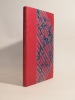
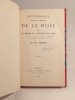
* Voir photographie(s) / See picture(s). * Membre du SLAM et de la LILA / ILAB Member. La librairie est ouverte du lundi au vendredi de 14h à 19h. Merci de nous prévenir avant de passer,certains de nos livres étant entreposés dans une réserve.
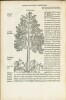
DE ARBORIBUS CONIFERIS.
P., Apud Gulielmum Cavellat, 1553. In-4 de (8) ff., 32 ff.; 8 gravures sur bois. Vélin moucheté, dos à nerfs orné, tranches rouges. Reliure de l’époque. 230 x 157 mm. EDITION ORIGINALE DE L’UN DES TOUS PREMIERS TRAITES SUR LES CONIFERES ILLUSTRE DE JOLIES GRAVURES SUR BOIS, œuvre de Pierre Belon, naturaliste et médecin français (Cérans, Sarthe, 1517- Paris 1564). First edition. The first work on coniferous trees and one of the first botanical books to cover a single species. Belon was the first to name all cone-bearing trees 'coniferae' a term which was followed by Gesner. Descriptions are given of the various species, including their locations, and he cites authorities such as Dioscorides. The work contains illustrations of Cedrus major, Picæ arboris figura, Pinus, Icon Pinastri, Laricis figura, Sapini arboris delineatio, Abies foemina, and Cupressus. Pierre Belon (1517-1564) was one of the most orginal naturalist of the Renaissance. "He was one of the first explorer-naturalists and between 1546 and 1550 he undertook long voyages through Greece, Asia, Judaea, Egypt, Arabia and other foreign countries. He looked at the world as an analyst devoted to detail. He succeeded in winning the confidence of the great and was famous during his lifetime" (DSB). The woodcuts are excellent. Ce précieux volume est précédé d’une autre édition originale très rare de Pierre Belon sur les antiquités égyptiennes : « De admirabili operum antiquorum et rerum suspicendarum praestantia liber primus. De medicato funere, seu cadavere condito & lugubri defunctorum eilatione. Liber secundus. De medicamentis nonnullis. servandi cadaveris vim obtinentibus. Liber tertius Ad rever, & illustriss D. Fran. Gard. Turnonium, Parisiis, 1553 », in-4 de 8 ff., 54 ff. et 4 ff. Ce curieux ouvrage traite des différentes cérémonies funéraires des anciens et des modernes, de l'embaumement des corps, de l'usage de la "momie" comme médicament, et de divers autres médicaments ou substances (cèdre, "naphta", nitre.) Il explique l'utilisation du bitume que les anciens Egyptiens utilisaient pour la momification des cadavres. Son action contre la putréfaction a incité les médecins à l'utiliser en thérapeutique. Apothicaire du Cardinal de Tournon, Pierre Belon a voyagé de 1546 à 1550 en Grèce, en Turquie, en Egypte, en Judée et en Arabie. Il en rapporta un grand nombre d'observations sur l'histoire naturelle. EXEMPLAIRE CONSERVE DANS SA RELIURE DE L’EPOQUE.
[ Aux Editions du Cercle D'Art] - BELON DU MANS, Pierre ; [ NORGE, Geo ]
Reference : 59851
(1942)
Portraits d'Oyseaux enrichys de quatrains pour plus facile cognoissance
Un des 125 exemplaires sur papier d'Arches numérotés (n°75), 1 vol. in-8 br. sous couv. rempliée, Chez Guillaume Cavellat, à l'enseigne de La Poulle Grasse, Paris, 1557, [ Aux Editions du Cercle D'Art, à Bruxelles, 1942 ], 59 pp.
![Portraits d'Oyseaux enrichys de quatrains pour plus facile cognoissance. BELON DU MANS, Pierre ; [ NORGE, Geo ]](https://static.livre-rare-book.com/pictures/CDL/59851_thumb.jpg)
![Portraits d'Oyseaux enrichys de quatrains pour plus facile cognoissance. BELON DU MANS, Pierre ; [ NORGE, Geo ]](https://static.livre-rare-book.com/pictures/CDL/59851_2_thumb.jpg)
![Portraits d'Oyseaux enrichys de quatrains pour plus facile cognoissance. BELON DU MANS, Pierre ; [ NORGE, Geo ]](https://static.livre-rare-book.com/pictures/CDL/59851_3_thumb.jpg)
Etat très satisfaisant (couv. lég. frottée avec petit accroc à un mors) pour cette charmante réimpression partielle en fac-similé, tirée à petit nombre. La préface est de Geo Norge (Georges Mogin).
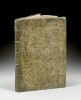
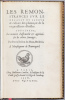
LES REMONSTRANCES SUR LE DEFAULT DU LABOUR & CULTURE DES PLANTES, & de la cognoissance d’icelles. Contenant, La manière d’affranchir & apprivoiser les arbres sauvages.
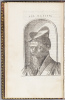
Paris, Cavellat, 1558. Petit in-8 de (20) et 80 ff. Maroquin bleu, plats entièrement ornés de filets dorés et motifs à froid, dos à faux nerfs richement orné, coupes décorées, roulette intérieure dorée, tranches dorées. Reliure de Simier, relieur du Roi. 170 x 105 mm. “The exceedingly rare first edition of Belon’s last work”. Pritzel, 609. « Ces remonstrances dans le domaine agricole offrent un grand nombre d’observations utiles » (Michaud). « La traduction latine par Clusius (de l’Ecluse) a été imprimée à Anvers, chez Chr. Plantin,1589, in-8. On trouve au verso de la table des sommaires le portrait de Belon, gravé sur bois » (Brunet, I, 761). Le présent ouvrage qui traite de l’agriculture fut traduit en latin pat de Lécluse sous le titre de Neglecta stirpium Cultura, etc , Anvers, Plantin, 1589, in-8, et Belon le réunit aux Observations, dont il publia aussi une édition latine à Anvers, 1605., in fol, accompagné du portrait de l’auteur. Ces Remontrances offrent un grand nombre d’observations utiles. Il y provoque l’établissement d’une pépinière d’arbres étrangers dont il donne la liste ; il engage le collège des médecins de Paris à cultiver dans un lieu public, « tant pour leur délectation que pour l’augmentation du savoir des doctes » diverses espèces de plantes ; idée adoptée ensuite par Richer de Belleval, qui fonda à Montpellier, le jardin des Plantes, antérieur à celui de la capitale. Le plan de Belon, en partie réalisé par l’évêque du Mans, René du Bellay, dans ses jardins de Tourvoye, fut recommandé à Henri II par le cardinal de Lorraine, mais le mauvais état des finances ne permit pas son exécution. Edition partagée par Guillaume Cavellat et Gilles Corrozet : l'exemplaire est conforme à celui de la BNF, avec, aux lignes 7 et 8 du titre : « La manière d'affranchir & apprivoiser les arbres sauvages". On trouve au verso du huitième feuillet liminaire un portrait gravé sur bois représentant Pierre Belon à l'âge de 36 ans. Ce portrait ornait déjà les Observations de plusieurs singularitez publiées en 1554 par les mêmes Cavellat et Corrozet ; d'après Albert Ohl Des Marais, il est l'œuvre du graveur lorrain Claude Wœiriot (cf. Renouard). SUPERBE EXEMPLAIRE D’UNE EDITION ORIGINALE DEVENUE INTROUVABLE, REVETU D’UNE EBLOUISSANTE RELIURE DE SIMIER, RELIEUR DU ROI.

INTRODUCTION A LA MECANIQUE STATISTIQUE / COLLECTION GRENOBLE SCIENCES.
PUG. 1992. In-4. Broché. Bon état, Couv. convenable, Dos satisfaisant, Intérieur frais. 301 pages illustrées de nombreuses figures dans le texte - Nombreuses annotations au crayon a papier et stylo rouge sur la page de garde et page de titre - Nombreux soulignements dans le texte au stylo rouge et crayon a papier dans le texte.. . . . Classification Dewey : 500-SCIENCES DE LA NATURE ET MATHEMATIQUES
Classification Dewey : 500-SCIENCES DE LA NATURE ET MATHEMATIQUES
Le soleil des vivants.
Bruxelles, H. Dessain, 1986 19 x 24, 388 pp., quelques illustrations, broché, très bon état.
Alimentation et morphologie. La révolution alimentaire actuelle, ses conséquences biologiques
vigot ,1936, in-8 de 192 pages ,ill. in-t., ,br. couv. illustrée ,Bon état , .(3 photos du livre sur mon site https://www.vieuxlivre.fr) .Les frais de port pour la France sont offerts à partir de 25 euros d'achat (Mondial relay ). (colissimo suivi +6,90 ).
LES YEUX OUVERTS SUR LA NATURE
Hachette. 1972. In-4. Relié. Etat d'usage, Coins frottés, Dos abîmé, Intérieur bon état. 91 pages. Couverture illustrée de photos en couleur. Photo en couleur en page de titre. Illustré de nombreuses photos en couleur. Scotch sur le dos. Dos se détachant.. . . . Classification Dewey : 500-SCIENCES DE LA NATURE ET MATHEMATIQUES
Jeunesse 2000. Classification Dewey : 500-SCIENCES DE LA NATURE ET MATHEMATIQUES
Cours élémentaire de Géologie.
Paris Félix Alcan, éditeur. 1894 228p 1 volume IN16.Percaline éditeur.Ouvrage orné de 279 gravures dans le texte et d'une carte coloriée.
Time, Space, and Narrative in Medieval Icelandic Literature
, Brepols, 2026 Hardback, 372 p., 156 x 234 mm, Illustrations:6 b/w, 22 col., 5 tables b/w., Language(s):English. *New . ISBN 9782503612232.
From the twelfth to the fourteenth centuries, Icelanders were responsible for a vast output of literature, extending well beyond the Sagas of Icelanders for which they are most well-known. These varied widely in style and subject, composed in different contexts by different members of society for differing purposes. Time and space formed central thematic and structural pillars in many of these texts as they explored the profound effects wrought on their society over time and reconciled their peripheral position in relation to the world?s perceived Mediterranean centre. How did these medieval Icelandic authors understand time and space? How did they portray, employ, and manipulate these concepts in order to craft their narratives? By bringing together genre-spanning articles from a broad range of Norse scholars, this collection offers a comprehensive treatment of these questions. Exploring genres ranging from the Sagas of Icelanders to hagiography and from Eddic poetry to ecclesiastical history, the contributions gathered here apply varied theoretical frameworks, digital methodologies, and episodic analyses to draw new conclusions and shed new light on this intriguing corpus.
BENARD (Karine), VAN HOLLEBEKE (Michèle), ZANETTI (Amélie)
Reference : 529141
ISBN : 285900078x
Les sources de l'information scientifique & technique. Environnement, médecine, énergie, agroalimentaire, biologie, informatique...
P., CFPJ, 1993. In-12 carré broché, 447 pp., index. (Les guides du CFPJ).
Très bonne condition. - Frais de port : -France 5,7 € -U.E. 8 € -Monde (z B : 12 €) (z C : 22 €)
BENCHEIKH Jamel Eddine; BREMOND Claude; MIQUEL André
Reference : 31436
ISBN : 2070721760
MILLE ET UN CONTES DE LA NUIT
Paris N.R.F Gallimard 1991 in 8 (22,5x14) 1 volume broché, couverture imprimée, 366 pages [2]. Collection '' Bibliothèque des idées ''. Très bel exemplaire ( Photographies sur demande / We can send pictures of this book on simple request )
Très bon Broché
La fin de l'éternel
1977, nrf Gallimard, in-8 broché de 162 pages, la fin de l'éternel | Etat : couverture un peu défraîchie, accroc sur le dernier plat, annotations au crayon (Ref.: ref88568)
nrf Gallimard
Mon ami l'électron. L'électronique racontée aux enfants. Adapté de l'américain par Michel Deutsch, directeur d'études à l'Ecole alsacienne. Illustrations de Joop Van Couwelaar.
Paris: Je sais, je sais, 1957 in-8, 192 pages, illustrations. Cartonnage illustré d'éd., très bon état.
Mon ami l'électron. L'électronique racontée aux enfants. Adapté de l'américain par Michel Deutsch, directeur d'études à l'Ecole alsacienne. Illustrations de Joop Van Couwelaar. (Paris: Je sais, je sais, 1957). [M.C.: livre pour enfants, sciences]
Benedikt Hjartarson, Andrea Kollnitz, Per Stounbjerg, and Tania rum
Reference : 57304
Cultural History of the Avant-Garde in the Nordic Countries 1925-1950
, Brill / Rodopi 2019, 2019 Hardcover, 968 pages, English, 240 x 165 mm, new book, in perfect condition, with complete index, some illustrations in colour, . ISBN 9789004366794.
A Cultural History of the Avant-Garde in the Nordic Countries 1925-1950 is the first publication to deal with the avant-garde in the Nordic countries in this period. The essays cover a wide range of avant-garde manifestations: literature, visual arts, theatre, architecture and design, film, radio, body culture and magazines. It is the first major historical work to consider the Nordic avant-garde in a transnational perspective that includes all the arts and to discuss the role of the avant-garde not only within the aesthetic field but in a broader cultural and political context: the pre-war and wartime responses to international developments, the new cultural institutions, sexual politics, the impact of refugees and the new start after the war.
Taschen The Complete Collector's : Editions 1991-2015
, Taschen, 2015 Hardcover with dusjacket,374 pages Illustrated. FINE ! 305 x 220 x 30 mm, ISBN 9789000060047.
Taschen is a luxury art book publisher founded in 1980 by Benedikt Taschen in Cologne, Germany. As of January 2017, Taschen is co-managed by Benedikt and his eldest daughter, Marlene Taschen.
Words and Deeds. Shaping Urban Politics from below in Late Medieval Europe
, Brepols, 2020 Hardback, 224 pages, Size:178 x 254 mm, Language: English. ISBN 9782503583860.
Summary This book focuses on the city and urban politics, because historically towns have been an interesting laboratory for the creation and development of political ideas and practices, as they are also today. The contributions in this volume shed light on why, how and when citizens participated in the urban political process in late medieval Europe (c. 1300-1500). In other words, this book reconsiders the involvement of urban commoners in political matters by studying their claims and wishes, their methods of expression and their discursive and ideological strategies. It shows that, in order to garner support for and establish the parameters of the most important urban policies, medieval urban governments engaged regularly in dialogue with their citizens. While the degree of citizens' active involvement differed from region to region and even from one town to the next, political participation never remained restricted to voting for representatives at set times. This book therefore demonstrates that the making of politics was not the sole prerogative of the government; it was always, to some extent, a bottom-up process as well. TABLE OF CONTENTS Introduction: Shaping urban politics from below. Citizen participation in late medieval Europe Jelle Haemers & Ben Eersels Part I: Institutional bargaining. Councils and institutions of broader participation The Universitas Massilie, an Assembly of the Whole City? Power Struggles and Social Tensions in Marseille During the 14th Century, Fran ois Otchakovsky-Laurens Popular politics and political transformation in Burgos, 1345-1426 Pablo Gonzalez Martin The introduction of large councils in late medieval towns: the example of Stockholm Sofia Gustafsson Part II: Interest groups and interactions. Craft guilds in urban politics Requested and consented by the good crafts. A new approach to the political power of craft guilds in late medieval Maastricht (1380-1428) Ben Eersels Craftsmen, urban councils, and political power in the Swabian cities of the Holy Roman Empire (14th-15th centuries) Dominique Adrian Giving Artisans a Voice: The Political Participation of Guilds in German Towns Sabine Von Heusinger Part III: Discourse, ideology and conflict Injury and Remedy. The language of contention in the southern Low Countries, 13th-16th centuries Jelle Haemers Discourse and collective actions of popular groups in Castilian towns before the 'Revolt of the Comuneros': the case of Valladolid Beatriz Majo Tom Ideologies and political participation of the commons in urban life of Northern Atlantic Spain during the late Middle Ages Jesus Solorzano Telechea The Politics of Record-Keeping in Fifteenth-Century English Towns Eliza Hartrich Conclusion: urban revolts and communal politics in the Middle Ages: problems and perspectives Jan Dumolyn
Ren Magritte : the key to dreams
Gent, Ludion, 2005 Softcover, 203 pages, 30.5 x 24 cm, English text, richly illustrated. *Fine condition. ISBN 9789055445592.
Ren Magritte : the key to dreams
Procès verbal fait pour délivrer une Fille Possédée par le malin esprit à Louviers.-
Publié d'après le manuscrit original et inédit de la Bibliothèque Nationale. Précédé d'une introduction par B. de Moray. Paris. Delahaye et Lecrosnier. 1881. In-8 (142 x 228mm) broché, couverture verte imprimée en rouge et noir, 2ff., CXIV, 98 pages, le cahier des pages 17 à 32 a été relié 2 fois. Dos de couverture taché et fendillé, bon état intérieur, exemplaire non coupé. Caillet, 940 De la Bibliothèque diabolique du Dr Bernouville. Fort intéressante étude sur une possédée de Louviers, Françoise Fontaine, peu connue et généralement oubliée de ceux qui se sont occupés du satanisme et des possessions.
Bibliothèque diabolique.
L'EAU BASE STRUCTURALE ET FONCTIONNELLE DES ETRES VIVANTS / COLLECTION EVOLUTION DES SCIENCES N°22.
MASSON ET CIE. 1962. In-8. Relié. Bon état, Couv. convenable, Dos satisfaisant, Intérieur frais. 175 pages - nombreuses figures et tableaux en noir et blanc dans et hors texte - jaquette en bon etat.. Avec Jaquette. . . Classification Dewey : 500-SCIENCES DE LA NATURE ET MATHEMATIQUES
Classification Dewey : 500-SCIENCES DE LA NATURE ET MATHEMATIQUES
Critique de la mesure
P., Hermann, 1937, un volume in 8 broché, 55pp.
---- EDITION ORIGINALE ---- Antinomie de la mesure - Conditions générales de la mesure - Les "postulats" de l'arithmétique - Origine de la ligne - Origine de la dimension numérique - Mesure de la force - La notion de masse - etc**364.CAV/F4
Les pierres du Messie. Collection : Les aventures de l'esprit.
Paris, Robert Laffont, 1997. 15 x 24, 231 pp., broché, très bon état.
traduit de l'américain par Sophie Brissaud.
Les Premiers Mexicains.La vie créole au XVIe siècle.
P., NRF Gallimard, 1969, 1 vol. in-8 br. sous couv. à rabats, de 330 pp.
De la collection "La Croix du Sud" dirigée par Roger Caillois.Traduit de l'espagnol par E. de la Souchière et E. Fisher.petite déchirure en plat inférieur due à l'arrachage de l'étiquette de prix sinon bel exemplaire.
Murillo: Persuasion and Aura
, Brepols - Harvey Miller, 2021 Hardback, 348 pages, Size:225 x 300 mm, Illustrations:14 b/w, 272 col., Language: English. ISBN 9781912554409.
Summary Murillo has attracted particular attention from historians since the seventeenth century to the present day, though opinions of his oeuvre have varied from period to period. The communicative power of his paintings, both then and now, has led him to be used and exploited for different ends. He deliberately cultivated this quality from the time he became an accomplished artist in his native Seville, where he enjoyed great prestige during his lifetime thanks to the resources of his art, his talent and his ability to elicit emotions and arouse passions. His paintings, as if they were prophecies, can only be understood from a visual culture approach and by analysing what his images provoke. Their seemingly easy and familiar appearance is merely the mirror that Murillo, with his command of local codes and the devices of painting, places in front of viewers to trigger a complex empathetic process designed solely to persuade and seduce them, often anticipating their response. TABLE OF CONTENTS Foreword Chapter I Murillo and image Chapter II How Murillo constructed his images: The rhetoric of gesture, appropriation and invention Chapter III Persuaded and seduced: Murillo and his patrons Chapter IV Art and illusion: Murillo and theatricality Chapter V How Murillo constructed his landscapes

