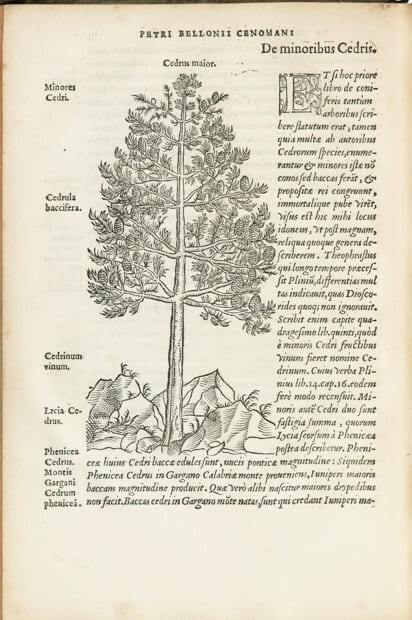
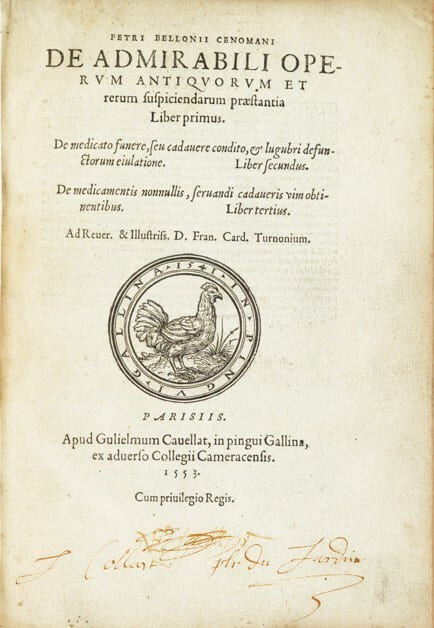
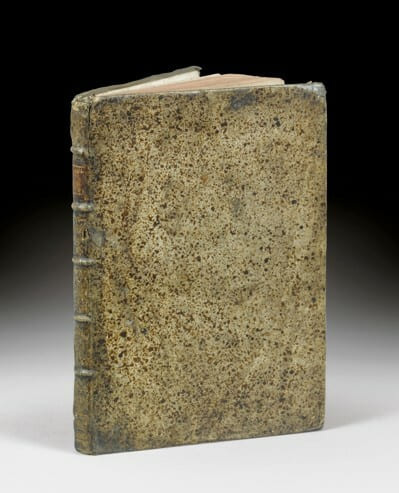
P., Apud Gulielmum Cavellat, 1553. In-4 de (8) ff., 32 ff.; 8 gravures sur bois. Vélin moucheté, dos à nerfs orné, tranches rouges. Reliure de l’époque. 230 x 157 mm. EDITION ORIGINALE DE L’UN DES TOUS PREMIERS TRAITES SUR LES CONIFERES ILLUSTRE DE JOLIES GRAVURES SUR BOIS, œuvre de Pierre Belon, naturaliste et médecin français (Cérans, Sarthe, 1517- Paris 1564). First edition. The first work on coniferous trees and one of the first botanical books to cover a single species. Belon was the first to name all cone-bearing trees 'coniferae' a term which was followed by Gesner. Descriptions are given of the various species, including their locations, and he cites authorities such as Dioscorides. The work contains illustrations of Cedrus major, Picæ arboris figura, Pinus, Icon Pinastri, Laricis figura, Sapini arboris delineatio, Abies foemina, and Cupressus. Pierre Belon (1517-1564) was one of the most orginal naturalist of the Renaissance. "He was one of the first explorer-naturalists and between 1546 and 1550 he undertook long voyages through Greece, Asia, Judaea, Egypt, Arabia and other foreign countries. He looked at the world as an analyst devoted to detail. He succeeded in winning the confidence of the great and was famous during his lifetime" (DSB). The woodcuts are excellent. Ce précieux volume est précédé d’une autre édition originale très rare de Pierre Belon sur les antiquités égyptiennes : « De admirabili operum antiquorum et rerum suspicendarum praestantia liber primus. De medicato funere, seu cadavere condito & lugubri defunctorum eilatione. Liber secundus. De medicamentis nonnullis. servandi cadaveris vim obtinentibus. Liber tertius Ad rever, & illustriss D. Fran. Gard. Turnonium, Parisiis, 1553 », in-4 de 8 ff., 54 ff. et 4 ff. Ce curieux ouvrage traite des différentes cérémonies funéraires des anciens et des modernes, de l'embaumement des corps, de l'usage de la "momie" comme médicament, et de divers autres médicaments ou substances (cèdre, "naphta", nitre.) Il explique l'utilisation du bitume que les anciens Egyptiens utilisaient pour la momification des cadavres. Son action contre la putréfaction a incité les médecins à l'utiliser en thérapeutique. Apothicaire du Cardinal de Tournon, Pierre Belon a voyagé de 1546 à 1550 en Grèce, en Turquie, en Egypte, en Judée et en Arabie. Il en rapporta un grand nombre d'observations sur l'histoire naturelle. EXEMPLAIRE CONSERVE DANS SA RELIURE DE L’EPOQUE.
Reference : YTB-75
Librairie Amélie Sourget
Madame Amélie Sourget
29 rue de Condé
75006 Paris
France
01 42 22 48 09
Chèque Carte Bancaire Nous assurons une garantie totale quant aux ouvrages que nous vendons : tous les livres proposés à la vente ont été préalablement collationnés, et leurs éventuels défauts sont toujours signalés. Conditions de vente conformes au règlement du SLAM et aux usages de la LILA (ILAB).

AMESTELODAMI APUD JODOCUM PLUYMERT 1678
Interessante raccolta seicentesca di due opere di botanica. La prima è l'edizione del 1678 dell'opera "Dissertatio de plantarum vegetatione" del filosofo naturale Digby Kenelm (1603-1665), membro della Royal Society e padre del vino in bottiglia. Nel 1654 circa supportò gli esperimenti alchemici nel circolo di Samuel Harlib (al quale apparteneva anche Robert Boyle) e nel 1661 aprì il suo laboratorio personale insieme all'alchemico transilvano Johannes Banfi Hunneadesos come assistente. L'opera, pubblicata per la prima volta nel 1661 come "A discourse concerning the vegetation of plants" è uno studio sulla crescita delle piante che sottolinea l'importanza dell'aria vitale, l'ossigeno, sostentamento delle piante, gemrinazione, riproduzione, Kenelm fu il primo in Europa a pubblicare questo tipo di risultati. Traduzione in latino a cura di Olferd Dapper. La seconda opera è l'edizione del 1679 del "Tractatus de arboribus coniferis et pice conficienda" di Johanne Conrado Axtio sulla gestione delle foreste di conifere e l'estrazione della pece, resine e carbon fossile. Risultano mancanti il frontespizio, le prime prime 84 pagine e tutte le incisioni. Sono presenti i seguenti capitoli "De modo conficiendae pici et usu" sull'estrazione della pece (mancante delle prime due carte), De fumo et fuligine, De candelis ligneis, De carbonibus & modo eos conficiendi. Alla fine "Epistola ad amicum de Antimonio" nella quale l'autore accusa il medico francese Gui Patin (1601-1672) di aver tentato di uccidere il proprio figlio (malato) anzichè curarlo con lo stesso mezzo (Ferguson). In buone condizioni. Copertina morbida con titolo manoscritto al dorso in buone condizioni generali con lievi usure marginali. Scoloritura al dorso. Legatura in buone condizioni. All'interno le pagine si presentano in buone condizioni con fioriture e bruniture. In 24. Dim. 13x7,5 cm. Pp. (6)+78+da 85 a 131. Interesting collection of 17th century of two works of botany. The first one is the edition of 1678 of the work "Dissertatio de plantarum vegetatione" by the natural phylsoopher Digby Kenelm (1603-1665), member of Royal Society and father of wine bottle. In 1654 circa he supported alchemic experiments in the circle of Samuel Harlib (to which Robert Boyle also belonged) and in 1661 had his own laboratory with the transylvanian alchemist Johannes Banfi Hunneadesos as assistant. The work was published for the first time in 1661 as "A discourse concerning the vegetation of plants" is a study about growth of plants underlining the importance of vital air, oxygen, sustenance of plants, germination, reproduction. Kenelm was the first one in Europe to publish these kind of results. Translation in latin by Olferd Dapper. The second work is the edition of 1679 of the "Tractatus de arboribus coniferis et pice conficienda" by Johanne Conrado Axtio about management of conifer forests and extraction of pitch, charcoal and resins. The title page, the first 84 pages and all the engravings lack. There are the following chapters "De modo conficiendae pici et usu" about the extraction of pitch (lacking of the first two pages), De fumo et fuligine, De candelis ligneis, De carbonibus & modo eos conficiendi. At the end "Epistola ad amicum de Antimonio" in which the author accuses the french doctor Gui Patin (1601-1672) to poison his son (who was illed) by means of it instead of which he cured him (Ferguson). In good conditions. Soft cover with handwritten title in the spine in good general conditions lightly worn in the extremities. Binding in good conditions. Inside pages are in good conditions with foxing and yellowing. In 24. Dim. 13x7,5 cm. Pp. (6)+78+from 85 to 131.