 Write to the booksellers
-
Type
Book (751)
Magazine (8)
Music sheets (1)
-
Language
English (2)
French (758)
-
Century
18th (19)
19th (31)
20th (297)
21st (154)
-
Countries
Belgium (178)
Canada (5)
Côte d'Ivoire (2)
Denmark (39)
France (490)
Netherlands (17)
Switzerland (29)
-
Syndicate
ALAC (5)
ILAB (102)
NVVA (24)
SLACES (7)
SLAM (41)
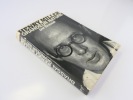
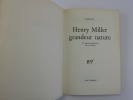
Henry Miller grandeur nature
Paris, Gallimard, 7 nov.1975, in-8, Broché-Jaquette éditeur, 264 pages. Jaquette présentant quelques accrocs. 16 photographies de Brassai en héliogravure.

NB. La librairie est fermée jusqu'à fin septembre. Les questions et commandes seront traitées début octobre.
Paroles en l'air
Paris, Jean-Claude Simoen , 1977, in-8, Broché, 171 pages. Très bon état.
NB. La librairie est fermée jusqu'à fin septembre. Les questions et commandes seront traitées début octobre.
Ecrits sur l'histoire (tome 2).
Paris, Arthaud, 1990. 15 x 24, 309 pp., broché, bon état (couverture légèrement défraîchie).
Tome 2 seul.
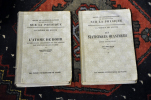
La théorie des quanta. Les statistiques quantiques et leurs applications
1930 1930. PUF, 2 vol. in 8, 404pp. sur les deux tomes ,reliure carton fort , dos toilé, . Edition originale. "L. Brillouin, fils de Marcel Brillouin, fut professeur de physique théorique à la Sorbonne puis au Collège de France."Parfait état
Ray E3*
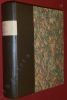
Théorie des Fonctions Elliptiques. Deuxième édition.
Paris, Gauthier-Villars, Imprimeur-Libraire, 1875, 1 volume in-4 de 592x240 mm environ, iv-700 pages, demi-reliure amateur brune et cartonnage marbré, feuillets non rognés. Tranches un peu salies avec quelques rousseurs
Charles Auguste Briot (né le 19 juillet 1817 à Saint-Hippolyte (Doubs), décédé le 20 septembre 1882 à Ault) est un mathématicien et physicien français.Jean-Claude Bouquet, né à Morteau le 7 septembre 1819 et mort à Paris le 9 septembre 1885, est un mathématicien français qui travailla notamment avec Charles Briot sur les fonctions doublement périodiques. Merci de nous contacter à l'avance si vous souhaitez consulter une référence au sein de notre librairie.
On Empire Liberty and Reform: Speeches and Letters (The Lewis Walpole Series in Eighteenth-Century Culture and History)
Yale university press 2000 536 pages 13 716x3 302x20 828cm. 2000. Broché. 536 pages.
Très bon état
Brunel Pierre Jullien Claudia Robilliard Stéphane
Reference : 500095901
(2002)
ISBN : 9782711772605
en finir avec les idees fausses propagees par l extreme droi
ATELIER 2014 11 8x1 2x17 6cm. 2014. Broché.
Très bon état
Hist Extraordin Butor: Essai sur un rêve de Baudelaire
Gallimard 1988 251 pages 10 8x17 7x1 9cm. 1988. mass_market. 251 pages.
Etat correct
La Main Et L'Esprit. Artistes Et Ecrivains Du Xviiieme Siecle A Nos Jours : Destins Croises
Editions de l'Amateur 2002 1x24x15cm. 2002. Broché.
très bon état de conservation
Cahiers du cinéma - Comité de rédaction : Pascal Bonitez, Jean-Louis Comolli, Serge Daney, Daniele Dubroux...
Reference : 113552
(1976)
Cahiers du cinéma N° 272 - Sur la fiction de gauche. Histoire d'U (Actes de Marusia. L'affiche rouge) - Photographies (suite) - Critiques. "La Marquise d'O. Winstanley" - Rencontre avec Emile de Antonio - Carthage An 10, Festival de Paris, Belfort - ...
1976 N° 272 - Décembre 1976 - Revue mensuelle illustrée du cinéma - Grand in-8 Broché, couverture illustrée - 65 pages
bon état
Cahiers du cinéma - Comité de rédaction : Pascal Bonitez, Jean-Louis Comolli, Serge Daney, Daniele Dubroux...
Reference : 113550
(1977)
Cahiers du cinéma N° 275 : Fortini/Cani (texte des sous-titres français) - La notion de plan et le sujet du cinéma (suite) - Sur la fiction de gauche - Critiques - le petit journal
1977 N° 275 - Avril 1977 - Revue mensuelle illustrée du cinéma - Grand in-8 Broché, couverture illustrée - 65 pages
bon état
Cahiers du cinéma - Comité de rédaction : Pascal Bonitez, Jean-Louis Comolli, Serge Daney, Daniele Dubroux...
Reference : 116852
(1977)
Cahiers du cinéma N° 278 - La fiction historique - Sur la fiction de gauche - Esthétique arabo-islamique - Entretien avec Chantal Akerman - Louis Skorecki : Digne : 20000 lieues sous la communication - Cannes 77 : Bribes
1977 N° 278 - Juillet 1977 - Revue mensuelle illustrée du cinéma - Grand in-8 Broché, couverture illustrée - 65 pages
bon état
Les Cahiers du Musée National d’Art Moderne, N° 1 (1979) à 12 (1983)
Centre Georges Pompidou 1996 12 numéros un double. In-4 30 x 21 cm. Brochés, couvertures illustrées en noir & blanc, environ 127 pp. par volume, texte sur 2 colonnes, illustrations en noir & blanc. Quelques couvertures poussiéreuse et quelques accroc de pellicules.
Tête de collection. Des essais inédits d'auteurs confirmés - Des travaux de jeunes chercheurs ou des textes d'importance historique jusque-là inaccessibles - Une analyse poussée de l'actualité culturelle internationale. Bon état d’occasion
Les Cahiers du Musée National d’Art Moderne, N° 23 à 28 Printemps 1988 - été 1989 [6 numéros]
Centre Georges Pompidou 1989 6 numéros. In-4. Brochés, couvertures illustrées en noir & blanc, environ 127 pp. par volume, texte sur 2 colonnes, illustrations en noir & blanc. Ensemble en bon état.
Des essais inédits d'auteurs confirmés - Des travaux de jeunes chercheurs ou des textes d'importance historiquejusque-là inaccessibles - Une analyse poussée de l'actualité culturelle internationale. Bon état d’occasion
Les Cahiers du Musée National d’Art Moderne, N° 35 à 50 Printemps 1991 - Hiver 1994 [14 numéros, dont 1 double]
Centre Georges Pompidou 1994 14 numéros. In-4. Brochés, couvertures illustrées en noir & blanc, environ 127 pp. par volume, texte sur 2 colonnes, illustrations en noir & blanc. Ensemble en bon état.
Des essais inédits d'auteurs confirmés - Des travaux de jeunes chercheurs ou des textes d'importance historiquejusque-là inaccessibles - Une analyse poussée de l'actualité culturelle internationale. Bon état d’occasion
Spritzmalerei.
München, Lothar Heinz Erlanger, 1930. 4°. 20(4) S. Mit 24 farb. Tafeln in Mappe. Illustr. Orig.-Halbleinenmappe (bestossen). ="Handbücher für Kunst-Erziehung." Band 1.

La théorie du grand complot mondial.
Editions Trajectoire, 2012. In-8, broché, 224 pages. Agréable exemplaire.
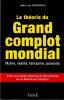
Le dernier chapitre, intitulé " Les conspirationistes n'ont pas toujours tort" Conclue brillamment cette étude dans son panorama historique. Les complots de toutes sortes ont émaillé l'histoire de l'Humanité, avec les zones d'ombre qui les caractérisent. Mais à l'heure de la mondialisation où l'information circule à la vitesse de la lumière, le mythe du Grand Complot est plus que jamais d'actualité. Repose-t-il sur des bases réelles, des données validées, des faits irréfutables ou n'est-ce qu'un fantasme ? Oui et non. Ce remarquable essai présente l'intérêt, contrairement à tout ce qui a été écrit sur le sujet, de ne jamais tomber dans l'exagération ni le déni. Un ouvrage passionnant et très documenté, qui s'en tient aux faits, se gardant bien de nourrir les délires conspirationistes les plus farfelus ou paranoïaques. Mise à jour du Samedi 27 Juin 2026. Paiement PayPal immédiat, Mondial Relay pour : France, Allemagne, Autriche, Belgique, Espagne, Italie, Portugal, Luxembourg, Pays-Bas, Pologne (Communiquer votre point ou locker si connu). Une participation supplémentaire peut être demandée pour les colis lourds hors France où les envois compris entre 5 et 25 kg sont dégressifs : 2 à 4 kilogrammes - 7.99 / 5 à 10 kg - 15.99 / 15 -25 kg - 25.99. Certaines de nos collections ( Vian, Céline, Camus (...) peuvent être expédiées en Franco de port. Pour linternational hors Europe (Suisse, Canada, Japon, Etats-Unis, les frais dexpéditions peuvent varier selon le poids (mise à jour : 1 juin 2026).
"CARTAN, ÉLIE. - THE EINSTEIN-CARTAN THEORY (ECT) OF GRAVITATION.
Reference : 48912
(1922)
Sur une définition géométrique du tenseur d'énergie d'Einstein. (+) Sur une généralisation de la notion de courbure de Riemann et les espaces à torsion. (+) Sur les espaces généralisés et la théorie de la Relativité. (+) Sur les espaces conformes...
Paris, Gauthier-Villars, 1922. 4to. Bound in 2 uniform full cloth, but of slightly different sizes. Paperlabels pasted to lower part of spines. A faint stamp to titlepage and some of the issues. In ""Comptes Rendus Hebdomadaires des Séances de L'Academie des Sciences"", Tome 174. 1815,(1) pp. (Entire volume offered). Cartan's papers: pp.437-439, 593-595, 734-737, 857-60, 1104-1107.
First edition of these papers, in which Cartan intruced the concept of ""Torsion"", the main inspiration for Einstein in his searce for a unified field theory. The ECT of gravity is a modification of the General relativity Theory""The Einstein-Cartan theory, also known as the Einstein-Cartan-Sciama-Kibble theory, is a classical theory of gravitation similar to general relativity but relaxing the assumption that the affine connection has vanishing antisymmetric part (torsion tensor), so that the torsion can be coupled to the intrinsic angular momentum (spin) of matter, much in the same way in which the curvature is coupled to the energy and momentum of matter. In fact, the spin of matter in curved spacetime requires that torsion is not constrained to be zero but is a variable in the principle of stationary action. Regarding the metric and torsion tensors as independent variables gives the correct generalization of the conservation law for the total (orbital plus intrinsic) angular momentum to the presence of the gravitational field. The theory was first proposed by Élie Cartan in 1922 and expounded in the following few years. Dennis Sciama and Tom Kibble independently revisited the theory in the 1960s, and an important review was published in 1976. Albert Einstein became affiliated with the theory in 1928 during his unsuccessful attempt to match torsion to the electromagnetic field tensor as part of a unified field theory. This line of thought led him to the related but different theory of teleparallelism."" (Wikipedia).
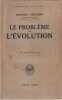
Le Problème de l'évolution. Avec 88 figures dans le texte.
Payot " Bibliothèque scientifique" - Paris. In-8, broché, 447 pages, 88 figures au trait en noir. Faible gauchissement, quelque taches sur le plat sans gravité. Très propre.
Bon Etat Mise à jour du Samedi 27 Juin 2026. Paiement PayPal immédiat, Mondial Relay pour : France, Allemagne, Autriche, Belgique, Espagne, Italie, Portugal, Luxembourg, Pays-Bas, Pologne (Communiquer votre point ou locker si connu). Une participation supplémentaire peut être demandée pour les colis lourds hors France où les envois compris entre 5 et 25 kg sont dégressifs : 2 à 4 kilogrammes - 7.99 / 5 à 10 kg - 15.99 / 15 -25 kg - 25.99. Certaines de nos collections ( Vian, Céline, Camus (...) peuvent être expédiées en Franco de port. Pour linternational hors Europe (Suisse, Canada, Japon, Etats-Unis, les frais dexpéditions peuvent varier selon le poids (mise à jour : 1 juin 2026).
"CAVENDISH, HENRY. - WEIGHING THE WORLD - THE MOST IMPORTENT ADDITION TO GRAVITATION THEORY SINCE NEWTON.
Reference : 43865
(1799)
Versuche über die Dichtigkeit der Erde zu Bestimmen. Erläutert vom Herausgegeber (Gilbert). (Experiments to determine the Density of the Earth.).
Halle, Rengerschen Buchhandlung, 1799. Without wrappers. In ""Annalen der Physik. Herausgegeben von Ludwig Wilhelm Gilbert"", Bd. 2, Erstes Stück. (The entire issue offered). Titlepage to vol. 2. Pp. 1-118 a. 2 folded engraved plates. Cavendish's paper: pp. 1-62. (the torsion balance of Michell shown on the plates).
First German edition of Cavendish's famous paper in which he calculated the weight of the earth and determined its mass. He also, as the first, observed gravitational motion of minute portions of matter. He estimates the earth's mass to 6,6 x 10 to the potential of 24 kg. The original paper ""Experiments to determine the Density of the Earth"" appeared in Philosophical Transaction, 1798.""Cavendish published five papers between 1784 and 1809...With one exception they were comparatively minor productions....The exception was his determination of the density of the earth or weighing of the world in 1798, by means of John Michell's torsion balance. The apparatus consisted of two lead balls on either end of a suspended beam" these movable balls were attracted by a pair of stationary lead balls. Cavendish calculated the the force of attraction between the balls fro the observed period of oscillation of the balance and deduced the density of the earth from the force. He found it to be 5.48 times that of water. Cavendish was the first to observe gravitational motions induced by comparatively minute portions of ordinary matter...By weighing the world he rendered the law of gravitation complete. The law was no longer a proportionally statement but a quantitatively exact one" this was the most importent addition to the science of gravitation since Newton.""(DSB III, p. 158.).
"CAVENDISH, HENRY. - WEIGHING THE WORLD - THE MOST IMPORTENT ADDITION TO GRAVITATION THEORY SINCE NEWTON.
Reference : 48206
(1799)
Versuche über die Dichtigkeit der Erde zu Bestimmen. Erläutert vom Herausgegeber (Gilbert). (Experiments to determine the Density of the Earth.).
(Halle, Rengerschen Buchhandlung, 1799). Without wrappers. In ""Annalen der Physik. Herausgegeben von Ludwig Wilhelm Gilbert"", Bd. 2, Erstes Stück. (The entire issue offered). 1-118 a. 2 folded engraved plates. Cavendish's paper: pp. 1-62. (the torsion balance of Michell shown on the plates).
First German edition of Cavendish's famous paper in which he calculated the weight of the earth and determined its mass. He also, as the first, observed gravitational motion of minute portions of matter. He estimates the earth's mass to 6,6 x 10 to the potential of 24 kg. The original paper ""Experiments to determine the Density of the Earth"" appeared in Philosophical Transaction, 1798.""Cavendish published five papers between 1784 and 1809...With one exception they were comparatively minor productions....The exception was his determination of the density of the earth or weighing of the world in 1798, by means of John Michell's torsion balance. The apparatus consisted of two lead balls on either end of a suspended beam" these movable balls were attracted by a pair of stationary lead balls. Cavendish calculated the the force of attraction between the balls fro the observed period of oscillation of the balance and deduced the density of the earth from the force. He found it to be 5.48 times that of water. Cavendish was the first to observe gravitational motions induced by comparatively minute portions of ordinary matter...By weighing the world he rendered the law of gravitation complete. The law was no longer a proportionally statement but a quantitatively exact one" this was the most importent addition to the science of gravitation since Newton.""(DSB III, p. 158.).The issue contains further papers by Ritter, Chladni et al.
An Introductory Memoir upon Quantics. received April 20, - Read may 4, 1854.
(London, Richard Taylor and William Francis, 1854). 4to. No wrappers as extracted from ""Philosophical Transactions"" 1854, Vol. 144 - Part I. Pp. 245-258.
First printing of the first paper in Cayley's famous memoirs on 'quantics', a term he coined for algebraic forms. In this paper Cayley throughout remodelled the whole basis for Invariant Theory.""In addition to his part in founding the theory of abstract groups, Cayley has a number of important theorems to his credit: perhaps the best known is that every finite group whatsoever is isomorphic with a suitable group of permutations (see the first paper of 1854). This is often reckoned to be one of the three most important theorems of the subject, the others being the theorems of Lagrange and Sylow. But perhaps still more significant was his early appreciation of the way in which the theory of groups was capable of drawing together many different domains of mathematics: his own illustrations, for instance, were drawn from the theories of elliptic functions, matrices, quantics, quaternions, homographic transformations, and the theory of equations. If Cayley failed to pursue his abstract approach, this fact is perhaps best explained in terms of the enormous progress he was making in these subjects taken individually.""(DSB)
Rimbaud et le C.A.C. 40
Le Dilettante 1998 112 pages 12x1x18cm. 1998. Broché. 112 pages.
Très bon état
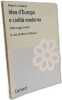
Idea d'Europa e civiltà moderna. Sette saggi inediti (Studi storici Carocci)
Carocci 2011 190 pages 15x1x21 6cm. 2011. Broché. 190 pages.
Très bon état

