 Write to the booksellers
-
Type
Book (5346)
Magazine (35)
Music sheets (3)
Photographs (8)
-
Latest
Last 24h (1)
Last month (72)
Last week (4)
-
Language
Czech (1)
English (3)
French (5375)
German (11)
Latin (1)
Spanish (1)
-
Century
17th (16)
18th (200)
19th (1142)
20th (2263)
21st (78)
-
Countries
Belgium (352)
Côte d'Ivoire (19)
Denmark (687)
France (3977)
Switzerland (357)
-
Syndicate
CLAM (2)
ILAB (3004)
NVVA (183)
SLACES (183)
SLAM (2110)
SNCAO (48)
Le fil de la vie: La découverte de l'ADN
Flammarion 1998 252 pages 14x22x2cm. 1998. Broché. 252 pages.
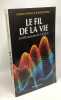
Comme neuf
Researches on Acids of the Lactic. Series. - I. Synthesis of Acids of the Lactic Series. Received February 14, - Read March 1, 1866.
(London, Taylor and Francis, 1866). 4to. No wrappers as extracted from ""Philosophical Transactions"", Vol. 156 - Part I, pp. 309-359. Clean and fine.
First printing. As Frankland discovered ""Combining Power"" (= valency), he had introduced powerfull analytical techniques.""From 1863 to 1870 he and Baldwin Duppa exploited zinc etyl and other organic reagents, including ethyl acetate, in the synthesis of ethers, dicaarboxylic acids, unsaturated monocarboxylic acids and hydroxy acids. This meticulousw work revealed clearly the structure and relationship of these compounds, and of course its methodology had great bearing on the growth of the chemical industry.""(DSB, V: p. 126).

Synthetical Researches on Ethers. - No. 1. Synthesis of Ethers from Acetic Ether. Received July 13, - Read November 16, 1865.
(London, Taylor and Francis, 1866). 4to. No wrappers as extracted from ""Philosophical Transactions"", Vol. 156 - Part I, pp. 37-72. Clean and fine.
First printing. As Frankland discovered ""Combining Power"" (= valency), he had introduced powerfull analytical techniques.""From 1863 to 1870 he and Baldwin Duppa exploited zinc etyl and other organic reagents, including ethyl acetate, in the synthesis of ethers, dicaarboxylic acids, unsaturated monocarboxylic acids and hydroxy acids. This meticulousw work revealed clearly the structure and relationship of these compounds, and of course its methodology had great bearing on the growth of the chemical industry.""(DSB, V: p. 126).
On a New Series of Organic Compounds containing Boron. Received May 15, - Read May 22, 1862.
(London, Taylor and Francis, 1860). 4to. No wrappers as extracted from ""Philosophical Transactions"" 1859 - Vol. 152 - Part I. Pp. 167-183. Clean and fine.
First printing of an importent chemical paper on the organometallic compounds.
The Bakerian Lecture. - Researches on Organo-metallic Bodies. - Fourth Memoir. Received February 17, - Read March 3, 1859.
(London, Taylor and Francis, 1859). 4to. No wrappers as extracted from ""Philosophical Transactions"" 1859 - Vol. 149 - Part I. Pp. 401-415. Clean and fine.
First printing of an importent chemical paper on the organometallic compounds.
"FRANKLAND, E. (EDWARD). - INTRODUCING ""VALENCY"" IN CHEMISTRY.
Reference : 42941
(1852)
On a New Series of Organic Bodies containing Metals. Received May 10,- Read June 17,1852.
London, Richard Taylor and William Francis, 1852 4to. No wrappers as extracted from ""Philosophical Transactions"" 1852 - Part II. With titlepage to Part II., pp. 417-444, textillustr. Fine and clean.
First appearance of an extremely importent paper in the histroy of chemistry as Frankland here introduced the concept of 'VALENCY' - he called it 'atomicity' - to explain the capacity of atoms to combine with other atoms. ""This led not only to the Kekulé structures, but also to the periodic table of Mendeléev, since that table was based on the regular change of valence with atomic weight.""(Asimov).""On May 10 1852 Frankland read to the Royal Society a paper on organic metallic compounds (the paper offered) in which he made the emperical observation that elements possessed fixed combining powers, or ""only room, so to speak, for the attachement of a fixed and definite number of the atoms of other elements."" The expression ""valence"" or ""Valency"" began to be used by other chemists only after 1865, wheras Frankland tended to use the misleading term ""atomicity""....Frankland's teching position at the Royal College of Chemistry and his influence on the Department of Sciences and Art science examinations enembled him to spread the idea through the younger generation of British chemists.""(DSB V, p. 126).The exact inception, however, of the theory of chemical valencies can be traced to an 1852 paper by Edward Frankland, in which he combined the older theories of free radicals and ""type theory"" with thoughts on chemical affinity to show that certain elements have the tendency to combine with other elements to form compounds containing 3, i.e. in the three atom groups (e.g. NO3, NH3, NI3, etc.) or 5, i.e. in the five atom groups (e.g. NO5, NH4O, PO5, etc.), equivalents of the attached elements. It is in this manner, according to Frankland, that their affinities are best satisfied. (Wikepedia).
La Mesure du Temps. La vie privée d'autrefois. Arts et métiers, modes, moeurs, usages des parisiens du XIIe au XVIII e siècle, d'après des documents originaux ou inédits.
Paris, Plon, Nourrit et Cie, 1888. In-12 de 237 pages d'appendice. Illustrations. Très bon état intérieur. Percaline verte, couvertures, nombreux tampons de l'O.R.T.F., Radio-France.

The Science of Conjecture: Evidence and Probability Before Pascal
Johns hopkins university press 2001 497 pages 15 748x3 81x23 876cm. 2001. Cartonné jaquette. 497 pages.
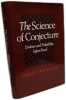
Bon état
La Révolution des Quanta + La civilisation du gène --- 2 livres coll. "Questions de science"
Hachette Littératures 1989 100 pages 13 2x1x20 8cm. 1989. Broché. 2 volume(s). 100 pages.
Bon état bonne tenue intérieur propre
La logique du vivant - une histoire de l'hérédité / Bibliothèque des sciences humaines
Gallimard 1971 in8. 1971. Broché.
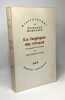
couverture défraîchie bords frottés tranche ternie
LA CHIMIE AU COLLEGE D ET- TOME III- SPECIMEN
EYROLLES. 1967. In-8. Relié. Bon état, Couv. convenable, Dos satisfaisant, Intérieur frais. 150 pages. . . . Classification Dewey : 540-Chimie et sciences connexes
Classification Dewey : 540-Chimie et sciences connexes
LA CHIMIE AU COLLEGE D ET- TOME II- SPECIMEN
EYROLLES. 1967. In-12. Relié. Bon état, Couv. convenable, Dos satisfaisant, Intérieur frais. 140 pages. . . . Classification Dewey : 540-Chimie et sciences connexes
Classification Dewey : 540-Chimie et sciences connexes
Emmenologia in qua Fluxus Muliebris Menstrui. Phænomena, Periodi, Vitia, cum Medendi Methodo, ad Rationes Mechanicas exiguntur. Huic Editioni accedunt ejusdam Authoris Prælectiones Chymicæ.
Paris, G. Cavelier, 1727. Cont. full mottled calf, raised bands, richly gilt back. Top of spine chipped. (14),238,(22) pp. and bound with: FREIND, JOH. Prælectiones Chymicæ, in quibus omnes fere Operationes Chymicæ. Ad vera Principia, & ipsius Naturæ Leges rediguntur. Editio nova, auctior & emandatior. Paris, G. Cavelier, 1727. (2),XIV,102 pp. + Appendix Paris, 1727. 32 pp. (Authors reply to critics).
Emmenologia has been considered a remarkable exposition from the iatro-mathematical or mechanical point of view. In 1704 he was appointed to the chair of Chemistry in Oxford and delivered lectures theron in the Asmolean Museum, and in 1705 went as army physician to Spain with the Earl of Peterborough. (Ferguson I:290-91). Freind is furthermore considered the first English historian of medicine.
Evolution de la fonderie de cuivre d'après les documents du temps.
1903 pet. in-4, (2ff.), IV, 360pp., (10ff.), illustré, br. Paris Renouard 1903
Tres importante iconographie.
Modifications que la Chaleur fait éprouver aux Acides Tartrique et Paratartrique.
(Paris, Crochard, 1838). No wrappers in ""Annales de Chimie et de Physique"", 2. Series, Tome 68, Cahier 4 (entire issue offered). Pp. 353-446. Fremy's paper: pp. 353-387.
""Frémy’s first project was to continue Pelouze’s studies of iron oxides, and he expanded them to include oxides of chromium, tin, and antimony that form salts with alkalies in the same way as manganese. In 1835 he published a memoir in the Annales de chimie on the splitting of fats by sulfuric acid, a process that was adopted by French industry. From then on, Frémy pursued scientific investigations as professor and industrial work as consultant (later as administrator of the Compagnie de Saint-Gobin). He proposed improvements in the chamber process for making sulfuric acid (low temperature and ample air and water), and he introduced the residue from burning pyrites as the raw material for iron production. From research on the setting of hydraulic cement, Frémy proceeded to the synthesis of rubies by heating alumina with potassium chromate and barium fluoride.""(DSB).
"FREMY, EDMOND. - TOWARDS ISOLATION OF FLUORINE FREMY'S SALT.
Reference : 45677
(1856)
Recherches sur les Fluorures. Premier Mémoire.
Paris, Victor Masson, 1856. No wrappers. Extracted from: ""Annales de Chimie et de Physique"", 3e Series - Tome 47. Pp. 5-50. Textillustr. With titlepage to vol. 47. Some scattered brownspots.
First appearance of Fremy's importent paper on the isolation of fluorine, a historic paper in electro-chemistry. The existence of the element fluorine had been well known for many years (since 1813, Davy), but all attempts to isolate it had failed and some experimenters had died in the attempt.""The history of fluorine is a tragic record. Marggraf described hydrofluoric acid in 1768, and Scheele studied it three years later. Lavoisier..., thought that all acids contain oxygen, but Davy showed that this one does not. Ampere suggested to Davy that hydrofluoric acid must be composed of hydrogen and an unknown element. Poul Schutzenberger expressed the belief that this unknown substance, fluorine, would be found to be the most active of all elements, and correctly predicted some of its properties. Ti is this extreme activity of the element that made its liberation such a difficult and dangerous task and brought agony and death to some of the pioneer investigators.""(Weeks p. 266-67). ""An important step was made by Frémy, Moissan’s first mentor, when he succeeded in preparing pure, anhydrous HF and also KHF2, so-called Frémy’s salt, expressed ""KFl.HFl"" using the notations of that time. Frémy had come very close to finding the solution by electrolysing anhydrous HF, molten calcium fluoride or potassium fluoride, but he seemed not to have had the idea of replacing these compounds by KHF2, perhaps because of the high melting point of the compound, TF = 293°C, which would have led to insurmountable technical difficulties."" Weeks ""Discovery of teh Elements"", p. 266 ff.
"Le guide du chimiste; répertoire de documents théoriques et pratiques à l'usage des laboratoires de chimie pure et de chimie industrielle."
Paris, G. Masson, 1885. "16 x 24, 988 pp., 157 figures, demi-reliure dos cuir avec pièce de titre, plats marbrés, bon état (quelques épidermures; cachets de la Bibliothèque des professeurs du collège Saint-Stanislas à Mons)"
ENCYCLOPEDIE CHIMIQUE. TOME 10 applications de chimie organique. Contribution à l'étude de la chimie agricole par Th Schloesing.
Paris Veuve Dunod 1888. In-8 VI 263pp. Demi percaline verte bradel, fleuron doré sur le dos, pièce de titre de basane rouge, (pas de mention de tomaison) reliure de l'époque. Orné de 88 figures dans le texte.
Bel exemplaire frais, relié sans mention de tomaison, bien complet du texte, du sujet traité et des illustrations (3577)
Traité d'analyse chimique quantitative
F. Savy 1875 in8. 1875. Relié.
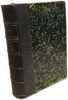
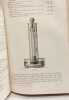
Bon état général cependant couverture défrâichie bords frottés coins émoussés tranche ternie quelques rousseurs
Anleitung zur qualitativen chemischen Analyse oder die Lehre von den Operationen, von den Reagentien und von den Reagentien und von dem Verhalten der bekannteren Körper zu Reagentien, sowie systematische Verfahren.... Mit einem Vorwort von Justus von ...
Braunschweig, Vieweg und Sohn, 1853. Contemp. hcalf. Richly gilt spine. XXIV,307 pp., textillustrations. Scattered brownspots, old underlinings throughout.
Anleitung zur qualitativen chemischen Analyse oder die Lehre von den Operationen, von den Reagentien....Mit einem Vorwort von Justus von Liebig. Vierzehnte Auflage.
Braunschweig, Vieweg und Sohn, 1874. Contemp. hcalf, gilt. Some wear. Hinges weakening. XXII,482 pp. Textillustrations.
TRAITE D'ANALYSE CHIMIQUE QUALITATIVE.
Paris Masson et Cie 1905. In-8 VI 769 4pp publicités. Demi chagrin acajou à coins, dos à nerfs orné de filets et chaînettes dorés, chaînette à froid sur les plats, tranches rouge, rel époque. Orné de 91 figures dans le texte, 1 planche en couleurs sur double page (analyse spectrale). Bel exp.
Manipulations et opérations chimiques, réactifs, essais au chalumeau, analyse des eaux potables, minérales, des terres, des engrais, recherches chimico-légales, analyse spectrale, micro-chimie.
TRAITE D'ANALYSE QUANTITATIVE.
Paris Masson et Cie 1909. 2vol in-8 VIII 983 667pp. Demi chagrin acajou à coins, dos à nerfs orné de filets et chaînettes dorés, chaînette à froid sur les plats, tranches rouges, rel époque. Orné de 430 figures dans le texte. Bel exp.
Dosage, séparation des corps simples et composés, analyses pondérale, électrolytique, volumétrique, gazeuse, analyse des eaux douces, minérales, terres, atmosphère, minerais, alcalimétrie...
Traité d'analyse chimique qualitative.
MASSON G. 8ème édition. 1896. In-12. Broché. Etat d'usage, Couv. défraîchie, Dos abîmé, Intérieur bon état. 651 pages. 2nd plat de couverture détaché. Nombreuses gravures en noir et blanc dans le texte. Mors fendus sur le 1er plat de couverture.. . . . Classification Dewey : 540-Chimie et sciences connexes
Nouveau tirage augmentée d'un supplément rédigé d'après la 16ème édition allemande, par le Dr L. Gautier. Classification Dewey : 540-Chimie et sciences connexes
Traité d'analyse chimique qualitative- Des opérations chimiques, des réactifs et de leur action sur les corps les plus répandus, Essais au chalumeau, analyse des eaux potables, minérales, des sols, engrais etc, Recherches chimico-légales,analyse spectrale
F. Savy. Non daté. In-12. Relié. Bon état, Couv. convenable, Dos satisfaisant, Intérieur frais. 508 pages. Titre et filets en doré au dos. Dos à 4 nerfs. Epidermures sur les plats. Couverture gondolée. Nombreuses rousseurs. Couverture désolidarisée. 47 figures en noir et blanc, dans le texte.. . . . Classification Dewey : 540-Chimie et sciences connexes
Traduit de l'allemand sur la 14ème édition par C. Forthomme. Classification Dewey : 540-Chimie et sciences connexes

