 Write to the booksellers
-
Type
Book (5379)
Magazine (35)
Music sheets (3)
Photographs (8)
-
Latest
Last 3 days (1)
Last month (71)
Last week (4)
-
Language
Czech (1)
English (3)
French (5408)
German (11)
Latin (1)
Spanish (1)
-
Century
17th (16)
18th (200)
19th (1142)
20th (2262)
21st (78)
-
Countries
Belgium (352)
Côte d'Ivoire (19)
Denmark (687)
France (4010)
Switzerland (357)
-
Syndicate
CLAM (2)
ILAB (3029)
NVVA (183)
SLACES (183)
SLAM (2135)
SNCAO (48)
"FREMY, EDMOND. - TOWARDS ISOLATION OF FLUORINE FREMY'S SALT.
Reference : 45677
(1856)
Recherches sur les Fluorures. Premier Mémoire.
Paris, Victor Masson, 1856. No wrappers. Extracted from: ""Annales de Chimie et de Physique"", 3e Series - Tome 47. Pp. 5-50. Textillustr. With titlepage to vol. 47. Some scattered brownspots.
First appearance of Fremy's importent paper on the isolation of fluorine, a historic paper in electro-chemistry. The existence of the element fluorine had been well known for many years (since 1813, Davy), but all attempts to isolate it had failed and some experimenters had died in the attempt.""The history of fluorine is a tragic record. Marggraf described hydrofluoric acid in 1768, and Scheele studied it three years later. Lavoisier..., thought that all acids contain oxygen, but Davy showed that this one does not. Ampere suggested to Davy that hydrofluoric acid must be composed of hydrogen and an unknown element. Poul Schutzenberger expressed the belief that this unknown substance, fluorine, would be found to be the most active of all elements, and correctly predicted some of its properties. Ti is this extreme activity of the element that made its liberation such a difficult and dangerous task and brought agony and death to some of the pioneer investigators.""(Weeks p. 266-67). ""An important step was made by Frémy, Moissan’s first mentor, when he succeeded in preparing pure, anhydrous HF and also KHF2, so-called Frémy’s salt, expressed ""KFl.HFl"" using the notations of that time. Frémy had come very close to finding the solution by electrolysing anhydrous HF, molten calcium fluoride or potassium fluoride, but he seemed not to have had the idea of replacing these compounds by KHF2, perhaps because of the high melting point of the compound, TF = 293°C, which would have led to insurmountable technical difficulties."" Weeks ""Discovery of teh Elements"", p. 266 ff.
"Le guide du chimiste; répertoire de documents théoriques et pratiques à l'usage des laboratoires de chimie pure et de chimie industrielle."
Paris, G. Masson, 1885. "16 x 24, 988 pp., 157 figures, demi-reliure dos cuir avec pièce de titre, plats marbrés, bon état (quelques épidermures; cachets de la Bibliothèque des professeurs du collège Saint-Stanislas à Mons)"
ENCYCLOPEDIE CHIMIQUE. TOME 10 applications de chimie organique. Contribution à l'étude de la chimie agricole par Th Schloesing.
Paris Veuve Dunod 1888. In-8 VI 263pp. Demi percaline verte bradel, fleuron doré sur le dos, pièce de titre de basane rouge, (pas de mention de tomaison) reliure de l'époque. Orné de 88 figures dans le texte.
Bel exemplaire frais, relié sans mention de tomaison, bien complet du texte, du sujet traité et des illustrations (3577)
Traité d'analyse chimique quantitative
F. Savy 1875 in8. 1875. Relié.
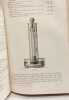
Bon état général cependant couverture défrâichie bords frottés coins émoussés tranche ternie quelques rousseurs
Anleitung zur qualitativen chemischen Analyse oder die Lehre von den Operationen, von den Reagentien und von den Reagentien und von dem Verhalten der bekannteren Körper zu Reagentien, sowie systematische Verfahren.... Mit einem Vorwort von Justus von ...
Braunschweig, Vieweg und Sohn, 1853. Contemp. hcalf. Richly gilt spine. XXIV,307 pp., textillustrations. Scattered brownspots, old underlinings throughout.
Anleitung zur qualitativen chemischen Analyse oder die Lehre von den Operationen, von den Reagentien....Mit einem Vorwort von Justus von Liebig. Vierzehnte Auflage.
Braunschweig, Vieweg und Sohn, 1874. Contemp. hcalf, gilt. Some wear. Hinges weakening. XXII,482 pp. Textillustrations.
TRAITE D'ANALYSE CHIMIQUE QUALITATIVE.
Paris Masson et Cie 1905. In-8 VI 769 4pp publicités. Demi chagrin acajou à coins, dos à nerfs orné de filets et chaînettes dorés, chaînette à froid sur les plats, tranches rouge, rel époque. Orné de 91 figures dans le texte, 1 planche en couleurs sur double page (analyse spectrale). Bel exp.
Manipulations et opérations chimiques, réactifs, essais au chalumeau, analyse des eaux potables, minérales, des terres, des engrais, recherches chimico-légales, analyse spectrale, micro-chimie.
TRAITE D'ANALYSE QUANTITATIVE.
Paris Masson et Cie 1909. 2vol in-8 VIII 983 667pp. Demi chagrin acajou à coins, dos à nerfs orné de filets et chaînettes dorés, chaînette à froid sur les plats, tranches rouges, rel époque. Orné de 430 figures dans le texte. Bel exp.
Dosage, séparation des corps simples et composés, analyses pondérale, électrolytique, volumétrique, gazeuse, analyse des eaux douces, minérales, terres, atmosphère, minerais, alcalimétrie...
Traité d'analyse chimique qualitative.
MASSON G. 8ème édition. 1896. In-12. Broché. Etat d'usage, Couv. défraîchie, Dos abîmé, Intérieur bon état. 651 pages. 2nd plat de couverture détaché. Nombreuses gravures en noir et blanc dans le texte. Mors fendus sur le 1er plat de couverture.. . . . Classification Dewey : 540-Chimie et sciences connexes
Nouveau tirage augmentée d'un supplément rédigé d'après la 16ème édition allemande, par le Dr L. Gautier. Classification Dewey : 540-Chimie et sciences connexes

Traité d'analyse chimique qualitative- Des opérations chimiques, des réactifs et de leur action sur les corps les plus répandus, Essais au chalumeau, analyse des eaux potables, minérales, des sols, engrais etc, Recherches chimico-légales,analyse spectrale
F. Savy. Non daté. In-12. Relié. Bon état, Couv. convenable, Dos satisfaisant, Intérieur frais. 508 pages. Titre et filets en doré au dos. Dos à 4 nerfs. Epidermures sur les plats. Couverture gondolée. Nombreuses rousseurs. Couverture désolidarisée. 47 figures en noir et blanc, dans le texte.. . . . Classification Dewey : 540-Chimie et sciences connexes
Traduit de l'allemand sur la 14ème édition par C. Forthomme. Classification Dewey : 540-Chimie et sciences connexes
Neue Verfahrungsweisen zur Prüfung der Pottasche und Soda, der Aschen, der Säuren, insbesondere des Essigs so wie des Braunsteins. auf ihren wahren Gehalt und Handelswerth. Für Chemiker, Pharmaceuten, techniker und Kaufleute lediglich nach eigenen Ver...
Heidelberg, C.F. Winter, 1843. Contemp. hcloth. Spine gilt and with gilt lettering. X,142 pp., textillustrations. Clean and fine printed on heavy paper.
First edition. - Poggendorff I,799 and II,1329.
TRAITÉ D'ANALYSE CHIMIQUE QUALITATIVE. Des opérations chimiques, des réactifs et de leur action sur les corps les plus répandus...
Paris Masson & Cie 1875 in 8 (19,5x13) 1 volume reliure demi basane verte, dos lisse orné de filets et de fleurons dorés, VIII et 508 pages, avec 47 figures dans le texte et un tableau dépliant colorié d'analyse spectrale. Carl Remigius Fresenius, 1818-1897. Cinquième édition françaisee traduite de l'allemand sur la 14ème édition par C. Forthomme. Bel exemplaire
Très bon Reliure
TRAITE D'ANALYSE CHIMIQUE QUALITATIVE
LIBRAIRIE F. SAVY. 1891. In-8. Broché. A relier, 1er plat abîmé, Dos abîmé, Intérieur acceptable. 596 pages. Nombreuses illustrations en noir et blanc dans le texte. Dos cassé, plats détachés, ouvrage en plusieurs parties. Manque le second plat.. . . . Classification Dewey : 540-Chimie et sciences connexes
Classification Dewey : 540-Chimie et sciences connexes
"FRESNEL, AUGUSTIN. - FORMULATING THE GENERAL LAW OF DOUBLE REFRACTION.
Reference : 59046
(1825)
Extrait d'un Mémoire sur la double Réfraction. (Lu à l'Academie des Sciences le 26 novembre 1821).
Paris, Crochard, 1825. Contemp. hcloth. Gilt lettering on spine. A few scattered brownspots. In: ""Annales de Chimie et de Physique, Par MM. Gay-Lussac et Arago."", tome 28. 448 pp. Entire volume offered. Fresnel's paper: pp. 263-279
First appearance of this importent paper - the paper was only published in full in the Mémoires two years later - in which he applies the concept of transverse waves to double refraction and representing the final construction, in the form of an equation of the fourth degree.In the paper Fresnel also explained the fact, that in some cases of quartz the rotation of polarization is from left to right and in other cases from right to left.. He proposed the term 'helical' to denote the property of rotating the plane of polarization, exhibited by such bodies as quartz. The term 'natural rotatory polarisation' is however, generally used.
COLLOID & CAPILLARY CHEMISTRY. Translated from the third German edition by H. Stafford Hatfield
London Methuen & Co, Ltd 1926 in 8 (25,5x16) 1 fort volume reliure percaline verte de l'éditeur (original green cloth), XV et 883 pages, avec 157 diagrammes. Herbert Freundlich. Bon exemplaire ( Photographies sur demande / We can send pictures of this book on simple request )
Bon Couverture rigide
Traité d'assainissement industriel comprenant la description des principaux procédés employés dans les centres manufacturiers de l'Europe occidentale, pour protéger la santé publique et l'agriculture contre les effets des travaux industriels. Publié par ordre (du) ... ministre de l'agriculture et du commerce. Atlas seul.
Paris, Dunod, 1870, gr. in-8vo, 2 ff. + 21 doubles planches de figures gravées (par Lemaître; machines, appareils, div. procédures, etc.), rousseurs dans qqs planches, reliure en demi-veau rouge, dos orné en or, frottements aux bords et aux coins.
Première édition. Charles-Louis de Saulses de Freycinet fut à la fois un homme de sciences et un grand administrateur de l'Etat. Sorti parmi les premiers de l'Ecole Polytechnique, il devint ingénieur des Mines, chef de l'exploitation de la Compagnie des chemins de fer du Midi, chef du cabinet militaire de Gambetta lors de la guerre de 1870. Par la suite, ministre des Travaux publics, il a lancé un ambitieux programme de construction de chemins de fer et de canaux.

(SLACES, NVVA)
Phone number : 41 (0)26 3223808
La spectroscopie hertzienne appliquée à la chimie. Absorption dipolaire - Rotation moléculaire - Résonances magnétiques
Dunod 1960 In-8, broché, couveture imprimée, XI-263 pp., figures dans le texte, bibliographie. Exemplaire en très bon état.
Très bon état d’occasion
ETUDE SUR QUELQUES DERIVES DE LA BENZOPHENONE, THESE
Imprimerie St-Paul, Fribourg. 1939. In-8. Broché. Etat d'usage, Couv. légèrement passée, Dos satisfaisant, Intérieur frais. Plaquette de 44 pages. Etiquette de code sur le 1er plat. Tampon et annotation de bibliothèque sur le 1er plat.. . . . Classification Dewey : 540-Chimie et sciences connexes
Thèse prés. à la Fac. des Sciences de l'Univ. de Fribourg. Classification Dewey : 540-Chimie et sciences connexes
ETUDE CRITIUE DE LA PREPARATION DE L'ACETATE DE VINYLE
Fakultät der Universität Freiburg (Schweiz). 1946. In-8. Broché. Bon état, Couv. convenable, Dos satisfaisant, Intérieur frais. 49 pages. Etiquette de code sur le 1er plat. Tampon et annotations de bibliothèque sur le 1er plat.. . . . Classification Dewey : 540-Chimie et sciences connexes
Thèse prés. à la Fac. des Sciences de l'Univ. de Fribourg (Suisse). Classification Dewey : 540-Chimie et sciences connexes
Transformation des aldéhydes et des acétones en alcools.
(Paris, Mallet-Bachelier), 1860. 4to. No wrappers. In: ""Comptes Rendus Hebdomadaires des Séances de L'Academie des Sciences"", Tome 55, No 1. Pp. (5-) 67. (Entire issue offered). Friedel's paper: pp. 53-58.
First apperance of the paper in which Charles Friedel described how he did the first preparation of isopropyl, the first secondary alcohol.Parkinson ""Breakthroughs"", 1862 C.
FABRICATION DE LA FECULE ET DE L'AMIDON, d'après les procédés les plus récents. 2e édition entièrement refondue et augmentée.
Paris Jules Rousset 1906. In-8 carré VI 392pp. Demi basane rouge, dos lisse orné de filets dorés, rel époque. Orné de 105 figures dans le texte ou à pleine page, 1 planche hors texte: broyeur, étuve, filtre...
(mag)
Fabrication et Raffinage des Huiles et Graisses d’origine animale. . Huiles et graisses d’animaux terrestres. Huiles et graisses d’animaux marins. Deuxième édition entièrement refondue et augmentée
Amédée Legrand 1927 In-4 16 x 25 cm. Broché sous couverture imprimée, VIII-439 pp., 34 figures dans le texte. Pliures sur le dos. exemplaire en bon état aux pages non coupées.
Bon état d’occasion
Fabrication et raffinage des huiles végétales. Manuel à l’usage des Explorateurs, Fabricants, Raffineurs, Courtiers et Négociants en Huiles. Quatrième édition, entièrement rédigée sur un nouveau plan
Amédée Legrand 1931 In-4 16,5 x 25 cm. Broché sous couverture imprimée, X-794 pp., 100 figures dans le texte. Pliures sur le dos, couverture et intérieur légèrement et uniformément jauni. Exemplaire en bon état. Nature et propriétés des corps gras - Méthode de fabrication des huiles - Monographie des huiles.
Bon état d’occasion
Strahlenbiologie. Grundlagen der Strahlengefaehrdung und des Strahlenschutzes des Menschen. 2. Auflage.
Zürich, Zentralstelle der Studentenschaft, 1983, in-4to, 52 S., Original-Broschüre.
(SLACES, NVVA)
Phone number : 41 (0)26 3223808
"Hydroculture et hydroponie, les cultures sans sol - ""La vie en vert"""
Rustica/Dargaud. 1982. In-8. Broché. Etat d'usage, Couv. convenable, Dos satisfaisant, Intérieur acceptable. 77 pages - nombreuses illustrations en noir et blanc dans et hors texte. Le film plastique sur les plats se décolle.. . . . Classification Dewey : 631.4-Science des sols : chimie, physique, fertilité
Illust. de Pascale Thérondel. Classification Dewey : 631.4-Science des sols : chimie, physique, fertilité

