 Write to the booksellers
-
Type
Art print (2)
Book (5907)
Magazine (20)
Manuscript (1)
Old papers (1)
Photographs (3)
-
Latest
Last 24h (3)
Last 3 days (1)
Last month (5)
Last week (3)
-
Language
English (10)
French (5919)
German (1)
Greek (1)
Italian (1)
Latin (2)
-
Century
16th (2)
17th (9)
18th (245)
19th (887)
20th (2969)
21st (135)
-
Countries
Belgium (266)
Canada (3)
Côte d'Ivoire (13)
Denmark (1368)
France (3983)
Switzerland (301)
-
Syndicate
ALAC (3)
CLAM (3)
ILAB (4131)
NVVA (139)
SLACES (139)
SLAM (2601)
SNCAO (15)
Linear operators. Spectral theory and some other applications -- EDITION ORIGINALE
London, MacMillan, 1953, un volume in 8 relié en pleine toile éditeur, 12pp., 454pp.
---- EDITION ORIGINALE ---- BON EXEMPLAIRE ** (9061-M5DEP)
A Powerful Röntgen Ray Tube with a Pure Electron Discharge. - [""THE SINGLE MOST IMPORTANT EVENT IN THE PROGRESS OF RADIOLOGY""]
Lancaster, PA and Ithaca, NY, The American Physical Society, 1913. 8vo. In the original printed wrappers. In: ""The Physical Review, Vol II, Second Series, No. 6"". With new paper back-strip and white paper label (""Alle Zeit Wach 1842"") pasted on to upper outer corner of front wrappers. Light wear to extremities, internally fine and clean. Pp. 409-430. [Entire volume: Pp. 409-536].
![A Powerful Röntgen Ray Tube with a Pure Electron Discharge. - [""THE SINGLE MOST IMPORTANT EVENT IN THE PROGRESS OF RADIOLOGY""]. "COOLIDGE, WILLIAM.](https://static.livre-rare-book.com/pictures/LLX/59849_1_thumb.jpg)
![A Powerful Röntgen Ray Tube with a Pure Electron Discharge. - [""THE SINGLE MOST IMPORTANT EVENT IN THE PROGRESS OF RADIOLOGY""]. "COOLIDGE, WILLIAM.](https://static.livre-rare-book.com/pictures/LLX/59849_2_thumb.jpg)
First appearance of Coolidge seminal paper in which he laid the foundation for all modern the basis for all modern X-ray tubes. The Coolidge tube, which also utilized a tungsten filament, was a major development in the then-nascent medical specialty of radiology and is widely regarded as being the single most important event in the progress of radiology. “While many clever designs were implemented to compensate for the technical limitations of early X-ray tubes, the true milestone--what some experts call ‘the single most important event in the progress of radiology’--did not occur until nearly 20 years later [after Röntgen’s discovery of the X-ray]. In 1913, William Coolidge, working in the General Electric Research Laboratory, developed the first so-called ‘hot’ X-ray tube, subsequently called the Coolidge tube. Based on his earlier research, Coolidge had figured out how to make the cathode out of the metal tungsten, which has the highest melting point of all metals. With a cathode made primarily of tungsten, cathode rays could be generated by running an electric current through the cathode and heating it" the more the cathode was heated, the more cathode rays it emitted. Thus, with cathode rays generated by heat rather than gas molecule collisions, the Coolidge tube could operate in a perfect vacuum. “By the mid-1920s, the Coolidge tube had essentially replaced the old gas-filled tubes. In addition, Coolidge later designed other innovations so that higher voltages could be used to produce higher frequency X-rays. This led to the development of so-called ‘deep therapy,’ in which X-rays are used to treat deeper tissues without excessively damaging outer layers of skin. Thanks to Coolidge’s milestone redesign of the X-ray tube, the use of X-rays in medicine--for both diagnostic and therapeutic applications--expanded widely throughout the world from the 1920s ad onward. Today, Coolidge’s ‘hot’ tube design is still the basis for all modern X-ray tubes” (Jon Queijo, Breakthrough! How the 10 Greatest Discoveries in Medicine Saved Millions and Changed Our View of the World).
Eléments d'optique géométrique à l'usage des candidats aux grandes écoles.
Gauthier-villars. 1933. In-8. Broché. Etat d'usage, Plats abîmés, Dos satisfaisant, Intérieur acceptable. VII + 206 pages - nombreuses figures en noir et blanc dans le texte - manque sur le 1er plat - 2ème plat désolidarisé et déchiré.. . . . Classification Dewey : 530-Physique
Classification Dewey : 530-Physique
Sur la méthode Doppler-Fizeau permettant la détermination par l'analyse spectrale de la vitesse des astres dans la direction du rayon visuel. 1891, 40pp. --- Notice sur la corrélation des phénomènes d'électricité statique et dynamique et la définition des unités électriques. 1893, 75pp. --- Les forces à distance et les ondulations. 1896, 26pp. --- Les travaux de Fresnel en optique. 1896, 35pp. --- Notice sur l'oeuvre scientifique de H. Fizeau.1898, 40pp. --- Unités électriques usitées dans les applications de l'électricité. 1899, 36pp. --- Les machines génératrices de courants électriques. 1900, 89pp. --- Le transport électrique de la force. 1901, 67pp. --- Les courants polyphasés. 1902, 91pp ---- soit NEUF TIRES-A-PART (NINE OFFPRINTS) DE MEMOIRES PUBLIES PAR A. CORNU DANS L'ANNUAIRE DU BUREAU DES LONGITUDES RELIES EN UN VOLUME --- BEL EXEMPLAIRE
P., Bureau des Longitudes, 1891-1902, un fort volume in 8 relié en demi-chagrin rouge (reliure de l'époque)
---- TRES RARE REUNION DE MEMOIRES ORIGINAUX DE A. CORNU ---- ENVOI DE A. CORNU A SON CAMARADE GENTY ainsi libellé : "Au Camarade GENTY - Souvenir amical - signé cornu" ---- BEL EXEMPLAIRE ---- "A series of experiments dating from 1871 led to a redetermination of the velocity of light by Fizeau's method, for which Cornu was awarded the La Caze Prize and the Rumford Medal. Cornu made a number of important contributions to spectrum analysis including very precise measurements of the wavelenghts of certain lines in the hydrogen spectrum. By observing the dges of the solar disk and applying the Doppler-Fizeau principle, he found a means of separating the solar spectra from the terrestrial spectra ; in the case of the latter he separated the influence of water vapor from that of air. Following the discovery of the Zeeman effect Cornu showed that the D line of sodium is decomposed, under normal magnetization, into four components, as opposed to three, thus forcing Lorentz to modify his theory of the Zeeman effect. Cornu's optical researches also included studies of conditionsfor achromatism in interference phenomena ; his work on measurement of the curvature of lenses ; and his explanation of vertain observed anomalies in the behavior of diffraction gratings in terms of minute variations in the distance between successive lines... Cornu is remembered for the elegant method of the so-called Cornu spiral for the determination of intensities in interference phenomena". (DSB III)**5956/M2
Corouge Gilbert, Delsarte Nicole, Marazzani Jean-L
Reference : R200113621
(1977)
ISBN : 2701102774
Physique et chimie 6éme
"Cedis / Belin. 1977. In-8. Broché. Bon état, Couv. convenable, Dos satisfaisant, Intérieur frais. 30+ 31+ 31+ 31+ 31+15 pages. Nombreuses illustrations en noir et blanc relevées d'orange, dans le texte. Inscription ""specimen"" sur le 1er plat (par de minuscules perforations).. . . . Classification Dewey : 530-Physique"
Classification Dewey : 530-Physique
L'EVOLUTION DE LA PHYSIQUE AU XIXe SIECLE - PAGES CHOISIES DES GRANDS PHYCISIENS
BIBLIOTHEQUE LAROUSSE. NON DATE. In-8. Broché. Etat d'usage, Couv. convenable, Coiffe en tête abîmée, Non coupé. 102 pages - pages non coupées - quelques portraits en noir et blanc hors texte - 1 etiquette collée au dos et partiellement manquant en tete - 1 trace de marquer noir et 2 tampons sur le 1er plat - 2 tampons sur la page de faux-titre - 1 trace de marquer noir et 1 tampon sur la page de titre - 2 tampons au dos de la page de titre - 2 tampons sur la table des matieres.. . . . Classification Dewey : 530-Physique
8 PORTRAITS HORS TEXTE. Classification Dewey : 530-Physique
L'évolution de la Physique au XIXe siècle. Pages choisies des grands physiciens.
P., Bibliothèque Larousse, 1914, petit in 8° broché, 103 pages ; des rousseurs, fortes sur la couverture.
PHOTOS sur DEMANDE. ...................... Photos sur demande ...................


Phone number : 04 77 32 63 69
La théorie de la relativité restreinte. Préface du Professeur Louis DE BROGLIE
P., Masson, 1949, un volume in 8, broché, couverture imprimée, (3), 1 feuillet d'errata, 173pp.
---- EDITION ORIGINALE ---- La cinématique et l'optique relativistes - L'électromagnétisme relativiste - La dynamique relativiste - Bibliographie**1360/cav.F4
Le second principe de la science du temps. Entropie, information, irréversibilité.
P., Le Seuil, 1963, in 8° broché, 158 pages ; traces de ruban adhésif sur les gardes.
PHOTOS sur DEMANDE. ...................... Photos sur demande ...................
Phone number : 04 77 32 63 69
COSTA de BEAUREGARD (O.) - DAUDEL (P.) - HILLION (P.) - JOUVET (B.) - KICHENASSAMY (S.).-
Reference : 73144
Relativité et quanta. Les grandes théories de la physique moderne.
Paris, Masson, 1968, in 8° broché, VI-231 pages.
PHOTOS sur DEMANDE. ...................... Photos sur demande ...................
Phone number : 04 77 32 63 69
Leçons de physique expérimentale sur l'équilibre des liqueurs, et sur la nature et les propriétés de l'air -- PREMIERE EDITION FRANCAISE traduite par M. LE MONNIER "WITH NUMEROUS ADDITIONS BY THE TRANSLATOR AND EXTRA PLATE (MACHINE DE BOYLE PERFECTIONNEE PAR M. HAUKSBEE -- BEL EXMPLAIRE
P., David, 1742, un volume in 8 relié plein veau marbré, dos orné de fers dorés, tranches rouges (reliure de l'époque), (légères éraflures sur les plats, coins légèrement émoussés, petite piqure de vers sans gravité à un mors), 16pp., 458pp., (7), 6 PLANCHES DEPLIANTES
---- PREMIERE EDITION FRANCAISE traduite PAR LE MONNIER, and EXTRA PLATE (machine pneumatique de M. BOYLE perfectionnée par M. HAUKSBEE)". (Sotheran 2nd suppl. vol. 1 N° 6754) ---- BEL EXEMPLAIRE ---- "COTES was a close friend of NEWTON, who selected him to edit and write the preface for the second edition of the Principia in 1713. He succeeded NEWTON as Lucasian professor at Trinity College in 1706. These lectures were among the earliest of their kind given in England. The appendix contains the only english translation of NEWTON's Scale of Degrees of Heat, his law of cooling. Also a paper by HALLEY and two by Dr. JURIN". (Babson collection n° 162) ---- DSB III pp. 430/433 - Wallis N° 360.217**1364/ARM1A-1365/CART.11
Leçons élémentaires d'histoire naturelle, à l'usage des jeunes gens, par le P. Cotte,... [ensemble] Leçons élémentaires de physique, d'astronomie et de météorologie, par demandes et réponses, à l'usage des enfants... par le P. Cotte,...
à Paris, chez J. Barbou, Impr.-Libr. 1787 In-12 17,5 x 9,5 cm. Reliure de l’époque veau havane, dos à nerfs encadés de fers dorés, VIII-471-VIII-174 pp., tables, 6 planches repliées in fine. Accroc en tête de dos, coins émoussés et frottés, intérieur en bon état.
L'essentiel des sciences de la nature telles qu'elles étaient connues en 1787 : théorie de la terre, cosmologie, minéralogie, botanique, les insectes. Bon état d’occasion
Physique 2
EDITIONS SCIENTIFIQUES CLAUDE HERMANT. Non daté. In-8. Broché. Bon état, Couv. défraîchie, Manque en coiffe de pied, Intérieur bon état. Sans pagination. Nombreuses figures dans le texte. Légèresmouillures en marge du texte.. . . . Classification Dewey : 530-Physique
Cinématique. Dynamiques. Attraction universelle... Classification Dewey : 530-Physique
PHYSIQUE - 2. MECANIQUE - PROPRIETES GENERALES DES AIMANTS ET DES COURANTS
HERMANT CLAUDE. NON DATE. In-8. Broché. Bon état, Couv. convenable, Dos satisfaisant, Intérieur frais. Environs 70 pages + III - nombreux schemas en noir et blanc dans le texte - texte dactylographié.. . . . Classification Dewey : 530-Physique
Classification Dewey : 530-Physique
PHYSIQUE - VOLUME 2.
EDITIONS SCIENTIFIQUES CLAUDE SERMANT. NON DATE. In-8. Broché. Etat d'usage, Couv. légèrement passée, Dos satisfaisant, Quelques rousseurs. environ 240 pages illustrées de nombreuses figures dans le texte.. . . . Classification Dewey : 530-Physique
Classification Dewey : 530-Physique
COMMENT SE SERVUR D'UN MICROSCOPE POUR FAIRE DES OBSERVATIONS EN LUMIERE POLARISEE
DE FRANCIA. NON DATE. In-12. Relié. Etat d'usage, Couv. défraîchie, Dos satisfaisant, Papier jauni. 17 pages. Relié par 1 agraffe rouillée. Quelques illustrations en noir et blanc, dans le texte. Nombreux soulignements à l'encre dans le texte.. . . . Classification Dewey : 530-Physique
Classification Dewey : 530-Physique
Le phénomène Zeeman.
Paris, Gauthier-Villars (Collection Scientia n°5), 1899, in 8°, cartonnage de l'éditeur, 100 pages.
...................... Photos sur demande ...................
Phone number : 04 77 32 63 69
"COULOMB, (CHARLES AUGUSTIN) - THE PRIZE-WINNING MÉMOIR CREATING THE SCIENCE OF FRICTION.
Reference : 44907
(1785)
Théorie des Machines Simples, en ayant égard au Frottement de leurs Parties, et a la Roideur des Cordages. piece qui a remporté le Prix double de l'Academie des Sciences pour l'année 1781.
Paris, Moutard, Panckoucke, 1785. 4to. Extract from ""Mémoires fe Mathematique et de Physique, Présentés à l'Academie des Sciences par divers Savans"", Tome X. Withtitlepage to vol. X. Pp. 131-332 and 5 folded engraved plates. The memoir has also its own titlepage. Fine and clean. Wide-margined.
First edition of this monumentalwork by which Coulomb CREATED THE SCIENCE OF FRICTION.""1781 saw him win the Academy prize for his mémoir ""Théorie des Machines Simples,"" in which the results of his experiments on the friction of different bodies slipping on one another (dry, or coated with greasy substances) were presented.""(Timoshenko p. 48).""Coulomb’s most celebrated study, one that brought him immediate acclaim, was ""Théorie des machines simples,"" his prize-winning friction study of 1781. He investigated both static and dynamic friction of sliding surfaces and friction in bending of cords and in rolling. From examination of many physical parameters, he developed a series of two-term equations, the first term a constant and the second term varying with time, normal force, velocity, or other parameters. In agreement with Amontons’s work of 1699, Coulomb showed that in general there is an approximately linear relationship between friction and normal force"" but he extended the investigation considerably to show complex effects due to difference in load, materials, time of repose, lubrication, velocity, and other considerations. Coulomb’s work in friction remained a standard of theory and experiment for a century and a half, until the advent of molecular studies of friction in the twentieth century. To quote Kragelsky and Schedrov’s recent monograph (p. 52) on the history of friction: ""Coulomb’s contributions to the science of friction were exceptionally great. Without exaggeration, one can say that he created this science.""(DSB).Poggendorff I:487.,
"COULOMB, (CHARLES AUGUSTIN) - THE PRIZE-WINNING PAPER ON MAGNETIC COMPASSES INTRODUCING THE TORSION BALANCE
Reference : 44921
(1780)
Recherches sur la meilleure Manière de fabriquer les Aiguilles Aimantées, de les suspendre, de s'assurer quelles sont dans le véritable Méridian magnétique: enfin de rendre raison de leurs Variations diurnes régulières: Pièce qui a partae le Prix p... - [THE PRIZE-WINNING PAPER ON MAGNETIC COMPASSES INTRODUCING THE TORSION BALANCE]
Paris, Moutard, Panckoucke, 1780. 4to. Extract from ""Mémoires fe Mathematique et de Physique, Présentés à l'Academie des Sciences par divers Savans"", Tome IX. With titlepage to vol. IX. Pp. (2), (167-) 264 and 4 folded engraved plates. The memoir has also its own titlepage. Fine and clean. Wide-margined.
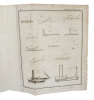
First printing of this monumental memoir (the invention of the TORSION BALANCE) dealing with the best way to construct a magnetic compass. The paper contains the design of a torsion suspension declination compass and the demonstration that the forces of torsion is proportional to the angle of twist. Coulomb received the prize awarded by the Academy for this paper drafted by the Academy in 1777 (he shared the prize with Van Swinden). - ""The importance of this memoir for Coulomb's career is that it CONTAINED ELEMENTS OF ALL HIS MAJOR PHYSICAL STUDIES: the quantitative study of magnetism, torsion and the torsion balance, friction and fluid resistance, and the germ of his theories of elasticity and magnetism.""(DSB).""Coulomb’s first writings on torsion were presented in his Academy prize-winning memoir of 1777, ""Recherches sur la meilleure maniere de fabriquer les aiguilles aimantées.""......... his simple, elegant solution to the problem of torsion in cylinders and his use of the torsion balance in physical applications were important to numerous physicists in succeeding years. In chapter 3, Coulomb developed the theory of torsion in thin silk and hair threads. Here he was the first to show how the torsion suspension could provide physicists with a method of accurately measuring extremely small forces. He showed that within certain angular limits, torsional oscillation consisted of simple harmonic motion. He examined the parameters relating the angle of twist to the length, diameter, and elastic properties of the torsion thread. In the range of simple harmonic oscillation Coulomb demonstrated that the force of torsion was proportional to the angle of twist. He used this principle in measuring small magnetic forces and also called attention to its use in measuring other forces, notably those of fluids in motion. Eventually he was able to measure forces of less than 9 x 10⁻⁴ dynes.""""Coulomb’s major memoirs in electricity and magnetism are his 1777 memoir on magnetic compasses, the famous series of seven electricity and magnetism memoirs read at the Academy from 1785 to 1791, and several magnetism memoirs prepared after the French Revolution. In his electrical studies Coulomb determined the quantitative force law, gave the notion of electrical mass, and studied charge leakage and the surface distribution of charge on conducting bodies. In magnetism he determined the quantitative force law, created a theory of magnetism based on molecular polarization, and introduced the idea of demagnetization (basically, that combinations of magnetic poles can ""cancel"" each other).""(DSB).Parkinson ""Breakthroughs"": 1777:P
La physique des nuages.
1940 P., Albin Michel, 1940, in 12 broché, 286 pages ; cent soixante-et-une illustrations, cachets.
...................... Photos sur demande ...................
Phone number : 04 77 32 63 69
COULOMB - OERSTED - AMPERE - ARAGO - BIOT - DAVY - FARADAY - G. & A. DE LA RIVE - FRESNEL - [Société française de physique]
Reference : 4805
Collection de mémoires relatifs à la physique publiés par la Société Française de physique : Tome I : MEMOIRES DE COULOMB - Tome II & III Mémoires sur L'ELECTRODYNAMIQUE --- 3 VOLUMES (complete set)
P., Gauthier-Villars, 1884/1887, 3 VOLUMES in 8 reliés en demi-toile grise à coins, étiquettes bordeaux, dos ornés d'un fleuron doré (reliures de l'époque), T.1 : 16pp., 414pp., T.2 : 7pp., 412pp., T.3 : (2), 403pp.,
---- EDITION ORIGINALE ---- Réunion en 3 volumes par la Société française de physique de mémoires relatifs à l'électricité et au magnétisme parus aux XVIIIe et XIXe siècles. Le premier volume contient tous les mémoires de COULOMB. Les deuxième et troisième volumes renferment les mémoires de OERSTED, AMPERE, ARAGO, DAVY, FRESNEL, BIOT et SAVART, FRESNEL, G. DE LA RIVE, FARADAY, BARLOW, A. DE LA RIVE, SAVARY, WEBER**4805/M1
Methoden der Mathematischen Physik -- BEL EXEMPLAIRE -- COMPLETE SET
Berlin, Springer, 1943, 2 volumes in 8 reliés en pleine toile éditeur, T.1 : 14pp., (1), 469pp., T.2 : 14pp., (3), 549pp.
---- BEL EXEMPLAIRE ---- Seconde édition**5679/M5DE
LA FAILLITE DU MATERIALISME, TOME II, LES PHENOMENES PHYSIQUES, L'ATOME, LES GAZ, LA CHALEUR ET L'ENERGIE (SCIENCE ET RELIGION, ETUDES POUR LE TEMPS PRESENT, N° 75)
Librairie Bloud & Cie, Paris. 1899. In-12. Broché. Etat d'usage, Couv. convenable, Dos abîmé, Intérieur acceptable. 62 pages. Tampons et annotations de bibliothèque sur le 1er plat et en page de titre.. . . . Classification Dewey : 530-Physique
'Science et religion', Etudes pour le temps présent, n° 75. Classification Dewey : 530-Physique
COURDILLE / SCHUNE / BENOIT / LEFEBURE
Reference : R320017393
(1984)
ISBN : 2040156240
EXERCICES DE PHYSIQUE AVEC RAPPELS DE COURS / SCIENCES DE LA NATURE ET DE LA VIE 1ere ANNEE.
DUNOD UNIVERSITE. 1984. In-4. Broché. Etat d'usage, Couv. convenable, Dos satisfaisant, Intérieur acceptable. 208 pages illustrées de nombreuses figures.. . . . Classification Dewey : 530-Physique
Classification Dewey : 530-Physique
"COURS ELEMENTAIRE DE PHYSIQUE + livret ""Notions sur les courants alternatifs"""
"ECOLE SPECIALE DES TRAVAUX PUBLICS. 1931. In-8. Broché. Bon état, Couv. convenable, Dos satisfaisant, Intérieur frais. 332 pages- nombreuses figures et formules de calculs dans le texte + en supplément, un livret de 51 pages ""Notions sur les courants alternatifs"". . . . Classification Dewey : 530-Physique"
Classification Dewey : 530-Physique

