 Write to the booksellers
-
Type
Art print (2)
Book (5886)
Magazine (20)
Manuscript (1)
Old papers (1)
Photographs (3)
-
Latest
Last 3 days (1)
Last month (5)
Last week (3)
-
Language
English (10)
French (5898)
German (1)
Greek (1)
Italian (1)
Latin (2)
-
Century
16th (2)
17th (9)
18th (245)
19th (887)
20th (2966)
21st (133)
-
Countries
Belgium (266)
Canada (3)
Côte d'Ivoire (13)
Denmark (1365)
France (3965)
Switzerland (301)
-
Syndicate
ALAC (3)
CLAM (3)
ILAB (4128)
NVVA (139)
SLACES (139)
SLAM (2601)
SNCAO (15)
Molecular reaction dynamics
Oxford university press. 1974. In-8. Relié. Bon état, Couv. convenable, Dos satisfaisant, Intérieur frais. 250 pages augmentées de quelques figures en noir et blanc dans texte.. Avec Jaquette. . . Classification Dewey : 530-Physique
Etiquette sur coiffe en pied. Tampon bibliothèque. Texte écrit en anglais. Classification Dewey : 530-Physique
Eléments de cinématique et de mécanique ---- EDITION ORIGINALE
P., Bernard, 1902, un volume in 8 relié en demi-chagrin marron (reliure de l'époque), 19pp., 412pp.
---- EDITION ORIGINALE ---- "Maurice LEVY had a distinguished career as a practicing engineer, teacher and researcher. From 1862 to 1883 he served as répéiteur in mechanics at the Ecole Polytechnique. In 1875, he was appointed professor of applied mechanics at the Ecole Centrale des Arts et Manufactures and in 1885 he became professor of analytic and celestial mechanics at the Collège de France... LEVY's research ranged over projective and differential geometry, mechanics, kinematics, hydraulics and hydrodynamics....". (DSB VIII p. 287)**8207/M5DE
"LEWIS, GILBERT N. - THE MASS-ENERGY EQUATION DERIVED WITHOUT RELATIVITY.
Reference : 47278
(1908)
A Revision of the Fundamental Laws of Matter and Energy.
London, Taylor & Francis, 1908. Contemp. hcalf. Title-and tomelabels in leather on spine, gilt lettering, spine gilt. Wear to spine ends. A crack along hinges (covers not detached). Spine worn. A stamp to verso of titlepage. In: ""The London, Edinburgh, and Dublin Philosophical Magazine and Journal of Science"", Vol. XVI, Sixth Series. VIII,984 pp., textillustr. and 28 plates. (Entire volume offered). Lewis's paper: pp. 705-717. Internally clean and fine.
First apperance of Lewis' first paper on relativity in which he derived the mass-energy relationship in a different way from Albert Einstein's derivation.Lewis’ other theoretical interests also flourished at M.I.T. The publication of Einstein’s theory of relativity (1905) and his mass-energy equation renewed Lewis’ interest in his early speculations on radiation. He derived the mass-energy equation from his early idea of the pressure of light without using the principle of relativity (1908). This striking concurrence of his view with Einstein’s convinced Lewis of the value of his youthful ideas and made him one of the very few early supporters of Einstein and relativity in America. Lewis is best known for his discovery of the covalent bond in chemistry. and his naming of the ""photon"" in 1926.The volume contains further importent papers by Rutherford & Royds, Lord Kelvin, Barkla, Soddy, J.J. Thomson, W.H. Bragg.
Millimicrosecond pulse techniques ---- EDITION ORIGINALE
London, Pergamon Press, 1954, un volume in 8 relié en pleine toile éditeur, 13pp., (1pp.), 310pp., figures dans le texte
---- EDITION ORIGINALE ---- Theoretical introduction - Transmission lines - Transformers - Pulse generators - Amplifiers - Cathode ray oscilloscopes - Applications to nuclear physics**7139/CAV.E6AR
Cours de chimie-physique - 5 volumes - Tome premier livre 1 + livre 2 - Tome deuxième livre 1 + livre 2 + livre 3.
Hermann & cie. 1934. In-8. Broché. Etat d'usage, Couv. convenable, Dos satisfaisant, Papier jauni. XIV + 702 pages (tome 1 livres 1+2) - X + XXXIX + VIII + XXXII + VIII + X + 893 pages (tome 2 livres 1+2+3) - nombreuses figures en noir et blanc dans le texte.. . . . Classification Dewey : 530-Physique
Tome 1 livre 1 : thermodynamique générale étude des états gazeux dilué et cristallin - tome 1 livre 2 : osmose et règle des phases étude du corps pur - tome 2 livre 1 : mélanges doubles triples - tome 2 livre 2 : équilibres chimiques solubilités des solides dans les liquides - tome 2 livre 3 : alliages, solutions diluées. Classification Dewey : 530-Physique
NOTICE EXPLICATIVE SUR LA PERSPECTIVOGRAPHIE
IMP. BERTRAND. 1961. In-12. Broché. Bon état, Couv. convenable, Dos satisfaisant, Intérieur frais. 6 pages; Quelques schémas en noir et blanc hors texte.. . . . Classification Dewey : 530-Physique
Classification Dewey : 530-Physique
La structure et la déformation des solides ---- EDITION ORIGINALE
P., Hermann, 1938, un volume in 8, broché, couverture imprimée, 53pp.
---- EDITION ORIGINALE**3309/o7ar
Leçons sur les essais de matériaux. I, La structure et la déformation des solides. Collection Actualités Scientifiques et Industrielles, 726, Laboratoire du Batiment et des Travaux Publics.
Paris, Hermann 1938, 250x170mm, 50pages, broché. Bel exemplaire.
10 planches en n/b, Pour un paiement via PayPal, veuillez nous en faire la demande et nous vous enverrons une facture PayPal
Acoustique Niveau 5
CENTRE DE FORMATION DES PERSONNELS COMMUNAUX. 1980. In-4. Broché. Bon état, Couv. convenable, Dos satisfaisant, Intérieur frais. 23 pages.. . . . Classification Dewey : 530-Physique
Généralités sur les mouvements vibratoires. Célérité du son. Qualités physiologiques des sons musicaux. Classification Dewey : 530-Physique
Traité complet et élémentaire de physique. Tome 3.
A Paris, Crapelet, Chez Deterville, 1801 ; in-8, demi-reliure de l'épque en veau havane, 4 ff, 414 pp., 11 planches dépliantes, gravures montées sur onglets.
Trace d'usure à la reliure sinon bon état
Library of Useful Knowledge. Volume I: Natural philosophy. Objects, Advantages, and Pleasures of Science Mechanics Hydrostatics Hydraulics Pneumatics Heat Optics Double Refraction and Polarisation of Light. With an explanation of scientific Terms.
London, Baldwin and Cradock, 1829. Contemp. hcalf. Spine gilt with gilt lettering. Titlelabel. Spine rubbed. Ca. 400 pp. Profusely illustrated with fine woodcuts (apparatus, instruments etc.).
Beiträge zur Kenntnis der disruptiven Entladung. Mitteilunen der Naturforschenden Gesellschaft in Freiburg.
Freiburg, Fragnière 1904, 235x160mm, 41Seiten, broschiert. Etiquette collée au dos.
6 Tafel, Pour un paiement via PayPal, veuillez nous en faire la demande et nous vous enverrons une facture PayPal
Formation mécanique du Système du Monde avec un résumé de la nouvelle théorie (Avec envoi d'auteur)
Gauthier-Villars et Fils. 1897. In-8. Broché. A restaurer, Plats abîmés, Dos abîmé, Non coupé. 183 pages. Nombreux schémas en noir et blanc dans et hors texte. Envoi d'auteur sur la page de garde (cf.photo). Plats désolidarisés.. . . . Classification Dewey : 530-Physique
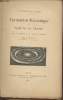
Classification Dewey : 530-Physique
Paratonnerres. Historique, efficacité, construction, installation, entretien et vérification.
P., Girardot, 1927, in 8° broché, VII-100 pages.
Orné de figures dans le texte. PHOTOS SUR DEMANDE. ...................... Photos sur demande ...................


Phone number : 04 77 32 63 69
Sciences physiques 1ère année de préparation aux BEP.
Delagrave.. 1972. In-8. Cartonnage d'éditeurs. Bon état, Couv. convenable, Dos satisfaisant, Intérieur frais. 495 pages.. . . . Classification Dewey : 530-Physique
Classification Dewey : 530-Physique
Cahiers de la ligue française de l'éducation physique fascicule 6 l'insuffisance respiratoire son traitement
Imprimerie bière 1948 16 pages in8. 1948. Broché. 16 pages.
Bon Etat
L'Illustration N° 4249. Fêtes franco-belges du Havre. - La chasse au chamois. - Débat entre Einstein et Bergson sur la relativité. - L'île d'Anticosti. - Saint-Anne d'Auray…
Couverture souple. Revue 30 x 40 cm. 20 pages + 20 pages de publicités. Couverture en état médiocre, réparée.
Périodique. L'Illustration, 9 août 1924.
Methods for Electromagnetic Field Analysis (IEEE Press Series on Electromagnetic Wave Theory).
New York, IEEE, 1995. Orig. cased boards. XII, 320 pp.
Diagramme N° 107 - La physique des solides
Editons du cap Monte-Carlo. Janvier 1966. In-12. Broché. Bon état, Couv. convenable, Dos satisfaisant, Intérieur frais. 95 pages environ illustrées de nombreuses photos et dessins noir et blanc.. . . . Classification Dewey : 530-Physique
Classification Dewey : 530-Physique
Om tryckets inflytande pa det elektriska ledningsmotstandet hos metaller samt en ny metod att mata hoga tryck
Upsala, Akademiska Bokhandeln 1902 61pp. + 3 plates out-of-text, 24cm., in the series "Upsala Universitets Arsskrift 1903. Matematik och naturvetenskap" vol.1, signed with dedication by the author, original softcover, [text in Swedish]
"LISSAJOUS, (JULES ANTOINE). - THE ""LISSAJOUS FIGURES"" AND THE ""PHONOPTOMÈTRE""
Reference : 44169
(1857)
Mémoire sur l'Étude optique des Mouvements vibratoires. Mémoire présenté à l'Academie des Sciences dans la séance du 6 avril 1857.
Paris, Victor Msson, 1857. 8vo. Contemp. hcalf, raised bands, gilt spine. Light wear along edges. Small stamps on verso of titlepage. In: ""Annales de Chimie et de Physique"", 3e Series - Tome 51. 512 pp. a. 2 folded engraved plates. Small stamp to verso of plates. (The entire volume offered). Lissajous paper: pp. 147-231 a. 2 large folded engraved plates showing his experimental apparatus, his Phonoptomètre and the curves.
First appearance of Lissajous's most substantiel paper in which he describes his experimental technique by which he, together with Helmholtz, founded the modern sound theory. His invention of the Phonoptomètre, a vibratingmicroscope in which a tuning fork is attached to the objective lens, is also described and depicted on the plate.""Lissajous developed an optical method for studying vibration and was generally interested in the physics of wave motion. ""Lissajous igures"" are the curves in the xy plane generated by the functions y=a sin( (w1t + q1) and x=b sin (w2t + q2), where w1 and w2 are small integers. The curves are today easily produced on an oscilloscope screen"" but Lissajous obtained them in the context of acoustics, from the superposition of the vibrations of the tuning forks....The French physicists awarded the Lacaze Prize to Lissajous for his ""beautiful experiments"" and both Rayleigh and Tyndall discussed his work in their treatises on sound.""(DSB VIII, pp. 398-99.).
On the Ultra-Violet Spectra of the Elements. Part I. Iron (with a map).
(London, Harrison and Sons, 1884). 4to. No wrappers as extracted from ""Philosophical Transactions"" Year 1883, Volume 174. - Pp. 187-222 a.
First printing. Liveing and Dewar published many papers between 1877 and 1904, attempting to correlate line and bands spectra with atomic and molecular states.""They noted the contrast between single spectral lines, multiplets, and bands, and they attempted to identify the emitting agents for single, multiplet, and band spectra. They classified great, intermediate, and weak intensities with the spectroscopic series as principal, diffuse, and sharp, respectively. Their studies included the differences between the arc, spark, and flame spectra of metals" the emission spectra of gaseous explosions and of the rare gases" and the effect of temperature and concentration on the absorption spectra of rare-earth salts in solution.""(DSB).
PHYSIQUE - Classe de Philosophie
Un ouvrage de 215 pages, format 135 x 185 mm, illustré, relié cartonnage, publié en 1931, J. de Gogord Editeur
Programme du 3 juin 1925
Phone number : 04 74 33 45 19
Physique théorique tome 2 : Théorie du champ - 2e édition revue.
Editions Mir. 1966. In-8. Relié. Etat d'usage, Couv. convenable, Dos satisfaisant, Papier jauni. 450 pages - jaquette abîmée.. Avec Jaquette. . . Classification Dewey : 530-Physique
Traduit du russe par Edouard Gloukhian. Classification Dewey : 530-Physique
PHYSIQUE DE BASE POUR BIOLOGISTES, MEDECINS, GEOLOGUES, SPCN, PCB, CES
Masson & Cie. 1959. In-8. Relié. Etat d'usage, Couv. légèrement pliée, Dos satisfaisant, Pliures. 368 pages. Illustré de nombreux dessins et graphiques en noir et blanc dans le texte.. . . . Classification Dewey : 530-Physique
Préface de L. Leprince-Ringuet. Classification Dewey : 530-Physique

